4332.50 · February 19, 2012 AD
Mason William Clarke
Mason William Clarke, born on 19 February 2012 in Brisbane, was the only child of separated parents Andrew Clarke, a property valuer who relocated to Sydney, and Sarah Clarke, an office manager. A quiet, ground-focused child who collected rocks obsessively, he was six when the school bus passed through a Portal into Clivilius, sustaining a forehead gash and cut hands in the collision. Raised communally in Bixbus, he attended the Learning Grove and Bixbus School, developing his childhood collecting into practical geological survey work for the settlement's building teams by fourteen.
Pockets Full of Gravel
Mason William Clarke was born on 19 February 2012 at the Royal Brisbane and Women's Hospital, the only child of Andrew David Clarke, a commercial property valuer, and Sarah Jane Clarke (née Ward), who managed the front office of a physiotherapy clinic in Red Hill. The family lived in a rented duplex in Kelvin Grove, in Brisbane's inner north, on a street where the council had planted bottlebrush trees along the verge and the neighbours' cats patrolled the fences with proprietary indifference.
The marriage was not a disaster. It was something quieter — a relationship that had run out of reasons to continue. Andrew and Sarah had married in 2010, after three years together, and Mason arrived eighteen months later with the force of a wanted child entering an unwanting household. They separated when Mason was three, in early 2015, with a courtesy that surprised their friends and a legal settlement that satisfied neither party entirely.
Andrew accepted a position with a valuation firm in Sydney six months after the separation, and the fortnightly weekend visits became monthly, then quarterly, reduced by distance and the particular inertia that overtakes absent fathers who mean well but cannot sustain the logistics of caring from eight hundred kilometres away. He paid Mason's school fees. It was the one contribution he made reliably, and Sarah, who resented much about the arrangement, did not resent that.
Sarah kept the duplex, kept her job, kept Mason's routine intact with the efficiency of a woman who had always been the one holding things together and who had simply, with the separation, been relieved of the pretence that anyone was helping. She was not bitter. She was tired, in the specific way of single mothers who work full-time and manage school drop-offs and bedtimes and Saturday morning swimming lessons without the possibility of handing any of it to someone else for an evening. Her own mother, Diane Patricia Ward, a retired legal secretary in a unit in Nundah, helped where she could — Tuesday and Thursday pick-ups, the occasional weekend when Sarah needed to work — and the arrangement held together in the way that arrangements do when every component is under strain but none has yet broken.
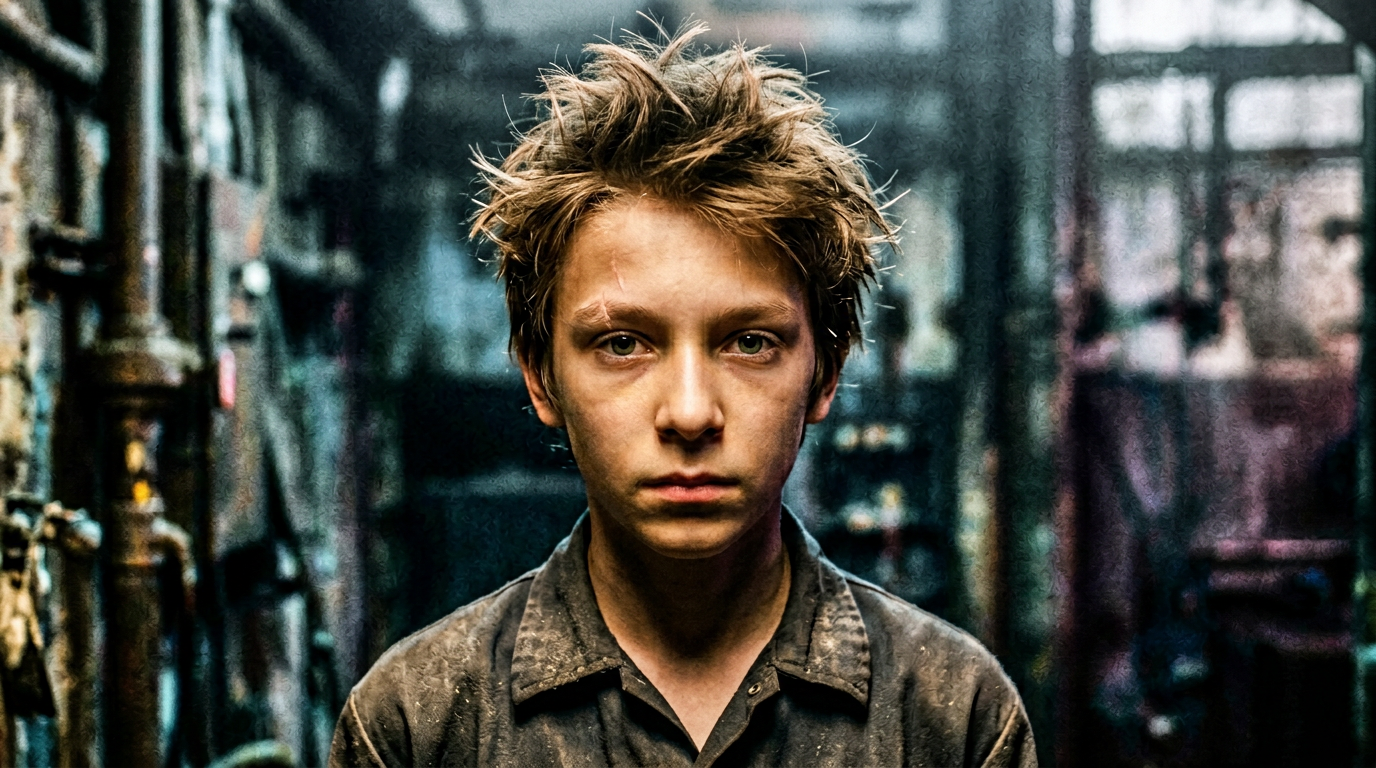
Mason's early childhood was ordinary in all the ways that mattered and peculiar in one. He was a healthy, unremarkable child — average height, light brown hair that resisted combing, green eyes that Sarah said came from her father — and he had a quality of attentiveness that his teachers noticed before his parents did. He watched things. At the park, while other children ran for the swings, Mason crouched at the base of the climbing frame and examined what was on the ground. Gravel, bark chips, the occasional coin, a cicada shell still clinging to the underside of a railing. He picked things up, turned them over, put them in his pockets.
Sarah emptied his pockets every evening. It was as routine as brushing his teeth. The collection that accumulated on his windowsill grew in a way that was initially charming and eventually concerning, because there was nowhere left to put the stones and he would not allow her to throw any of them away. She tried once, clearing a handful of what she considered unremarkable quartz fragments into the bin while he was at swimming, and the resulting distress — not a tantrum, something worse: a quiet, sustained devastation — ensured she never attempted it again.
He entered Brisbane Grammar School's Preparatory Year in January 2018, seven months before the field trip to D'Aguilar. Andrew paid the fees — it was, in fact, Andrew who had insisted on Grammar, citing its science programme and outdoor excursions, and Sarah, who thought private school for a six-year-old was an extravagance driven more by guilt than pedagogy, had consented because the alternative was another argument conducted over the phone between Brisbane and Sydney, and she did not have the energy.
Mason took to the school with the ease of a child who had never been particularly attached to his previous routine. He made friends without urgency, lost them without visible distress, and carried on collecting things from every surface he encountered. His Prep teacher, Mrs. Helen Marsh, described him in his mid-year report as "enthusiastic, tactile, and frequently distracted by anything on the ground." He was the child who returned from every outdoor activity with his pockets bulging, who could not pass a garden bed without stopping, and who once brought a dead moth to show-and-tell with such reverence that Mrs. Marsh did not have the heart to tell him it was disintegrating on his palm.
What the Ground Gave Back
The overnight field trip to D'Aguilar National Park departed from Brisbane Grammar School on the morning of Saturday, 4 August 2018. Mason, at six, was among the youngest students on the bus. Sarah had hesitated before signing the permission form — an overnight trip felt ambitious for a child who still sometimes woke in the night and called for her — but Mason had been insistent, and the supervising adults reassuring, and she relented with the particular anxiety of a mother who knew she was being sensible and felt it anyway.
He sat near the front of the bus, his backpack on the seat beside him, his pockets already containing two quartz pebbles from the school car park. He was not old enough to appreciate the ecology lectures or the guided walk the way the older students did. He appreciated the forest the way a six-year-old appreciates anything — completely, physically, without analysis. He put his hands in the creek. He picked up every stone he could reach. He collected a palmful of smooth rocks from the trail and stored them in the front pouch of his backpack with the gravity of someone securing valuables.
The bus departed D'Aguilar on the morning of 5 August for the return to Brisbane. Mason was seated in the middle section, his backpack on the floor between his feet, his pockets full of D'Aguilar gravel.
The bus passed through a Portal opened across a road in the Brisbane suburbs and collided with vehicles on the far side, in the landscape of Clivilius. The impact threw Mason forward out of his seat. His forehead struck the metal frame of the seat ahead, opening a gash above his left eyebrow that bled with the profusion common to scalp wounds. His hands, thrown out to break his fall, landed on the jagged rocks that had spilled from his open backpack — the D'Aguilar collection, scattered by the collision, cutting into his palms and fingers. The injuries were painful and bloody but not life-threatening. He was six years old, bleeding from his head and his hands, in a place he had never seen, surrounded by adults and children who were screaming or crying or trying not to do either.
He did not scream. He sat on the floor of the bus and held his hands open in front of him, palms up, watching the blood pool in the lines of his skin. The adults who reached him took the expression on his face for shock. It may have been. It may also have been the particular stillness of a child who did not understand what had happened and had no framework for processing it, and who defaulted to the only behaviour he knew: looking at what was in front of him.
Raj Patel cleaned and bandaged his hands. The forehead wound was closed with adhesive strips from the first-aid kit. Mason did not cry during the treatment. He cried later, at night, when the adults had arranged the children in a makeshift shelter and the dark was unfamiliar and his mother was not there to answer when he called for her.
The weeks that followed were incomprehensible to a child his age. He understood that they could not go home. He did not understand why. He understood that the adults were frightened, though they tried to hide it, and that two of the children from the bus — Sophia and Ethan — were not there any more, and that the adults' faces when those names were mentioned carried a quality he could not name but which he recognised, with the instinct of a child who watches more than he speaks, as something permanent and terrible.
The settlement that became Bixbus grew around him like weather — something that happened without his consent or comprehension. He was too young to contribute to the building effort and too young to be left unsupervised, and the adults who had been trip supervisors became, by default and necessity, his carers. The arrangement was communal in the early months. Susan Clarke — no relation, a coincidence of surname that produced confusion among newcomers for years — Emma Thompson, and David Nguyen shared the care of the youngest children, organising sleeping arrangements, meals, and the approximation of routine that small children require in order to believe that the world, however strange, has not collapsed entirely.
Mason adapted in the way that adults call resilience and that children experience as something less comfortable — a kind of enforced forgetting, in which the old life blurred not because it had been processed but because the new life demanded too much attention to leave room for looking back. He remembered his mother in fragments: the smell of her shampoo, the sound of the front door, the weight of her hand on his back when she leaned over to check his seatbelt. He did not remember her face clearly by the time he was eight. He knew this, and he did not tell anyone, because the knowledge felt like a failure — as though remembering was something he owed her and could not pay.
The Learning Grove opened in late August 2018, four shipping containers arranged in a U-shape and repurposed as classrooms. Mason was among its first and youngest students, though "student" was a generous term for a six-year-old sitting on a folding chair in a metal box learning to read from salvaged materials. Jenny Triffett, who had taken on the role of lead teacher with the competence of a woman who had run classrooms in Hobart and was not about to let a dimensional catastrophe lower her standards, recognised Mason's particular mode of attention early. He would not sit still for reading drills. He would not focus on letter formation for more than ten minutes. But he would spend an entire morning sorting a pile of rocks by colour, then by weight, then by texture, with a concentration that suggested the problem was not attention but direction.
Triffett adapted. The Learning Grove's philosophy — still forming in those early months, shaped as much by necessity as by theory — favoured practical engagement over rigid structure, and Mason became an early test case for what that meant with very young learners. His reading instruction was tied to labelling his specimens. His counting exercises used his rock collection. His first complete written sentence, produced in October 2018 in handwriting that strained the definition of legible, read "This rock is grey and smooth," and Triffett kept it pinned to the wall for the rest of the year as evidence — to herself as much as anyone — that the approach was working.
As the Learning Grove expanded — temporary modular classrooms added to the original containers as Bixbus grew, new arrivals bringing children of all ages — Mason moved through the ability-based groupings that replaced traditional year levels. He was behind in literacy, roughly average in numeracy, and significantly ahead in anything that involved his hands and the physical world. The partner sites that the school established with operations across Bixbus gave him his first taste of structured practical learning: mornings of academic work in the classroom, afternoons at the Haven of Wilds, Verdant Nursery, or the Orchard of Abundance, where the work was physical and the lessons embedded in doing rather than reading.
Two Hundred Specimens
The transition from the Learning Grove to Bixbus School in late 2019 was, for Mason, less a change of institution than a change of building. The school occupied a permanent facility — purpose-built, with classrooms that did not rattle when the wind picked up — and the educational philosophy that had crystallised during the Learning Grove period carried across intact. Mornings remained devoted to academic work. Afternoons were for practical engagement at sites across Bixbus, working alongside adults, learning through participation what classroom instruction could only approximate.
Mason's academic progress remained uneven through his primary years. His reading caught up to his peers by ten, driven less by any love of books than by the practical necessity of reading the geological reference materials that the settlement's small library contained. His writing improved to functional adequacy. His mathematics was capable in applied contexts — he could calculate volumes, estimate weights, measure distances — and unreliable in abstract ones. Fractions as a concept defeated him repeatedly; fractions as a practical problem, encountered while helping to portion building materials, did not. His teachers noted the discrepancy without surprise. It was a pattern the school had seen in other children, and the ability-based system allowed him to advance where he was strong without being held back or pushed forward artificially where he was not.
He was not lazy. He was not unintelligent. He was a child whose mind operated through his hands and his eyes, who understood the world by touching it, and who found the translation of physical knowledge into written form effortful in a way that the acquisition of the knowledge itself was not. Triffett, who remained as principal, and her staff — Emma Thompson and Greta Smith among them — recognised this and worked with it, which was the school's strength and the reason Mason continued to learn at all.
By twelve, his collecting had evolved from accumulation into something approaching systematic study. He maintained a specimen collection in a wooden crate beside his bed — Clivilius rock samples, sorted by type, labelled in his cramped handwriting with location, date, and physical properties. He had catalogued over two hundred specimens by his twelfth birthday, a project nobody had assigned or asked for, which he pursued with the same quiet intensity he had brought to the windowsill collection in Kelvin Grove, six years and a dimension away. The crate was his territory. He did not like other people touching the specimens without asking, and the one occasion when a bunkmate moved the crate to sweep under the bed produced a reaction — not violent, but cold and absolute — that discouraged any further interference.
His afternoons, under the school's community mentorship programme, shifted increasingly toward the building and construction teams that continued to expand Bixbus's infrastructure. He had started at ten, carrying materials and watching. By twelve, he was identifying stone quality — which deposits yielded material suitable for foundations, which clay soils held moisture and which drained, where the sandstone fractured cleanly and where it crumbled. The builders tolerated his presence initially and relied on his knowledge eventually, not because a twelve-year-old's judgement was infallible but because his understanding of the local geology, accumulated across years of obsessive collection, was genuinely useful and in several cases more detailed than their own.
He was not universally liked. Mason at thirteen was a quiet boy with a scar above his eyebrow and a habit of correcting people about rock types with a directness that he did not recognise as rude and that his peers found grating. He had friends — a small, shifting group who shared his practical orientation or who were patient enough to tolerate his long silences and sudden enthusiasms about mineral composition — but he was not socially fluent. He did not read expressions well. He interrupted conversations to deliver information he considered important, could talk about geological formations for twenty minutes without noticing that his audience had lost interest, and when this was pointed out he was bewildered rather than embarrassed, because the information was interesting and he genuinely could not fathom why someone would not want to hear it.
His emotional life was largely private. He did not talk about his mother. He did not talk about Brisbane. When other children — particularly the older ones who remembered Earth more clearly — spoke about the lives they had left behind, Mason listened with the expression of someone hearing about a country he had visited once as an infant. His memories of Sarah had faded to sensory impressions by ten and to something vaguer by twelve — not memories so much as the knowledge that memories had once existed, an absence that was itself a presence in his interior life. He carried it without complaint, because he had never known another way to carry it, and because grieving for something he could barely recall felt dishonest in a way he could not articulate.







