Mary Louise Killerton (née Greenfield)
Mary Louise Killerton, née Greenfield (10 January 1825 – 20 October 1900), was a Salem-born landscape and portrait painter who spent the greater part of her adult life in Boston, Massachusetts. Daughter of portrait painter Edmund Greenfield and his wife Catherine née Hartley, she married architect Charles Edward Killerton at the Park Street Church, Boston, on 15 June 1845, and together they raised their only son, Francis Charles Killerton. She exhibited regularly at the Boston Athenaeum throughout her working life, maintaining an independent artistic practice within a marriage that placed considerable demands on her adaptability and resilience.
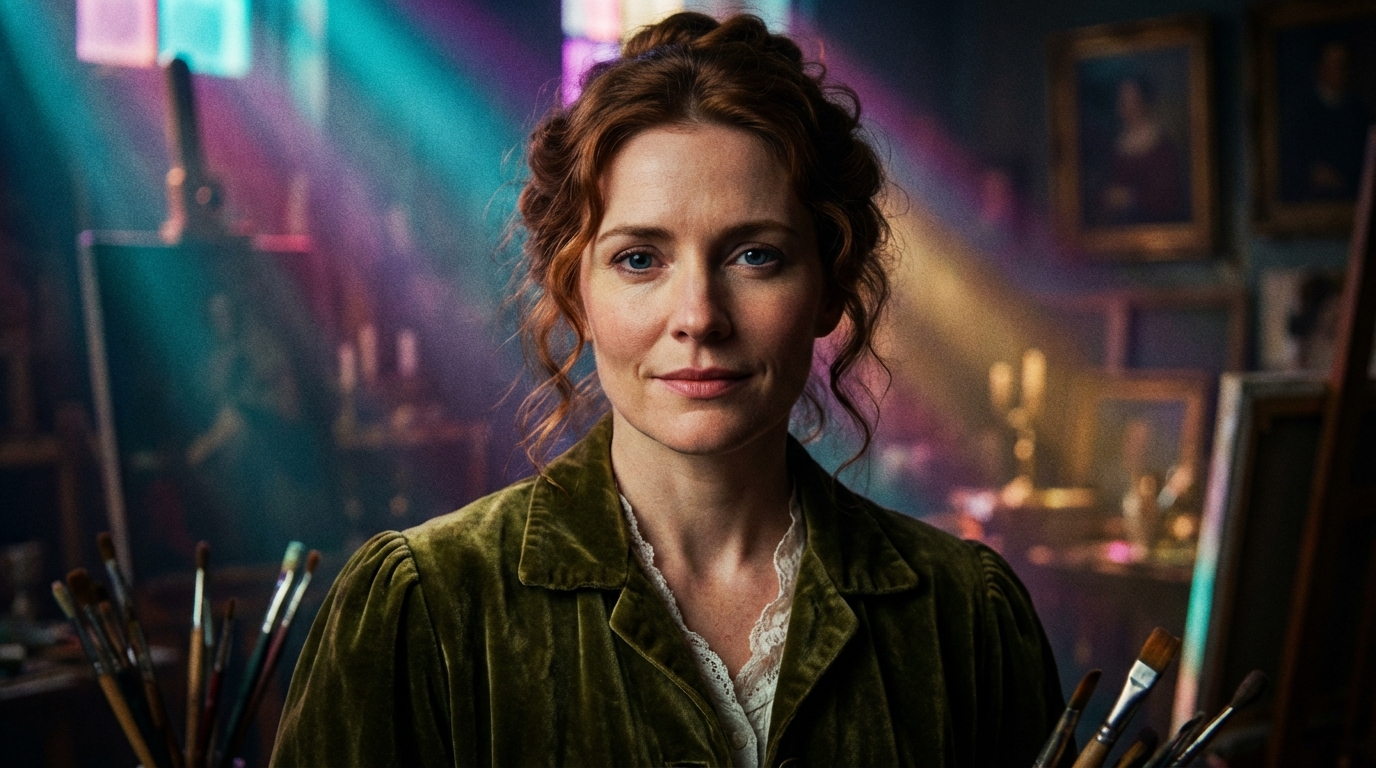
Mary Louise Killerton, née Greenfield (1825–1900)
Salem Origins: The Greenfield Household
Mary Louise Greenfield was born on 10 January 1825, in Salem, Massachusetts, the elder daughter of Edmund Algernon Greenfield and Catherine Greenfield, née Hartley. Salem in the 1820s was a city of faded maritime grandeur still negotiating its identity in the wake of the shipping trade's long decline — prosperous enough in certain quarters, but no longer the commercial force it had been in the previous century, and the more cultivated families of the town had turned their energies inward, toward education, the arts, and the civic life of a community that had learned to value reputation as much as income.
Edmund Greenfield occupied a comfortable if not wealthy position in this social landscape. He was a portrait painter of genuine local reputation, trained in his youth in the workshops of Boston and briefly in Philadelphia, whose clientele consisted principally of the merchant families and professional men of Essex County who wished to be commemorated in oil with appropriate dignity. It was not a life of abundance — portrait commissions arrived irregularly, and the gap between a finished canvas and a settled account was a persistent feature of Edmund's professional existence — but it was a life organised around the primacy of craft, and that organisation shaped his elder daughter in ways she would carry for the rest of her life.
Catherine Greenfield, née Hartley, had been born in Marblehead, Massachusetts, in 1800, and had received an unusually thorough musical education for a woman of her time and class — she played the pianoforte with real accomplishment and had studied theory and composition to a level that went well beyond the genteel dilettantism expected of young women in that era. She gave private lessons to supplement the household income and regarded music not as an ornament but as a discipline, a view she communicated to her daughters by example rather than instruction.
Mary Louise grew up, therefore, in a household where artistic work was both livelihood and identity, where the smell of linseed oil and turpentine drifted from her father's ground-floor studio, and where the sound of scales and exercises from her mother's parlour piano was part of the daily texture of the house on Derby Street. She had a younger sister, Clara Anne Greenfield, born in 1828, with whom she was close throughout childhood and adolescent years, though the two women would later inhabit very different lives — Clara married a Salem merchant in 1850 and remained in Essex County, whilst Mary Louise's marriage took her to Boston and, in some respects, to a world her sister never fully entered.
Early Education and Artistic Formation
Mary Louise received her earliest formal education at a dame school on Charter Street, Salem, where reading, arithmetic, and needlework were delivered in the manner of the period — thoroughly but without particular inspiration. What education she received in the arts came primarily from her father's studio, where she was permitted to observe and, from the age of perhaps nine or ten, to handle brushes and mix colours under Edmund's intermittent supervision. He was not a systematic teacher, and his attention was divided between her and the commissions that commanded his professional energy, but he had a good eye and an honest tongue, and what he told her about composition, tone, and the management of light was worth more than any formal instruction she might have received elsewhere.
By her early teens, it was apparent to everyone who looked that Mary Louise had inherited something of her father's talent — not his facility with portraiture, which required a particular sensitivity to the human face that she was slower to develop, but a strong instinct for landscape and a capacity for capturing atmospheric effect that was distinctly her own. She spent considerable time sketching along the Salem waterfront and in the fields and woodland south of the town, developing a body of work in pencil and watercolour that Edmund showed, without excessive sentimentality, to a professional acquaintance visiting from Boston in the summer of 1840. The acquaintance, a drawing master named Cornelius Whitelaw who maintained connections with the Massachusetts Normal Art School in Boston, expressed genuine interest, and the conversation that followed led, over the course of the next year, to Mary Louise's admission to the school's newly established course of instruction in fine art.
She arrived in Boston in the autumn of 1841, at the age of sixteen, lodging initially with a respectable family on West Cedar Street, Beacon Hill — a domestic arrangement organised by her father's acquaintance Cornelius Whitelaw, who understood both the promise and the vulnerability of a young woman from Salem setting out to study art in the city. The Massachusetts Normal Art School's design course was not, at that point, a place of rarefied artistic ambition — its founding purpose was the training of drawing teachers and the development of practical design for industrial application — but it provided Mary Louise with formal instruction in colour theory, compositional principles, figure drawing, and the history of European painting that went considerably beyond anything Salem had been able to offer her.
She remained in Boston, with periodic returns to Salem for family visits, for two years, completing the course in 1843. Her instructors found her work technically accomplished and praised the quality of observation in her landscape studies, though one of them — a man of pronounced academic opinions named Professor Harlan Briggs — expressed the view, in the manner that certain men of the period adopted with female students, that her colour was too bold for the English tradition and that she would benefit from greater restraint. Mary Louise absorbed the comment and largely ignored it, a response that was characteristic.
Meeting Charles Killerton and the Courtship
It was through the informal gatherings of Boston's artistic and professional community — the evening parties and conversazione hosted in the parlours of Commonwealth Avenue and Beacon Hill — that Mary Louise first encountered Charles Edward Killerton in the spring of 1844. She was nineteen; he was twenty-four and newly established at the firm of Cabot & Thorndike, still finding his professional feet and carrying the particular social stiffness of a young man who is more comfortable with drawings than with people.
Their introduction was made by a mutual acquaintance — a woman named Mrs. Harriet Pelham, who hosted the gathering at her house on Marlborough Street and had the social instinct to seat them near one another at supper on the grounds that they were both, in their respective ways, serious people who found small talk effortful. The conversation they had that evening — about the relationship between structural form and visual beauty in civic architecture, a topic on which Mary Louise had formed opinions from her own artistic practice — was one of the few times Charles Killerton had found himself genuinely surprised by another person's thinking, and he remembered it clearly for the rest of his life.
The courtship that followed was not swift. Charles was deliberate by nature, and he was also, as has been noted, in a financial position that made the prospect of marriage more aspiration than immediate reality in the winter of 1844. He called on Mary Louise at the lodgings she had taken by then on Bowdoin Street, he attended the occasional gathering at which she was present, and he wrote her letters — formal and rather better than his conversation, because writing gave him time to consider what he actually meant to say. Mary Louise, for her part, was patient up to a point. She found him interesting and, beneath the stiffness, genuinely thoughtful, but she was also a woman with her own professional ambitions and her own sense of what she was and was not prepared to wait for. By the autumn of 1844, she had made it clear — with a directness that surprised him and impressed him in equal measure — that she required rather more certainty about his intentions than his conduct had thus far supplied.
They became formally engaged in February 1845 and married on 15 June 1845, at the Park Street Church on Tremont Street, Boston. Mary Louise was twenty years old. Her father Edmund travelled from Salem for the occasion, and her mother Catherine, who had been suffering from a recurring winter bronchitis, made the journey as well, sitting through the ceremony with the satisfaction of a woman who had formed a clear opinion of her daughter's choice and found it favourable.
Marriage, the Pinckney Street Household, and the Practice of Painting
The newly married Killertons established themselves in a rented house on Revere Street, Beacon Hill, modest by the standards of the neighbourhood but adequate for a young couple of their means and prospects. Mary Louise arranged her painting materials in the small back bedroom that served as a studio and set about making a domestic life that did not require her to abandon the work she had come to Boston to do.
This was not a straightforward negotiation. Charles Killerton was not an unsympathetic husband by the standards of mid-nineteenth-century Boston — he respected his wife's talent and took genuine pride in her work — but he was a man shaped by the assumptions of his class and generation, and those assumptions were not always compatible with a wife who maintained a professional practice with its own demands on time, attention, and occasional absence. There were periods in the early years of their marriage when the management of the household and the management of her painting life produced a friction between them that neither was particularly articulate in addressing directly. Charles's professional preoccupations left him with limited patience for discussions about the competing demands on his wife's time, and Mary Louise had a temper that, when sufficiently provoked by his obliviousness, expressed itself with a sharpness that surprised those who knew her only in social settings.
They moved to the larger house on Pinckney Street, still Beacon Hill, in 1848, by which point Charles's practice had grown sufficiently to support more comfortable accommodation. It was at Pinckney Street that the household found its more settled character — a life organised around Charles's professional demands but within which Mary Louise had established, through persistence and a certain quiet intractability, the conditions she needed to paint.
The late 1840s also brought losses. Two pregnancies between 1846 and 1849 ended without a living child — the first in miscarriage at some months, the second with an infant, a boy, who was born in December 1848 and died within a week. These were griefs that Mary Louise bore with a composure that those around her generally interpreted as equanimity but which was, in truth, something more effortful than that. Charles, whose own response to loss was to withdraw into work, was less present during these periods than he might have been, a fact that Mary Louise did not complain of publicly and did not entirely forgive privately. Their son, Francis Charles Killerton, was born on 9 October 1850, and the relief and joy of that birth — a healthy boy, full-term and vigorous — carried with it the weight of what had come before it.
The Boston Athenaeum and a Career in Public View
Throughout the 1850s and into the 1860s, Mary Louise continued to develop her painting practice with an ambition that the Boston art world, to its credit, recognised with moderate consistency. She submitted work to the annual exhibitions at the Boston Athenaeum on Beacon Street from 1852 onward, achieving her first accepted submission in that year with a landscape study of the Concord River at late afternoon — a canvas of perhaps twenty-four by thirty inches that was hung in a secondary gallery but was noted by the Boston Evening Transcript in a review of the exhibition as demonstrating "an atmospheric sensitivity beyond the common run of the amateur productions on display." Mary Louise cut out the notice and kept it, which was unlike her general attitude toward critical opinion.
She exhibited at the Athenaeum in most years through the 1850s and 1860s, with the occasional gap when domestic demands or Charles's health prevented her from completing work to a standard she was prepared to show. Her subjects were primarily landscapes — the North Shore of Massachusetts, the river valleys west of Boston, the coastal marshes of Essex County that she had known since childhood — though she also produced a small number of portraits during this period, including one of Elizabeth Anne Killerton, her mother-in-law, completed in 1858 and which hung in the front parlour of the Pinckney Street house for the remainder of Charles's life.
Her relationship with the Athenaeum's exhibitions was not without frustration. Women exhibitors in this period were accepted but not treated as the equals of their male counterparts in terms of positioning, publicity, or the seriousness with which critics engaged their work. The better-placed galleries went to men; the more substantial notices went to men; the conversations after openings in which professional reputations were negotiated and advanced went primarily to men. Mary Louise was aware of this and said so, in the company she trusted, with a candour that occasionally startled her interlocutors. She was not, however, a woman inclined toward public protest — her resistance was expressed through the persistence of her attendance and the quality of her work rather than through formal advocacy, which was a choice shaped partly by temperament and partly by the practical constraints of her situation.
She sold work intermittently throughout this period, primarily to the professional and merchant families of Boston who wished to decorate their parlours with landscapes of recognisable New England character. The income from these sales was not inconsiderable, though it was irregular, and it went entirely into the household account rather than being treated as separate from the family finances — an arrangement that reflected both the custom of the time and the particular character of Mary Louise's relationship with money, which was that she was practical about it and not sentimental.
The Panic of 1857 and the Household Under Strain
The financial difficulties that followed the Panic of 1857 tested the Killerton household more severely than Charles generally acknowledged in later years. Several of his commissions were deferred or cancelled, and the income from the practice contracted significantly through 1857 and 1858. The Pinckney Street house was maintained, but economies were made — in staff, in the entertainment they had previously offered regularly, in various small ways that were invisible to casual observers and exhausting to manage.
During this period, Mary Louise sold a number of canvases that she had not intended to part with, including two substantial landscape studies — one of Gloucester Harbour at sunrise that she had completed in the summer of 1856 and regarded as among her best work, and one of the Salem waterfront in winter that had particular personal significance as a relic of her girlhood observations. She sold them to a dealer on School Street for prices that were fair enough by market standards but that represented, for her, a form of loss that went beyond the monetary. Charles knew of it and said nothing at the time, which was the wrong response, though he understood this only later. Mary Louise did not raise the subject herself; she had made a decision and it was made, and rehashing it would have served no purpose she could identify.
The practice recovered through 1859 and 1860, and the household found its footing again, but the Panic years left a residue in their marriage — not resentment exactly, but a clarity on Mary Louise's part about the limits of what she could rely on and what she needed to provide for herself.
Francis, the Workshop, and Motherhood on Her Own Terms
Francis Charles Killerton proved, from an early age, to be a child of both his parents in ways that were evident to everyone who knew the family well and invisible to those who assessed parentage too narrowly. He had his father's analytical rigour and his instinct for spatial and structural thinking; he had his mother's sensitivity to form and atmosphere, her curiosity about the relationship between built things and the natural world, and — less flatteringly for both of them — a capacity for stubbornness that he could have inherited from either parent with equal plausibility.
Mary Louise's relationship with Francis was closer and more easily expressive than Charles's. She was not a sentimentalist in the conventional Victorian maternal mode — she did not hover, she did not indulge — but she was attentive in the way that artists are attentive, noticing what was actually in front of her rather than what she expected to see. She encouraged Francis's drawing from an early age, sitting with him on Sunday afternoons at the parlour table while Charles was in his study, teaching him the elements of observation and composition that her own father had taught her on Derby Street. She was a better teacher than Edmund had been — more patient, more systematic, more willing to explain as well as demonstrate — and the foundation she gave Francis in seeing was, in its way, as consequential for his later career as the structural engineering he learnt in his father's workshop.
She also, though she said little about it directly, shaped his sense of what a woman's intellectual and professional life could and should look like. Francis grew up in a household where his mother painted seriously, exhibited publicly, sold her work, and held opinions about art and architecture that were taken seriously — at least within the family — and this was not the household of most of his contemporaries. When, years later, he would meet and marry Eleanor Stanton, a woman of comparable professional seriousness and ambition, the ease with which he recognised what Eleanor was and what she required was not entirely unrelated to what he had observed on Pinckney Street.
When Charles enrolled Francis at Boston Latin School in 1856, and when, later, the decision was made to send him to Phillips Academy Andover in 1864, Mary Louise was involved in those deliberations to a degree that Charles's later account of the decisions did not always acknowledge. She had views about Francis's education that were specific and considered, and she pressed them — including, with some persistence, the case for exposing Francis to the arts and humanities alongside the mathematical and scientific training that Charles naturally prioritised.
The 1860s: Elizabeth Anne's Death, Charles's Grief, and the Household Steadied
The death of Elizabeth Anne Killerton on 2 November 1870 — Mary Louise's mother-in-law — preceded by five years the death of George William Killerton on 18 September 1865, which struck Charles more heavily than the loss of his mother had. George William's death in the autumn of 1865 left Charles in one of the more difficult periods of his professional and personal life, and it fell to Mary Louise, as it had fallen to her before in times of her husband's interior difficulty, to manage the household with more than usual competence whilst simultaneously offering a degree of emotional steadiness that was not always appreciated in the moment.
She did it without complaint and without entirely concealing her own grief — she had, over twenty years of marriage, come to value George William's quiet approval of her, his rare but genuine compliments on her painting, and the occasional conversation they had had about art when Charles was not in the room. His death was a real loss to her, separate from the loss Charles experienced, and she allowed herself to feel it whilst also keeping the household running and Charles functional. It was the kind of compound labour — emotional, domestic, practical — that women of her generation performed as a matter of course and for which there was no particular vocabulary of acknowledgement.
Her own father, Edmund Greenfield, died in Salem on 14 March 1867, at the age of sixty-seven. Mary Louise travelled to Salem for the funeral with Francis, who was sixteen, and spent a week with her mother Catherine and her sister Clara settling Edmund's estate, which was modest but not complicated. Catherine Greenfield survived her husband by four years, dying in Salem on 22 September 1871. Mary Louise's visits to Salem became less frequent after her mother's death — Clara remained there, and the two sisters corresponded regularly, but the thread connecting Mary Louise to her origins had frayed sufficiently that she felt herself, by the early 1870s, to be fully and irreversibly a woman of Boston.
Francis's Independence and the San Francisco Years
Francis left for Mesopotamia aboard the SS Endeavour in March 1873, and his departure — even with the knowledge that it was connected to his uncle Henry James Killerton's archaeological expedition to Uruk, and therefore organised rather than improvised — was an event that his mother watched from the Pinckney Street doorstep with the particular feeling of a parent who has done her work well enough that her child no longer needs her in the same way.
She wrote to him throughout the Mesopotamia journey, letters that were warmer and more personal than Charles's and that asked rather different questions — about what the ancient buildings looked like in the early morning, about what the light was like over the desert, about whether the food was tolerable and whether he was sleeping adequately. Francis's replies, preserved in the family correspondence, suggest that he answered the architectural questions more thoroughly than the personal ones, which Mary Louise found both predictable and faintly amusing.
When Francis returned to Boston in the summer of 1873 and then, in early 1874, made clear his intention to establish himself in San Francisco rather than in his father's practice, Mary Louise expressed neither the opposition nor the enthusiasm with which Charles expressed his own version of support. She asked practical questions — about the city, about his financial arrangements, about the partners he intended to work with — and when satisfied that the plan was as sound as a young man's ambitious plan could reasonably be, she helped him prepare for the journey west with the same pragmatic attentiveness she had brought to everything else.
Francis's founding of Killerton Enterprises on 15 June 1874, and the company's subsequent growth through the later 1870s, were developments she followed with pride and with a specific parental interest in the aesthetics of what the firm was building — requesting drawings and descriptions of completed projects in her letters and, occasionally, offering observations about proportion and material that Francis, to his credit, took seriously. The letters between Mary Louise and Francis in the period from 1874 to 1890 represent, in many respects, the most direct surviving evidence of what kind of mind she had and what kind of mother she was: precise, interested, affectionate in an unsentimental way, and entirely unwilling to let geographical distance substitute for genuine engagement.
Widowhood: The Final Decade, 1890–1900
Charles Edward Killerton died on 5 June 1890, at the Pinckney Street house, after a decline that had been gradual enough that its ending was neither sudden nor entirely unexpected. Mary Louise was sixty-five years old, and the decade of her widowhood was one of the most sustained periods of independent life she had known since the years before her marriage.
She continued to paint, though the scale of her canvases diminished somewhat in the early 1890s as she found the management of large panels increasingly demanding, and she continued to exhibit at the Boston Athenaeum until 1896, when her eyesight began to deteriorate with a speed that her physician, Dr. Herbert Wainwright of Massachusetts General Hospital, attributed to a progressive condition of the retina. The diagnosis was delivered in January 1896, and Mary Louise received it with the composure of a woman who had been managing difficult information for most of her adult life, though her letters to Francis in the months following suggest that the prospect of losing her sight was, of the various losses she had absorbed, the one she found most specifically grievous. Painting had been the one thing that was entirely her own — predating Charles, predating the marriage, predating Pinckney Street — and the removal of it was a particular amputation.
She adapted as much as she was able, shifting in her final years to smaller-format watercolour work that she could manage in good natural light by a window, and to a heightened investment in the social and intellectual life of the household — visitors were received regularly on Tuesdays, and Mary Louise's afternoons became a modest but genuine salon in which conversation about art, architecture, and the life of the city was conducted with an energy that those who attended found entirely disproportionate to the age of their hostess.
Her sister Clara Greenfield Hollis — Clara had married one Thomas Hollis of Salem in 1850 — visited from Salem in the autumn of 1899 and again in the spring of 1900, and reported to Francis in a letter of April 1900 that Mary Louise was frailer than on her previous visit but clear-minded and unwilling to be fussed over, which Clara noted with the affectionate exasperation of a younger sister who has spent a lifetime recognising this particular quality and knowing better than to argue with it.
Death
Mary Louise Killerton, née Greenfield, died on 20 October 1900, at the family home on Pinckney Street, Beacon Hill, Boston, at the age of seventy-five. She had been confined to the house since late August, when a persistent weakness in her chest had made it clear that the autumn would be her last. Francis travelled from San Francisco in September, remaining in Boston through October, and was at Pinckney Street when she died on a Sunday morning in the third week of the month.
She was buried beside Charles Edward Killerton at Mount Auburn Cemetery in Cambridge, Massachusetts, in the family plot that Charles had purchased in 1865 following his own father's death.
Henry James Killerton, her brother-in-law, attended the funeral and remained for several days at a hotel on Tremont Street, calling daily at Pinckney Street to sit with Francis and talk about his brother and his sister-in-law with the directness and warmth that had always distinguished Henry's manner from Charles's — the two brothers, Mary Louise had once remarked to Francis, had apparently shared a father and a mother but had distributed their inheritance very unequally. Henry did not disagree.
Francis returned to San Francisco in November 1900, carrying with him a small landscape study in oil — a view of the Concord River at dusk that Mary Louise had completed in the early 1860s and which she had asked, in terms of characteristic practical specificity, to be given to him rather than donated or sold. It hung in Killerton House on Broadway Street, Pacific Heights, until Francis's own death on 27 January 1925.







