Mary Ellen Fairchild
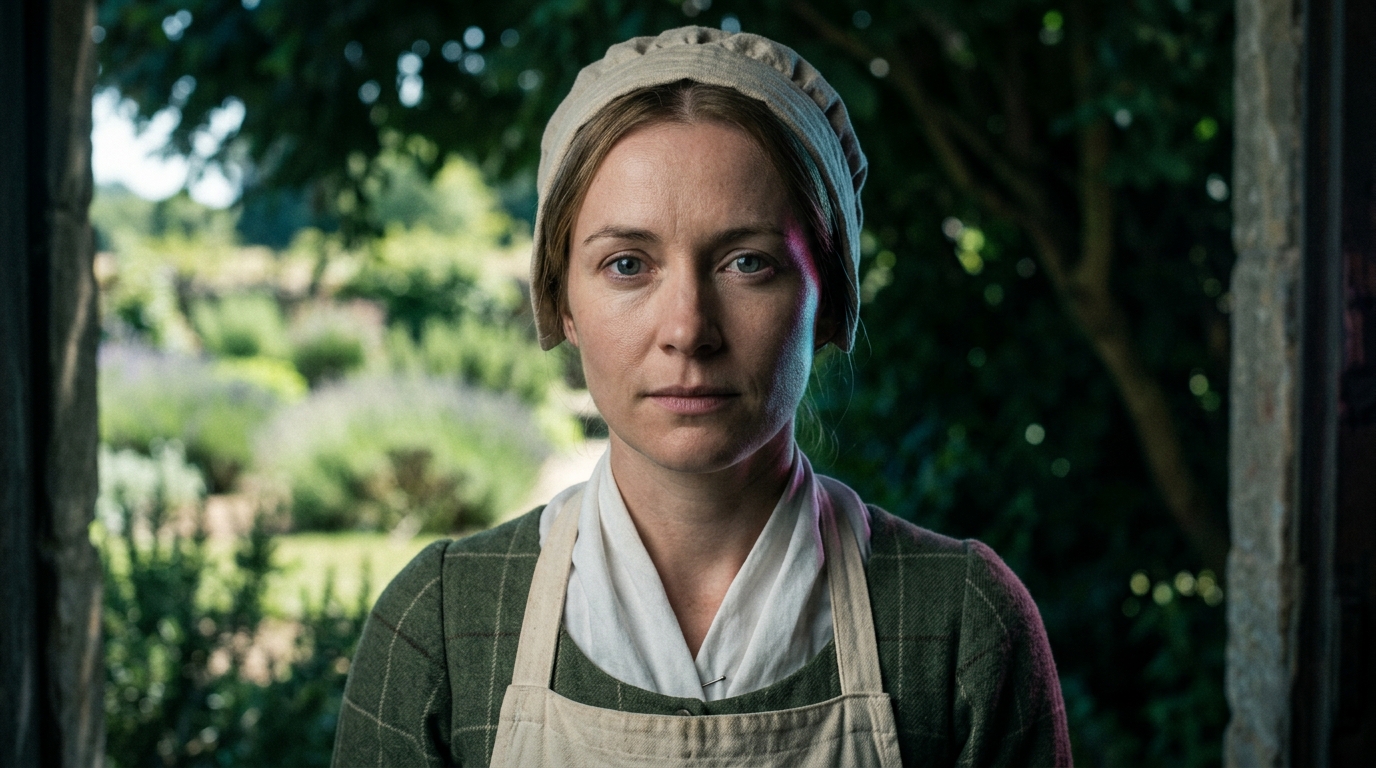
Mary Ellen Fairchild (1777–1857) was a Painswick-born healer and midwife, daughter of a herbalist and a midwife, and one of Brierly's five founding Guardians. Recruited by Jonathan Blackwood for the one craft the settlement could not survive without, she crossed to Clivilius in 1810 and built its first clinic and herb garden, tending its sick for nearly half a century. She trained her successor, Alice Turner, and outlived every other Guardian to become the last of them — the settlement's final link to Earth, closed at her death.
A Painswick Childhood
Mary Ellen Fairchild was born on 9 December 1777, in the steep wool town of Painswick, Gloucestershire, where the houses climbed the valley side in pale Cotswold stone and the churchyard yews stood clipped like dark sentinels above the river. She was the third child of James Fairchild, a herbalist of wide and patient learning, and Rebecca Fairchild, a midwife whose name was spoken with gratitude across the surrounding parishes. Into that household, healing came not as a profession but as the very weather of the place, and Mary grew up breathing it — the green, bitter smell of her father's drying-room, the muffled urgency of the night calls that took her mother out across the hills to wherever a child was coming into the world.
Hers was a house that valued knowledge, compassion, and service in equal measure, and she was raised in it alongside her two older brothers, William and Thomas. The boys were fond of her and protective, but it was clear early that the family's particular gift had settled most deeply on the youngest, and on a girl. While her brothers were turned towards trades that would take them out into the ordinary world, Mary was drawn inward, towards the still centre of the household where the sick were tended and the frightened were calmed, and she went towards it without ever being pushed.
Her education was largely informal, but it was uncommonly rich for being drawn from life rather than from books. From her mother she learned the whole craft of childbirth — the long patience of a difficult labour, the signs that told when all was well and the rarer, graver signs that told when it was not, the care of exhausted mothers and fragile newborns in the dangerous days that followed. From her father she took the great catalogue of herbal medicine: which plant eased which complaint, how each was best dried and prepared and dosed, and — the hardest lesson, and the one he prized most — when it was wiser to do nothing at all and let the body find its own way back.
She had a natural gift for all of it, and a temperament that suited it, neither squeamish nor sentimental, steady in the presence of pain. By the age of fifteen she was already sought out in Painswick in her own right, trusted by neighbours twice and three times her age for a skill and a gentleness well beyond her years.
Family Tree
The Stranger Who Came Seeking
In the ordinary course of things, Mary would have lived out her life as her mother had, the trusted healer of a Gloucestershire parish, marrying perhaps, perhaps not, dying at last in the town that had borne her. That her life took an altogether stranger road was the work of a single visitor. In 1798, when she was twenty-one and her reputation had begun to spread beyond the valley, a man named Jonathan Blackwood came to find her.
Blackwood was a figure who moved through learned and scientific circles with an ease that opened doors, and whose true purposes few who met him ever fully grasped. He had heard, along whatever quiet channels carried such news to him, of the young healer of Painswick, and he had come a long way on the strength of it. What he was recruiting for he revealed only by degrees, and only once he was satisfied she was worth the revealing: an undertaking of a kind no one in her world had words for — the founding of a settlement in Clivilius, an unexplored land that lay beyond the reach of any map, reachable at all only through the Portal Keys it was in his singular power to bestow.
He was assembling, he told her, a company of five, each chosen for a craft the venture could not survive without. Hers was the most fundamental of all. A settlement might struggle on without a vintner or a builder for a season; it could not survive a week without someone to keep its people alive.
It was no small thing he asked, and Mary did not treat it as one. To accept a Key was to have it bound to her own blood, and to leave behind the green, rain-fed country of her birth in all likelihood for ever — to set her back on her parents, her brothers, the churchyard where she had always assumed she would lie. She weighed it for a long time. But she was young, and gifted, and possessed of a quiet appetite for the thing no one had done before; and beneath that, more steadying than any of it, lay the simple recognition that a place full of people venturing into the unknown would need her, perhaps more than her familiar parish ever truly had.
With her parents' blessing, given not lightly, she chose to go. The decision set her among the five who would become the Guardians of Brierly — Thomas Ainsworth, who would lead them; Elizabeth Carrington, who would green the land; George Whitmore, who would give it its vines; Robert Aldridge, who would raise its walls; and Mary, who would hold its life in her hands.
A Healer in a Barren Land
Mary crossed into Clivilius with the founding party on 10 May 1810, arriving alongside the main body of settlers and her fellow Guardians at the stretch of empty ground that would become Brierly. Nothing in Gloucestershire had prepared her for the first sight of it. Where she had left soft hills quilted green to the horizon, she found a bare and silent country, the soil untried, the light strange, not a single growing thing on it that her eye knew how to name. It was the kind of vista that might have broken a less settled spirit. Mary looked at it and saw, beneath the desolation, a community that would shortly need tending — and she set to work that first day.
Her first care was shelter for the sick and the injured, for in a raw settlement hauling itself out of nothing, hurts and fevers would not wait on comfort. The clinic she raised was simple, little more than four walls and a clean dry space and a store of what remedies she had carried with her, but it was the first of its kind in Brierly and the place to which, for nearly half a century afterwards, the settlement would bring its suffering.
Her second care was a garden. The medicines she had brought from Earth were finite and irreplaceable, and she knew that the day they ran out she would be left empty-handed unless she could find their like in this new soil. So she began, with the careful discernment her father had drilled into her, to learn the unfamiliar flora of Clivilius — testing, observing, noting which plants held virtue and which held only harm, coaxing the useful ones into cultivation. The herb garden she made was the first Brierly ever knew, and it became, in time, as vital to the settlement's survival as its fields and its wells. From it came the salves and tinctures and teas on which the colony's health increasingly rested, grown from a world's own ground rather than carried from another.
Through all of it she was known above everything for her composure. In a young settlement beset by the accidents and illnesses of frontier life, she was the still point — the one who did not panic, whose hands stayed steady and whose voice stayed level when others' did not. That calm was itself a medicine. It comforted the frightened as surely as her draughts eased their bodies, and it did much, in the precarious early years, to keep the whole community from tipping into despair when misfortune struck. People learned that whatever had happened, however bad, Mary would come, and would know what to do, and would not flinch; and the knowing steadied them.
The Household Reformed
For the first two years she practised alone, the only person in Clivilius who carried the full weight of medical knowledge. It was a heavy solitude, and in 1812, with the settlement at last steady enough on its feet to bear the strain, she sent word back to Earth for her parents. James and Rebecca were elderly by then, and the crossing was no small ordeal for people of their years, but they made it nonetheless — drawn, perhaps, as much by the chance to be near their daughter again as by the colony's need of them. They brought with them a combined lifetime of accumulated skill, the herbalist and the midwife who had first taught her, and they gave it freely to the young community in the years that remained to them.
For a time, then, the Fairchild household stood again much as it had in Painswick — three generations of healers gathered beneath one roof, the drying-room and the birthing-stool and the quiet authority of long practice, only now set down on the soil of another world entirely. It was a strange and moving continuity, and Mary felt it keenly.
Her brothers, William and Thomas, chose to remain in England, unwilling to leave the lives they had built there, but the bond between them was not broken by the gulf between worlds. Letters passed back and forth when the crossing allowed it, carrying news and affection and, now and then, some fresh scrap of medical knowledge the brothers had come upon and thought their sister might use. Through those letters, and through her parents' presence, Mary kept hold of where she had come from even as she gave herself wholly to where she now was.
The Steady Hand of Brierly
For four decades and more, Mary Ellen Fairchild was the settlement's physician, surgeon, and midwife — the one constant presence at every birth and every deathbed Brierly knew across two generations. She delivered the children of the founders and, in time, the children of those children; she set the broken bones of men who had been infants when she arrived; she sat with the dying and closed their eyes and comforted those they left. There was scarcely a family in the settlement that did not owe her some debt, and scarcely a life among them she had not touched at its beginning, its end, or some frightened hour between.
Her authority in a crisis was absolute, and worn so lightly that those she treated scarcely noticed the steel beneath the gentleness until they had cause to.
The clearest proof of it came in 1837, when Charles Sinclair — Elizabeth's husband, the settlement's naturalist — was caught in a rockslide that crushed his leg beyond any hope of saving. It was the gravest kind of work a healer could be called to, an amputation that would kill the patient as readily as save him if the hand that held the knife wavered. Mary's did not. With the younger healer Alice Turner steady at her side to assist, she took off the ruined leg and brought Charles through it alive, and he lived more than twenty years afterwards on the wooden limb the settlement's builder made him. It was the sort of decisive, unflinching act that Brierly had long since learned it could rely on her for, and she met it as she met everything else — without display, without hesitation, and without ever afterwards making more of it than the day's work required.
She understood, as she aged, that the most important thing she could leave the settlement was not any single cure but the knowledge itself, which would die with her unless she gave it away. So she turned much of her later energy to teaching. In Alice Turner she found an inheritor worthy of the craft, and she trained her with the same patient thoroughness her own mother had once spent on her — the midwifery first, then the long apprenticeship in the herb garden, the reading of symptoms, the judgement of when to act and when to wait. Through Alice the knowledge reached further still, passed on to others in turn, so that the chain her parents had begun in a Gloucestershire parish ran on unbroken into a community that would, before long, have no other link to the medicine of Earth at all.
For all the gravity of her calling, there was a private Mary beneath the public one, and those nearest her knew her gentler enthusiasms. She loved her garden not only for its uses but for itself, and spent what rare idle hours she had among its beds, coaxing some difficult new plant to take or simply sitting in the green quiet she had made out of barren ground.
And she wrote — verses, kept private, drawn from the strange austere beauty of Clivilius and from the hardships and small joys of the life she had chosen there. She never meant them for other eyes, and few were ever read; but they were a solace to her, a way of setting down what a life so given over to others' needs might otherwise have left unspoken, and they suggest a woman of more inward depth than her brisk, capable public face revealed.
The Last Guardian
Time, which she had spent her life holding at bay for others, came at last for her own generation. The founders began to fall away. George Whitmore died in February 1850, the first of the Guardians to go, and Elizabeth Sinclair followed that same October. Robert Aldridge's strength failed in his turn, and in the autumn of 1855 Thomas Ainsworth, the leader of the company, the man who had crossed first and mapped the empty land, was laid in the Brierly ground as well. One by one the Portal Keys went still as the blood that bound them cooled, until at last only Mary's remained warm.
For the final years of her life she was the last Guardian of Brierly. The weight of what that meant is not easily overstated. Hers was now the single living Key in the settlement — the one and only thread that still, in principle, connected Brierly to the Earth from which all its people had ultimately come. Every other road between the worlds had closed with the death of the one who held it; only Mary's blood kept a door ajar. She had crossed as one of five, sharing the burden of that link among a company; she would carry it, at the end, entirely alone.
She bore it as she had borne everything — without complaint, and without any visible change in the steady habit of her days. There was a fitting symmetry in it that the settlement itself may not have fully grasped: the one Guardian whose whole life had been the keeping of others alive was the one left to keep alive, in her single ageing body, the colony's last tie to its origin. Whether she understood with full clarity that her own death would seal Brierly off for good — that the door would close behind her and not reopen in any lifetime she could imagine — no record survives to say. But the holding of it was hers alone, and she held it to the end, tending her patients and her garden in a settlement that had long since become, in every way that mattered, her whole world.
The Closing of the Road
Mary Ellen Fairchild died on 22 May 1857, at the age of seventy-nine, after a life given over, almost in its entirety, to the care of others. She had delivered or healed or buried very nearly everyone in the settlement at one time or another, and Brierly mourned her as a community mourns the loss of the person it had most depended upon — not with the grand ceremony owed to a leader, but with the deeper, more personal grief owed to the one who had been present at all its beginnings and all its endings. She was buried in the ground of the settlement she had served from its first barren day.
With her death, Brierly lost the last of its Guardians. The Portal Keys were silent now, every one of them, and the road to Earth that had run, at the end, through Mary's blood alone closed with her final breath. The settlement she left behind did not falter — it was self-sustaining by then, fed by its own fields, warmed by its own hearths, and healed by the medicine she had placed in Alice Turner's keeping — but from that day it stood alone, cut off from the world of its origin and turned wholly in upon itself.
For more than a century and a half it would remain so, a community of a few hundred souls living out their lives in complete isolation, until a chance contact with distant Bixbus, far beyond anything Mary could have foreseen, would open Brierly to the wider world once more. That it survived those long shut-in generations at all owed more than a little to the woman who had taught it, through forty-seven years of steady hands, how to keep itself alive.







