Mary Eleanor Blackwood (née Thompson)
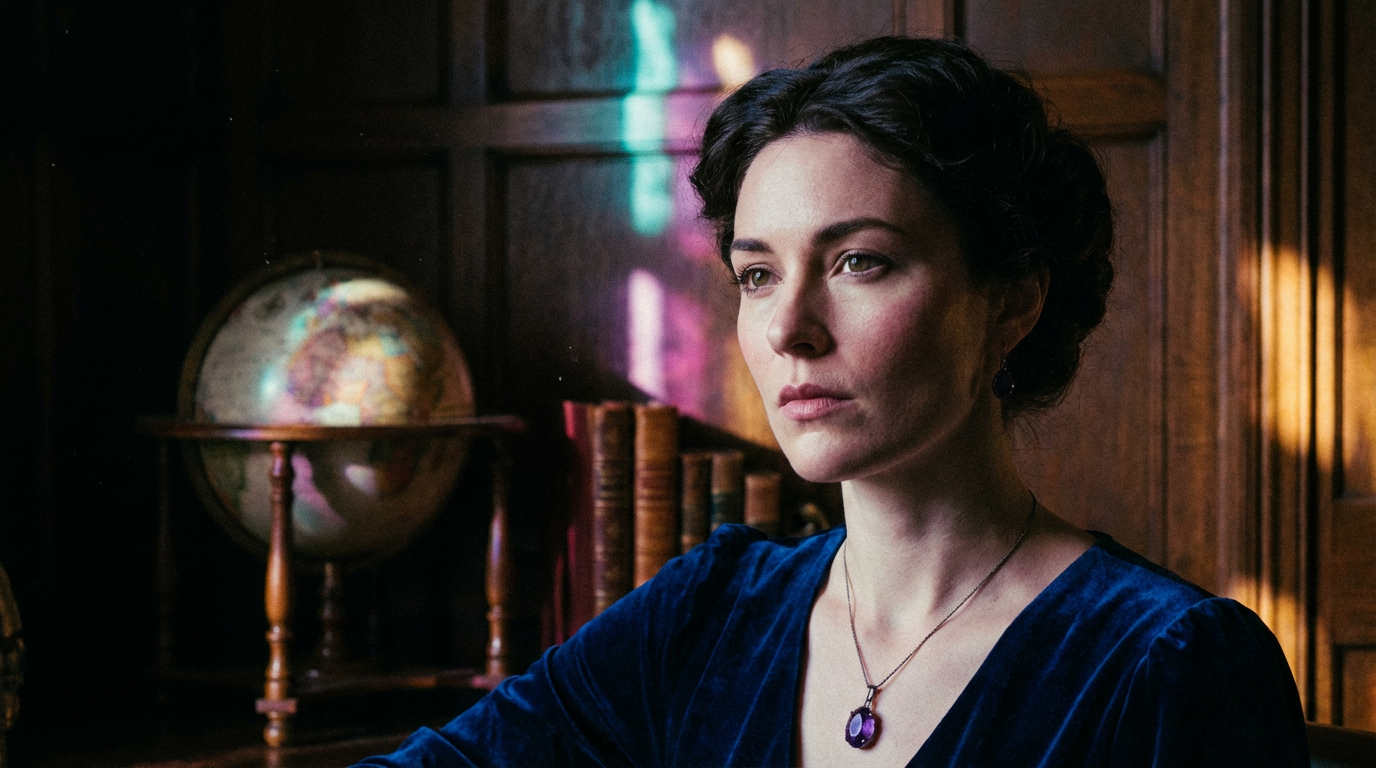
Mary Eleanor Blackwood, née Thompson (1875–1963), was the wife of Thomas Alastair Blackwood and the mother of Alastair Prometheus and Edward Thomas Blackwood, whose departures from the family's legal tradition she anticipated, encouraged, and never fully understood. Born into Hobart's banking establishment, she married the Blackwood dynasty's fourth-generation managing partner in 1901, survived his sudden death in 1930, and spent her remaining three decades managing a widowhood whose independence arrived too late for her to enjoy without qualification.
Early Life and Family
Mary Eleanor Thompson was born on 3 September 1875 in Hobart, Tasmania, the eldest of four children born to Arthur James Thompson, a banker whose institutions served Hobart's commercial and professional establishments, and Catherine Thompson, née Aldridge, the daughter of a Launceston solicitor whose family connections extended across northern Tasmania's legal and mercantile networks. The Thompson household occupied a substantial sandstone residence on Davey Street, within comfortable distance of Arthur's offices and the Anglican cathedral whose services the family attended with the regularity that Hobart's professional class considered both a spiritual obligation and a social requirement.
Mary's siblings arrived across the decade that followed. Her brother Arthur William, born in 1877, entered the family bank and eventually succeeded their father as its managing director. Her sister Catherine Frances, born in 1880, married a Launceston doctor and settled in the north. Her youngest brother, James Edward, born in 1883, enlisted in 1915 and was killed at Gallipoli on 7 August of that year — a loss that cracked something in the Thompson family's composure that subsequent decades would repair structurally but never entirely restore.
Arthur James Thompson was a cautious, meticulous man whose professional success derived from the accurate assessment of risk and the disciplined avoidance of speculative ventures whose returns, however attractive, exceeded what careful analysis could justify. He applied the same principles to domestic life, creating a household that was well-ordered, financially secure, and emotionally moderate in ways that provided his children with stability at the cost of spontaneity. Catherine Thompson was warmer, more socially engaged, and possessed of a wit that she deployed in private settings with a sharpness that her public manner — gracious, conventional, the banker's wife — did not advertise. Mary inherited qualities from both parents: her father's capacity for careful observation and her mother's habit of maintaining a public surface whose relationship to the private self it concealed was more complex than casual acquaintances perceived.
Education and Youth
Mary's education followed the pattern prescribed for Hobart's professional daughters during the 1880s and early 1890s — a local girls' school whose curriculum combined academic instruction with the social accomplishments that colonial society expected of young women whose futures, it was assumed, would be determined by the men they married rather than by the capabilities they developed. She was an exceptional student whose intelligence her teachers noted without quite knowing what to do with it. She excelled in literature and history, showed an aptitude for languages that the curriculum's elementary French could not adequately engage, and developed a reading habit whose scope and ambition exceeded anything that her schooling demanded or her social world rewarded.
The reading was the key to Mary — or rather, the gap between what she read and what she was expected to become was the key. She consumed novels, political philosophy, the emerging literature on women's education and social reform that was circulating through Australian intellectual networks during the 1890s, and she processed this material with a critical intelligence that produced conclusions she had the sense — or the caution, or the cowardice, depending on one's assessment — not to express in contexts where their expression would have complicated her social position. She was not a radical, not a suffragist, not a public advocate for anything. She was a woman who thought more than she said, and who maintained the distance between thinking and saying with a discipline so practised that most people who knew her mistook the silence for agreement.
Marriage to Thomas Alastair Blackwood
Mary married Thomas Alastair Blackwood on 14 June 1901, at St David's Cathedral in Hobart. She was twenty-five years old, he twenty-nine. The match connected Hobart's banking and legal establishments in a union whose strategic advantages both families recognised and whose personal dimensions the couple themselves were left to negotiate. Thomas Alastair was a man whose professional competence Mary respected and whose emotional limitations she perceived with a clarity that the courtship's conventional structure did not provide the opportunity to discuss. She married him knowing that portions of her inner life would remain inaccessible to him, and accepting that the marriage would function on the basis of shared capability rather than mutual transparency.
The acceptance was neither resignation nor self-deception. Mary understood, with the analytical precision she had inherited from her father, that marriage to a Blackwood entailed specific terms: the husband's career would constitute the household's organising principle, the wife's capabilities would be deployed in support of that career, and the emotional dimensions of the partnership would be managed rather than explored. She had observed these terms in operation through her acquaintance with Clara Winifred Blackwood, her mother-in-law, whose social intelligence and domestic competence Mary recognised as genuine achievements whose invisibility constituted the most honest measure of what the Blackwood family expected from its women. Mary entered the marriage intending to fulfil these expectations and simultaneously to maintain, within the private spaces that domestic management afforded, an intellectual and emotional life that the expectations did not encompass.
Motherhood
The first years of the marriage produced the domestic establishment that Thomas Alastair's professional position required and one devastating loss. Their first pregnancy, in 1904, ended in a stillbirth in January 1905 — a boy, delivered after a prolonged and traumatic labour, the cord wrapped twice around the neck. The attending physician's handling of the delivery left Mary with a conviction that the death had been preventable — a conviction she maintained privately and bitterly for the rest of her life, never raising it publicly because public accusation against a medical professional would have created a scandal whose damage to the Blackwood name exceeded what her grief, however justified, could warrant. The calculus was characteristic: Mary weighed her personal fury against the institutional consequences of expressing it and chose silence, as she chose silence on so many subjects whose suppression cost her more than anyone around her understood.
Alastair Prometheus Blackwood arrived on 17 April 1910, five years after the stillbirth — five years during which Mary endured the particular anxiety of a woman who knew what pregnancy could cost and who approached the prospect of another with a fear whose rational basis her desire for a living child could not entirely override. The boy was healthy, vigorous, and possessed from infancy of an alertness that Mary recognised as something beyond the ordinary range. She named him Prometheus — the fire-bringer, the titan who stole knowledge from the gods and gave it to humanity — over Thomas Alastair's objection that the name was excessive. The choice was Mary's most visible act of self-assertion within the marriage: a declaration, encoded in a name, that her son's life would not be bounded by the Blackwood legal tradition and that the ambition she had suppressed in herself would find expression in the generation that followed.
Edward Thomas Blackwood was born on 22 August 1912, his conventional names a concession to the family expectations that Alastair's naming had challenged. Edward was a quieter child, more amenable to the household's routines, and Mary loved him with a steadiness that differed in character from the more complicated attachment she felt toward Alastair — the elder son carrying, from before his birth, the weight of his mother's thwarted intellectual ambitions in addition to the more ordinary expectations of parental love.
Life Within the Blackwood Household
Mary's management of the Blackwood household during the 1910s and 1920s followed the pattern established by four generations of Blackwood wives, though she executed the role with a self-awareness that her predecessors had not all possessed. She maintained the social programme, hosted the gatherings that connected the firm to its clients, managed the domestic staff, supervised the children's education, and ensured that the household's public presentation reflected the standards that the Blackwood name demanded. She performed these functions with a competence that matched Clara's and an inner detachment that exceeded it — maintaining throughout the decades of her marriage a distinction between the woman she presented to the world and the woman who existed behind the presentation that was sharper and more deliberately maintained than the gap that most people carry between their public and private selves.
Her friendships with women outside the Blackwood circle provided the intellectual companionship that the marriage did not. She maintained connections with women whose progressive views on education, women's rights, and social reform aligned with the convictions she held privately but did not express publicly. These friendships were conducted through afternoon visits, correspondence, and the reading groups that Hobart's educated women organised as a socially acceptable framework for discussions whose content sometimes exceeded what the framework's conventional appearance suggested. Thomas Alastair was aware of these friendships without fully grasping their significance — he understood that his wife moved in circles whose intellectual ambitions exceeded the domestic world she appeared to inhabit, but the gap between his understanding and his curiosity about what the ambitions consisted of was one of the marriage's defining silences.
She read. She read voraciously, systematically, and with an intellectual hunger that the domestic role she occupied could not satisfy and that the social conventions of her position required her to pursue in private. She read the novels and political theory that had engaged her since adolescence, the emerging literature on child psychology and educational reform that informed her approach to raising Alastair and Edward, and the scientific publications whose content she followed with a lay person's comprehension and a lay person's awareness that comprehension was not the same as expertise. The reading shaped the household's intellectual atmosphere in ways that Thomas Alastair perceived without attributing to their source — the conversations at dinner, the books that appeared in the children's rooms, the questions that Alastair began asking at an age when most children were still accepting the answers they were given.
Widowhood
Thomas Alastair Blackwood collapsed at his desk at Blackwood and Associates on the morning of 30 March 1930 and died within the hour. He was fifty-eight years old. Mary was fifty-four. The boys were twenty and seventeen.
The loss was not unexpected in the sense that Mary had watched the pattern that killed her husband develop over the preceding two years — the escalating hours, the deteriorating sleep, the refusal to delegate or rest that she had urged against with increasing urgency and decreasing effect. It was unexpected in the sense that death, when it arrives, is always unexpected — the finality of it exceeding whatever preparation the anticipation of it was supposed to provide. Mary received the news at home, delivered by a clerk from the firm whose face communicated the information before his words confirmed it. She sat down, she absorbed the fact, and she began — within hours, with a competence that those around her found both impressive and faintly disturbing — to manage the consequences.
The consequences were substantial. Thomas Alastair had died in the opening months of the Depression, and the firm's finances, already strained by the economic downturn, required attention that Mary's father's banking background had equipped her to provide. She worked with the firm's remaining partners to stabilise the practice, managed the household's transition to a reduced income, and ensured that both sons' educations continued without interruption. Alastair was at university; Edward was completing school. Neither would enter the law. Mary had known this for years — had known it, in Alastair's case, since the boy was old enough to demonstrate that his mind operated on a scale and at a speed that the legal profession's incremental logic could not accommodate — and the knowledge, which would have distressed Thomas Alastair, provided Mary with a complicated satisfaction that she would not have been able to explain to anyone who did not understand the distinction between a mother's hopes for her children and a wife's compliance with her husband's expectations.
The widowhood that followed Thomas Alastair's death was, in certain respects, the most authentic period of Mary's life. She was no longer required to maintain the public surface that the Blackwood marriage had demanded. She was no longer obligated to suppress her opinions in deference to her husband's professional position. She was no longer managing the gap between who she was and who she appeared to be, because the social structures that had required the gap no longer applied to a widow whose husband's death had released her from obligations whose weight she had carried for thirty years without acknowledging, even to herself, how heavy they had been. She joined organisations whose progressive orientations she had previously supported only through private friendships. She expressed opinions in public settings that she had previously confined to her reading groups and her correspondence. She became, in her late fifties and sixties, a version of the woman she might have been from the beginning if the world into which she had been born had permitted it.
Her Sons
Mary watched both sons pursue careers in medicine — Alastair with a brilliance and ambition that exceeded anything the Blackwood family had previously produced, Edward with a steadier competence that reflected his father's temperament applied to a different discipline. She was proud of both, though her pride in Alastair carried undertones that she recognised without being able to resolve. She had named him Prometheus. She had filled his childhood with books and questions and the implicit instruction that the world's existing arrangements were insufficient and that intelligence was the instrument by which they might be improved. Whatever Alastair became — and he became something remarkable, and something whose moral dimensions were not entirely clear — Mary's contribution to the making of him was substantial, and her awareness of that contribution informed her responses to his adult career with a complexity that simple maternal pride could not encompass.
Edward's death on 5 April 1970, at the age of fifty-seven, preceded Mary's own by seven years. She was ninety-four when she lost her younger son — old enough that the grief arrived in a body already diminished by age and through emotional channels already abraded by decades of previous losses. She bore it as she bore everything: privately, completely, and with a composure that those around her continued, after seventy years of observation, to mistake for equanimity.
Death
Mary Eleanor Blackwood died on 11 March 1963 in Hobart, at the age of eighty-seven. She had been increasingly frail through the preceding winter, her mobility reduced by the arthritis that had been tightening its grip on her joints for a decade, her eyesight diminished to the point where the reading that had sustained her throughout her life was possible only with a magnifying glass whose weight her hands could barely manage. She died in her sleep — the quietest of departures for a woman whose inner life had been anything but quiet, the silence of her death mirroring the silence she had maintained, with such sustained and costly discipline, throughout the decades of her public existence.
She was survived by both sons — Alastair Prometheus, then fifty-two, and Edward Thomas, then fifty. Her elder son's career had taken him into territories whose ambition she had seeded and whose moral complexity she had observed from a distance without ever fully comprehending. Her younger son continued the steadier work in medicine that his temperament had always suited, his presence in Hobart providing the continuity that Mary's declining years required.
Mary Eleanor Blackwood had been the most private of the Blackwood wives — the one whose inner life was richest and whose public expression of it was most rigorously controlled. She had married into a dynasty that required its women to be capable and invisible, and she had fulfilled both requirements with a precision that left those who knew her uncertain, even after decades of acquaintance, whether the composed surface they observed was the person or the performance. The answer, which Mary never provided and which the surviving evidence does not resolve, was that the distinction had ceased to be meaningful long before anyone thought to ask the question. She had lived so long behind the surface that the surface and the self had merged, the suppression becoming so habitual that it no longer registered as suppression — merely as the way she was. Whether this represented adaptation, loss, or a form of survival so thoroughgoing that it constituted its own kind of achievement, Mary's silence on the subject was, characteristically, the most eloquent thing about her.







