Marion Ruth Schofield (née Carrington)
Marion Ruth Schofield, née Carrington (1929–2016), was an Adelaide Hills woman shaped by a widowed mother, a Depression childhood, and a Methodist creed that prized the appearance of coping above all. She gave up teaching for library work and marriage to the war-marked Edward Schofield, and raised three children with a competence that never faltered and rarely warmed. She held her household together by needing nothing from it — a strength that was also a wall, and one she handed to her children as surely as she fed them.
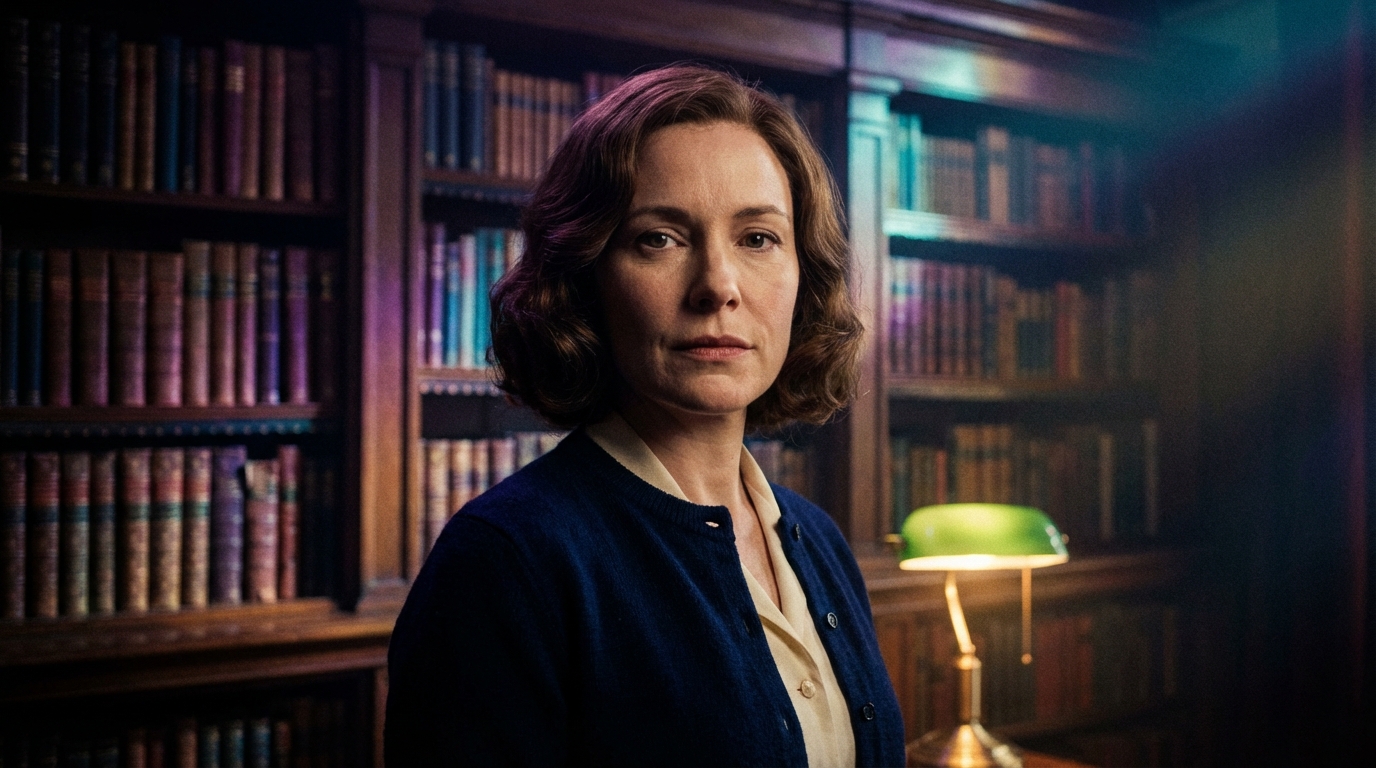
Constance's Daughter
Marion Ruth Carrington was born on 21 August 1929 in Balhannah, an Adelaide Hills township of apple orchards and dairy farms, the second of four children of Harold Arthur Carrington, a storeman at the local fruit-packing shed, and Constance May Carrington, née Whitford, whose hard energy held the family together through the worst of the Depression. Their home was a rented weatherboard cottage with a leaking iron roof and walls too thin for privacy; Marion shared a room with her older brother, Ronald, born in 1927, until a hung curtain was judged to make the arrangement decent.
Two more followed — Keith in 1932, and Judith in 1935, whose birth nearly killed their mother and left Constance with health that never fully returned. Harold was a good-natured man whose optimism ran well ahead of his prospects; he worked when the shed had work and took whatever else he could find, and the family lived perpetually a bad season away from real hardship.
It was Constance who set the terms of Marion's character. She stretched every penny, wasted nothing, mended what could not be mended again, and kept a standard of cleanliness and respectability she held to be non-negotiable whatever their circumstances. From her, Marion took the lessons that would govern her whole life: that a woman's work is never finished, that complaint changes nothing, and that the appearance of coping matters very nearly as much as coping itself. The Balhannah Methodist church supplied the rest — hard work, temperance, moral rectitude, and a horror of being pitied.
Family Tree
The Year Her Father Died
She was ten when the war began, old enough to feel the adults' fear without grasping its cause. The Adelaide Hills, strangely, did better in those years — demand for produce rose and the long unemployment eased, and Harold found steady work for the first time in memory. But the war took Ronald. He enlisted in 1944 at seventeen, with his father's tacit blessing and his mother's anguish, came back from the Pacific in 1946 someone else — withdrawn, quick to anger, unable to settle — and drifted between jobs and towns until his letters thinned and stopped. The family heard, through distant relatives, of a wife in Queensland and children Marion never met. Ronald became an absence no one discussed, which was how the Carringtons handled most wounds.
Harold's health had never been strong, and the post-war years finished it. A cough that worsened through the winter of 1947 was confirmed the next spring as tuberculosis, already past the reach of the sanatorium. He died in September 1948, leaving Constance widowed at forty-three with Keith, sixteen and apprenticed to a mechanic, and Judith, thirteen and still at school. Marion, nineteen and working as a junior assistant at a draper's in Mount Barker, was caught between her own first independence and her family's sudden need.
Need won, as it generally did with Marion. To keep them solvent and off charity — the latter unthinkable to Constance — the two women turned the cottage into a boarding house for the summer visitors the Hills drew, and for three years Marion cooked, cleaned, laundered and managed the logistics of strangers under their roof. It was thankless work, and she was good at it, and it gave her the household competence that would come to define her.
A guest changed her course — a retired Adelaide schoolmistress who watched the capable young woman bring her tea and change her linen, and pressed her to apply to teachers' college. Marion enrolled at the Adelaide Teachers' College in 1952, older than her fellow students and feeling it, and the coursework came easily. The classroom did not. The constant performance of it, the demand to command a room and project authority, drained her as no amount of scrubbing ever had. She finished the qualification and knew she would never use it. She had learned something about herself: she could serve any number of people tirelessly, but she could not stand in front of them and be watched.
A Contained Man
She met Edward James Schofield at a church social in Mount Barker in the spring of 1953. She was twenty-four, working part-time at the Stirling Library and still helping with the now-diminished boarding house; Judith had married into Adelaide, Keith had gone to Port Augusta for work, and Constance's energy had not returned. Edward was thirty, a biology teacher down from Murray Bridge to see his ageing parents, and Marion noticed him because he stood apart — not unfriendly, but contained, watching the room with the same detachment she knew in herself.
Their courtship was slow, hemmed in by distance and by Edward's difficulty with anything that asked him to put feeling into words. They walked the Hills bushland, drank tea in modest cafés, and circled depths neither was ready to sound. She understood, without being told, that the war had wounded him — she saw it in the sudden blank stares, the flinch at certain sounds, the silences that came and went without explanation — and she did not ask. Her own family had taught her that pressing at a wound only made it bleed. She offered instead what she had: steady presence, competence, and the willingness to take him as he was. For Edward it felt like grace. It did not occur to either of them that a marriage might be built on more.
The House She Made
They married in April 1955 at the Stirling Methodist Church, Marion in a dress she had sewn herself, the reception a hall of sandwiches and auxiliary cake. There was no honeymoon and neither of them felt the lack. She made the bachelor's brick house on the edge of Stirling into a home — curtains hung, a vegetable garden dug, secondhand furniture refinished by her own hand — and gave up the library when her pregnancy showed, as married women were expected to.
Douglas Edward came on 14 February 1956, serious from the cradle. Marion found motherhood both filling and isolating in ways she had not foreseen: the relentless demands of an infant set against Edward's long hours and longer silences, leaving her, some days, exhausted and quietly alone in a house whose walls seemed to lean inward. Felicity Marion arrived in 1958, all noise and colour where her brother was contained, delightful and depleting at once. James Albert came in 1961.
James undid the certainties her competence rested on. From infancy he was different — slow to his milestones, easily overwhelmed, lost at what the others had found simple — and the doctors offered little, the very words for his difference scarcely existing yet. Marion read what she could find, pushed for what scant help there was, and built the patient, ordered world he needed. She did it well. She did it, as she did everything, without letting anyone see what it cost.
What She Would Not Show
There were nights, after the children slept and Edward had gone into his books, when she sat alone in the kitchen and let herself feel the full weight of it before folding it away and carrying on. No one saw those nights. That was the point of them. The Methodist stoicism of her girlhood had hardened into something like doctrine: difficulty was to be endured rather than spoken, and self-pity was an indulgence she would not permit herself or, in truth, easily forgive in others.
It was her great strength and it was the wall around her, and the two were the same thing. She tended everyone and let no one tend her, and there was a pride in that refusal she never examined — a quiet conviction that she was the one who coped, the one who held, the still point the rest of them turned around. She met weakness in others with patience but not always with warmth; the relative who could not manage, the neighbour who wept too readily, drew her help and, beneath it, a faint cool judgement she would have been ashamed to speak aloud.
Her children felt it as a particular kind of attention. She was never neglectful — they were fed, clothed, listened to, held to a standard — but she managed them more surely than she knew them. She read Douglas's moods with precision and answered them with order rather than with herself, and the boy, watching, learned the lesson exactly: that love looked like competence, that feeling was a thing you handled alone in the kitchen at night where it would trouble no one. She gave him that as surely as she gave him his dinner. It would shape the whole of his life, and the shape was not entirely kind.
Of her three children, it was James she never stopped tending, and with James — only with James — the competence and the warmth were not two separate things. Every Saturday for the rest of her life she made the trip to him, brought the biscuits he liked, and sat through the unchanging shape of his afternoon. He asked nothing of her she could not give, and she loved him with an ease she could never quite find for the children who could see her clearly.
The Shape of a Marriage
Her marriage to Edward was not unhappy, but it was never the partnership a later generation would take for granted. He provided and never raised his hand or his voice, things she had learned not to assume in a husband. He was a good father in his fashion — present, responsible, attentive to his children's schooling. But there were walls in him she could not breach, silences that ran for days, and she navigated his moods as she had once navigated her boarders': with patience, observation, and carefully lowered expectations. When the nightmares came she laid a hand on his arm and spoke quietly until he surfaced, and she never asked what he had dreamed.
Constance did not have an easy old age. The years of widowhood and overwork had left her frail, and through the 1960s it was Marion who drove out to Balhannah and then, when that became impossible, took her mother into the Stirling house — nursing her through a long decline with the same uncomplaining competence Constance herself had taught, the lesson passing back up the line to the woman who had set it. Constance died in 1968. Marion washed and dressed her for the undertaker with her own hands, and told no one she had done it.
The church became her life outside the house. After the move to Stirling they joined the Anglican parish — a compromise between his nominal faith and her Methodism — and she gave herself to it with her usual competence: the fêtes organised, the rosters kept, the meals carried to families in trouble. It offered adult company, a purpose beyond the domestic, and the deep satisfaction of being needed. Her library work resumed, part-time, once James was at school — the small Stirling branch, the gentle order of catalogues and call numbers, a little money of her own for fabric and books and small treats, and an identity that was neither wife nor mother.
Alone in the Stirling House
When the children had gone — Douglas into medicine and the containment she recognised with a complicated pride, Felicity into the teaching Marion had abandoned and a marriage to a pleasant local-government man, James into supported accommodation in his twenties, with the part-time care he would always need — she turned the same steadiness on Edward's long decline. His retirement in 1988 let his old demons expand into the empty hours; his stroke in 1998 made her, at nearly seventy, more nurse than wife. She managed his medications and his appointments and his shrinking world without complaint, because that was what marriage meant, and complaint had never once been permitted.
Edward died in March 2003, and Marion found herself, at seventy-three, alone for the first time in her adult life. The grief was complicated — sorrow, and relief that his suffering was over, and something harder to name that may have been mourning for the closeness the marriage had never managed. She stayed in the Stirling house and held to her routines with characteristic will: church on Sundays, the library on Wednesdays, James every Saturday, the garden kept immaculate. Her children and grandchildren filled the brick house with noise and then left her to her quiet, and she read, as she always had, finding in books the company that people had so rarely been allowed to be.
Felicity's children came often when they were small, and Marion was easier with her grandchildren than she had ever been with her own — the distance of a generation softening something in her, so that she could sit on the floor at their games in a way she had never managed with Douglas or Felicity, and be, for an afternoon at a time, uncomplicatedly warm.
She and Douglas, grown, met like two people who spoke the same language and could not use it on each other. He rang on Sundays, dutiful and precise; she gave him the news of the parish and the garden, asked after his work and not his life, and each of them came away from the call having said everything except the thing. Neither ever remarked on it. To remark on it would have broken the one rule they truly shared.
She grew old the way she had lived — upright, self-sufficient, and quietly immovable about not being a burden. As her body slowed she waved away the offers that frightened her more than the slowing did: a move closer to Felicity, a woman to help in the house, the regular looking-in that she heard as an accusation of frailty. She had spent a lifetime as the one who tended; she could not become the one who was tended, and she defended the distinction well past the point of sense.
In the autumn of 2016 she fell in the garden, reaching for something she would not afterwards admit she should have left, and fractured her hip. Characteristically, she told no one for as long as she could stand it — dosed herself, kept up appearances, made light of the stiffness — until she could no longer rise from a chair and Felicity found her grey with pain. The hip was repaired, but the cascade that such falls so often set off in the very old had already begun: the surgery, the immobility she loathed, the slow loss of ground. Pneumonia settled into her chest as the winter came on.
Marion Ruth Schofield died on 2 September 2016, aged eighty-seven, in a care ward whose borrowed order she would have hated to depend on, twelve days after a birthday she had insisted on marking at home. The woman who had spent a lifetime tending others, and refusing to the last to be tended, was cared for at the end by hands she had never once asked for help — undone, in part, by the very pride that had held her family together. Her children buried her from the Stirling church, beside Edward, and Douglas stood at the graveside reading the grief in everyone around him, as he always did, and showing none of his own.







