Margaret Helen Blackwood (née Stevenson)
Margaret Helen Blackwood, née Stevenson (1913–1993), was the wife of Dr Alastair Prometheus Blackwood and the woman whose social acuity, financial connections, and sustained silence provided the domestic architecture within which the Obsidian Healthcare Group's founder conducted his career. The daughter of a Melbourne financier, she married brilliance without comprehending its full dimensions, raised two children in a household whose private operations exceeded her oversight, and outlived both her son and her husband without publicly disclosing what she knew about either death.
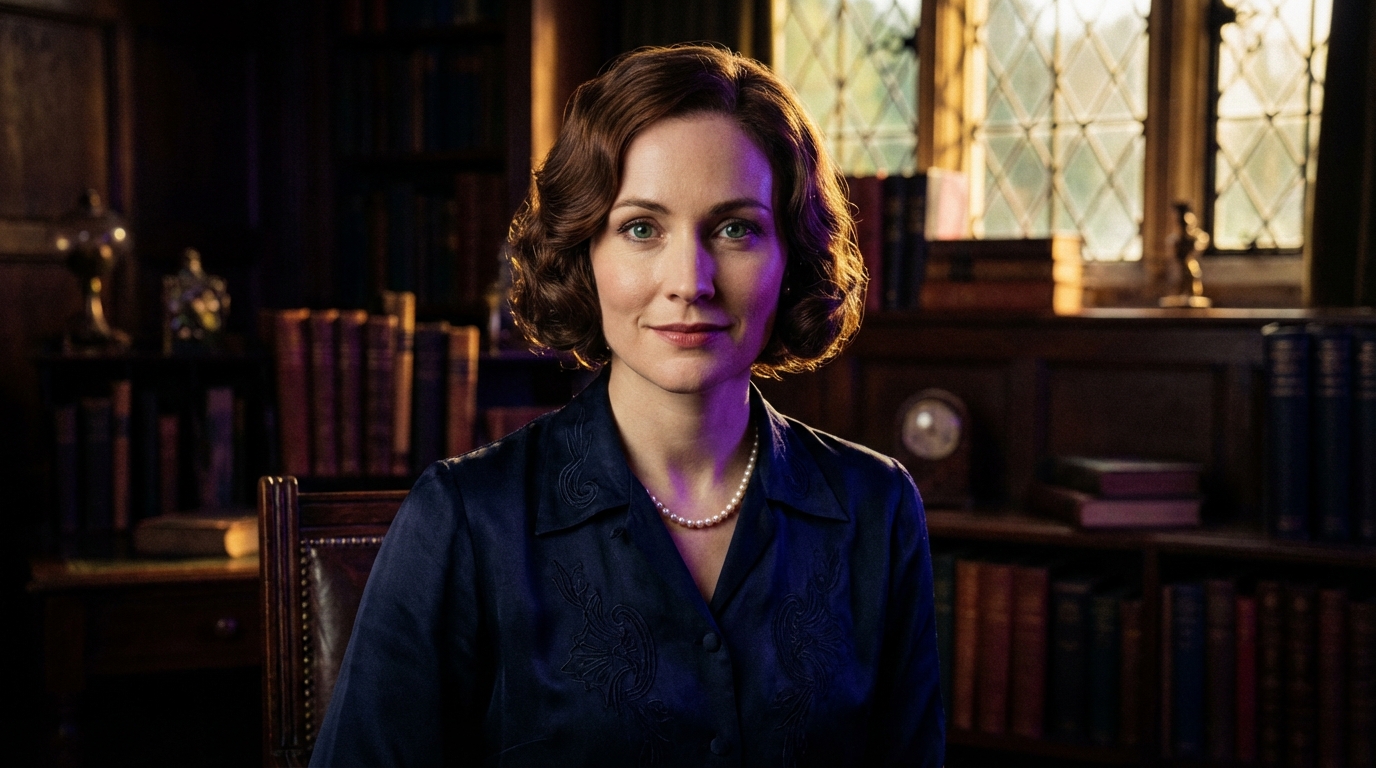
Origins
Margaret Helen Stevenson was born on 28 September 1913 in Toorak, Melbourne, the only daughter of Harold William Stevenson, a financier whose investment interests encompassed mining, pastoral holdings, and the emerging medical infrastructure that post-Federation Australia was developing with capital that men like Harold knew how to provide. Her mother, Constance Stevenson, née Alderton, was the daughter of a Western District grazier whose family's wealth derived from wool and whose social position derived from the assumption that pastoral money, held long enough, became indistinguishable from old money. The Stevenson household in Toorak occupied a substantial Edwardian residence whose grounds, staff, and social calendar communicated a prosperity that Harold considered understated and that Constance considered appropriate.
Margaret had two brothers — Harold George, born in 1910, who entered the family's financial operations and managed the Stevenson investment portfolio until his retirement, and Arthur William, born in 1916, who studied law at the University of Melbourne and practised commercial law in the Collins Street firms that served Melbourne's financial establishment. Margaret occupied the position that daughters of wealthy families in interwar Melbourne were expected to occupy — educated, presentable, socially accomplished, and available for a marriage whose strategic dimensions would be assessed by her father with the same analytical rigour he applied to investment decisions. The expectation was not experienced as oppressive because its ubiquity made it invisible; Margaret grew up understanding that her education, her social training, and her cultivation of the accomplishments that Melbourne society valued in young women of her class were preparation for a role whose parameters had been established before she was born.
Education and Youth
Margaret attended the Presbyterian Ladies' College in Melbourne, where she received the education that the era prescribed for daughters of the city's professional and financial establishment — academic instruction sufficient to produce informed conversation, domestic training sufficient to manage a substantial household, and social polish sufficient to navigate the occasions at which Melbourne's commercial families consolidated their relationships through their children's interactions. She was an adequate student whose capabilities her teachers assessed as solid without being exceptional, a judgment that reflected both the limitations of what she was asked to do and the possibility — never tested, because the testing would have required circumstances that her life did not provide — that she might have been capable of more.
She excelled in music, playing the piano with a facility that her instructors described as genuinely accomplished and that she herself regarded as the most authentic of her attributes — the one skill whose development had been motivated by personal pleasure rather than social obligation. The piano remained, throughout her life, the activity to which she retreated when the other activities that structured her days became insufficient, and the quality of her playing — technically precise, emotionally restrained, and possessed of a depth that surprised listeners who expected from Margaret Stevenson nothing more than competent drawing-room performance — suggested an inner life whose complexity the social surface did not advertise.
Alastair
Margaret met Alastair Prometheus Blackwood in late 1934 at a Melbourne medical reception to which Harold Stevenson had been invited in his capacity as a prospective financial supporter of research programmes at the Walter and Eliza Hall Institute. Alastair was twenty-four years old, completing his internship at the Royal Melbourne Hospital, and possessed of a combination of intellectual intensity and social awkwardness that Margaret found simultaneously disconcerting and compelling. He was unlike the young men she had been introduced to through her parents' networks — the sons of financiers and graziers and lawyers whose conversational range extended to sport, commerce, and the social arrangements that constituted Melbourne's primary mechanism for reproducing its class structure. Alastair talked about neurological function and the boundaries of consciousness and the philosophical implications of surgical intervention on identity, and Margaret listened with an attention whose quality Alastair registered without understanding its source.
Harold Stevenson assessed the match with professional thoroughness. The Blackwood name carried weight — the Tasmanian legal dynasty, the colonial history, the professional respectability that five generations of achievement had accumulated. Alastair's medical career was promising, his research ambitions suggested the kind of institutional trajectory that financial support could accelerate, and the alignment of the Stevenson investment portfolio with the emerging medical sector made the connection commercially as well as socially advantageous. Harold approved the match. Constance approved the match. Margaret consented to the match, her consent encompassing both the genuine attraction she felt toward a man whose mind operated in territories she could not map and the awareness — present but unexamined — that the territories she could not map might contain things she would prefer not to discover.
They married on 7 June 1935 at Toorak Presbyterian Church. Margaret was twenty-one years old. The ceremony was substantial, the Stevenson connections filling the church and the reception that followed with the representatives of Melbourne's financial and professional establishment. Alastair endured the occasion with a composure that Margaret, who was learning to read him, recognised as performance rather than comfort. He did not enjoy social display. He did not, for that matter, enjoy most forms of social interaction that did not involve the exchange of information he considered consequential. The marriage began with this asymmetry in place — Margaret's social capabilities constituting a resource that Alastair's ambitions required and that his temperament could not have generated — and the asymmetry persisted, without resolution, for the next fifty years.
The Marriage
Margaret's role within the Blackwood household was established early and maintained with the consistency that both partners understood to be its defining feature. She managed the domestic arrangements — staff, entertaining, the social calendar that connected Alastair's professional activities to the broader networks of Melbourne's medical and financial establishment. She appeared at medical galas, board events, and the institutional occasions at which Obsidian Healthcare Group's public reputation was cultivated and maintained. She performed these functions with the competence that her upbringing had prepared her to provide and with a composure whose smoothness concealed the fact that the household she was managing contained dimensions she was not permitted to access.
Alastair's absences were frequent, his explanations minimal, and the restricted-access areas of their domestic and professional properties — the laboratories, the locked study rooms, the facilities whose purposes Margaret was not invited to enquire about — constituted a permanent feature of the marriage's architecture. Margaret adapted to these conditions by developing a relationship with knowledge that was, in its own way, as sophisticated as anything her husband's research produced. She knew enough to understand that she did not know everything. She knew enough to understand that the things she did not know were not omissions but exclusions — that Alastair's privacy was not the absent-mindedness of a busy professional but the deliberate management of information whose disclosure he considered incompatible with the domestic arrangement their marriage represented. She did not challenge the exclusions. Whether her silence reflected trust, fear, complicity, or the particular form of self-preservation that consists of not asking questions whose answers one suspects one could not accommodate was a question that Margaret herself may not have been able to answer with certainty.
Children
Maxwell Alastair Blackwood was born on 12 June 1940 in Melbourne. Victoria Evelyn Blackwood followed on 4 March 1943. Margaret raised both children with the practical dedication that Alastair's absences required and that her own upbringing had modelled — the management of a substantial household, the supervision of education and social development, and the provision of the domestic stability that a father whose presence was intermittent and whose attention, when present, was distributed according to criteria that domestic affection could not satisfy, was unable to provide.
Maxwell was the child upon whom Alastair's institutional ambitions converged. From an early age, the boy was assessed, guided, and prepared for a role within Obsidian whose parameters Alastair defined with the methodical attention he brought to experimental protocols. Margaret observed this process with the particular anxiety of a mother who understood that her husband was shaping their son's future according to principles she could not fully identify and whose consequences she could not predict. She did not intervene — the marriage's established dynamics did not accommodate intervention in Alastair's professional decisions, and the boundary between his professional decisions and his paternal ones had been erased so thoroughly that Margaret could not have challenged one without challenging both.
Victoria Evelyn received less of her father's focused attention, a circumstance that Margaret experienced as both an injustice and a relief. The girl grew up with more domestic freedom than her brother, her development shaped more by Margaret's influence than by Alastair's institutional requirements, and the relative neglect — if neglect was the appropriate term for the absence of the kind of attention that Maxwell received — may have constituted, in retrospect, a form of protection.
The Losses
Maxwell Alastair Blackwood died on 3 May 1974 in Sydney, at the age of thirty-three. The death was sudden. The circumstances were unexplained. The official record provided a cause that satisfied legal requirements without satisfying the questions that the death generated — questions about what Maxwell had been doing in Sydney, about the nature of the work that had consumed the final months of his life, and about the relationship between his death and the research that his father had been conducting with increasing intensity during the preceding years.
Margaret bore the loss as she bore everything that her marriage produced — privately, completely, and without the public expression of the grief, the fury, and the suspicion that the circumstances warranted. She was sixty years old. Her son was dead. Her husband's response to the death was to withdraw further into the private research that had defined his career and that Margaret had spent forty years choosing not to examine too closely. The withdrawal was, in its way, the most revealing thing Alastair ever communicated to her: his reaction to the death of their son was not to grieve but to intensify the work — a response that implied either that the work was more important than the loss, or that the work and the loss were connected in ways that grief could not address and that Margaret's questions, had she asked them, might not have survived the answers.
She did not ask them. The silence that had defined the marriage's relationship to Alastair's private activities extended, in the years following Maxwell's death, to the subject of Maxwell's death itself. Margaret and Alastair occupied the same domestic spaces with the practised coordination of two people whose shared life had been organised around the management of what was not discussed, and the addition of their son's death to the list of undiscussed subjects was experienced not as a rupture but as an extension of existing terms.
Alastair Prometheus Blackwood died on 30 September 1985 at his Daylesford estate. Margaret was seventy-two years old. No post-mortem was conducted. The funeral was closed to the public. The estate — including the laboratories, the locked study rooms, and the botanical conservatory whose contents Margaret had never been invited to inspect — passed to the Obsidian Historical Trust, an entity whose governance structure Alastair had designed and whose operations Margaret was not consulted about. She was, upon her husband's death, a wealthy widow whose financial security was assured by the Stevenson resources and the Obsidian provisions that Alastair's corporate structures had established. She was also a woman who had spent fifty years married to a man whose life's work she had supported without comprehending, whose son had died under circumstances she had not been permitted to investigate, and whose death left her in possession of questions whose answers had been sealed inside institutional archives she could not access.
Widowhood
Margaret spent the final eight years of her life in the Toorak house she had occupied since her marriage, its rooms accommodating the Stevenson furniture, the Blackwood portraits, and the piano whose music had sustained her through five decades of a marriage that had provided everything except the one thing she had not known, at twenty-one, to require: the right to know what was happening inside her own household. She maintained contact with Victoria Evelyn, whose distance from Obsidian's institutional orbit provided the only family relationship that was not complicated by the organisation's shadow. She attended to her grandchildren — Maxwell's daughter Evelyn Rose, and whatever contact Victoria Evelyn's circumstances provided — with the warmth that the grandmother's role permitted and that the wife's and mother's roles had not always accommodated.
She played the piano. In the evenings, alone in the drawing room of the Toorak house, she played Chopin and Schubert and the Beethoven sonatas whose emotional complexity had accompanied her since adolescence, the music providing what it had always provided: a language for feelings whose expression her life's other languages — the social, the domestic, the managerial — had not been designed to accommodate. She played with the same technical precision and emotional restraint that had characterised her performances throughout her life, and those who heard her during these final years noted that the restraint had changed — that there was, beneath the controlled surface, a quality that had not been present before, as though the instrument were being used not merely to produce music but to contain something that the player could not otherwise hold.
Death
Margaret Helen Blackwood died on 14 February 1993 in Melbourne, at the age of seventy-nine. The cause was a stroke — sudden, decisive, the body resolving in a moment what the mind had managed across decades. She was found in the drawing room, beside the piano, though whether she had been playing or merely sitting beside the instrument whose presence had accompanied her through every phase of her life was not determined. Victoria Evelyn was notified. The funeral was private, as the family's funerals had been since Alastair had established the precedent.
Margaret Helen Blackwood had been the wife of the most brilliant and the most opaque member of the Blackwood dynasty — the woman who managed the household, maintained the social façade, raised the children, attended the functions, and sustained across half a century a silence whose character changed over time without ever breaking. She married a man whose mind she admired and whose work she could not fathom. She raised a son who was groomed for institutional succession and who died before he could complete it, under circumstances whose explanation she was not provided. She raised a daughter whose relative neglect may have constituted the most protective thing her marriage produced. She outlived them both — the son and the husband — and spent her final years in a house full of questions she had never been permitted to ask, playing music whose emotional depth was the closest she came, in seventy-nine years, to saying what she knew, what she suspected, and what she had chosen, for reasons that were equal parts loyalty and survival, not to say aloud.







