Margaret Florence Mitchell (née Lawson)
Margaret Florence Mitchell, née Lawson (1938–2015), was a beloved schoolteacher and folklorist whose gift for transforming history into living narrative shaped generations of Broken Hill students. Born to healer Alice Lawson three months after her father Harry's mysterious disappearance from the mines, Margaret inherited both her mother's sensitivity to unseen forces and her passion for preserving oral traditions. Her marriage to pragmatic mining foreman Richard Mitchell united opposing worldviews in a household where engineer Bill inherited discipline, nurse Sarah balanced both perspectives, and youngest son Ethan carried forward her mystical legacy—becoming the supernatural investigator she had always recognised him to be.
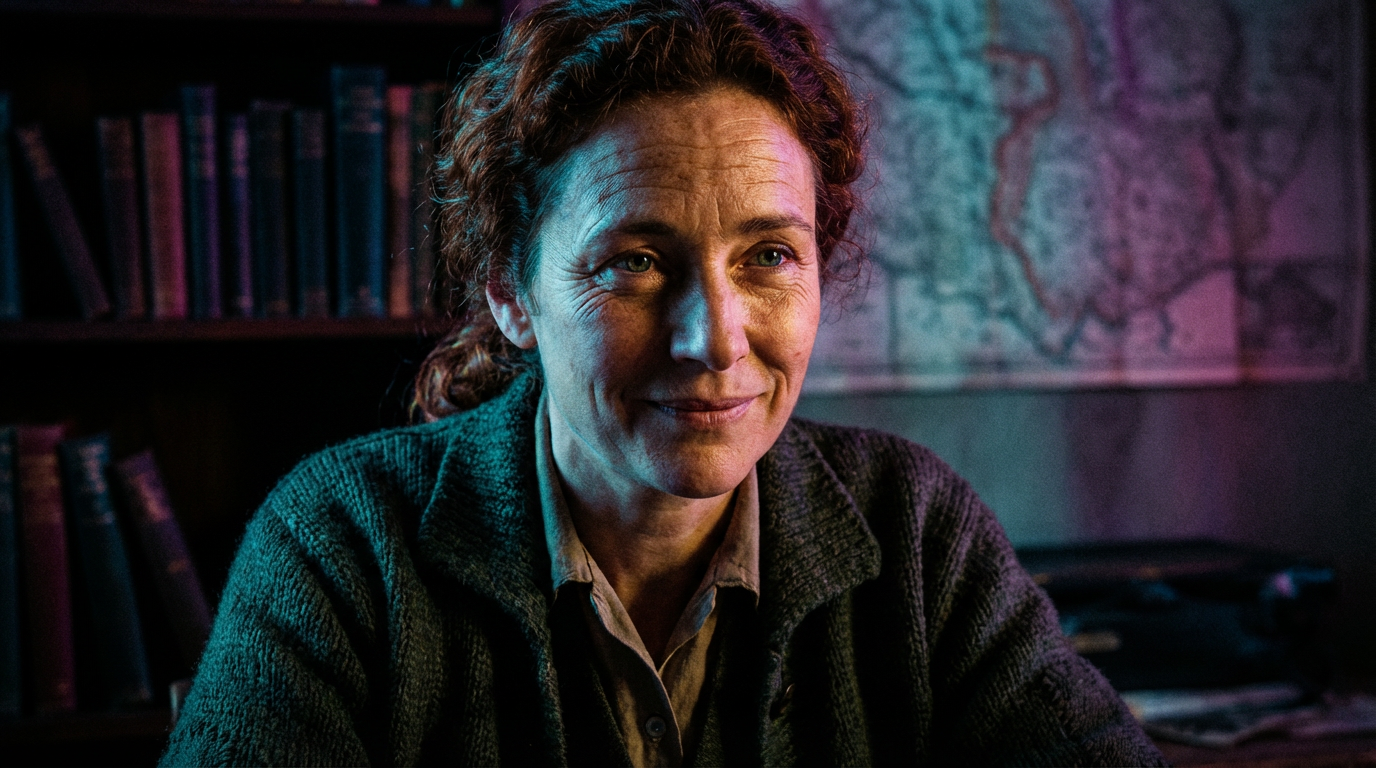
Birth and Early Tragedy
Margaret Florence Lawson was born on 19 April 1938 at Broken Hill District Hospital, entering a world already shaped by absence and mystery. Her father, Henry "Harry" Lawson, had disappeared three months earlier under circumstances that would haunt her mother for decades and seed in Margaret a lifelong fascination with the unexplained.
Harry Lawson had been a miner at the South Broken Hill operations—a hardworking man known for his superstitious nature and his willingness to speak of things other miners preferred to leave unmentioned. He told stories of shadows moving in tunnels where no one stood, of whispers carried on currents of stale air, of a wrongness that sometimes settled over certain sections of the underground. His colleagues dismissed such talk as fancy, the imaginings of a man who read too many penny dreadfuls, but Harry insisted he was merely describing what he observed.
In October 1937, when Alice was six months pregnant, Harry was among several workers trapped underground following a cave-in at Level 8. The rescue took two days, during which families gathered at the mine entrance in agonised vigil. Harry emerged alive but altered—his eyes carrying something his wife couldn't name, his sleep troubled by dreams he refused to describe. He became withdrawn, spending hours staring at nothing, starting at sounds only he could hear.
On 15 January 1938, Harry left for his shift and never returned. His tools were found at his workstation; his lamp hung on its hook; his colleagues reported nothing unusual about the morning. He simply vanished, as if the earth itself had reclaimed him. The company conducted searches, police made inquiries, and eventually the matter was closed with the official notation that Henry Lawson had abandoned his post and presumably his family.
Alice knew better. Whatever Harry had encountered in those two days underground had followed him out, and eventually it had finished what it started. She never spoke of him again, at least not to Margaret, though sometimes in her later years she would pause mid-sentence, her gaze fixed on something distant, and Margaret would understand that her mother was remembering the man whose absence had defined both their lives.
A Mother's Legacy
Alice Lawson raised her daughter alone in a small cottage on Beryl Street, supporting them through her work as a healer, midwife, and keeper of folk traditions. She was a formidable woman—proud, independent, and possessed of knowledge that the respectable citizens of Broken Hill consulted despite their public scepticism. When doctors failed and prayers proved insufficient, people came to Alice with their ailments and their fears, and more often than not they left with remedies that worked.
Margaret's earliest memories were woven through with the textures of her mother's world: the smell of drying herbs hanging from kitchen rafters; the soft murmur of women sharing troubles over cups of tea; the shelves lined with bottles and jars containing preparations whose purposes Alice explained with patient thoroughness. She learned to identify plants by their leaves and roots, to understand which remedies addressed which complaints, and to recognise that healing encompassed more than the merely physical.
Alice was also a collector of stories. She gathered accounts of strange occurrences the way other women gathered recipes—disappearances that defied explanation, sightings of figures that shouldn't exist, patterns of tragedy that repeated across generations. Her notebooks filled with meticulous records of these testimonies, cross-referenced and annotated, forming an unofficial archive of Broken Hill's supernatural history. Margaret grew up hearing these stories as bedtime tales, absorbing them so thoroughly that the boundary between documented fact and whispered legend became permanently blurred.
"The past doesn't vanish," Alice would say, turning pages filled with her careful handwriting. "It lingers. In places, in people, in the stories we tell. Our job is to listen, to remember, and to pass it forward."
Margaret understood, even as a child, that she was being trained for something. Her mother was preparing her to carry knowledge that might otherwise be lost—traditions too old for books, observations too strange for official record, truths too uncomfortable for polite acknowledgment. It was a responsibility Margaret would embrace throughout her life.
A Stepfather's Steadiness
In 1942, when Margaret was four years old, Alice married John William Mitchell, a railway worker and returned serviceman who offered the stability their small household had lacked. John was a cousin of the mining Mitchell family—related to Jack Mitchell, whose son Richard would one day become Margaret's husband—though the connection was distant enough that the eventual marriage raised no concerns about consanguinity.
John Mitchell was a practical man, grounded in the tangible world of schedules and maintenance and mechanical operation. He had served in the Middle East during the early years of the war, returning with a limp from shrapnel damage and a quiet disposition that suggested experiences he preferred not to discuss. He treated Margaret as his own from the first day, providing the paternal presence she had never known while respecting the bond between mother and daughter that preceded his arrival.
The household he joined was unlike anything in his experience. Alice's remedies and folk beliefs initially puzzled him, but he adapted with the pragmatism that defined his character. If his wife wished to dry strange plants in the kitchen and keep notebooks filled with tales of ghostly encounters, he saw no reason to object. Margaret watched him navigate this unfamiliar territory with careful respect, never dismissing what he couldn't understand, never pretending to believe what he couldn't accept.
"Your stepfather grounds us," Alice explained when Margaret was old enough to appreciate the observation. "Without him, we might float away entirely."
John's influence balanced Alice's mysticism with structure and routine. Margaret learned from him the value of consistency, of showing up and doing the work regardless of how one felt about it, of maintaining the machinery of daily life so that other pursuits became possible. When he died in 1956—a heart attack at the signal box where he had worked for fourteen years—Margaret mourned him as the father he had chosen to become, the steady presence who had given her childhood its stability.
Education and Emerging Gifts
Margaret attended Broken Hill Public School and later Broken Hill High School, where her talents for literature and history quickly distinguished her from her peers. She possessed an unusual gift for narrative—the ability to transform dry facts into vivid stories that seemed to breathe with life. Her essays blurred the boundaries between documented events and imaginative reconstruction, earning both praise for their creativity and occasional concern about their factual liberties.
"History isn't just what happened," she wrote in one secondary school assignment that her teacher preserved as an example of exceptional student work. "It's how what happened continues to affect us. The past lives in the present, if we know how to look for it."
She was drawn particularly to local history—the stories of Broken Hill's founding, its growth into a mining powerhouse, and the countless smaller narratives that official records ignored. She interviewed elderly residents for school projects, recording their memories of events that predated her birth, and began compiling her own notebooks in conscious imitation of her mother's practice. The unexplained interested her especially: disappearances without resolution, tragedies that seemed to repeat, places that acquired reputations for strangeness across generations.
Her classmates regarded her with a mixture of admiration and wariness. Margaret Lawson was brilliant, everyone agreed, but there was something unsettling about her fascination with darkness. She was too interested in the morbid, too willing to discuss things that decent people preferred to leave unmentioned. She made friends carefully, choosing those who shared her curiosity or at least tolerated it, and learned early that her interests would always set her somewhat apart.
After completing her secondary education in 1955, Margaret enrolled at Adelaide Teachers' College, where she trained in primary education with specialisations in literature and history. The program emphasised progressive pedagogical methods—learning through engagement rather than rote memorisation, teaching as facilitation rather than dictation—and Margaret absorbed these principles enthusiastically. She began developing the storytelling techniques that would later make her beloved among generations of students: the dramatic pauses, the questions that provoked curiosity, the way she transformed historical figures into characters as vivid as any in fiction.
Return to Broken Hill
Margaret returned to Broken Hill in 1959, accepting a teaching position at Burke Ward Primary School that would mark the beginning of a career spanning three decades. She was twenty-one years old, equipped with modern training and ancient knowledge, eager to share both with the children who would pass through her classroom.
Her teaching style was unconventional from the start. Where other teachers relied on textbooks and worksheets, Margaret told stories. History became adventure; geography became exploration; even mathematics took on narrative dimensions when she framed problems as puzzles requiring solution. Her students remembered lessons that had occurred forty years earlier, so vivid was her capacity to make the abstract concrete and the distant immediate.
She also continued her mother's work of collecting and preserving local lore. She visited elderly residents on weekends, recording their memories before time claimed them. She researched archives at the Broken Hill Historical Society, tracking patterns of occurrence that official history overlooked. Her notebooks multiplied, filling shelves in the spare room of her mother's cottage, each volume carefully indexed and cross-referenced with others in a system only she fully understood.
Alice watched her daughter's dedication with quiet satisfaction. The traditions were being carried forward; the knowledge would not be lost. When Alice's own health began to decline in the late 1970s, she knew that everything she had gathered and preserved would continue in Margaret's capable hands.
Marriage to Richard Mitchell
Margaret met Richard Mitchell at a community dance in August 1956, the same month his father Jack died. Their first conversation was brief—a few words exchanged near the refreshment table, nothing memorable to either party—but something in the encounter lodged itself in Margaret's consciousness. She found herself thinking about the serious young miner with the grief-shadowed eyes, wondering what stories he carried that he would never tell.
Their courtship developed slowly over the following eighteen months, constrained by Richard's mourning and Margaret's teacher training in Adelaide. They exchanged letters during her absence—his brief and practical, hers longer and more reflective—and saw each other during holiday visits that gradually became the purpose of her returns rather than incidental to them. Richard proposed in February 1958, and they married at St Peter's Anglican Church on 12 April of that year.
From the beginning, their marriage was a union of opposites. Richard's world was built on tangible realities: ore to be extracted, machinery to be maintained, problems to be solved through effort and expertise. Margaret's world encompassed dimensions he couldn't perceive and didn't wish to examine. He dismissed her interest in folklore as harmless eccentricity; she accepted his scepticism as the natural limitation of a mind constructed differently from her own.
"We complement each other," she explained to friends who questioned how such different people could sustain a marriage. "Richard keeps me grounded. I remind him that not everything important can be weighed and measured."
The arrangement worked because neither demanded the other change. Richard didn't require Margaret to abandon her notebooks and her stories; Margaret didn't expect Richard to suddenly perceive the unseen currents she navigated daily. They occupied a shared life while maintaining separate interior worlds, connected by affection and commitment rather than complete understanding.
Motherhood
William arrived in 1960, Sarah in 1963, and Ethan in 1968—three children born across eight years, each reflecting different combinations of their parents' qualities. Margaret approached motherhood with the same narrative sensibility she brought to teaching, treating childhood as a story unfolding rather than a project to be managed.
Bill, the eldest, gravitated toward his father's world from earliest childhood. He loved machinery and mathematics, displaying the practical intelligence that would eventually make him a mining engineer. Margaret recognised that her eldest son would never share her fascination with the unseen, and she loved him no less for it. Every family needed its anchors, its connections to the solid earth; Bill would be theirs.
Sarah occupied the middle ground between her parents' perspectives. She inherited Margaret's empathy and Richard's practicality, eventually channeling both into nursing—a profession that healed bodies while attending to the spirits that inhabited them. Margaret saw in Sarah the capacity to bridge worlds that she and Richard could never quite connect, and took quiet pride in watching her daughter become the family's emotional translator.
Ethan was different from the moment of his birth. Margaret sensed it immediately—something in the way his newborn eyes seemed to focus on things beyond the visible, the way his infant cries sometimes responded to presences only he perceived. She recognised the signs because her mother had described them: the old knowing, the sensitivity to unseen forces that appeared occasionally in certain bloodlines. Ethan had inherited not Richard's pragmatism or even Margaret's trained perception, but something rawer and more powerful—a direct connection to dimensions most people never glimpsed.
She nurtured this gift carefully, shielding it from Richard's dismissal while providing Ethan with the frameworks he would need to understand and control what he experienced. She shared her notebooks with him, introduced him to the lore she had gathered, and answered his questions with honesty rather than reassurance. When he began hearing voices after his great-aunt Alice Mitchell's death in 1981—the paternal aunt who had recognised his potential years earlier—Margaret was the one who helped him understand what was happening.
"It's not madness," she told him, holding his shaking hands while Richard insisted on doctors and diagnoses. "It's awakening. Alice knew you had this. She prepared you for it, in her way. Now you need to learn to live with it."
The Tragedy of Violet Dallow
Margaret learned of her son's secret relationship with Violet Dallow only after the girl's murder in October 1988. The revelation came through police questioning—officers investigating the Silverton Strangler's latest victim discovered that Ethan had been conducting a clandestine romance with the sixteen-year-old, meeting her in cemeteries at night, sharing his supernatural investigations with a girl six years his junior.
Richard was appalled by the inappropriateness; Margaret was heartbroken by the tragedy. She had never met Violet Dallow, yet she mourned the girl with genuine grief—not only for the life cut short but for what her death would do to Ethan. She had seen her son's capacity for isolation, his difficulty connecting with others who couldn't share his perception of reality. Violet had apparently bridged that gap, and now she was gone.
The weeks following Violet's murder were the darkest Margaret had witnessed in her own home. Ethan stopped eating, stopped sleeping, stopped responding to the family's concern. He spent hours at the cemetery, waiting for Violet's voice to join the chorus of dead he could hear. He was questioned by police and cleared of involvement, but the shadow of suspicion lingered in some quarters, adding public shame to private devastation.
Margaret sat with her son during those terrible weeks, not speaking—what words could reach grief of that magnitude?—but present, bearing witness, refusing to let him disappear entirely into the world of spirits he increasingly preferred. She understood that he would never fully recover from this loss. Some wounds don't heal; they merely become part of who you are.
The Teaching Years
Throughout her children's growth and the dramas of family life, Margaret continued teaching—three decades of shaping young minds, preserving old stories, and transforming Broken Hill's history into living narrative. Her classroom became legendary among former students, a place where the past seemed to breathe and ancestors became as vivid as present company.
She retired from formal teaching in 1992, at the age of fifty-four, but continued mentoring students and advising researchers for years afterward. The Broken Hill Historical Society consulted her on matters of local folklore; university students writing theses on outback communities sought her expertise; documentary filmmakers recording the region's oral traditions found in Margaret a treasure trove of material.
Her notebooks, by this time, filled an entire room—decades of collected testimonies, annotated observations, cross-referenced patterns of occurrence and recurrence. She had never published any of this material, viewing herself as curator rather than author, but she began the slow work of organising it for eventual transmission. Ethan would inherit this archive, she knew, and he would understand its value better than anyone else could.
Widowhood
Richard's death on 27 October 2002 ended a marriage of forty-four years—a partnership that had somehow worked despite its fundamental contradictions. Margaret stood at his hospital bedside with Sarah, watching the man who had been her anchor take his final laboured breaths, and felt the ground shift beneath her in ways both expected and surprising.
She had known this was coming. Richard's lungs had been failing for years, the accumulated damage of decades in the mines finally claiming its due. But knowing didn't prepare her for the emptiness that followed—the silence where his presence had been, the absence of his sceptical commentary on her latest folkloric discovery, the loss of the one person who had witnessed her entire adult life.
The funeral was simple, as Richard would have wanted. Bill delivered a eulogy that captured his father's public qualities—the work ethic, the dedication to safety, the professional respect he had earned—while leaving the private complexities unmentioned. Ethan stood at the back of the church, his relationship with Richard unresolved and now unresolvable. Margaret noticed, and grieved anew for the reconciliation that would never occur.
After Richard's death, she turned with renewed intensity to her life's work. The notebooks demanded organisation; the stories required preservation; the traditions needed transmission before her own time ended. She spent her widowed years completing tasks that had been deferred while marriage demanded its share of her attention, preparing the archive that would continue after she was gone.
Final Years
Margaret's health declined gradually through the early 2010s. Heart disease, diagnosed in 2011, progressively limited her activities while leaving her mind sharp and her determination intact. She continued receiving visitors, continued advising researchers, continued adding to notebooks that had become her life's testament.
Ethan visited more frequently during these years, their bond deepening as her condition worsened. They spent hours together reviewing her collected material, Margaret explaining connections and patterns that might not be obvious to anyone else, Ethan recording her insights for future reference. She was preparing him, as Alice had once prepared her, to carry forward knowledge that might otherwise be lost.
"You're the one who will understand all of this," she told him during one of their final conversations. "Bill thinks I was eccentric; Sarah thinks I was imaginative. But you know what I was actually doing. You know it's real."
Ethan did know. He had spent his life navigating the same territories his mother had mapped, hearing the same whispers she had documented, perceiving the same patterns she had traced across generations. Her archive would become his foundation, the collected wisdom of a woman who had devoted her existence to preserving what most people preferred to forget.
Death and Legacy
Margaret Florence Mitchell died on 8 August 2015, at the age of seventy-seven, with her children gathered around her hospital bed. Her passing was peaceful—a gradual dimming rather than sudden extinction, consciousness retreating slowly until only silence remained. Sarah, whose nursing experience had prepared her for this moment, confirmed what the monitors already showed. Their mother was gone.
The funeral was held at St Peter's Anglican Church—the same sanctuary where Margaret had married Richard fifty-seven years earlier, where she had attended countless services throughout her life, where the community gathered to mark its passages. Former students filled the pews alongside family and friends, many of them now in their fifties and sixties, remembering a teacher who had made history live.
Ethan delivered no eulogy. He stood quietly at the graveside as Margaret was lowered into the earth beside Richard, reunited in death with the husband whose worldview she had never shared but whose presence she had never stopped valuing. His grief was too deep for public words, too bound up with everything his mother had represented—the validation of his gifts, the framework for understanding them, the proof that he was not alone in perceiving what others couldn't see.
Her headstone bore an inscription she had chosen years earlier, during a conversation about mortality that had seemed abstract then and felt prophetic now:
"The past is never truly gone; it lingers in stories, waiting to be told again."
The words captured something essential about the woman buried beneath them. Margaret Mitchell had spent her life proving their truth—gathering the lingering past, shaping it into stories, ensuring it would continue to be told. Her notebooks passed to Ethan, who received them as the inheritance they were: not merely paper and ink, but decades of accumulated wisdom, a map of invisible territories, a guide for navigating the spaces between the seen and unseen.
She who had given voice to Broken Hill's ghosts now joined them, another presence in the places where memory endures. Perhaps Ethan heard her, in the quiet moments when the veil grew thin. Perhaps her voice joined the chorus of dead whose whispers he had been hearing since childhood. If so, she would be telling stories still—because the past never truly ends, and neither do those who dedicate themselves to remembering it.







