Margaret Fiona Jennings (née Sullivan)
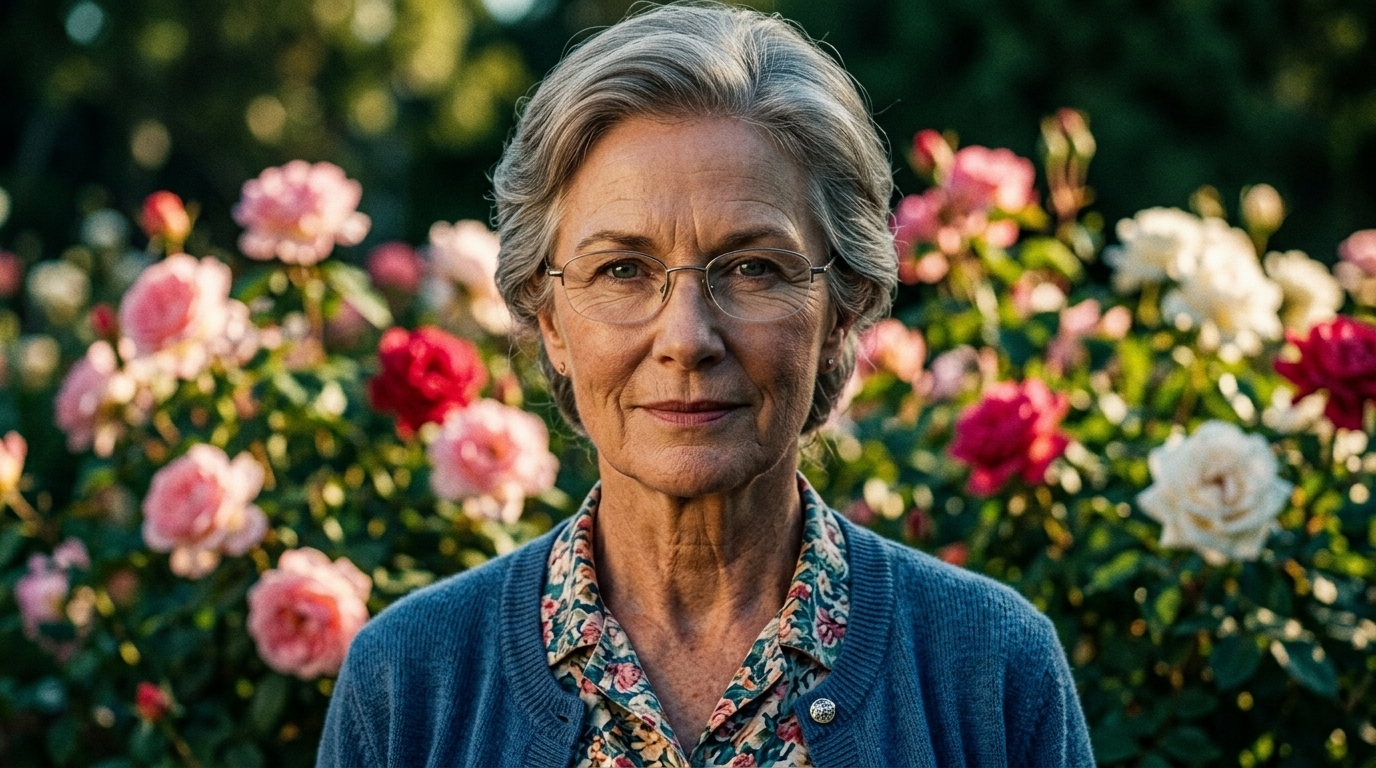
Margaret Fiona Jennings (1923–2012), née Sullivan, was a Gawler schoolmaster's daughter whose quick, bookish mind found little room in the life she chose. In 1943 she married the farmer Edward Jennings and spent half a century running the Jennings Family Farm household, raising three children, teaching the district's women, and growing prize roses. She outlived her husband, her eldest son Brian, and her daughter-in-law, dying at eighty-nine after fifteen years of widowhood.
The Schoolmaster's Daughter
Margaret Fiona Sullivan was born on 17 March 1923 in Adelaide, the second of the three children of Albert Sullivan, a schoolteacher, and his wife Florence Sullivan, née McCreedy. Albert had taken his first posting in the city, and it was there that Margaret arrived, between her elder sister Vera and her younger brother Colin. But the family did not stay in Adelaide long. While Margaret was still small, Albert was transferred north to a school in Gawler, the planned town at the meeting of the South and North Para rivers some forty kilometres from the capital, and it was Gawler that became the true landscape of her childhood.
She grew up, then, as the schoolmaster's daughter in a country town — a particular and not always comfortable position. Her father was a fixture of local life, known to every family whose children passed through his classroom, and Margaret bore the small daily scrutiny of being his. The Sullivans were not wealthy. A teacher's salary stretched only so far across three children in the Depression years, and Florence ran the household with the careful economy of a woman who turned collars, kept a vegetable patch, and wasted nothing. But the house was full of books, and that was the inheritance that came to matter most.
From Albert she absorbed a reverence for learning that ran deeper than anything the town around her seemed to value. She read early and voraciously — Austen first, then the Romantic poets, Wordsworth above all, whose long looking at hills and weather spoke to something in a girl surrounded by paddocks. At the Gawler school and beyond it she was plainly the cleverest child in most rooms she entered: quick-tongued, impatient, and already half-aware that the cleverness might prove more burden than gift in a place with so little use for it.
Her sister Vera, three years the elder, was the prettier and the more biddable of the two and married young; her brother Colin, born after the family reached Gawler, was the baby and the favourite, a sunny, uncomplicated boy who enlisted the moment the war would have him and came home from the islands quieter than he went. Margaret loved them both and was, in the way of clever middle children, always a little apart — the watchful one, the reader, the one who noticed things and said them.
Family Tree
A Mind With Nowhere to Put It
What Margaret wanted, for as long as she could remember wanting anything, was to teach as her father taught — or, in her more private and less respectable ambition, to write. She finished her schooling with marks that in another decade, or another body, might have carried her to a university or a teachers' college in the city. She had the intellect for it, and in Albert she had a father who believed in it.
But she came of age into the narrow channel the times kept for clever girls. Money was tight, the places were few, and the Second World War arrived precisely as the question of her future turned urgent, closing doors that had only ever stood ajar. She did a little casual teaching as a pupil-assistant at her father's school and some clerical work in the town, and she filled the gap between her abilities and her opportunities the way she would fill it for the rest of her life — privately, in notebooks, in poems and fragments of stories she showed almost no one.
A restlessness ran through her in those years that never entirely left her. She was a young woman with a first-rate mind in a town and a decade that had already decided what a young woman's mind was for, and some hard, watchful part of her never quite forgave the arrangement.
Edward
She met Edward Charles Jennings in 1941, at a wartime fundraising social held in the hall of St Peter's Anglican Church in Gawler. She was eighteen; he was twenty-three, a grave, big-handed young farmer from a property out past the edge of town, kept off the battlefields and on the land by the manpower regulations and an ailing father. They were, on the face of it, an unlikely pairing — the quick-tongued, bookish schoolmaster's daughter and the silent man who measured his words like seed.
And yet she found in his steadiness something she had not known she was looking for. Edward did not match her cleverness and never pretended to; what he offered instead was a bedrock constancy, a seriousness about work and land and duty that she recognised, obscurely, as a kind of integrity. He, for his part, was plainly daunted and plainly smitten. Their courtship moved slowly through the war years, decorous and a little grave, conducted against a background of rationing and absent men and casualty lists in the paper.
They were married on 17 April 1943, a clear autumn Saturday, at St Peter's — the same church in whose hall they had met. Margaret was twenty. She left the book-lined certainties of her father's house and went out to the Jennings Family Farm to become a farmer's wife: a life for which nothing in her bookish girlhood had prepared her, and which she had chosen with her eyes open.
Two Margaret Jenningses
The farmhouse Margaret came to in 1943 was not yet hers. It was ruled by her mother-in-law — the elder Margaret Jennings, widow of the founder, a stern and frugal pioneer who had helped carve the property from the scrub and had buried her husband only a few years before. For fifteen years the two women shared a name, a kitchen, and a settled, low-grade contest over how a household ought to be run.
The elder Margaret distrusted the young one's books and her town manners and her notions; the younger found the old woman's flinty thrift and her certainties hard going. They were never enemies, exactly — there was respect in it, and Margaret learnt a great deal of practical farm-craft from her mother-in-law that no school had ever taught her — but the house held two mistresses uneasily, and Margaret spent the first half of her marriage as something close to a guest in the home she was meant to be making. Only when the elder Margaret Jennings died in 1958 did the younger become, at last and unambiguously, the woman of the house.
With Edward himself she settled into a marriage that outsiders sometimes struggled to read. They were not demonstrative — he had no gift for it, and she had long since learnt to do without — but there was a deep, functional devotion in the way they carved the world between them: his domain the land, hers the house and the money and the children, each trusting the other to hold up an end. They argued often and sharply, for she had a tongue that could draw blood and he a temper that could fill a room. Beneath the arguing was something neither would have thought to call love and both relied upon entirely.
The Farmhouse She Made Her Own
Once it was hers, Margaret ran it with an intelligence the work had been waiting for. She kept the farm's books with a precision Edward never matched, steering the money through good seasons and ruinous ones, and she brought to the household a sharp, organising mind that turned the rambling old farmhouse into something close to an institution. Brian would remember his mother as the family's quiet administrator — the one who actually knew where the money was.
She refused, too, to let the farm narrow her entirely. Over the years of her marriage she established an informal school for the district's women, gathering them at the farmhouse to teach the practical disciplines that isolation and a tight budget demanded: preserving and bottling, the running of a household economy, the small agricultural skills a farm wife was simply expected to possess and almost never taught. It was teaching of a kind, at last, and she was good at it — brisk, exacting, and generous with what she knew.
Beyond her own gate she became a figure in the district's web of women's institutions: the Country Women's Association branch, the guild at St Peter's, the auxiliary that shadowed Edward's Agricultural Society. She organised and she chaired, she ran the supper rosters and the fundraising stalls, and she brought to committee work the same impatient competence she brought to her books. It was, in its way, the public life her girlhood had been denied — scaled down to the size a country town allowed, but real for all that.
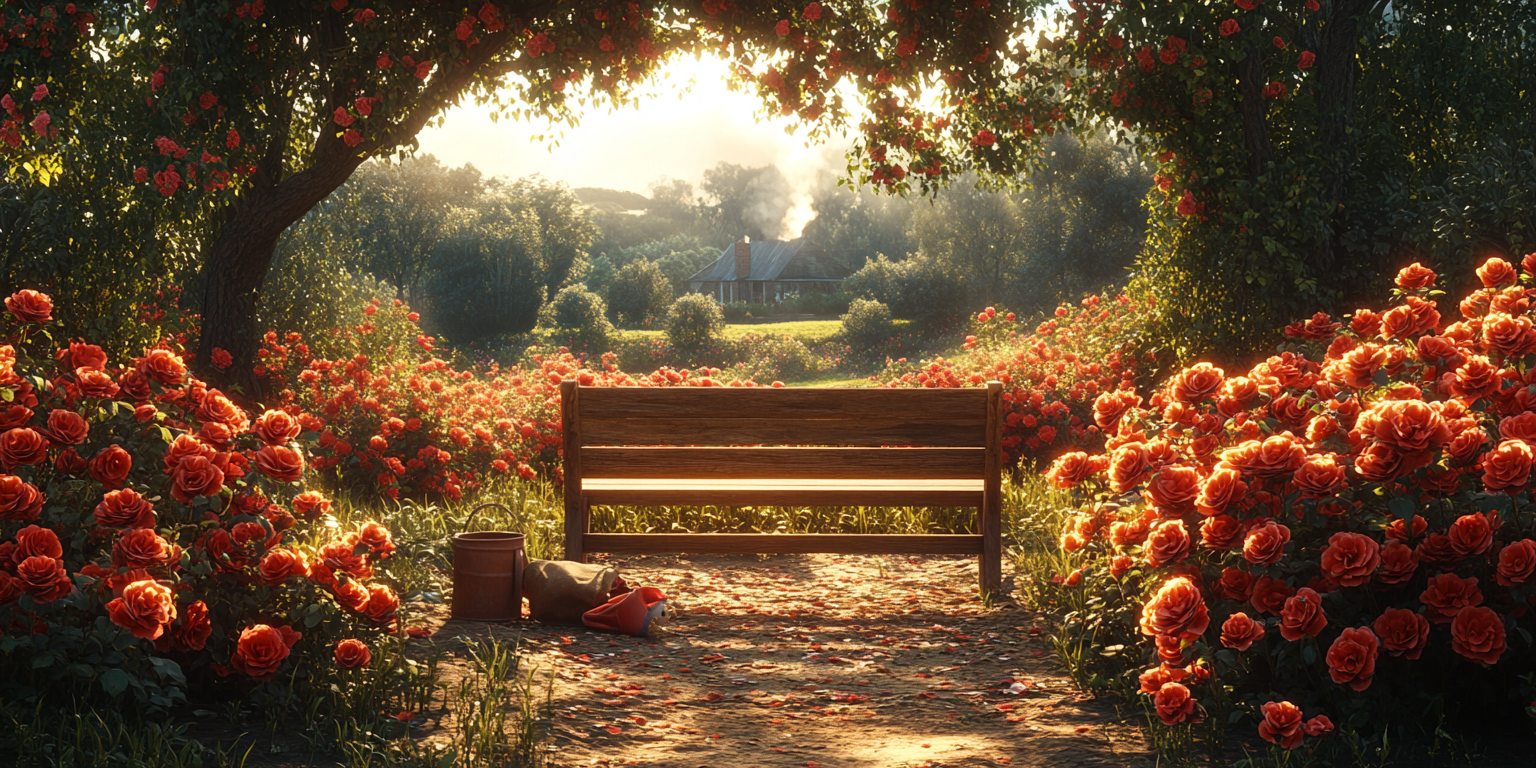
Her great creation, though, was the rose garden. Out of the dry, grudging Gawler ground she coaxed an extravagance of colour that became locally famous, hauling water through droughts to keep it alive and entering her best blooms in the Gawler shows, where they regularly carried off prizes. The roses were her argument against the drabness of the working farm — proof, renewed every spring, that beauty could be made to grow in a place that did not obviously want it.
And in the late hours, when the house was finally quiet, she went on writing. The poems and stories she had begun as a thwarted girl continued through five decades of marriage, filling cheap exercise books she kept to herself and showed, occasionally and grudgingly, only to those she trusted. She never sought publication and would have been mortified by the suggestion. The writing was not for an audience; it was simply where she put the part of herself the farm had no use for — the private life of a mind that had wanted a larger world and had made its peace, mostly, with this one.
Three Children, and the Weight in the Middle
Margaret and Edward had three children. Brian Edward was born on 3 September 1945 at the Gawler and District Hospital; Sarah Louise followed in 1948, and David Charles in 1951. She raised them with the same brisk competence she brought to everything — less openly tender than exacting, but fiercely invested in who they might become.
She was not, if she was honest, evenhanded. She was closest to Sarah, who shared her love of growing things and something of her creative cast of mind, and she found there an easy companionship she never quite managed with her practical, engine-minded eldest son or her easygoing younger one. It was a small, human partiality, and the family knew it, and it cost a little — as such things do — in the quiet arithmetic of who felt most seen.
Her hardest domestic work was the long mediation between her husband and her firstborn. Edward and Brian loved the same land and could agree on almost nothing about its future, and for decades Margaret stood in the gap between them, interpreting, softening, brokering the truces that two undemonstrative men could not negotiate for themselves. She was good at it and she grew weary of it, and there were years when she resented being the household's shock-absorber, expected to translate one stubborn man to another while no one thought to ask what it took out of her.
In time Sarah Louise married and moved to Adelaide, building a life of her own while remaining her mother's closest confidante by letter and telephone; David Charles, never suited to the land, took up a trade and settled away, dutiful and a little distant. Neither stayed on the farm. Margaret, who had chafed at its narrowness herself as a young woman, understood the leaving far better than Edward ever managed to.
The grandchildren, when they came, were her reward. Brian and his wife Patricia gave her seven across the late 1960s, the 1970s and into the 1980s — Cody, Anne, Catherine, Janice, Kenneth, Raymond and Tania — and Sarah and David added more. She watched the brood with a sharper, fonder eye than she had ever quite allowed herself as a young mother, taking particular wonder in Kenneth, whose musical gift carried him off to the Sydney Conservatorium at the age of eight. When Brian built her a rocking chair in his workshop, solid and plain in the way of everything he made, she kept it by the window that looked onto her roses, and she sat in it to read.
Two Funerals in a Single Year
Edward's heart had been failing by degrees since 1993, and on 15 August 1997 it stopped. He died at the farmhouse, aged seventy-nine, with Margaret beside him, ending a marriage of fifty-four years. She had spent more than half a century learning to read a man who could not say what he felt, and his going left a silence in the house that all her words could not fill.
She was still inside that first grief when the second arrived. On 18 November 1997, barely three months after his father, Brian collapsed and died of a heart attack on the farm he had spent his life improving. He was fifty-two. To bury a husband of fifty-four years was the expected sorrow of a long life; to bury her eldest son fourteen weeks later was something else entirely — a wrongness in the order of things that no amount of resilience could make sit right. Margaret stood at the graveside at St Peter's for the second time in a single season, and the district that had filled the church for Edward filled it again for his son.
The Long Outliving
What followed was fifteen years of widowhood and of outliving. Margaret had always been the durable one, and now durability became almost a curse: she went on, and on, while the people around her did not. Leadership of the farm passed, after Brian's death, to her granddaughter Anne — the second of Brian's children, who came back from research work in the Riverina to take up the property and would in time carry the family forward as Anne Elizabeth Evans. Margaret remained at the farmhouse, the matriarch of a place she had first entered as a daughter-in-law more than fifty years before.
The losses did not stop. In September 2002 her daughter-in-law Patricia, Brian's widow, died of cancer at fifty-five, and Margaret — who had watched this educated Adelaide girl give up her own ambitions for the farm two decades earlier, and had recognised in that surrender something of her own — grieved her as she would have grieved a daughter. There was a private ache in it she never fully spoke: a sense of a pattern repeating, of clever women folded one after another into the same demanding ground.
Other sorrows were quieter and harder to name. Cody, the eldest grandchild and the first of the next generation she had welcomed, drifted away from the family after his father's death, growing distant for reasons Margaret could not fathom and was never given. She mourned him as a kind of living absence — one more thing the years took without explanation.
Her final decade was the slow narrowing that great age brings. She kept her roses as long as her hands allowed, and she kept her notebooks, the decades of private poems and stories she would never publish and would not throw away. In her last years she left the farmhouse for a nursing home in Gawler, within sight of the town her father had taught in, and there, on 20 September 2012, she died, aged eighty-nine. She had outlived her husband, her eldest son, her daughter-in-law and most of her own generation, and she was buried at last beside Edward, in the district that had been the whole, constraining, deeply loved geography of her life.







