4331.179 · June 28, 2011 AD
Lucas James White
Lucas James White, born on 28 June 2011 in Brisbane, was the second of three children of Craig White, a carpenter, and Karen White, who worked part-time at the local IGA. A physically exuberant child from Ferny Hills, he attended Brisbane Grammar on a bursary. He was seven when the school bus passed through a Portal into Clivilius, where a compound leg fracture with arterial damage required emergency vascular surgery and left him with a permanent limp. He attended the Learning Grove and Bixbus School, gravitating toward animal husbandry at the Haven of Wilds.
Mud on Every Surface
Lucas James White was born on 28 June 2011 at the Prince Charles Hospital in Chermside, the second child of Craig Anthony White, a self-employed carpenter, and Karen Marie White (née Douglas), who worked part-time at the Ferny Hills IGA. He arrived three years after his brother, Tyler Craig White, born on 9 April 2008, and three years before his sister, Holly Karen White, born on 14 March 2014. The family lived in a fibro-and-timber house on a quarter-acre block in Ferny Hills, in Brisbane's north-western suburbs, where the bush pressed up against the back fence and the D'Aguilar Range sat on the horizon like a promise.
Craig was a broad, sunburnt man who had started his apprenticeship at sixteen and launched his own business at twenty-eight, running a two-man operation that built decks, pergolas, retaining walls, and the kinds of small residential jobs that kept a family fed without ever making it wealthy. He worked six days a week and spent Sundays in the yard or at Samford with the boys, building things, fixing things, and tolerating the kind of destruction that two young sons inflicted on anything within reach. He was a good father in the way of men who express love through shared activity rather than conversation — present, reliable, incapable of discussing an emotion, and utterly bewildered on the rare occasions when his children needed him to.
Karen managed the household with the practical patience of a woman who had grown up the eldest of four in a Housing Commission flat in Zillmere and who considered the fibro house in Ferny Hills, with its leaking gutters and its temperamental hot water system, a significant step up. She was warm, direct, and possessed of a laugh that carried from the kitchen to the back fence. She worked the morning shift at the IGA three days a week — enough to cover the groceries and the electricity, not enough to cover the school fees that had become a point of quiet tension since Lucas started at Grammar.
Tyler was the older brother in every sense that mattered to a younger boy — bigger, faster, braver, and willing to include Lucas in his adventures with the casual authority of a firstborn who considered his younger brother a subordinate but not an inconvenience. The two of them spent weekends building cubby houses from scrap timber Craig left in the yard, riding bikes along the creek path behind the estate, and catching skinks in the garden with a determination that exceeded their skill. Holly was four when the bus left for D'Aguilar, a small, solemn child who followed her brothers' chaos with an expression of bewilderment that Karen found hilarious and which Holly herself did not appreciate.
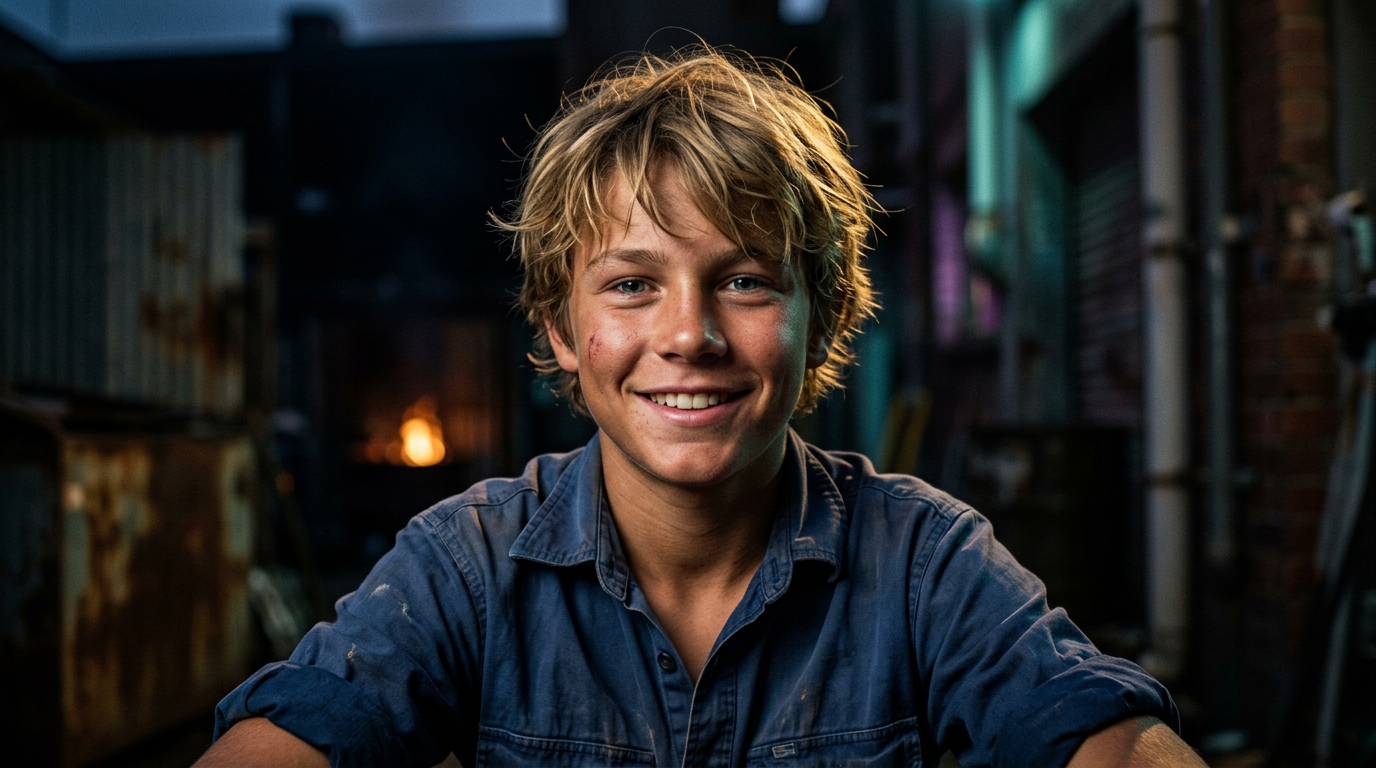
Lucas was, by every account, a child in motion. He was the boy who came home with mud on every surface, who could not sit in a chair without tipping it, who broke his collarbone at five falling out of a tree he had been told not to climb and was back in the same tree within a fortnight of the cast coming off. He was sandy-haired, blue-eyed, perpetually grazed, and possessed of an enthusiasm that adults found either charming or exhausting depending on how much of it they had absorbed in a given day. His energy was not hyperactive — it was directed, physical, purposeful. He wanted to be outside, to be moving, to be doing something with his hands, and the indoor world of classrooms and worksheets felt to him like a punishment for a crime he had not committed.
His enrolment at Brisbane Grammar School was Craig's idea, born from an unlikely source: a client whose son attended the school had mentioned the outdoor education programme and the bursary scheme that made it accessible to families who could not afford the full fees. Craig, who had left school at fifteen and carried no sentimentality about formal education, nonetheless recognised in Lucas a restlessness that the local state school was not equipped to channel. Karen was sceptical — Grammar felt like a world that was not theirs, and the residual fees even after the bursary required sacrifices she catalogued silently and did not complain about aloud. Lucas entered in Year 2, in 2018, and took to the school's outdoor programme with the unselfconscious delight of a child who had been handed exactly what he needed.
He was not a strong academic student. His reading was adequate. His mathematics was below average in a way that his teachers attributed to inattention rather than inability, because Lucas could solve practical problems — how to build a ramp for his bike, how to calculate whether a branch would support his weight — with an intuitive spatial reasoning that did not translate to worksheets. He was popular in the way that physically confident children are popular at seven: the boy everyone wanted on their team at lunchtime, the one who organised the games, the one who was first to volunteer for anything that happened outside.
The Toy Car
The overnight field trip to D'Aguilar National Park departed from Brisbane Grammar School on the morning of Saturday, 4 August 2018. For Lucas, whose family lived fifteen minutes from the park's southern boundary, D'Aguilar was already familiar territory — Craig had taken the boys there for day walks half a dozen times, and Lucas had scrambled up rock faces and waded through creek crossings with the confidence of a child who considered the bush an extension of his backyard. The school trip offered something different: a night under canvas, a campfire, the licence to be in the bush without parental supervision, which at seven felt like a form of freedom so extravagant it was barely believable.
He sat near the back of the bus with a group of older boys who tolerated his presence with the mild amusement that eleven-year-olds reserve for enthusiastic younger children. He had brought a toy car — a red metal Holden ute that Craig had given him from a service station display, small enough to fit in his palm — and he spent the outbound journey rolling it along the windowsill and the back of the seat in front, producing engine noises that he considered realistic and that the boy beside him considered grounds for relocation.
At D'Aguilar, Lucas was in his element. He ran where other children walked. He climbed what other children looked at. He waded into the creek up to his thighs before Susan Clarke called him back, and he spent the campfire evening roasting marshmallows with the methodical intensity of a child who had been taught by his father that anything involving fire deserved proper attention. He slept badly — too excited, too aware of the night sounds around the campsite, too conscious that this was the best thing that had ever happened to him.
The bus departed D'Aguilar on the morning of 5 August for the return to Brisbane. Lucas was seated in the middle section, the red Holden ute in his hand. He had been rolling it along the armrest when the bus passed through a Portal opened across a road in the Brisbane suburbs and collided with vehicles on the far side, in the landscape of Clivilius.
The impact threw Lucas sideways. The toy car flew from his grip. He fell across the aisle and his left leg struck the metal base of a seat with the full force of his momentum. The pain was immediate and absolute — a compound fracture of the left tibia, complicated by a severed arterial branch that began haemorrhaging into the surrounding tissue. He screamed. He was seven years old and he screamed in a way that cut through the noise of the wreck and brought every adult within earshot moving toward him.
Raj Patel reached him first. The bleeding was visible and significant — a dark, rapid spread beneath the skin of his lower leg that Patel recognised as arterial. He applied a tourniquet from the first-aid kit, improvised a splint, and kept Lucas talking while the child's face went the colour of paper. The pain was beyond anything Lucas had a framework for understanding. He had broken his collarbone at five and considered himself experienced in the field of injury. This was a different category. This was the kind of pain that made the world contract to a single point and everything outside that point — the shouting, the wreckage, the sky that was wrong — become irrelevant.
He was extracted from the bus on a spine board through the roof hatch, fifteen to thirty minutes after the collision, when first medical responders from Bixbus reached the scene. The vascular surgery that followed — conducted under field conditions by people whose training and equipment were not designed for the operating theatre they improvised — saved his leg and, in all probability, his life. The arterial damage was repaired. The fracture was stabilised. The risk of compartment syndrome, which the medical team monitored through the days that followed, did not materialise into the worst of its possible outcomes.
But the leg was not the same. It would never be the same. The fracture healed with the resilience of young bone, but the arterial repair left scar tissue that restricted blood flow during sustained exertion, and the muscle damage around the break site produced a weakness that physiotherapy could improve but not eliminate. Lucas, at seven, was too young to understand what this meant in any terms beyond the immediate: it hurt, he could not run properly, and nobody could tell him when it would stop hurting.
The answer, which nobody gave him because he was seven and the adults around him were dealing with catastrophes that made one child's leg seem manageable, was that it would not stop — not entirely, not ever. The pain would become familiar. The limp would become slight. The limitation would become the kind of thing he stopped noticing on good days and could not ignore on bad ones.
The Boy Who Kept Moving
The first months in Bixbus were defined, for Lucas, by immobility. He could not walk without assistance for six weeks after the surgery. He could not walk without pain for four months. He lay on a makeshift bed in the medical area and watched, through the open side of the shelter, the settlement being built around him by people whose bodies worked the way bodies were supposed to work, and the frustration of it — the forced stillness, the dependence, the sheer indignity of being carried to the latrine by adults who had better things to do — produced a fury that he expressed by refusing to cry and a grief that he expressed by not talking about his leg at all.
He talked about everything else. Lucas at seven, even injured, even frightened, even stranded in a dimension he did not understand, was a talker. He talked to the adults who checked on him. He talked to the children who visited. He talked to Raj Patel during the daily wound assessments with a stream-of-consciousness commentary on what he could see from his bed that Patel found simultaneously endearing and relentless. The talking was a shield. It filled the space where silence would have required him to think about things he was not equipped to think about — his parents, his brother, his sister, his home, his leg, and the growing suspicion, which he could not have articulated but which settled into him like a weather change, that the life he had known was not coming back.
He began walking again in October 2018, with a limp that was pronounced at first and gradually diminished to a slight unevenness visible primarily when he was tired or when the weather changed. The Learning Grove had opened by then, and Lucas joined its earliest classes with the enthusiasm of a child who had spent two months on his back and who would have attended a lecture on tax law if it meant being upright and among other people. Jenny Triffett assigned him to a group with other young children, including Mason Clarke, and Lucas threw himself into the school's practical activities with a vigour that his leg did not always support and that his temperament would not allow him to moderate.
He pushed too hard. He always pushed too hard. The Learning Grove's afternoon sessions at partner sites across Bixbus — the Haven of Wilds, the Verdant Nursery, the Orchard of Abundance — were designed to give children hands-on experience in the settlement's working operations, and Lucas wanted all of it. He wanted to carry feed at the animal enclosures. He wanted to dig planting beds at the nursery. He wanted to haul irrigation pipe at the orchard. His leg burned after an hour of sustained activity. He did not mention it. When Emma Thompson noticed him limping badly one afternoon and told him to sit down, he argued with a stubbornness that she found infuriating and that masked, as stubbornness in children often does, a terror of being told he could not do what other children could.
The transition to Bixbus School in late 2019 brought structure that suited Lucas better than he expected. The morning academic programme remained his weakest area — his literacy improved slowly, his numeracy remained below average, and his concentration during desk-based work had not improved since Brisbane. But the afternoon mentorship component, which placed students with community teams based on interest and ability, gave him a formal channel for the physical engagement he craved. He gravitated toward the animal husbandry teams at the Haven of Wilds, where the work was physical but not punishing in the way that construction or surveying would have been on his leg.
He was good with animals. This surprised no one who knew him and surprised Lucas himself, because he had always thought of himself as a builder, a climber, a runner — and animals required a patience and a gentleness that he had not known he possessed. The Haven of Wilds housed a growing collection of fauna, some domesticated, some studied, all requiring daily care that was unglamorous and essential: feeding, mucking out, monitoring health, managing breeding stock. Lucas, who could not sit through a reading comprehension exercise without fidgeting, could spend an entire afternoon in a livestock pen, observing behaviour patterns and adjusting feed ratios with a focus that his academic teachers would not have believed possible.
His social life in Bixbus was, on the surface, uncomplicated. He was well-liked. He had been well-liked since he was seven, and the quality persisted into adolescence — he was friendly, funny in a physical rather than verbal way, generous with his time, and possessed of a warmth that drew people in without apparent effort. He was the teenager who remembered everyone's name, who included the quiet kids without making it obvious, who could defuse a tense moment with a joke that was stupid enough to work. He had a wide circle of acquaintances and no close friends, a distinction that nobody noticed because Lucas made sure they did not.
He did not talk about his leg. He limped — slightly, persistently, more noticeably at the end of a long day — and he did not explain it, and he did not allow it to become a topic of conversation. When younger children asked what was wrong with his leg he said "old war wound" with a grin that closed the subject. When adults suggested he rest or take a lighter assignment he thanked them and did not follow the advice. The leg was a fact of his body, like his sandy hair or his blue eyes, and he treated it with the same absence of comment — not denial, exactly, but a refusal to let it occupy narrative space in his life. He was Lucas. He was fine. He kept moving.
What he did not do was talk about anything that mattered. He did not talk about Brisbane. He did not talk about Craig or Karen or Tyler or Holly. He remembered them — at fifteen, his memories of Earth were clearer than Mason Clarke's, detailed enough to hurt — and the clarity was precisely the problem. He remembered his father's hands, thick and calloused, holding the steering wheel on the way to Samford. He remembered his mother's laugh carrying from the kitchen. He remembered Tyler pushing him off the cubby house roof into a pile of leaves. He remembered Holly's face when she was confused, which was often.
These were not the fading impressions of a child who had been too young to encode them properly. They were sharp and specific, and Lucas kept them sealed behind a sociability so consistent and so cheerful that most people mistook it for emotional health.







