4338.207 · July 26, 2018 AD
Locks and Relics
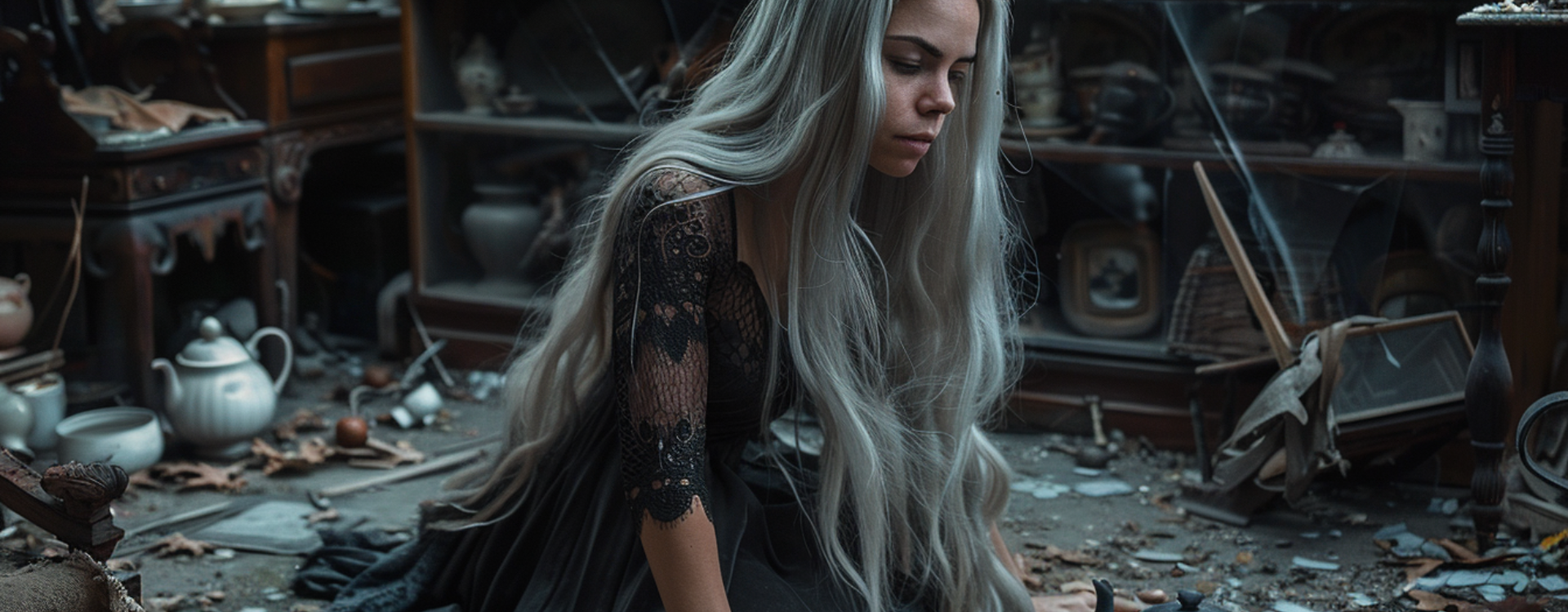
Beatrix returns to the shuttered antique shop she once shared with Brody, dressed in grief and a cursed black gown. In the frozen quiet of early morning, memory collides with reality—and when a new padlock bars her from the past, she’s forced to face what’s truly irretrievable.
"Sometimes the door doesn’t close behind you—it locks from the other side, while you’re still holding the key."
After multiple failed attempts, the black dress remained draped over me, a fabric shroud that seemed to cling tighter with each moment that passed. Its lace sleeves hung limply from my shoulders, partially unfastened, a sad half-measure of escape I couldn’t complete. When I’d finally arrived home after Joel’s farewell, the intention had been clear—burn it, purge it, be done with it. Rid myself of the dress, of its memories, of its curse. But instead of fire, there had been paralysis. I’d stood before the mirror, frozen, the ghost of my reflection staring back at me, gaunt and hollow-eyed.
I had only managed to unlatch the sleeves before collapsing into a storm of sobs. There was no ceremony to it, no catharsis—just raw, unbridled emotion erupting from some forgotten chamber inside me. My body trembled, hands gripping the edge of the basin for balance, as wave after wave of tears spilled freely, the sound of them hitting porcelain lost in the swell of grief. A floodgate opened, one I had long reinforced with silence and routine, now crumbling under the weight of everything I had refused to feel.
The guilt over Brody’s death had never left—it was a constant shadow, always trailing behind me, its edges sharp, its presence relentless. It had woven itself into the rhythm of my days, embedding deep, like grit under skin, until I no longer knew where I ended and the guilt began. And then came the battle with his parents—cold words, courtrooms, unrelenting judgement—each interaction stripping away what little I had left. Their fury, understandable as it was, siphoned away the last reserves of emotional strength I’d clung to. What remained of me afterwards was not strength, but habit. Survival masquerading as normality.
And now, here I was.
Drawn by something inexplicable, pulled like a moth to a flame I’d once called home. Standing barefoot across the road from our long-closed antique shop, its windows dark, its sign weathered by time. The bitumen beneath my feet felt rough, the early morning chill biting at my ankles, but I couldn’t bring myself to move. The pre-dawn silence wrapped around me like a cold embrace, the kind that offers no comfort, only confirmation: you are alone.
The clock had crept to five a.m.—that suspended hour of day when the world still sleeps, when even the city itself seems to hold its breath. No headlights, no footsteps, no birdsong. Just me, shivering in a dress soaked in ghosts, staring at a door that would never open the same way again.
Re-lacing the sleeves of the dress, my fingers moved numbly, stiff with cold and clumsy with fatigue. The fabric clung to my skin, damp with remnants of drizzle and salt from earlier tears, heavier now than cloth had any right to be. I braced against the chill of the dark, frigid morning air, but the physical discomfort barely registered—an afterthought in the storm of emotion swirling inside me. The dress, that cursed relic, clung to my form like an accusation I could neither answer nor deny.
As I stepped off the kerb, my foot sank straight into a shallow, near-frozen puddle, sending a shock of icy water through my already-numb toes. I gasped, the breath sharp and immediate. For a moment, just a moment, the cold jolted me back to myself—away from memory, away from grief. The puddle, slick and glinting faintly under a nearby streetlamp, was the only remnant of the earlier rain. A quiet testament to the world’s indifference—to my loss, to my mourning. Nature dripped and sighed around me, utterly uninterested in sorrow.
The shop loomed ahead. Our shop.
What had once been a beacon of hope, a shared dream painstakingly carved out of second-hand treasures and whispered ambitions, now stood still and silent, like a mausoleum. Each brick seemed heavier than I remembered, the paint on the signage faded, flaking as if shedding its own past. What was once vibrant and full of promise now felt vacant, suspended in time. A monument not just to Brody’s absence, but to my own failure to preserve what we’d built.
The silence of the hour was profound. The occasional distant bark of a dog or the low rumble of an early morning car only accentuated the void here—outside this shuttered doorway, in the hollow where my heart had once hoped. I wasn’t entirely sure why I’d come. Closure? Redemption? Punishment? Perhaps all three. Perhaps none. Perhaps this was simply where I needed to be, in the hush before the sun rose and demanded explanations I couldn’t give.
My pulse pounded, a rhythm that echoed the inner chaos I could no longer tame. As I reached the front door, I pressed my hands to the glass, cupping them in a frame against the cold pane. A fog bloomed beneath my breath—fleeting, pale, ghostlike. I peered in, desperate for some vision of the past: a glint of brass, a familiar reflection, something to convince me it hadn’t all disappeared. But the shop gave nothing back. Just darkness, thick and unyielding, like the grief I couldn’t name aloud.
A sigh escaped me, heavy and involuntary. The kind that pulls itself from the bones, rather than the lungs. I stepped back, letting my hands fall away, leaving faint prints behind—blurred smudges of longing and frost.
The chill had settled into my feet now, crawling slowly upward, a steady reminder of the hour, the wet ground, and the consequences of lingering too long in a place where the past refused to rise.
I turned, slipping down the alley beside the shop, the familiar route that had once been my shortcut to the rear loading door. The passage was narrower than I remembered, the stone wall of the old church pressing in on one side, its surface pockmarked and weathered with age, while the flower shop’s newer brickwork stood clean and flat on the other. The contrast between the two—centuries-old grit versus suburban neatness—felt jarringly apt. One bore the weight of forgotten rituals; the other offered a façade of renewal. Together, they framed my path, the narrow way forward bordered by history and change.
And somewhere in between, I walked—caught between mourning and motion, memory and necessity.
As I reached the back door, a flicker of hope ignited—small but stubborn—and I retrieved the spare key from my purse. Its cool metal pressed against my palm, familiar and comforting, as though the key itself recognised me. It was more than just a tool; it was a relic of what once had been mine. This key, tiny and unassuming, held the weight of secrets and silent acts of mercy. Detective Karl Jenkins had pocketed it during the chaos of that final investigation, choosing not to log it as evidence. His decision—one made in the quiet folds of compassion rather than protocol—had always struck me as oddly intimate. A quiet acknowledgement of grief that no court or chain of command could properly address.
My breath billowed out in thick clouds, curling into the icy air, thinning as it rose. I held the key like it was a talisman, its teeth biting faint impressions into my skin as I approached the door. Each step stirred memories—of quiet mornings arranging brass trinkets, of Brody’s laugh echoing from within. Of life before everything collapsed.
But then I saw it.
The new padlock.
It glinted under the alley’s sparse light, its sheen cruel in its perfection. A stark, impersonal thing, it clung to a thick chain wrapped around the door handles like a noose. My heart sank. The key in my hand became useless, absurd even, like some ceremonial object stripped of power.
Desperation flared.
I reached out and gripped the padlock, yanking it in frustration. It barely budged, the metal biting back with a hollow clank. The chains rattled like bones, loud and jarring against the hush of the early morning. The sound ricocheted down the narrow alley, disturbing nothing and no one but me. I tried again, this time with both hands, as if my effort could somehow bend time or force the past to relent.
But it was no use.
I rested my forehead against the cool wooden door, the old timber firm against my skin. I felt foolish. Not just for coming here, but for hoping—for thinking that a sliver of steel and sentiment could undo the reality that time had hardened.
The padlock was not just a barrier; it was a verdict. A cold declaration that I could no longer turn back. That space, that life, was no longer mine to enter. It belonged to silence now, to memory, to decay.
I stood there, hands still curled around the lock, the cold seeping through my sleeves and settling deep into my bones. The futility of it all—of this night, of my regrets—pressed down until I had to step back or be swallowed by it.
The door wasn’t the only thing shut. So many parts of my life had been sealed off just like this—without warning, without grace.
And so I stood for a moment longer, alone with the echoes and the chains, before finally slipping the key back into my purse. It might never fit another lock, but I wasn’t ready to let it go just yet.







