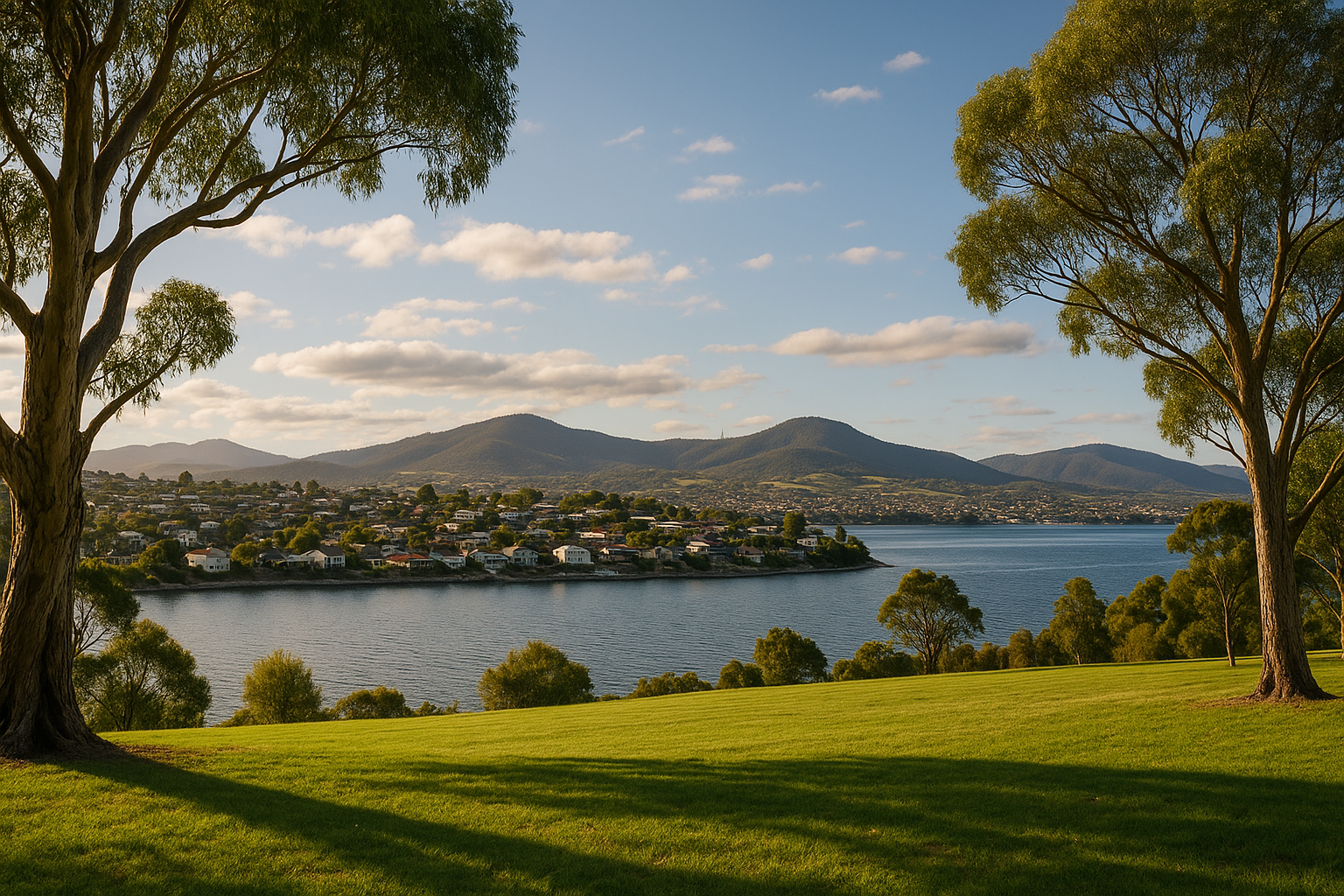
Lindisfarne, Tasmania, Australia
Lindisfarne is a historic eastern shore suburb of Hobart, Tasmania, situated on Muwinina country along the River Derwent. From Captain Hollingbury's 1834 sandstone cottage through post-war suburban expansion, it has embodied quiet resilience—demonstrated most powerfully during the 1975 Tasman Bridge disaster. Home to the enigmatic Vaucluse Nursing Home since 1947, Lindisfarne balances civic respectability with institutional mystery, its character shaped by community service, natural beauty, and secrets that settle gently into memory.
Ancient Shores and First Peoples
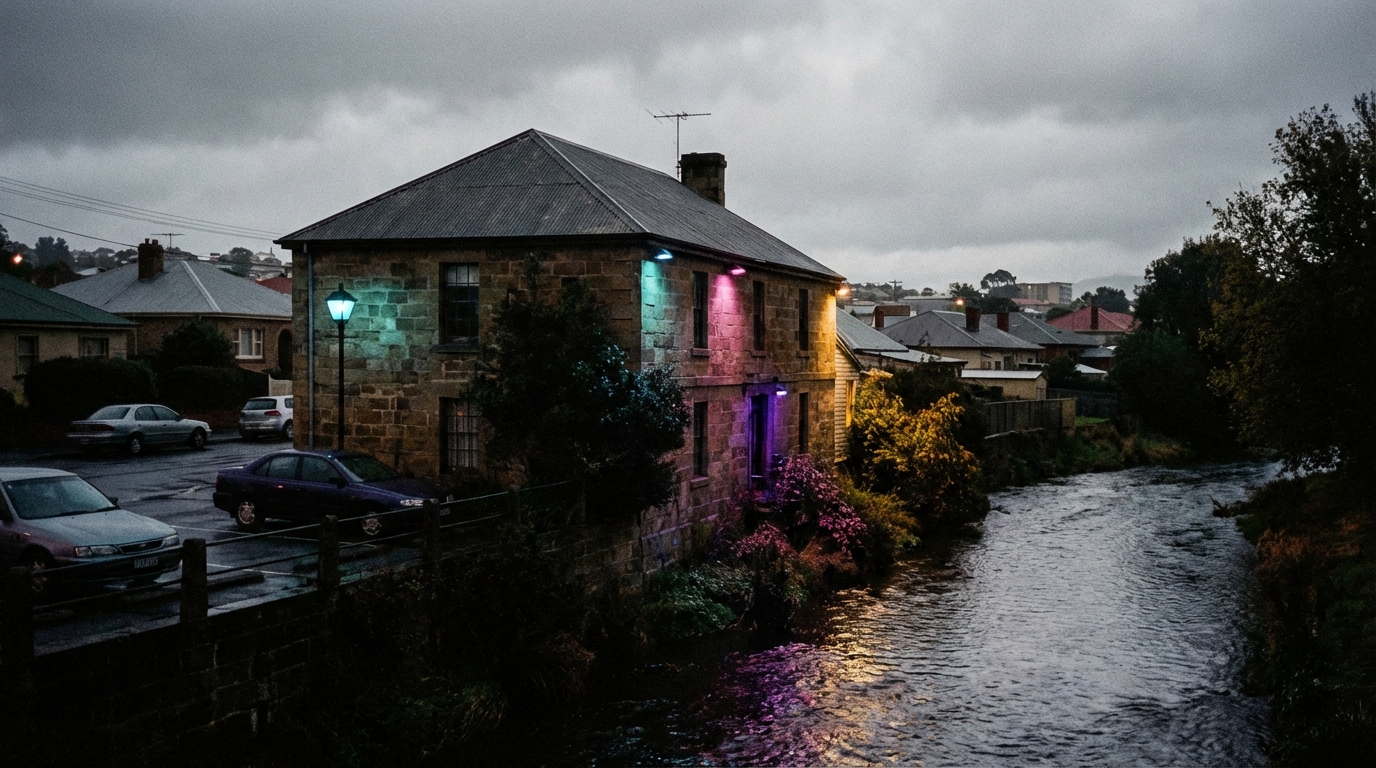
Long before European sails appeared on the horizon, the land that would become Lindisfarne belonged to the Muwinina people, the original custodians of the southeastern Tasmanian coast. For thousands of years, they walked the shores where the River Derwent curves gently past what are now tree-lined suburban streets, gathering shellfish from the rocky foreshores and leaving behind the shell middens that would later puzzle colonial settlers. The Muwinina understood this landscape intimately—its seasonal rhythms, its abundant waters, its sacred sites along the river's edge. Their presence endures in the archaeological traces scattered throughout the eastern shore, silent testimony to a connection with country that predates recorded history by millennia.
The river itself, which the Muwinina had known by names now largely lost to colonial erasure, would later be renamed the Derwent by European explorers. Its waters defined the character of the place: calm, reflective, and possessed of a quiet beauty that has drawn people to its shores across every era of human habitation. The gentle terraces rising from the waterfront, the morning mists that settle in the valleys, the afternoon light playing across the river's surface—these eternal qualities of the landscape would shape the character of the suburb that eventually took root here.
Colonial Settlement and Early Development
European settlement of the eastern shore began in earnest during the 1830s, when land grants drew free settlers seeking pastoral opportunities beyond Hobart Town's expanding boundaries. Among the earliest to establish a permanent presence was Captain William Hollingbury, a retired naval officer who constructed a sandstone cottage on the higher ground in 1834. His modest dwelling, built from locally quarried stone in the Georgian style favoured by the colony's respectable classes, still stands today—a tangible link to the suburb's colonial origins and a reminder that Lindisfarne's history is measured not in decades but in centuries.
The name "Lindisfarne" itself was bestowed by the Reverend Robert Knopwood, the colony's first chaplain, who saw in the eastern shore's tranquil beauty an echo of the Holy Island of Lindisfarne off the Northumbrian coast. Whether the comparison was apt in any spiritual sense, the name carried associations of sanctuary, remoteness, and quiet contemplation that would prove remarkably prescient. The suburb that grew here would indeed become a refuge of sorts—first for colonial settlers seeking respite from Hobart Town's bustle, later for returned servicemen and their families, and eventually for elderly Tasmanians spending their final years in institutions that combined care with discretion.
Throughout the nineteenth century, Lindisfarne remained a sparsely populated agricultural district, its orchards and farms supplying Hobart's markets whilst its waterfront attracted those with means enough to build holiday retreats. The ferry service connecting the eastern shore to the city centre established patterns of commuter travel that would persist for generations, and the rhythms of departure and return became embedded in the community's daily life. Even then, Lindisfarne exhibited the quality that would define it through subsequent eras: a sense of being connected to yet distinct from the larger urban centre, suburban without being merely peripheral.
Post-War Transformation
The Second World War and its aftermath transformed Lindisfarne from a quiet rural retreat into a proper suburb. Returning servicemen, benefiting from government housing schemes and eager to establish families, flooded into the eastern shore during the late 1940s and 1950s. Red brick houses sprouted along newly surveyed streets, their modest designs reflecting both post-war austerity and optimism. Young families planted roses in front gardens, established vegetable patches in back yards, and created the kind of tight-knit community that would become the suburb's enduring character.
It was during this period of rapid growth that Vaucluse Nursing Home opened its doors. Established in 1947 on the grounds of the former Wellesley Estate, the Georgian-styled facility was founded by Alastair Prometheus Blackwood's newly formed Obsidian Healthcare Group. Its stated purpose was to provide care for the war widows and elderly parents of returning soldiers who had discovered, upon their homecoming, that their families needed professional support. The timing was opportune; the need was genuine. Yet from its earliest days, Vaucluse carried whispers of purposes beyond mere eldercare—rumours of wartime connections, of sealed basement rooms, of corporate interests that extended far beyond the compassionate treatment of the aged.
The suburb's first matron, Miss Hilda Bramwell, set a tone that would persist for decades: discipline tempered by devotion, precision balanced by genuine care. A World War I veteran herself, Bramwell understood both the visible and invisible wounds that warfare inflicted, and she approached her charges with the kind of practical compassion that Lindisfarne would come to embody. Under her stewardship, Vaucluse became not merely a facility but an institution—a place where the suburb's values found their most concentrated expression.
A Community Tested: The Tasman Bridge Disaster
On 5 January 1975, the MV Lake Illawarra, a bulk carrier laden with zinc concentrate, collided with the Tasman Bridge, causing two spans to collapse onto the ship's deck. Twelve people died—seven in vehicles that plunged into the river, five crew members aboard the vessel. The bridge, which had opened in 1964 as the vital artery connecting Hobart's eastern and western shores, was severed. For the residents of Lindisfarne and the entire eastern shore, the disaster meant immediate and prolonged isolation from the city that had always been just minutes away.
What followed revealed Lindisfarne's character more clearly than any peacetime circumstance could have done. Within hours of the disaster, residents had organised emergency ferry crossings, coordinating with neighbours to ensure that essential workers could reach their jobs and that supplies could flow to communities suddenly cut off from normal commerce. Families whose homes had space took in those who had been stranded on the wrong side of the river. Local businesses extended credit to customers facing unexpected hardship. The Lindisfarne community, tested by catastrophe, responded with the kind of quiet, practical resilience that required neither fanfare nor recognition.
The bridge would not fully reopen until October 1977, and the period of isolation left lasting marks on the eastern shore's identity. Lindisfarne emerged from the experience with a strengthened sense of self-reliance and community solidarity. The disaster had demonstrated that when the connection to the wider world was severed, the suburb possessed the internal resources—material, social, and spiritual—to endure. This proved to be a defining lesson, one that would shape how Lindisfarne understood itself in the decades that followed.
Institutions and Identity
The civic character of Lindisfarne crystallised during the latter decades of the twentieth century through the establishment and maturation of institutions that gave the community structure and meaning. The Lindisfarne Rowing Club, training its members in dawn practices on the calm waters of the Derwent, produced champions whose discipline reflected the suburb's broader values. The Gardeners' Guild, maintaining the tradition of horticultural excellence that had distinguished the eastern shore since colonial times, connected residents to the soil and seasons in ways that transcended mere hobby. Churches, schools, and community halls provided the infrastructure for a civic life that was active without being ostentatious.
Volunteerism became a distinguishing feature of Lindisfarne's social fabric. The suburb consistently recorded participation rates in community service that exceeded state and national averages—a statistic that surprised no one familiar with the area's character. Whether serving meals at the aged care facilities, maintaining the memorial gardens, or staffing the emergency services that had proven so vital during the bridge disaster, Lindisfarne residents demonstrated a commitment to collective wellbeing that seemed almost instinctive. This was not the volunteerism of grand gestures but of quiet, sustained dedication: the same neighbours showing up week after week, year after year, asking neither recognition nor reward.
The Lindisfarne Mercury, the local publication that chronicled community affairs, became a repository of this civic spirit. Its pages recorded births, deaths, and marriages; reported on council meetings and school fêtes; published letters from residents whose pseudonyms sometimes concealed identities but never obscured the genuine engagement with local concerns. Reading through decades of the Mercury's archives reveals a community that took itself seriously without ever becoming pompous—that understood the importance of local matters whilst maintaining perspective on their place in the larger world.
Vaucluse and the Shadows of Care
No account of Lindisfarne would be complete without extended consideration of Vaucluse Nursing Home, the institution that has stood on the suburb's higher terraces since 1947 and has come to embody both its finest qualities and its most persistent mysteries. The Georgian-styled facility, with its landscaped gardens and River Derwent views, has evolved from a post-war rest home into a comprehensive centre for geriatric and palliative services. Generations of Lindisfarne families have entrusted their elderly members to its care, and generations of staff have dedicated their careers to the compassionate treatment of residents in their final years.
Yet Vaucluse has never been merely what it appeared. Owned and operated by the Obsidian Healthcare Group—a privately held medical conglomerate whose origins remain as murky as its ambitions are vast—the facility has always operated under protocols that exceeded standard aged care requirements. Certain residents have been designated as "Legacy Priority," a classification whose precise meaning has never been publicly explained. Sealed rooms and locked basement doors have attracted speculation that ranges from the plausible to the fantastic. Former employees, bound by confidentiality agreements that survive their departures, have spoken only obliquely of surveillance concerns, unexplained internal transfers, and the sense of working within structures whose full purposes remained hidden.
The 2003 renovation of the Derwent Suite, Vaucluse's specialised dementia ward, intensified rather than resolved these questions. Funding from Obsidian's research arm came with unusually high security during construction and vague disclosures that troubled some observers. Workers reportedly encountered unexpected structural elements during excavation, and at least two contractors departed mid-project without explanation. The resulting facility introduced innovations in dementia care that were praised by families even as they unsettled staff with their clinical precision. Room 7, in particular, became the subject of internal mythology—a space where strange acoustics, voices repeated through walls, and equipment malfunctions seemed to concentrate.
Whether these rumours reflected genuine phenomena or merely the inevitable accumulation of stories within any institution where death is a constant presence, they became part of Lindisfarne's identity. The suburb that prized quiet respectability also harboured, in its most prominent institution, shadows that no amount of landscaped gardens or community integration could fully dispel.
The Summer of 2018
The events of July and August 2018 brought Lindisfarne's tensions—between care and concealment, between community and mystery—into sharp relief. Within the span of a few weeks, the suburb witnessed disappearance, death, and revelations that blurred the boundaries between personal tragedy and institutional crisis.
Jamie Greyson, a young man who worked part-time as an administrative assistant and carer at Vaucluse whilst supporting his uncle Kain Jeffries, vanished from the facility's premises in late July. His disappearance drew Detective Sarah Lahey into an investigation that would prove unexpectedly personal: Lahey's own grandmother, Jane Lahey, was a resident at Vaucluse, receiving palliative care for terminal cancer. The detective's visits to her grandmother became entangled with her professional inquiries, and the boundaries between the roles—granddaughter, investigator, mourner—dissolved in ways that neither she nor the institution could fully manage.
On 31 July, Jane Lahey awakened from nightmares in severe distress, calling out names connected to Killerton Enterprises and triggering an urgent call to her granddaughter. What followed was a cascade of revelations: family secrets that had remained buried for decades, connections between the investigation and the Lahey family that Sarah had never suspected, and the discovery that her prime suspect, Luke Smith, was bound to her by ties of blood she had never known existed. Virginia Collins, Vaucluse's Executive Director, witnessed these events with the helpless compassion of a caregiver confronting circumstances that no amount of professional training could have prepared her for.
Jane Lahey died on 4 August 2018. Robert Gangley, her longtime friend and fellow resident known for his caustic wit and unfiltered complaints, followed three days later. The deaths, whilst officially recorded as natural, left questions that Lindisfarne chose not to pursue too vigorously. The suburb's gift for discretion, for maintaining surfaces whilst acknowledging that depths existed beneath them, served it well during a period when too much scrutiny might have revealed more than anyone wished to know.
Character and Contradictions
What, then, is Lindisfarne? The question admits no simple answer, for the suburb has always been characterised by productive tensions rather than easy resolutions. It is a place where colonial heritage meets contemporary compassion, where post-war optimism established communities that subsequent generations have maintained with quiet dedication. It is a suburb of red brick houses and landscaped gardens, of dawn rowing practices and afternoon tea services, of volunteers who show up reliably and neighbours who check on one another without being asked.
Yet it is also a place where secrets settle gently into institutional memory, where sealed rooms and missing archives whisper of untold stories, and where the difference between care and concealment sometimes blurs into ambiguity. The shell middens left by the Muwinina remind visitors that this land has known human presence for far longer than European settlement, and that the current arrangements—however permanent they may seem—are merely the latest chapter in a story that began millennia ago and will continue long after the present inhabitants have passed.
The River Derwent flows past Lindisfarne as it has always done, indifferent to the dramas that unfold on its shores. The morning mists rise from its surface; the afternoon light plays across its waters; the evening settles into stillness that seems almost sacred. Residents walking along the foreshore paths, tending their gardens, visiting elderly relatives in the institutions that line the higher terraces, participate in rhythms that connect them to all who have walked these same paths before. In this sense, Lindisfarne offers what all true communities offer: the opportunity to belong to something larger than oneself, to contribute to patterns of life that will outlast any individual contribution.
Contemporary Lindisfarne
Lindisfarne remains one of Hobart's most desirable eastern shore suburbs, its property values reflecting the enduring appeal of river views, established gardens, and proximity to both city amenities and natural beauty. Young families continue to move into the area, drawn by the quality of local schools and the sense of community that pervades neighbourhood life. Long-term residents, some of whose families have lived here for generations, maintain the traditions of civic engagement and mutual support that have always distinguished the suburb.
Vaucluse Nursing Home continues to operate under Obsidian Healthcare Group ownership, its waiting list exceeding eighteen months—an indicator of its enduring reputation for quality care despite the murmurs and mysteries that have attached to its history. Under the leadership of Executive Director Virginia Collins, who served from 2012, the facility embraced trauma-informed care, intergenerational programmes, and an honest acknowledgment of its complex past. Collins's approach—neither sanitising history nor allowing it to overshadow the genuine compassion that most staff brought to their work—became a model for how institutions might reckon with ambiguous legacies.
The suburb's cultural life has evolved with changing times whilst maintaining connections to established traditions. The rowing club still trains on the Derwent; the Gardeners' Guild still hosts shows and shares expertise; the churches and community halls still provide spaces for gathering and celebration. New residents, initially attracted by practical considerations, often find themselves drawn into the patterns of volunteerism and civic participation that define Lindisfarne life. The suburb absorbs newcomers not by demanding conformity but by demonstrating, through countless small examples, what it means to belong to a place that takes belonging seriously.

