Lillian Mair Porter (née Hughes)
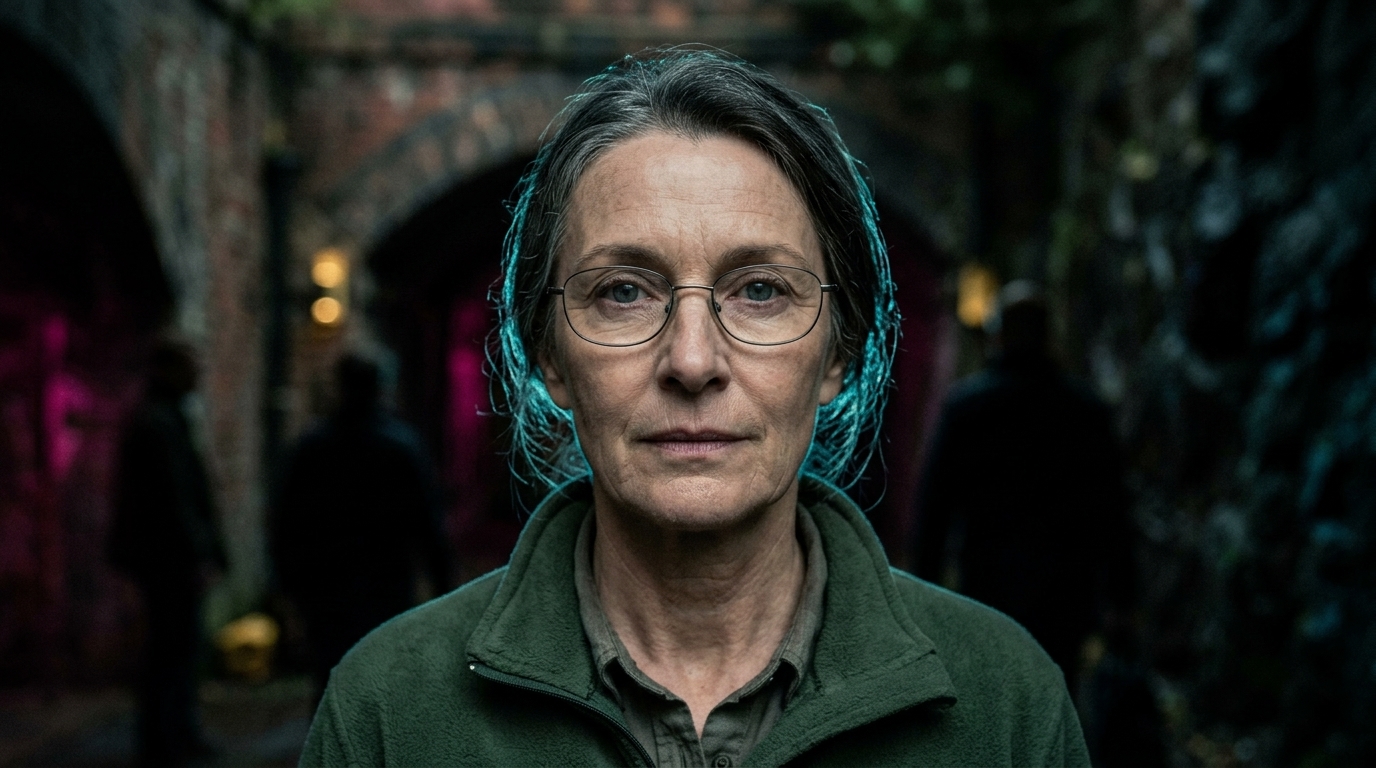
Lillian Mair Porter (née Hughes; b. 7 February 1963, Monmouth) was a hydrologist who spent her career studying the river ecosystems of the West Country and the slow damage done to them by over-abstraction. A vet's daughter raised on the River Wye, she was a formidable, absorbed scientist more at ease with rivers than with people. She married the flood engineer Graham Porter in 1988; their only child, Nathan, vanished into an overseas posting in 2018 and was never heard from again.
A Childhood by the Wye
Lillian Mair Porter, née Hughes, was born on the 7th of February 1963 in Monmouth, in the green border country where Wales loosens into England and the River Wye runs broad and brown beneath wooded hills. She was the middle of three children in a household that was bookish, chapel-shaped and quietly intellectual. Her father, David Hughes, was a country veterinary surgeon whose practice covered the hill farms for miles around; her mother, Eluned Hughes (née Price), had trained as a teacher before the children came and never quite stopped teaching, correcting grammar at the supper table and keeping a house full of books.
Her older brother, Owen, born in 1960, was practical and rooted, the sort of boy who wanted to stay exactly where he was; her younger sister, Carys, born in 1966, was the sociable one, forever surrounded by friends. Lillian sat between them as the watcher, the child who would vanish for whole afternoons down to the river and come back with her socks soaked and her pockets full of stones, able to tell you where the water ran fast and where it stilled and what lived under the bank.
The Wye made her. She grew up on its gravelled shallows and its deep brown pools, learning before she had any word for it that a river is not a line on a map but a living thing — a system of flow and sediment and creature, of salmon runs and kingfishers and the way a flood remade the meadows every few winters. Where other children saw water, Lillian saw a question she wanted to spend her life answering.
She was clever in the precise, undramatic way that does not always announce itself in a classroom. She wore glasses from the age of nine and was happiest behind them, observing; she was not shy so much as economical with herself, content to listen while Carys talked and Owen argued. Her teachers at the comprehensive in Monmouth recognised the quiet seriousness in her and pushed her towards the sciences, and she went willingly, finding in physics and biology the same satisfaction the river gave her — the sense that the world held together according to rules a patient mind could learn.
Family Tree
Aberystwyth, and the Science of Rivers
She was the one who left. In 1981 she went up to the University of Wales at Aberystwyth to read geography, drawn by its strength in the physical science of landscape and by the fact that it sat on the Welsh coast where the rivers she loved finally met the sea. It was the first time she had lived away from the borders, and she took to it with the unflustered competence that would mark the whole of her working life.
At Aberystwyth she found the discipline that gave her childhood a name. Hydrology — the study of how water moves through a catchment, how rivers carry and sort and shape, how a watershed lives and breathes across seasons — answered the question the Wye had put to her at seven. She specialised in river systems and freshwater ecology, and she was good at it, good enough that her tutors noted the rare combination of field instinct and analytical patience in a student who said very little and missed almost nothing.
It was not, in the early 1980s, an easy field for a woman. Hydrology and water science were dominated by men, and Lillian spent her formative years as often as not the only woman on a riverbank or in a seminar room, learning to let her work argue for her because the room would not always listen to her voice. She did not make a banner of it. She simply became undeniable, and after her degree she took a master's in hydrology and went into the water sector with a quiet determination to study rivers for a living and to be taken seriously while she did it.
Reading the Catchments
She built her career in the unglamorous, essential science of Britain's rivers. She began in the scientific division of a regional water authority and, through the upheavals of the industry — the privatisation of 1989, the founding of the National Rivers Authority, and its absorption into the Environment Agency in 1996 — she stayed faithful to the same work: monitoring the ecological health of the West Country's rivers, sampling water quality, modelling how the Severn, the Avon and the Somerset catchments responded to rain and drought and the steady pressure of human demand.
Her particular concern, the one that became something close to a vocation, was abstraction — the quiet over-drawing of water from rivers to supply farms, factories and homes, and the way it left summer rivers gasping, their gravels exposed, their ecosystems thinning year on year. She was a methodical, formidable scientist whose competence was never in doubt, and she spent decades documenting, with patient and accumulating dread, the slow degradation of the very waterways she had loved as a girl. It was the great sorrow of her professional life, watched in data: the rivers were dying by degrees, and most people would not see it until it was very far advanced.
She was happiest in the field, in waders, with a sampling kit and a notebook, where the world made sense and required nothing of her socially. She was less at ease in meetings, where her unwillingness to overstate a finding sometimes read as diffidence, and where her habit of going quiet while she thought was occasionally mistaken for having nothing to say. Those who worked closely with her learned otherwise. She was the colleague whose figures you trusted, whose caution you ignored at your peril, and who would walk a riverbank in the rain for hours sooner than sit through a presentation about it.
The absorption that made her so good at her work was also the defining trait of the rest of her life, and not always a kindness to those around her. Her attention was a real and powerful thing, but it was finite, and she had committed the larger share of it to rivers a long time before anyone else came to ask for it. She lived, much of the time, half submerged in some catchment of her own, surfacing into ordinary life with a faint sense of having been somewhere more interesting.
Two Quiet People
She met Graham Porter in the middle of the 1980s, on a joint project where her hydrology met his flood engineering, and she recognised him almost at once as a particular kind of fellow creature. He was a careful, reticent man who, like her, found people harder than problems and expressed whatever he felt through the quality of his work rather than the warmth of his words. Where she saw the river as a living system to be understood, he saw it as a force to be held in its place, and in the overlap of those two views — the ecologist and the engineer, the one who wanted to let the water be and the one who wanted to keep it back — they found a great deal to talk about and, eventually, a way of being together.
The courtship was conducted, as such things go for two undemonstrative people, over fieldwork and shared lunches and long technical arguments that neither of them wanted to end. Lillian, who had never expected to marry and had rather assumed her life would be lived alongside rivers and not people, found in Graham a companionship that asked nothing of her she could not give. He did not require her to be effusive. He did not mind the silences. He understood, without needing it explained, a woman whose mind was frequently elsewhere, because his own so often was too.
They married in 1988 in a small register-office ceremony, with her brother and sister and a scattering of colleagues, and they built a marriage that more expressive people found baffling and that suited the two of them down to the ground. The warmth between them ran underground, where it could not be seen but could be relied upon entirely. For thirty years and more it held, through every disappointment the world handed them, a partnership of two quiet people who had each found the one other person who did not expect them to be anyone else.
Half Away
Children were not the centre of the plan, in so far as there was a plan. They came to it late and approached it with the cautious practicality they brought to everything, and the road was not entirely smooth. There had been one early loss, a pregnancy in the years before that did not hold; they grieved it in their wordless fashion, privately and without discussion, and did not try to name aloud what it had cost them. They did not speak of trying again. They simply carried on, and in time Lillian found herself, at thirty, expecting the child who would be their only one.
When Nathan James Porter was born on the 9th of April 1993, in a Bristol maternity ward, his mother passed the long hours of her labour adjusting her glasses between contractions and discussing the previous week's rainfall in the Severn basin with the bemused midwife. Her body was entirely present to the work of birth; her mind, as ever, was at least in part somewhere upstream. It was not coldness. It was simply the shape of her attention, which had never learned to give itself wholly to any one thing while a river somewhere needed thinking about.
She loved her son, and she was a gentler presence in his childhood than his father — quicker to soften, slower to correct. But she was, by her own later and unsparing assessment, only ever half there. She would surface fully and gladly when Nathan brought her a question about water, kneeling beside him over a puddle or a stream to explain where it had come from and where it would go, and in those moments she gave him everything she had. The rest of the time she was kind and distracted and elsewhere, and the boy learned, as children do, to take the version of his mother that was on offer.
What she gave him, in the end, was her eye. Long before he chose his own path, she had taught Nathan to look at a river and see a living system rather than a quantity of water — to care whether it was healthy, to notice what it carried and what it had lost. That ecologist's conscience was hers, passed down almost without her noticing across the gravels of a dozen West Country rivers, and it would shape the whole direction of his life. It was, perhaps, the truest thing she ever managed to say to him, and she said it without words, in the only language she fully trusted.
Where the Water Goes
The long arc of her career ended much as it had run, in patient witness to rivers under strain. The winter of 2013 and 2014, when the Somerset Levels flooded and the water stood for weeks across the low country, found Graham and Lillian at the ends of their working lives studying the same disaster through their two old lenses — he seeing a failure of defence and maintenance, she seeing a catchment overwhelmed and an ecology drowned. She eased out of her work not long after, around 2015, retiring quietly from a profession that had been the love of her life and that had left her, after forty years, with the sober knowledge that the rivers were in worse health than when she had begun.
Then, in 2018, her son took a position with a private firm called Killerton Enterprises and went abroad, and was never heard from again. Whatever the work was, it took him somewhere past the reach of any letter or telephone call, and from the day he left there was simply nothing — no word, no message, no return. Lillian, who had spent a lifetime learning that water disappears in one place and surfaces, untraced and unbidden, somewhere far off, reached helplessly for the only comfort her science offered: that a thing gone out of sight is not always a thing gone out of the world. She did not really believe it. She held to it anyway.
She carried the loss differently from Graham, and they carried it together in their wordless way. Where her husband reached for the punishing certainty that his coldness had driven the boy off, Lillian was visited by a subtler, more particular grief — the knowledge that she had given the best of her attention to rivers and only ever the leftovers to her son, and that there would now be no chance to alter the ratio. She had been half away for the whole of his childhood. She had always assumed there would be time, later, to be more present. There was not.
She and Graham grew old together in the same quiet Bristol house, two ageing scientists living alongside a grief that had no shape and no end, and not falling apart, because they were not the sort. In her sixties Lillian went back, more and more, to the rivers — not to study them now but simply to be near them, walking the Avon towpaths and, when she could, the old gravelled reaches of the Wye where her life had started. She would stand and watch the brown water move through the valley as it had moved through every year she had been alive, going somewhere she could not follow, and she would think, against all the evidence she had ever gathered, that water always comes out somewhere in the end. It was not science. It was the nearest thing to hope a hydrologist could carry, and she carried it down to the river most mornings, and let it be enough.







