Liam Thomas Claiborne
Liam Thomas Claiborne carries the weight of inherited contradictions with an ease that belies their burden—the son of a decorated detective and a celebrated artist, navigating adolescence in the shadow of his father's psychological unravelling whilst maintaining the careful equilibrium his mother taught through example. Born into a household where creativity and duty collided daily, he learned early to move between worlds with the same fluid grace that characterises his athletic frame, becoming the family's quiet ballast whilst still discovering who he might become beyond their fractures.
Birth and Early Complications
Liam Thomas Claiborne arrived at 4:23 AM on 3 September 2001 at the Royal Hobart Hospital, two weeks early and breech, forcing an emergency caesarean that transformed what should have been a controlled delivery into crisis. The surgery itself proceeded smoothly until Sandra haemorrhaged post-delivery, requiring multiple transfusions that left her weakened for months. Charlie, racing from a crime scene in Glenorchy through one of Hobart's worst September storms, arrived just as the surgical team wheeled Sandra into theatre, his dress uniform still bearing traces of processed evidence.
The name came without debate—Thomas for Charlie's father, then struggling with advanced emphysema in Melbourne, and Liam from Sandra's Irish grandfather whom she'd never met but whose emigrant story had shaped family mythology. The child emerged silent initially, requiring suctioning before his first cry filled the operating theatre—a sound Charlie would later describe as simultaneously the most terrifying and beautiful thing he'd ever heard.
Those first months tested the marriage's foundations. Liam proved colicky and resistant to any schedule, crying through nights with an intensity that left both parents hollow-eyed and desperate. Charlie, working rotating shifts in the Criminal Investigation Branch, would take the 3 AM feeds, pacing their Battery Point cottage's narrow hallway whilst reading case notes aloud—the monotonous recitation of evidence logs apparently soothing to his son in ways lullabies never achieved. Sandra, struggling with undiagnosed postnatal depression whilst trying to maintain her artistic practice, found herself unable to paint, the canvases in her studio gathering dust whilst she wrestled with feelings of failure and disconnection.
The breakthrough came at eleven weeks when Sandra's mother, Margaret Harris, moved in temporarily, her quiet competence providing the support structure the young family desperately needed. Margaret recognised her daughter's depression from her own experience after Daniel's birth, arranging psychiatric consultation with Dr. Elisabeth Manning without judgment or drama. The medication and modified artistic practice—small watercolours instead of major oils—slowly restored Sandra's equilibrium, whilst Charlie took unprecedented leave from the force, three weeks that raised eyebrows amongst senior officers but which he never regretted.
Early Childhood and Family Dynamics
Liam's early years unfolded against the backdrop of his parents' careful choreography around each other's careers. Monday, Wednesday, and Friday, he attended Little Wonders Family Daycare in South Hobart, run by Mrs. Jennifer Coates, a former kindergarten teacher whose structured yet warm approach suited his developing temperament. Tuesdays and Thursdays were Sandra's studio days, Liam playing quietly with blocks and crayons in a corner sectioned off with child gates, learning early that Mother's painting time was sacred, requiring a particular quality of silence.
The arrival of his sister Amelia on 15 March 2003 shifted the household's dynamics fundamentally. Where Liam had been difficult, Amelia was serene, sleeping through nights from six weeks, nursing without fuss. The contrast might have bred resentment; instead, two-year-old Liam appointed himself her protector, dragging his mattress to sleep beside her cot during thunderstorms, sharing his Vegemite sandwiches when she began solids, translating her pre-verbal communications with startling accuracy.
Charlie's promotion to Detective Senior Constable in 2004 brought longer hours but also predictable shifts, allowing more structured family time. Weekend bushwalks became ritual—Charlie teaching tree identification and basic tracking whilst Sandra gathered materials for still lifes, Liam strapped to his father's back until he insisted, at age four, that he could walk the whole track himself. These Saturdays in Mount Wellington's shadow, or along the Derwent's banks, created the family's happiest memories, before complexity overtook simplicity.
The household operated on unspoken divisions of labour. Charlie managed discipline and logistics—school runs, sports schedules, doctor appointments. Sandra handled emotional nurturing and cultural education—gallery visits, music lessons, the reading of bedtime stories that became increasingly elaborate theatrical performances. Liam learned to navigate between these poles, understanding when to seek his father's practical solutions and when to need his mother's intuitive comfort.
Primary School Years
Liam entered Mount Nelson Primary School in February 2007, a sandstone institution perched above the Derwent where Hobart's professional class educated their children. His prep teacher, Miss Catherine Wells, noted in her first term report that Liam possessed "unusual emotional intelligence for a boy his age," observing how he mediated playground disputes with natural diplomacy, often sacrificing his own interests to maintain group harmony.
Academically, Liam proved capable without brilliance. His reading progressed steadily—preference for non-fiction, particularly natural history and adventure stories. Mathematics came easily until abstraction replaced concrete problems. His handwriting remained appalling despite intervention, leading to an occupational therapy assessment that revealed nothing beyond "boy who'd rather be moving." Teachers consistently praised his cooperation and consideration whilst noting a tendency toward quiet withdrawal when overwhelmed.
Sport provided Liam's primary outlet and identity. He began Little Athletics at age six, showing natural speed and coordination. By Year 3, he'd joined the under-10s rugby team, playing halfback with an instinctive understanding of space and timing. Charlie attended every match possible, standing silent on sidelines whilst other fathers shouted instructions, his presence both supportive and slightly intimidating to other parents aware of his police rank.
The 2010 hostage crisis that triggered Charlie's PTSD coincided with Liam's ninth birthday. The changes in his father were immediately apparent to a boy attuned to emotional currents. Charlie's hypervigilance manifested in obsessive checking of locks, sudden startlement at dropped objects, and most disturbingly, sitting guard in Liam's bedroom at night with his service weapon. Liam pretended to sleep through these vigils, understanding instinctively that acknowledging them would somehow make them worse.
During Charlie's intensive therapy period, Liam assumed responsibilities beyond his years. He walked Amelia to school, prepared afternoon snacks, invented elaborate games to distract her from their father's absence and mother's strained attention. Teachers noticed his increased anxiety—nail-biting, difficulty concentrating, occasional tears over minor frustrations. The school counsellor, Mrs. Patricia Drummond, provided support without forcing disclosure, teaching Liam breathing exercises and journaling techniques he still employs.
Adolescent Navigation
The transition to Hobart College in 2013 represented liberation from primary school's contained environment. The sprawling campus with its modernist architecture and progressive pedagogy suited Liam's developing independence. He chose subjects pragmatically—sciences and mathematics for university prerequisites, geography for genuine interest, drama for Sandra's quiet approval though he never auditioned for productions.
His social circle formed around sport rather than academic interests. The First XV rugby team provided structure and belonging, training sessions and weekend matches creating rhythm in weeks otherwise marked by Charlie's unpredictable moods and Sandra's careful management of household tension. Team captain Martin Greaves became his closest friend, their friendship built on mutual understanding of complicated fathers—Martin's dad being a cardiac surgeon whose perfectionism manifested differently but equally oppressively.
Girls remained largely theoretical until Year 10, when Sabrina Martindale's attention during a biology partnership evolved into Liam's first relationship. They dated for seven months with the sweet awkwardness of fifteen-year-olds—holding hands at school socials, studying together at the State Library, sharing earbuds on bus rides home. The breakup, initiated by Sabrina who felt Liam was "too closed off emotionally," left him confused rather than devastated, unable to explain that emotional availability felt dangerous when he'd watched his father's emotions destroy him.
Academic performance stabilised at solid B+ level, with occasional A's in subjects that captured his interest—a Year 11 Environmental Science project on Derwent estuary health earned distinction and shaped his university intentions. Teachers consistently noted his reliability and maturity whilst expressing concern about his tendency to deflect personal questions, to position himself as supporter rather than supported.
The Weight of Family Secrets
By 2018, seventeen-year-old Liam had developed sophisticated strategies for navigating his fracturing family. He recognised the signs of his father's investigations consuming him—the distant stares, missed dinners, lies about whereabouts that Sandra pretended to believe. He understood his mother's gallery openings and committee meetings provided escape from domestic tension. He watched Amelia's increasing defiance with sympathy, remembering his own adolescent anger but choosing different expressions.
The July 2018 period surrounding the theatre death investigation marked a particular low point. Liam observed his father's paranoid behaviours—the installation of surveillance equipment, mysterious packages arriving at odd hours, conversations that stopped when he entered rooms. Unlike Amelia, who confronted these changes directly, Liam chose strategic invisibility, maintaining routines that required minimal parental interaction whilst monitoring the situation's deterioration.
His text to Charlie—"Got a ride with Cooper's dad. Don't worry about it"—represented years of learned adaptation. The casualness masked hurt at another broken promise, another missed connection, but also protected both of them from confrontation's emotional cost. He'd learned this technique from Sandra, watching her manage Charlie's PTSD through careful indirection, never forcing acknowledgment of what couldn't be fixed.
The family's October 2018 crisis, when Sandra discovered Charlie's surveillance of their home, played out largely without Liam's direct involvement. He was studying at Martin Greave's house, a convenient absence he'd engineered sensing impending explosion. Returning home to find his parents occupying separate spaces, communicating through him and Amelia, he simply adapted again, becoming the bridge between their islands of silence.
University and Environmental Awakening
Liam's entrance to the University of Tasmania in 2019 to study Environmental Science represented conscious choice rather than default. The field combined his genuine interest in natural systems with practical career prospects that satisfied Charlie's concerns about employment whilst appealing to Sandra's values around sustainability and conservation. The course also provided structure and purpose during his father's post-retirement dissolution.
His first-year subjects—ecology, chemistry, environmental policy—revealed unexpected passion for understanding system interconnections. Professor David Hutchinson's lectures on climate change impacts on marine ecosystems particularly resonated, connecting to childhood memories of rock pooling with Charlie along Tasmania's coast before complexity overwhelmed their relationship. Liam threw himself into studies with focus that surprised family members accustomed to his academic competence without enthusiasm.
University social life proved more challenging. Living at home for financial reasons meant missing halls of residence bonding experiences. His friendship circle remained primarily soccer-based, though he'd stopped playing competitively, citing study pressures though actually avoiding commitments that might conflict with family crisis management. Romance remained sporadic—brief connections that ended when partners wanted emotional intimacy he couldn't provide whilst maintaining his family role as stable centre.
The COVID-19 pandemic's arrival in 2020 forced the family into unwanted proximity. Remote learning meant Liam attended lectures from his childhood bedroom whilst Charlie drifted through the house like a ghost and Sandra maintained professional obligations via endless Zoom meetings. The forced togetherness revealed rather than created distances—four people sharing space whilst inhabiting entirely separate emotional worlds.
Present Circumstances
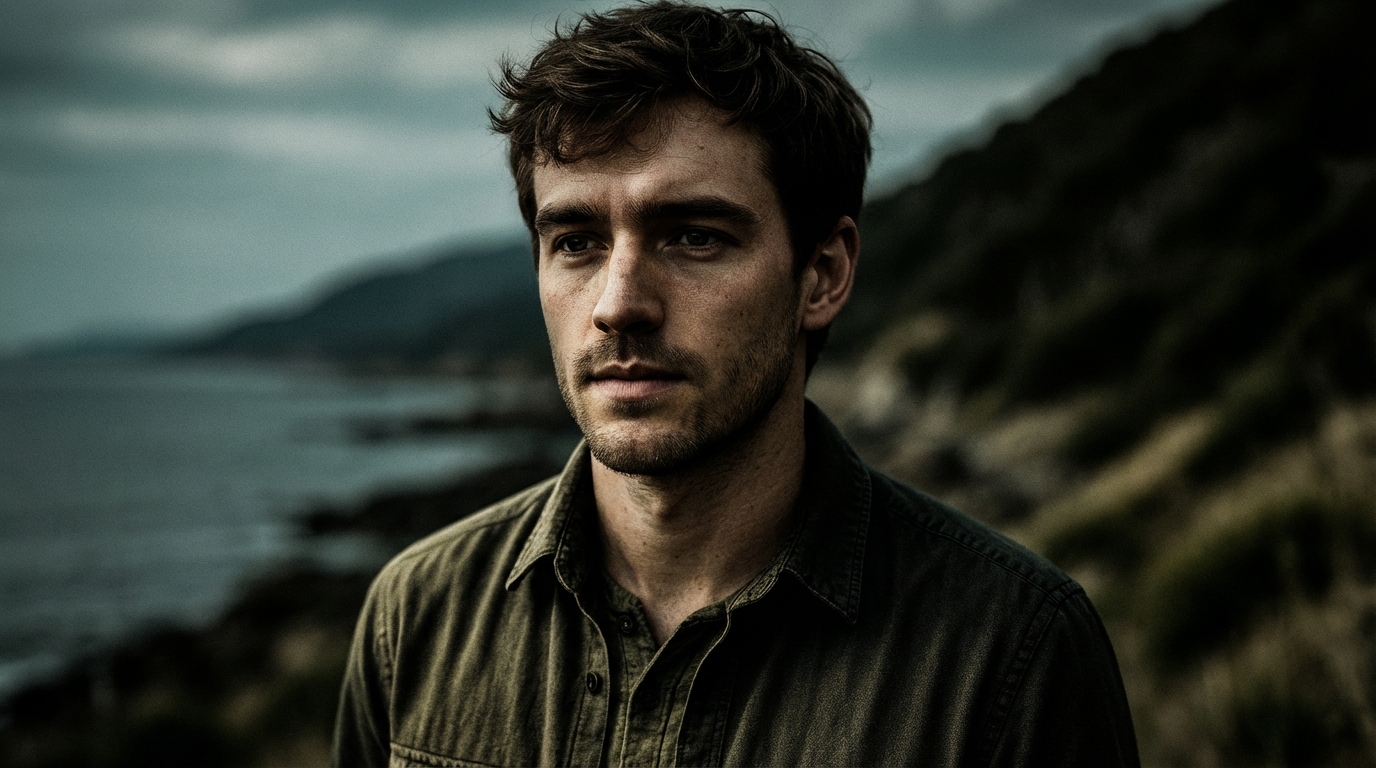
At twenty-four in 2025, Liam Thomas Claiborne embodies quiet competence shaped by premature responsibility. Standing 5'10" with the lean build of someone who runs for mental clarity rather than fitness, his sandy-brown hair perpetually tousled in a style that suggests casual indifference masking careful construction. The hazel eyes, inherited from both parents, carry Charlie's observational intensity softened by Sandra's artistic sensitivity, creating an expression simultaneously open and guarded.
His final year of Environmental Science approaches with strong academic record—distinction average, two published papers on estuarine microplastic contamination, research assistant position with the Institute for Marine and Antarctic Studies. Professor Hutchinson has encouraged postgraduate studies, possibly PhD focusing on climate adaptation strategies for coastal communities. The work appeals intellectually whilst offering escape from family dynamics through fieldwork's legitimate absences.
Accommodation remains the Battery Point cottage's converted garage studio, a space Sandra had intended for artistic retreat but which became Liam's domain during high school. He's transformed it into orderly sanctuary—desk organised with scientific precision, bed made with military corners learned from Charlie, walls decorated with topographic maps and Sophie Blackmore's photographs from their brief reconnection in third year. The space exists separately from the main house, connected but autonomous, perfectly representing his family position.
Relationships remain his most significant challenge. Current girlfriend Emma Greaves (Martin's cousin, ironically) appreciates his steadiness whilst growing frustrated with emotional unavailability. She recognises trauma's secondhand effects—the hypervigilance learned from Charlie, the aesthetic deflection inherited from Sandra, the compulsive caretaking that substitutes for genuine intimacy. Their future remains uncertain, dependent on Liam's ability to risk vulnerability he's spent decades avoiding.
The Burden of Balance
Liam's role within the Claiborne family has evolved from protected child to protective adult, though the transition occurred so gradually nobody marked its passage. He manages Charlie's medical appointments under the pretence of casual reminder, monitors Sandra's wine consumption without comment, provides Amelia audience for her artistic experiments whilst deflecting her questions about their parents' marriage. The emotional labour exhausts him in ways he can't articulate, having no model for his particular burden.
His coping mechanisms reflect both parents' influences filtered through personal temperament. From Charlie, he learned compartmentalisation and routine's stabilising power. From Sandra, he absorbed art's capacity for processing inexpressible emotions—though his medium is landscape rather than canvas, finding peace in Tasmania's remote corners where mobile reception fails and family can't reach. The Overland Track, walked solo each January, provides annual reset, six days of silence broken only by footfalls and bird calls.
Friends recognise but don't fully understand his premature gravitas. Martin Graves observes that Liam seems forty rather than twenty-four, carrying weights that age him beyond years. Sabrina Martindale, now married with a child, occasionally messages to check his wellbeing, recognising in his careful responses the same emotional protection that ended their relationship. Emma pushes gently against his barriers, understanding that forcing confrontation might shatter rather than breakthrough.
Professional prospects appear strong despite personal challenges. The environmental sector values his technical competence and communication skills, the ability to translate complex science for public understanding inherited from Sandra's cultural bridge-building. Job offers have come from mainland consultancies, government departments, international NGOs. He defers decision, citing thesis completion whilst actually unable to imagine leaving Tasmania, abandoning his post as family guardian.







