4328.285 · October 11, 2008 AD
Liam Patrick Wilson
Liam Patrick Wilson, born on 11 October 2008 in Brisbane, was the third of four children of Mark Wilson, an auto mechanic, and Lisa Wilson, a dental receptionist. A self-contained child fascinated by the mechanical engineering of insects, he was nine when the school bus passed through a Portal into Clivilius, sustaining a dislocated shoulder and cracked ribs. He attended the Learning Grove and Bixbus School, where his childhood interest in how things worked evolved into practical workshop skills — repairing and improving Bixbus infrastructure by seventeen.
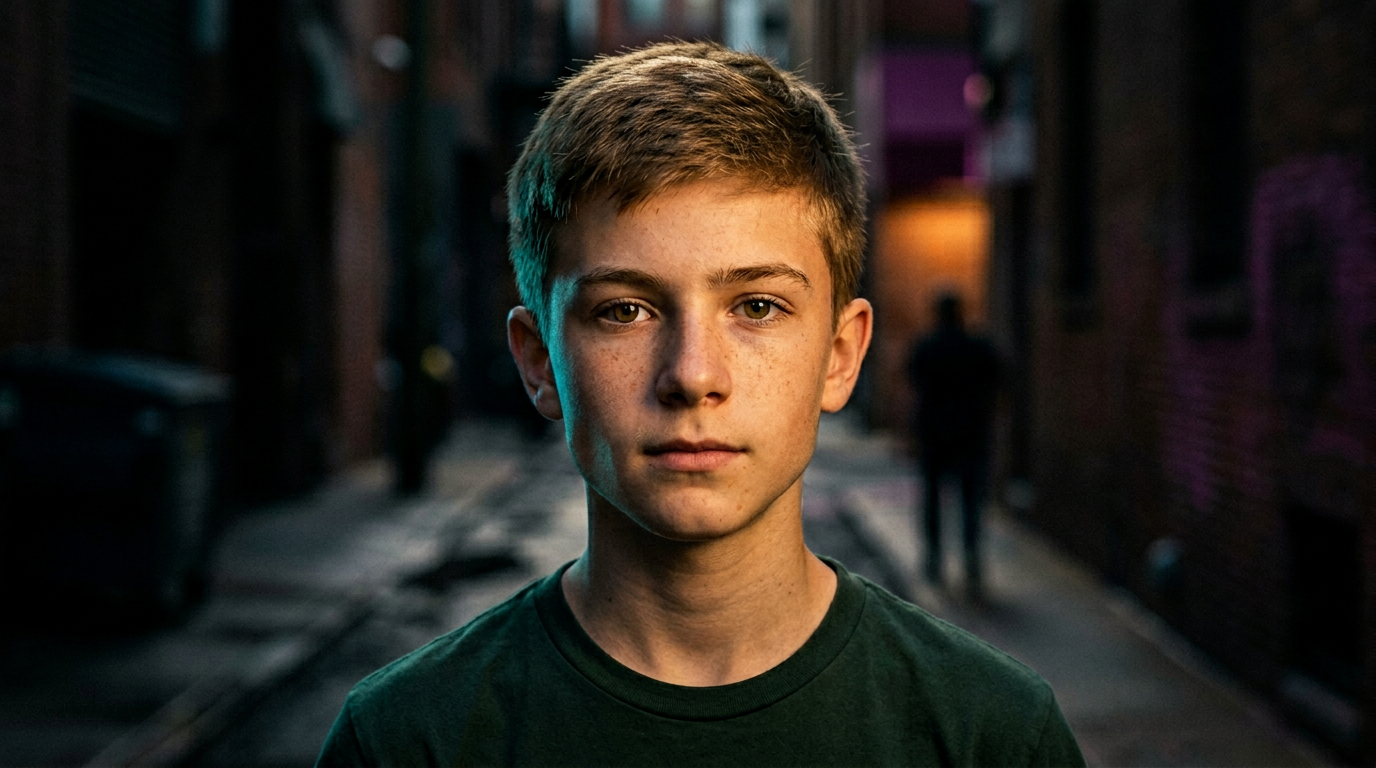
The Third of Four
Liam Patrick Wilson was born on 11 October 2008 at the Prince Charles Hospital in Chermside, the third of four children of Mark Stephen Wilson, an auto mechanic who ran a small workshop in Stafford, and Lisa Marie Wilson (née O'Brien), who worked three days a week on reception at a dental practice in Kedron. He arrived two years after his brother, Jack Mark Wilson, born on 4 January 2006, and a year after his sister, Chloe Anne Wilson, born on 19 September 2007. His younger brother, Ryan Patrick Wilson, followed on 22 May 2012. The family lived in a three-bedroom brick house in Stafford Heights that had been built in the 1970s and had been almost continuously under renovation since Mark and Lisa bought it in 2005, a project that Mark pursued with enthusiasm and intermittent competence.
The house was loud. Four children in three bedrooms — Jack and Liam shared, Chloe had the smallest room to herself, Ryan slept in a cot and then a toddler bed in his parents' room until the extension was finished, which it was not by the time the bus left for D'Aguilar — produced a domestic atmosphere that Lisa described, to friends and with some accuracy, as controlled chaos. The mornings were a procession of lost shoes, disputed cereal boxes, and the particular logistics of getting four children to two different schools and one childcare centre with one car and a husband who left for the workshop at six.
Mark was a quiet man in a loud household. He had worked on cars since he was fifteen, when his father, Geoffrey Alan Wilson, a retired truck driver who lived alone in a unit in Zillmere since the death of his wife Rosemary in 2004, had let him dismantle a Holden Commodore in the driveway and put it back together over the course of a summer. Mark understood engines the way some people understood music — instinctively, physically, without needing the theory to precede the practice. He was good with his hands and uncertain with his words, and the combination made him a reliable mechanic and an inexpressive father who loved his children with an intensity he demonstrated by fixing things for them and could not demonstrate in any other way.
Lisa was the organiser, the negotiator, the one who remembered which child had which appointment and which form was due at which school. She had grown up in Nundah, the eldest of three daughters born to Patrick and Margaret O'Brien — Patrick a plasterer, Margaret a school crossing supervisor — and she had inherited from her mother a capacity for managing multiple competing demands without visible stress that Margaret herself attributed to Catholicism and Lisa attributed to practice. She was affectionate, firm, and possessed of a patience that frayed visibly by Thursday evening and regenerated, through some mechanism her children did not understand, by Monday morning.
Jack was the responsible eldest — serious, reliable, burdened with the expectation of setting an example that he accepted without resentment and performed without flair. Chloe was social, sharp-tongued, and already at eleven developing the negotiating skills that would serve her well in the arguments she conducted with her parents and brothers with equal vigour. Ryan, at six, was a cheerful, undemanding child whose primary contribution to the household was an ability to fall asleep anywhere and a total indifference to the chaos around him.
Liam was the one nobody needed to worry about. That was the phrase Lisa used, and she meant it as a compliment. Of the four, Liam was the most self-contained — not withdrawn, not antisocial, but capable of occupying himself for hours without requiring supervision, intervention, or entertainment. He disappeared into the back garden after school and reappeared at dinner with grass stains on his knees and something in a jar, and in between he had been somewhere that none of the adults in his life tracked with any precision because there was always something more urgent demanding their attention.
The jars accumulated. This was the first thing any visitor to the Wilson house noticed about Liam: the jars. Recycled pasta sauce jars, jam jars, the occasional specimen container that Lisa had brought home from the dental practice, all lined up along the windowsill of the bedroom he shared with Jack, each containing some form of insect life. Ants. Beetles. Caterpillars he attempted to raise to butterflies with a success rate he refused to calculate. A huntsman spider that he kept for three weeks and named Gerald, and which Jack discovered on the wall above his bed at two in the morning, producing a confrontation between the brothers that woke the entire house and resulted in Gerald's relocation to the garden shed.
Liam's interest in insects was not scientific in the way that Ethan Williams's was, though the two boys were at the same school and shared enough common ground to recognise each other across a classroom. Ethan drew insects — precise, labelled, taxonomic. Liam watched them. He crouched beside ant trails for half an hour and studied the traffic patterns. He flipped logs in the garden and tracked what lived underneath. He was fascinated not by what insects were called but by how they worked — how ants communicated, how spiders engineered their webs, how beetles converted the mechanical advantage of their body structure into feats of strength that seemed to violate common sense. He wore bug-themed t-shirts not because he wanted to be an entomologist but because he thought bugs were extraordinary, and he wanted the world to know.
He entered Brisbane Grammar School in Year 3, in 2017. Lisa had resisted the idea — the fees were a stretch even with the partial bursary Mark had applied for, and she did not see what Grammar offered that Stafford Heights State School could not. Mark, who rarely insisted on anything domestic, insisted on this. The school's science programme and its field excursions were, he argued in his quiet, persistent way, exactly the kind of thing Liam needed, and the argument was one of the few Mark won in their marriage, a fact Lisa acknowledged with the good grace of a woman who knew her husband was right and the mild irritation of one who wished he would be right more often about things that cost less money.
The Wrong Sky
The overnight field trip to D'Aguilar National Park departed from Brisbane Grammar School on the morning of Saturday, 4 August 2018. Liam, at nine, was old enough to pack his own bag and young enough to do it badly — Lisa repacked it on the Friday evening, removing a torch with dead batteries and adding sunscreen, a hat, and the sandwich she knew he would not eat but felt compelled to provide. He brought a jar. He always brought a jar.
He sat in the middle of the bus, near but not beside Ethan Williams, with whom he shared a mutual awareness that did not quite amount to friendship. They occupied adjacent positions in the school's ecosystem of interests — both drawn to the natural world, both more comfortable with insects than with rugby — but Ethan's intensity was solitary and precise where Liam's was gregarious and mechanical, and the difference kept them at a companionable distance rather than drawing them close.
At D'Aguilar, Liam spent most of the guided walk on his hands and knees. Susan Clarke, who was leading the group, twice had to call him back from the undergrowth where he had followed something small and many-legged off the trail. He found a golden orb-weaver's web strung between two trees and stood in front of it for ten minutes, studying the radial architecture with the concentration of an engineer reading a blueprint. He did not catch anything for his jar. He did not want to. The forest was too large and too alive to reduce to a specimen, and Liam, at nine, was beginning to understand the difference between keeping something and understanding it.
The bus departed D'Aguilar on the morning of 5 August for the return to Brisbane. Liam was seated in the middle section, his jar in his backpack, his head turned toward the window.
The bus passed through a Portal opened across a road in the Brisbane suburbs and collided with vehicles on the far side, in the landscape of Clivilius. The impact threw Liam sideways into the seat frame. His right shoulder dislocated on impact — the joint wrenching forward and out of the socket with a pain that was blinding and immediate. He also cracked two ribs on his right side where his torso struck the armrest, injuries that would make breathing painful for weeks and that he did not fully register at the time because the shoulder consumed every available unit of his attention.
David Nguyen reached him and recognised the dislocation. The reduction — relocating the joint — was performed on the floor of the wrecked bus, without anaesthetic, with Nguyen talking him through it in a calm, steady voice while Liam gripped his own knee with his left hand and made a sound that was not a scream and not a word but something between the two that the children nearest to him would remember for years. The shoulder went back in. The pain did not leave but it changed — from the sharp, electric wrongness of a joint out of place to the deep, thudding ache of a joint that had been damaged and returned.
He was nine. He was old enough to understand that the sky was wrong. It was the first thing he noticed after the pain receded enough to let him notice anything — the colour of the sky, the quality of the light, the absence of the familiar suburban landscape that should have been visible through the bus windows. The other children were crying or calling for adults. Liam sat with his right arm cradled against his chest and looked at the sky and understood, with the quiet certainty of a child who had spent years observing systems and patterns, that they were not where they were supposed to be.
What Beetles Taught Him
Liam's shoulder healed within six weeks. His ribs took longer — eight weeks before he could breathe deeply without discomfort, ten before he could lift anything heavy with confidence. The injuries were not severe enough to prevent him from joining the Learning Grove when it opened in late August 2018, and Liam attended from the first week, his right arm in a sling fashioned from a strip of salvaged fabric, his jar somehow intact in his backpack, empty and clean and waiting.
The Learning Grove gave him structure he had not known he needed. At nine, Liam was old enough to participate meaningfully in the ability-based groupings that Jenny Triffett established, and his academic skills — average in reading, reasonable in mathematics, strong in anything that involved observation or spatial reasoning — placed him in groups that moved at a pace he could follow without boredom or frustration. The afternoon practical sessions at partner sites were where he came alive. He rotated through the Haven of Wilds, Verdant Nursery, and the Orchard of Abundance in those first months, and it was at the nursery that he discovered something about himself that the bug jars in Stafford Heights had only hinted at.
He liked making things work. The nursery's irrigation system — rudimentary, improvised from salvaged piping and containers — needed constant adjustment. Liam, watching an adult struggle with a blocked junction, suggested using a bent piece of wire to clear it, a solution so obvious and so effective that the adult in question looked at him with the particular expression of someone who has been outsmarted by a nine-year-old. It was not the last time. Liam's mind worked in mechanisms. He saw blockages and thought about flow. He saw structures and thought about load. He saw problems and thought about the simplest physical intervention that would solve them, and this capacity — which had always been present in his fascination with insect engineering — became, in the improvisational environment of early Bixbus, unexpectedly useful.
The transition to Bixbus School in late 2019 formalised what the Learning Grove had begun. Liam's mornings were spent in academic classes where his performance was solid if unspectacular. His afternoons, under the community mentorship programme, drifted steadily toward the settlement's workshop operations — the teams that built, repaired, and maintained the infrastructure of a growing community. He started as an observer at ten, watching adults repair water pumps and construct shelving. By eleven, he was helping. By twelve, he was solving problems that the adults had not yet identified, spotting the weak joint in a fence, the misaligned hinge on a gate, the drainage flaw in a path before it became a puddle.
He retained his interest in insects, but it changed shape as he grew. The jars disappeared. The fascination with how things worked remained and broadened — from the mechanical engineering of beetle exoskeletons to the mechanical engineering of everything else. He could explain, at thirteen, why a particular structural joint was failing, using an analogy to the way a spider distributes tension across a web that was so precise and so unexpected that the builder he was working with asked him to repeat it. He was not a theoretical thinker. He could not have written an essay about engineering principles. But he could look at a broken thing and see what was wrong with it, and he could look at an unbroken thing and see where it would break next.
This talent — quiet, practical, rooted in years of watching systems at close range — made him valuable in a settlement that was still building itself.
His personality at seventeen was an accumulation of the qualities that had defined him at nine, refined by eight years in a community where self-sufficiency was not a virtue but a necessity. He was practical, unhurried, observant. He spoke less than Lucas White and more than Mason Clarke, and what he said tended to be specific and useful rather than decorative. He was the teenager who, when a conversation stalled or a group could not agree on an approach, would offer a solution so simple it seemed obvious in retrospect and had not occurred to anyone else. This quality earned him respect among the adults he worked with and a mild reputation among his peers as someone who was reliable in a crisis and slightly boring the rest of the time — a characterisation Liam was aware of and entirely unbothered by.
He was not, however, without complication. Liam at seventeen carried the particular weight of a child who had been self-sufficient too young and for too long. He did not ask for help. He did not accept it easily when offered. He had been looking after himself since the age of nine — not because the adults in Bixbus had failed him, but because there were always younger children who needed more, and Liam, who had been the third of four in a household where nobody needed to worry about him, had carried that identity into a new world and never set it down. He managed his own problems. He fixed his own equipment. He processed his own grief in private, if he processed it at all.
The emotional cost of this self-reliance was a distance that people who knew him well — and few people knew him well — could sense but not name.
He missed his family with a clarity that had not diminished in eight years. He was nine when the bus went through the Portal, old enough to remember everything — the house in Stafford Heights, the workshop smell of his father's overalls, his mother's voice calling from the kitchen, Jack's steady presence in the bunk above him, Chloe's laugh, Ryan's small hand reaching for his on the walk to school. The memories were complete and undimmed, and Liam kept them in the same place he kept everything important: somewhere functional, accessible when needed, and never on display.
His mornings were spent at Bixbus School. His afternoons were spent in the workshops, where he repaired what was broken and improved what was not, his hands moving with the same patient attention he had once given to the ants on the garden path in Stafford Heights. He was seventeen and he was competent and he was fine, in the particular way that people who have been fine since they were nine are fine — not because the weight had gone but because the carrying of it had become so habitual that they had forgotten it was there.







