Lewyyd Thrain Drikarsus
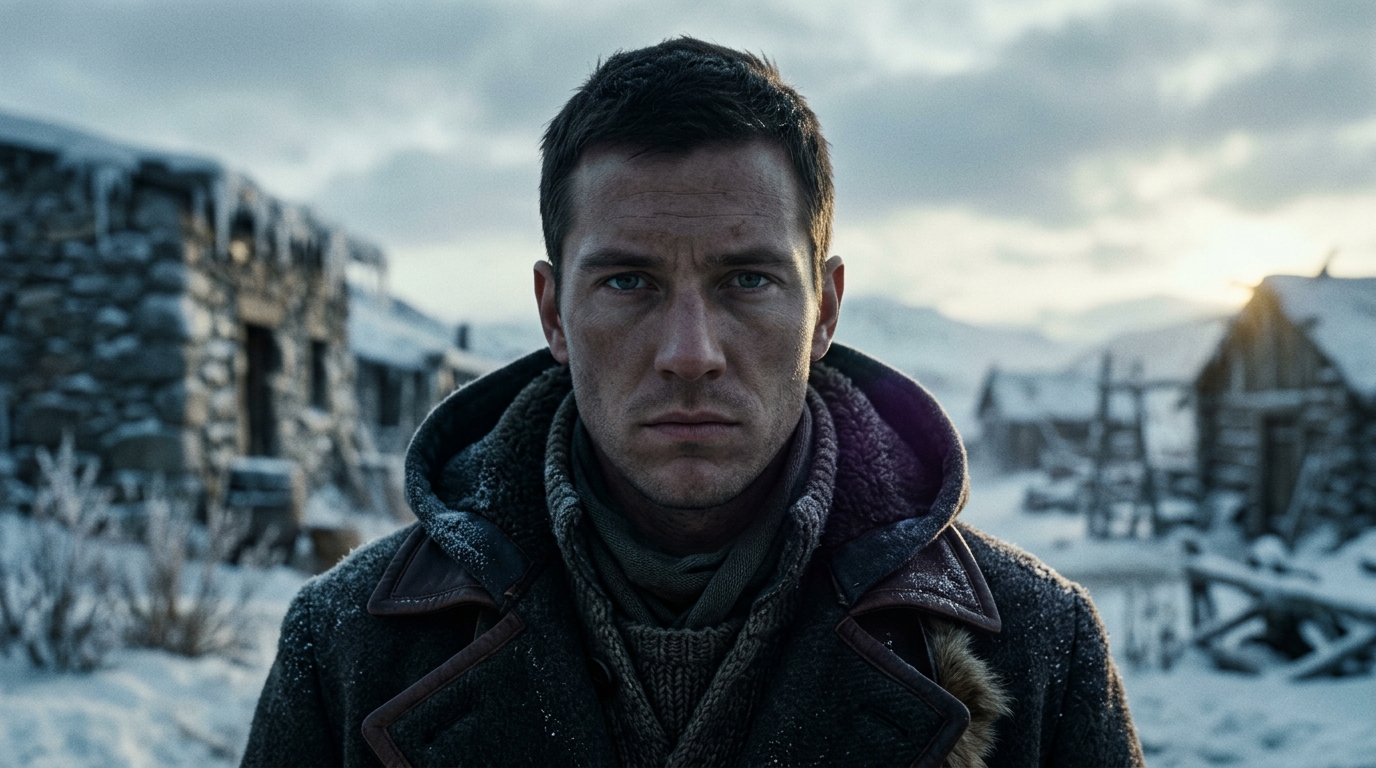
Lewyyd Thrain Drikarsus (1990–2021) was the only Chief of Belkeep born in the settlement itself, and the last to hold the office. Made Chief at fifteen by the sudden death of his mentor Thrain Harper, he governed for sixteen years with a cold, methodical competence that kept the settlement alive without ever inspiring it. Hardened by the office he was handed as a boy, he presided over Belkeep's slow decline and died at thirty-one, believing the settlement was finished.
A Child of the Ice
Lewyyd Thrain Drikarsus was born in Belkeep on 19 March 1990, and he would become the only Chief the settlement ever raised from its own stock rather than received from Earth. He never saw another sky. The cold that visitors and Earth-born settlers experienced as an assault was, to Lewyyd, simply the condition of the world—the baseline against which everything else was measured, no more remarkable than air. He could not miss the warmth he had never felt, could not mourn seasons he had never known, and this gave him from the beginning a kind of grounding that the settlement's older residents lacked. They endured Belkeep. He merely lived there, because there was nowhere else that living meant anything.
His parents, Eldrik and Aeliana Drikarsus, were among the settlers who had come through the Portal in Belkeep's founding years and helped drag a community out of the ice by improvisation and stubbornness. Eldrik Magnus Drikarsus, born in 1955, was a hunter—one of the few men who could read the lake, the shifting sea ice and the movements of what little game the valley offered, and who kept the settlement fed in the years before its systems formalised. Aeliana Maeve, born a Prescott, was the steadier presence of the two, the one who held a household together in conditions that broke households routinely. Between them they gave Lewyyd a childhood that was, by Belkeep's grim standard, stable and loved—a fact that would make the shape of his adult life crueller by contrast.
The Drikarsus Household
The family home was a modest, sturdy structure, better kept than most, warmed by Aeliana's care and ordered by Eldrik's discipline. From his father Lewyyd absorbed the settlement's hardest lessons early: that the land was indifferent, that mistakes were paid for in lives, and that sentiment was a luxury a hunter could not afford on the ice. Eldrik was not a warm man. He taught by expectation and correction rather than encouragement, and Lewyyd grew up believing that competence was the only currency worth earning and that feelings were something you managed privately, if at all.
He was not raised alone. His sister Lyra was the counterweight to their father's severity—quick, watchful and loyal, the one person to whom Lewyyd spoke without calculating first. Where he was methodical and closed, she was sharp and open, and in the years before responsibility hardened him she was the nearest thing he had to a confidante. The two of them learned Belkeep together: the augured fishing holes, the safe distances from the lake's edge, the protocols that governed every step outside the settlement's perimeter. It was an ordinary childhood conducted at the edge of death, which is to say it was a Belkeep childhood, and Lewyyd knew no other kind to compare it against.
What set him apart, even young, was a seriousness that unsettled the adults around him. He did not play so much as observe. He watched how the Council Cottage worked, how decisions were made and who made them, with an attentiveness that read less as ambition than as a child trying to understand the machine that kept him alive. It was this quality, more than any spark of brilliance, that would draw the attention of the man who shaped his life.
Harper's Boy
Thrain Harper was Chief of Belkeep from 1995, and long before that he had been one of the settlement's respected elders—a figure the Drikarsus family admired enough that they had given their son his name at birth, five years before Harper ever held the office. That the boy called Thrain would one day inherit Harper's chair was a coincidence the settlement would later find almost unbearable to reflect on, but at the time it was simply a name.
Harper saw in the young Lewyyd what others found merely odd: a temperament suited to the unglamorous, grinding work of keeping a settlement alive. He began, through Lewyyd's early teens, to teach him—not charisma or vision, which Harper distrusted, but the patient discipline of governance. How the stores were counted. How a ration was calculated against a projected winter. How to deliver a decision that would cost someone dearly without flinching and without pretending it cost nothing. Harper was preparing a successor, though he can have had no expectation the succession would come as soon or as brutally as it did.
In 2005, Thrain Harper died suddenly. The settlement had no time to arrange anything careful. By the Council of Stewards' choice and the plain necessity of a community that could not function leaderless, the office of Chief fell to the boy Harper had been grooming. Lewyyd Thrain Drikarsus was fifteen years old.
Fifteen and Chief
What that did to him was the central fact of his life, and he never spoke of it directly. A child who had barely begun adolescence was handed an office appointed for life, in a settlement where the Chief bore final responsibility for who ate, who was sent onto the ice, and who was left to die when nothing could be done. He did not grow into the role over a gentle apprenticeship. He was thrown into it whole, at an age when the settlement's other children were still testing how close to the lake's edge they dared to walk.
He responded the only way his upbringing had equipped him to: by becoming, as completely as possible, the office itself. Whatever boy remained in him at fifteen he set aside, deliberately and permanently, because a boy could not be Chief and Belkeep needed a Chief. He cultivated a stern, unhurried gravity that was partly genuine and partly armour, and he wore it so consistently and for so long that by adulthood there was no longer any clear line between the man and the performance. The seriousness that had unsettled the adults of his childhood became total. He was rarely seen to laugh. He did not court affection, and he did not receive much.
The community's response to a teenage Chief was, understandably, ambivalent. Some resented taking direction from a boy; others pitied him; a few, quietly, protected him, steering him through his first years with a care he was too proud to acknowledge needing. That he survived those years without a catastrophic error was a testament less to precocious genius than to the systems Barker and Harper had built before him—systems designed precisely so that Belkeep would not depend on the brilliance of any single leader. Lewyyd did not need to be brilliant. He needed to be steady, and steadiness he had in abundance, because he had been made of nothing else.
The Weight of the Stores
For sixteen years Lewyyd governed Belkeep, and the work was, almost entirely, the patient administration of scarcity. He met daily with the Council of Stewards and his Second-in-Command in the Council Cottage, and the business of those meetings was rarely dramatic: the state of the reserves, the failing heating in one quarter, the repairs that could not wait, the deaths to be recorded. The romance that outsiders might imagine in the leadership of a frozen frontier outpost was entirely absent. It was accountancy conducted at the edge of survival, and Lewyyd was suited to it in a way few others could have been.
The moral weight of the role settled onto him young and never lifted. To ration a scarce food supply is to decide, in slow motion, who suffers and by how much, and to do it every day for years is to develop either a protective hardness or a fatal inability to function. Lewyyd developed the hardness. He learned to make the calculation and carry the outcome without letting it show, and while this made him an effective Chief it also made him a diminished man—someone who had spent so long suppressing what he felt that he grew genuinely uncertain, in time, whether he felt much at all.
He governed, for thirteen of those years, alongside the settlement's founder. Cody Jennings, the Earth-born Guardian who had opened the Portal and named the place, remained a presence in Belkeep until his death in 2018, and the relationship between the two men was one of the more quietly complicated in the settlement's history. Cody was everything Lewyyd was not: haunted by guilt, given to grand hopes and grander regrets, forever measuring Belkeep against the promised land he had imagined and failed to deliver. Lewyyd had imagined nothing. He had been born into the reality Cody grieved, and he governed it without illusion. He respected the founder and was, in his reserved way, patient with him, but he privately regarded Cody's guilt as a kind of self-indulgence the settlement could not afford. Belkeep did not need someone to mourn what it might have been. It needed someone to count the stores.
Elda, and the Argument About the Future
The nearest Lewyyd came to a life outside the office was Elda Marrick. Older than him by more than a decade, sharp, restless and impatient with the settlement's fatalism, Elda served as a Steward through the middle years of his chieftainship, and she was the one person in Belkeep who refused to treat the Chief as an institution rather than a man. Their relationship was real and enduring, and it was also, from beginning to end, an argument.
Elda believed Belkeep's survival could not be indefinite endurance—that the settlement had to change, to innovate, to gamble scarce resources on the possibility of a better future rather than spend them all on merely lasting until tomorrow. Lewyyd, shaped entirely by systems built to prevent catastrophe, distrusted every gamble on principle. What worked had been paid for in deaths, and he was not inclined to risk more lives on Elda's hopes. Their disagreements were not abstract policy debates; they were the fault line of both his governance and his private life, and the two were never separable. She pushed him, over years, to reconsider what leadership was for, and he moved—slowly, grudgingly, incompletely—but the office always won the argument in the end. When forced to choose between the woman and the caution the settlement had drilled into him, he chose caution, every time, and told himself it was duty.
They never built the ordinary life that might have grown from such a relationship. There were no children, no household of their own that outlasted the arguing. Lewyyd had been made Chief before he had learned how to be anything else, and he could not now learn to be a husband or a father alongside it. Elda understood this about him better than he understood it himself, and stayed anyway, for years, which was its own kind of verdict on him—that he was worth staying for, and that staying cost her something he could never quite bring himself to repay.
The Long Winter and the Slow Decline
His father died in 2010, when Lewyyd was twenty—Eldrik taken by the same indifferent land he had spent his life reading, in the manner Belkeep dealt out its deaths. Lewyyd recorded it in the settlement's ledger as he recorded every death, and if he grieved, he did it where no one saw.
The defining crisis of his chieftainship came in 2014, in the stretch the settlement remembered afterwards simply as the Long Winter—a period when the weather deteriorated beyond even Belkeep's brutal baseline and the reserves came within a hard margin of running out. It was the kind of emergency the office had trained him for since he was fifteen, and he met it with the cold precision that was his one great gift, rationing the settlement to the bone and holding it there through sheer refusal to bend until the conditions eased. People went hungry under his management, but far fewer died than should have, and the survival of Belkeep through 2014 was as close to a triumph as his tenure ever produced. It was, characteristically, a triumph of prevention—a disaster that did not happen—and no one cheered a disaster that did not happen.
What he could not prevent was slower and more final. By the latter half of the 2010s Belkeep was dying, not in a crisis but by attrition. Births had all but ceased. The population, having peaked in the middle of the decade, was ageing and thinning, and no amount of careful rationing could ration a community back into growth. The year 2018 brought the death of Cody Jennings and a settlement visibly past its best, and Lewyyd governed the decline the only way he governed anything—methodically, without complaint, and without hope he was willing to show. He understood, more clearly than most, that he was presiding over an ending. He simply saw no alternative to presiding over it well.
The Sea
There was one place the Chief went to stop being the Chief. Lewyyd was drawn, all his life, to the settlement's turbulent sea—the churning, half-frozen water that had killed as many as the lake and offered even less, and that he nonetheless returned to alone whenever the office loosened its grip enough to let him. He never explained the pull, and no one who knew him well enough to ask would have expected an answer. Something in the sea's indifference suited him; it asked nothing, promised nothing, and did not require him to decide anything. Beside it he was briefly not responsible for anyone.
It was the closest thing to an inner life he permitted himself to be seen having, and even it was solitary. The man who had been made a public figure at fifteen kept whatever remained of his private self at the waterline, out of the settlement's sight, and took most of it with him unspoken.
The Last Winter
Lewyyd Thrain Drikarsus died on 12 September 2021, at the age of thirty-one. The cause was an illness the settlement had no means to treat—a fever that took hold and worsened past the reach of Belkeep's failing medical provisions, the sort of death that a resourced community would have prevented without difficulty and that Belkeep, as it had for every other soul it lost, simply could not. He had governed for sixteen years, more than half his life, and he had never held any office but this one nor known any world but the one that killed him.
He died believing Belkeep was finished. He could not have known that within six years the settlement would be found by Bixbus, its survivors relocated, its story carried out into a wider Clivilius that had forgotten it existed. He died in the isolation he had governed his whole life, certain the ending he was presiding over was the only one there would be. No new Chief was installed after him. The Council of Stewards took up what remained, and the office he had been handed at fifteen quietly lapsed with the man, as though it had only ever been his to hold.
They buried him where he had gone to be alone, on a rise above the sea he had never explained his love for. It was, for a man who had spent his life keeping a settlement fed and warm and never once been thanked in a way he could feel, an unusually honest resting place—overlooking the one thing in Belkeep that had never asked him for anything.







