Leicestershire, England
Leicestershire was a landlocked county in the heart of England, a shire of rich farmland and old market towns gathered around its county town of Leicester. Its ground held some of the oldest rocks and fossils in the country, in the crags of Charnwood Forest; its fields held a fallen king's last battle at Bosworth and a doomed queen's childhood at Bradgate. Famous for its pork pies, its Stilton, its hunting country and its agricultural improvers, it was the quiet, productive middle of England.
The Shire
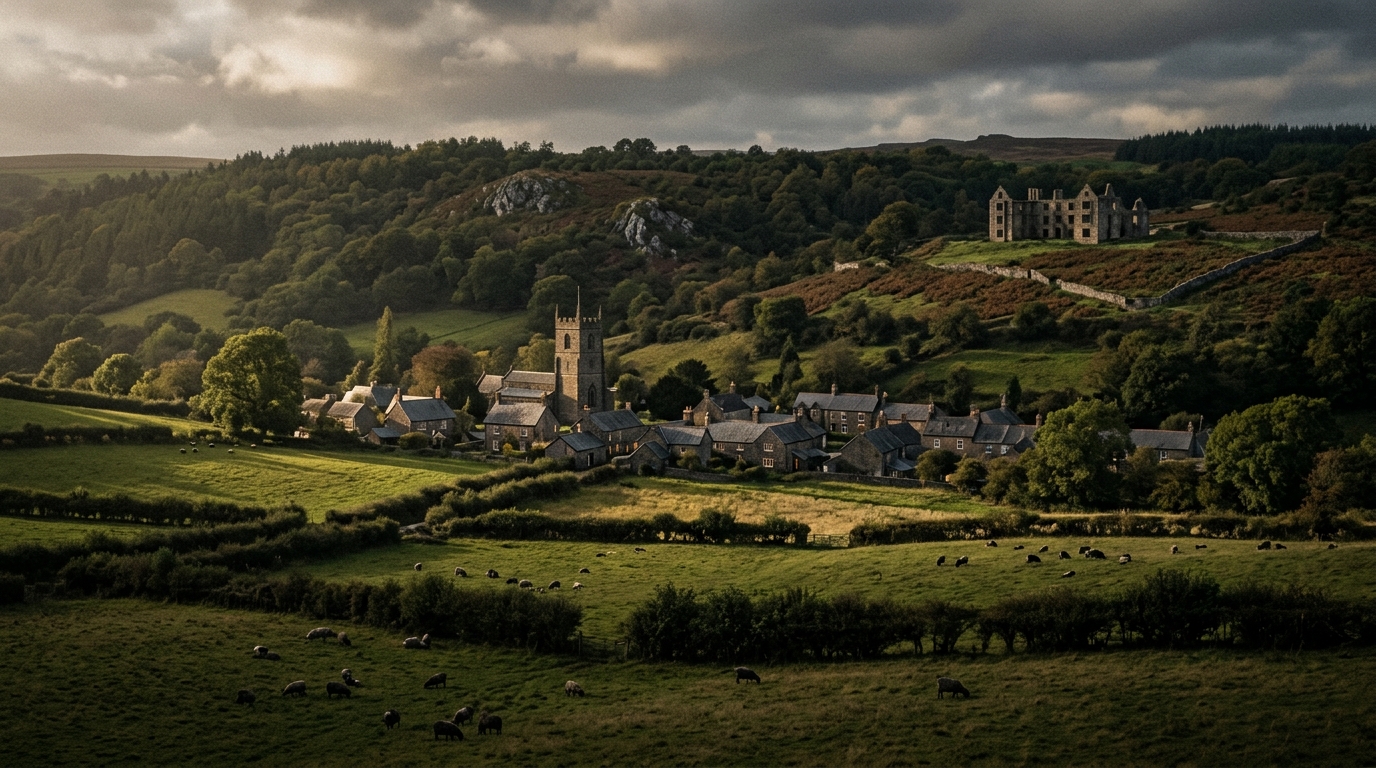
Leicestershire was a county in the middle of England, in the most literal sense — landlocked, central, neither north nor south, one of the shires of the East Midlands through which the rest of the country tended to pass on its way somewhere else. It gathered around its county town, Leicester, at its heart, and spread out from there into rich farmland and old market towns and a scatter of villages built from the local slate and granite. The Romans had run their great roads across it — the Fosse Way slicing through, Watling Street forming its south-western edge, the line that had once divided Saxon England from the Danelaw — and ever since it had been a place of through-traffic, crossed and recrossed, easy to overlook.
But it was the particular quality of Leicestershire that it held, beneath an unassuming surface, far more than a passing traveller would guess: older ground than almost anywhere in England, the last field of a king, the childhood of a queen, and a long tradition of quietly making things the wider world could not do without.
Older Than England
In the north-west of the county the farmland buckled upward into Charnwood Forest, a rough upland of crags and heath and ancient woodland rising over the surrounding fields. The rock that broke through there was among the oldest in England — Precambrian stone laid down some six hundred million years ago, when the ground that would become Leicestershire lay underwater near the southern tropics, off the edge of a vanished supercontinent. For most of scientific history it had been believed that rock so old could hold no fossils, that complex life had simply not yet existed to leave a trace. Then, in 1957, a handful of schoolboys climbing in a Charnwood quarry found, pressed into the ancient stone, the unmistakable frond-shaped impression of a living thing.
It was named Charnia, after the forest that had kept it, and it overturned a settled certainty: here was a creature from a world half a billion years gone, the first fossil of its great age to be found anywhere on Earth, recognised in a Leicestershire quarry by a boy who did not yet know what he had. The county that the rest of England passed through without a glance turned out to be standing on some of the oldest evidence of life on the planet.
A Queen's Childhood and a King's Last Field
Charnwood held, as well as its deep time, an older human story. Within it lay Bradgate Park, a great deer park enclosed for the better part of a millennium, where the ruins of a Tudor mansion stood among the bracken and the grazing herds. The house had been the childhood home of Lady Jane Grey, the learned and devout girl who, through no real ambition of her own, was placed on the English throne in 1553 and held it for nine days before she was deposed; she went to the block the following year, not yet seventeen. The county kept the bracken-grown ruin of the place where she had been a child, a quiet monument to one of the saddest brief reigns in English history.
A few miles to the west, the county kept the memory of a still more consequential day. In the summer of 1485, in a field near Market Bosworth, the armies of Richard III and Henry Tudor met in the battle that decided the Wars of the Roses. Richard, the last of the Plantagenet kings, was killed there; the crown passed to the Tudors, and with it the whole course of English history turned. The king's body was carried off to Leicester and the dynasty he had died defending was finished — but the field where it happened was Leicestershire's, a stretch of ordinary midland farmland over which a royal house had ended.
Hunting Country
East of the forest the county softened into the rolling grass and thick hedges of the Leicestershire Wolds, and here it became something different again: the heartland of English fox-hunting, the most famous hunting country in the world. Melton Mowbray, the market town at its centre, was the unofficial capital of the sport, the place to which the gentry of England came each season to ride out with the great packs — the Quorn above all, and the Cottesmore and the Belvoir nearby — across open grassland made for the chase. By local tradition it was in Melton, on a riotous night in the eighteen-thirties, that a party of young aristocrats literally daubed the town with red paint and gave the language its phrase for a wild night out.
The county fed its visitors as memorably as it mounted them. Melton Mowbray gave its name to a pork pie of such particular character that the name would one day be protected by law; the rich pastures of the Vale of Belvoir produced the blue-veined Stilton that took its name, confusingly, from a village in another county altogether; and from Leicestershire dairies came the deep-orange Red Leicester that carried the shire's name onto cheeseboards everywhere. It was a county that had made itself, among other things, into one of the larders and playgrounds of England.
The Improver's County
For all its hunting and its pies, Leicestershire's deeper genius was for improvement — for the patient, practical work of making useful things better. It was at Dishley, near Loughborough, that Robert Bakewell spent the latter half of the eighteenth century remaking the very animals of the farmyard, breeding his sheep and cattle with a deliberate, selective rigour no one had applied before and producing in his New Leicester sheep a creature so improved that its bloodline spread to farms across the empire and beyond. The agricultural revolution had many fathers, but few more important than the quiet Leicestershire grazier who proved that livestock could be designed.
The same practical streak ran through the county's industry. In the north-west, around Coalville, lay a coalfield that had been worked for generations, its pit villages built upon the seams beneath them. At Loughborough stood the largest bell foundry in the world, whose bells hung in cathedral and church towers across the country and far past it — among them the great bell of St Paul's, cast in a Leicestershire works and carried down to London to ring out over the capital. When at last the coal ran out and the pits closed, the county did something characteristically constructive with the wreckage: across the worked-out ground of the old coalfield it began, in the closing years of the twentieth century, to plant the National Forest, millions of trees rising over land that mining had exhausted — a deliberate greening of its own industrial scars.
The Middle of England
It was, in the end, a county that rewarded a second look. The traveller hurrying through saw flat fields and market towns and the spread of an ordinary midland city, and missed almost everything: the six-hundred-million-year-old rock beneath the heath, the field where a dynasty had ended, the deer park where a nine-days' queen had played as a child, the bells of distant cathedrals that had been born in its foundries, the revolution in the farmyard that had helped feed an empire. Leicestershire wore its significance lightly, as the middle of England tends to, and kept it for those who troubled to look.
And it remained, as it had always been, a place that things and people came out of as much as a place they passed through. Its county town sent its sons and daughters into the wider world without ceremony — the Smiths and the Patels among countless others, families whose beginnings were registered in the shire before their lives carried them far beyond it — and Leicestershire, incurious and productive and old beyond reckoning, simply went on being the quiet, consequential heart of the country: easy to cross, and easy to underestimate.







