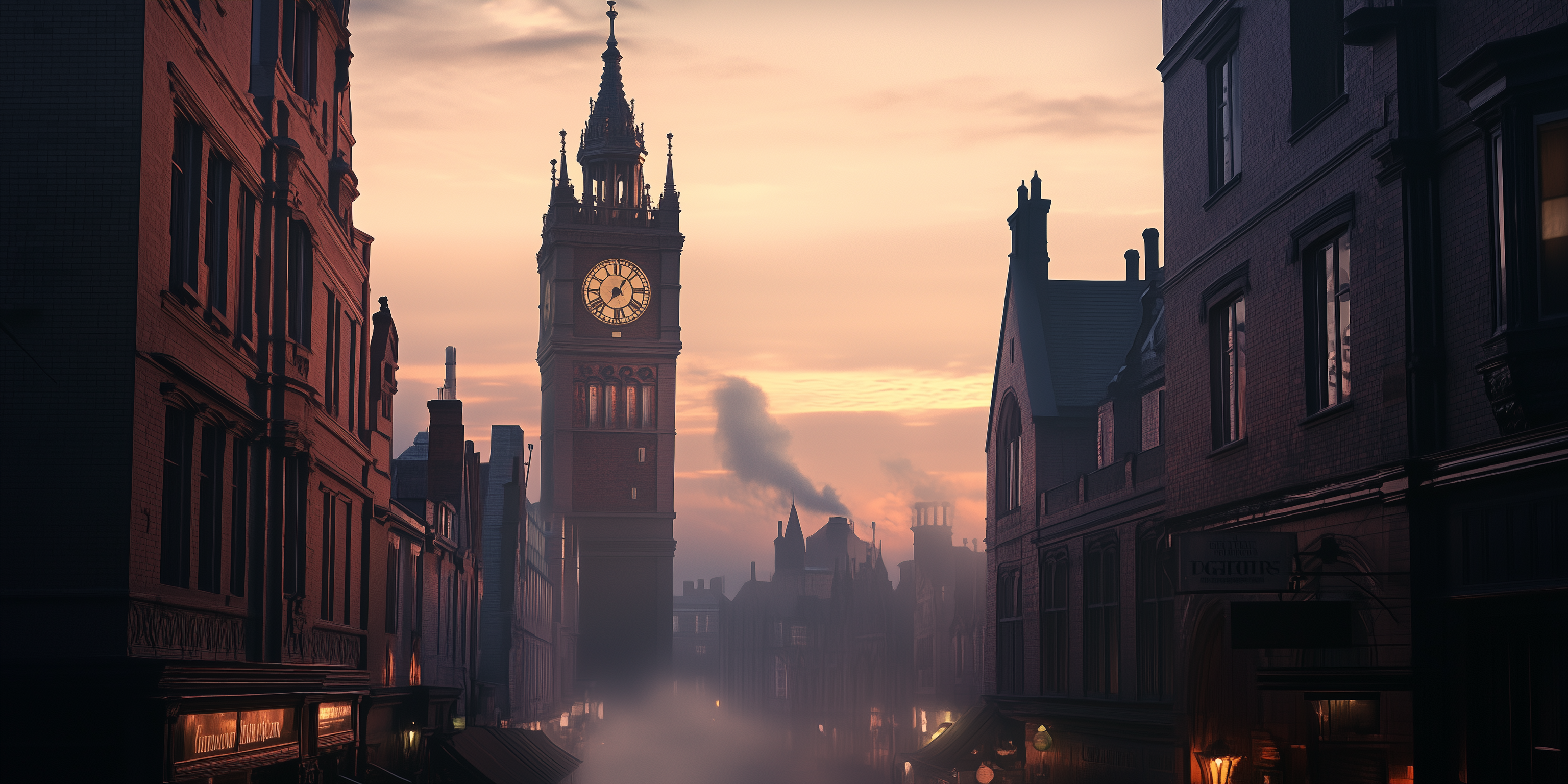
Leicester, Leicestershire, England
Leicester, on the River Soar in the English Midlands, was one of the country's oldest cities — Roman Ratae beneath a medieval market town beneath a Victorian industrial powerhouse that made it the hosiery capital of Britain. It was the city that buried and, five centuries later, rediscovered Richard III, and that successive waves of migration — most famously the East African Asians of the 1970s — remade into one of Britain's most diverse places. It was the birthplace of the Patel and Smith families, among others.
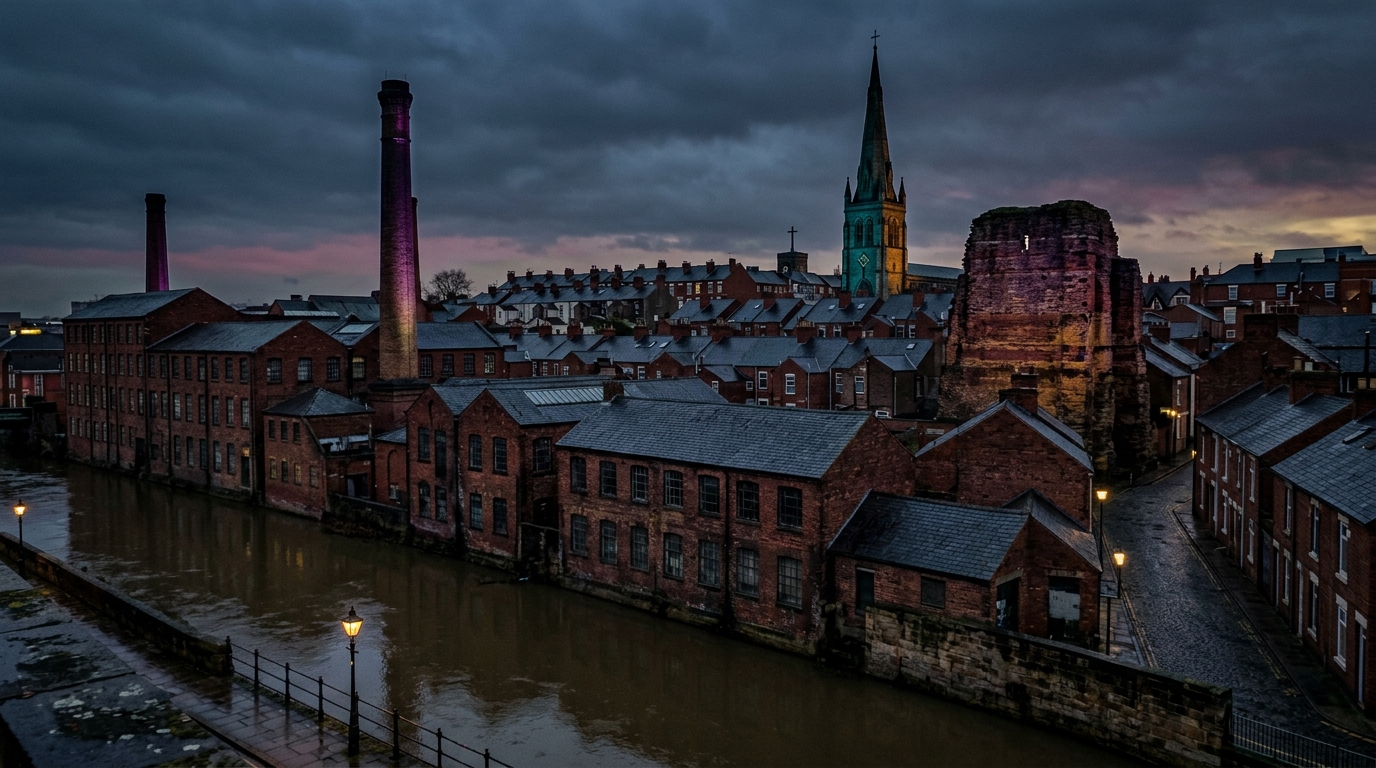
Ratae by the Soar
Leicester was one of the oldest cities in England, and it wore its age in layers. It began as Ratae Corieltauvorum, a Roman town founded around the middle of the first century at the point where the Fosse Way, the great road slicing across the province, crossed the River Soar. The Romans gave it the usual furniture of a provincial town — a forum and a basilica, public baths, a grid of streets with drains beneath them, temples to assorted gods, one of them to the Persian mystery-god Mithras. When the legions withdrew from Britain early in the fifth century the town fell into ruin, but it did not vanish; a great fragment of Roman masonry, the Jewry Wall, still stood, among the largest pieces of Roman building to survive anywhere in the country — a wall that had outlasted the empire that raised it.
Over the centuries that followed, Saxons and Danes and Normans each took their turn over the place, and Leicester settled into the long life of an English market town on the Soar. It is the particular character of such old towns that nothing is ever wholly erased: the Roman street beneath the medieval lane beneath the modern road, the wall that survives its builders. Leicester was a city one could read downward, like a core sample, each age pressed beneath the one that came after.
The Lost King
Through the Middle Ages it grew prosperous on wool, with a castle by the river and a guildhall in its heart and a merchant class that endowed it with the buildings of its confidence. But the thing for which the medieval city would, centuries later, become famous the world over, it did not know it possessed. In 1485, after the last battle of the Wars of the Roses was fought a short way off, the body of the defeated king — Richard III, the last of the Plantagenets and the last English king to die in battle — was brought to Leicester and buried without ceremony in the church of the Greyfriars. The friary was dissolved and pulled down in the next century, the grave was lost, and the king lay forgotten beneath the changing city for more than five hundred years, while it built and rebuilt over him without the least idea that he was there.
He surfaced, astonishingly, in 2012, when archaeologists digging beneath a council car park found a battle-scarred skeleton that proved, by the new sciences, to be the lost king himself. In 2015 he was carried through crowded streets and reinterred with honour in Leicester Cathedral, and a city that had spent five centuries unaware of what lay under its tarmac found itself, all at once, the keeper of a king. It was a strangely Leicester sort of story — the overlooked place holding, all along and unknowingly, something the world would come to marvel at.
The City That Clothed the World
Between the buried king and the found one, Leicester became a city of machines and making. The knitting frame took hold early, and by the eighteenth and nineteenth centuries the town had become the centre of hosiery manufacture in Britain, its mills turning out stockings and knitwear, its workshops cutting and stitching boots and shoes; for a long time it could fairly be said that Leicester clothed and shod a good part of the world. The trade drew the rural poor into the city in their thousands, and the prosperity it made was real but unevenly shared, bought at the usual industrial price of crowded courts and long hours and the labour of children.
It was a city with an inventive, practical streak that ran beyond its looms. It was from Leicester, in 1841, that a cabinetmaker named Thomas Cook organised a railway excursion to a temperance meeting a few miles off, and in doing so more or less invented the packaged holiday and the modern tourist trade. More than a century later, in the laboratories of its university, a scientist working on the inherited patterns in human DNA stumbled in 1984 upon the technique of genetic fingerprinting — the same science that would one day reach back across five hundred years to put a name to the bones beneath the car park. The city that made things had a habit of making consequential ones.
A City Remade
The deepest transformation, though, was in the people themselves. Through the second half of the twentieth century Leicester became one of the most diverse cities in Britain, remade by successive waves of arrival. South Asians had begun settling there in the 1960s; then, in 1972, when Idi Amin expelled the Asian population of Uganda, tens of thousands of East African Asians looked for somewhere to go, and many of them looked to Leicester, where a community was already established. The city's authorities, notoriously, took out a newspaper advertisement in Uganda all but begging them to settle somewhere else. They came anyway, in their thousands, and they remade the parts of the city that had been left for dead — nowhere more visibly than along Belgrave Road, the stretch of jewellers and sari shops and restaurants that became known as the Golden Mile, ablaze each year with one of the largest celebrations of Diwali held anywhere outside India.
Other arrivals followed — Caribbean families whose carnival became a fixture of the city's summer, Somalis through the 1990s, Poles and Lithuanians and others after the eastward expansion of Europe in the 2000s, Syrians and Afghans later still. By the census of 2011 the white British, for so long the unremarked majority, were a majority in Leicester no longer — among the first cities in the country of which that could be said. The advertisement that had once told a community to stay away had been answered, in the end, by a city that became something new: plural, layered, and quietly proud of it.
Sons and Daughters of Leicester
A city of so much coming and going was, of necessity, a city of departures as much as arrivals, and it scattered its own children across the world as steadily as it took others in. Among the families whose roots ran into its streets were the Patels, of the South Asian community that had remade the city around the Golden Mile, and the Smiths, an ordinary Leicester family of the kind the place had produced by the hundred thousand. From the Smiths' terraced ordinariness a son named Noah went out, in time, to the far side of the planet, carrying the family name to Australia and a life lived under a hotter sun than Leicester ever offered — one small thread among the countless the city sent into the world, mostly unrecorded, each beginning in the same grey midland streets.
This was the quieter truth beneath the famous diversity: that Leicester was a place people were from. For every family that arrived to remake it, others left it to make their lives elsewhere, and the city seeded the wider world with its sons and daughters as unremarkably as it absorbed the sons and daughters of other places. A city is, among other things, the sum of the beginnings it gives people, and Leicester had given a great many.
The Underdogs
If the modern city needed a single emblem of its character, it found one, improbably, in its football club. In 2016 Leicester City, a club that had spent most of its history in the game's middle reaches and had begun the season as a five-thousand-to-one outsider, won the Premier League — one of the great upsets in the history of the sport, an unfashionable city's unfashionable team confounding every expectation and every wealthier rival. The whole of Leicester poured into its streets, and for a season the attention of the world rested, with delight, on a place it had mostly never thought about.
It suited the city, that triumph of the overlooked. Leicester had spent most of its long life being underestimated — a workaday midland town, neither London nor one of the great northern cities, easy to pass through on the way to somewhere else. But it had kept a king without knowing it and given the world the holiday and the means to read a person's blood; it had taken in the unwanted and made of them a Golden Mile; and it had a way, when no one was watching, of turning out to contain far more than anyone had supposed. Beneath its ordinary surface ran two thousand years of arrivals and departures — Roman wall and lost king and migrant street and scattered child, layer pressed beneath layer beside the slow brown Soar.







