Laura Mei Chen
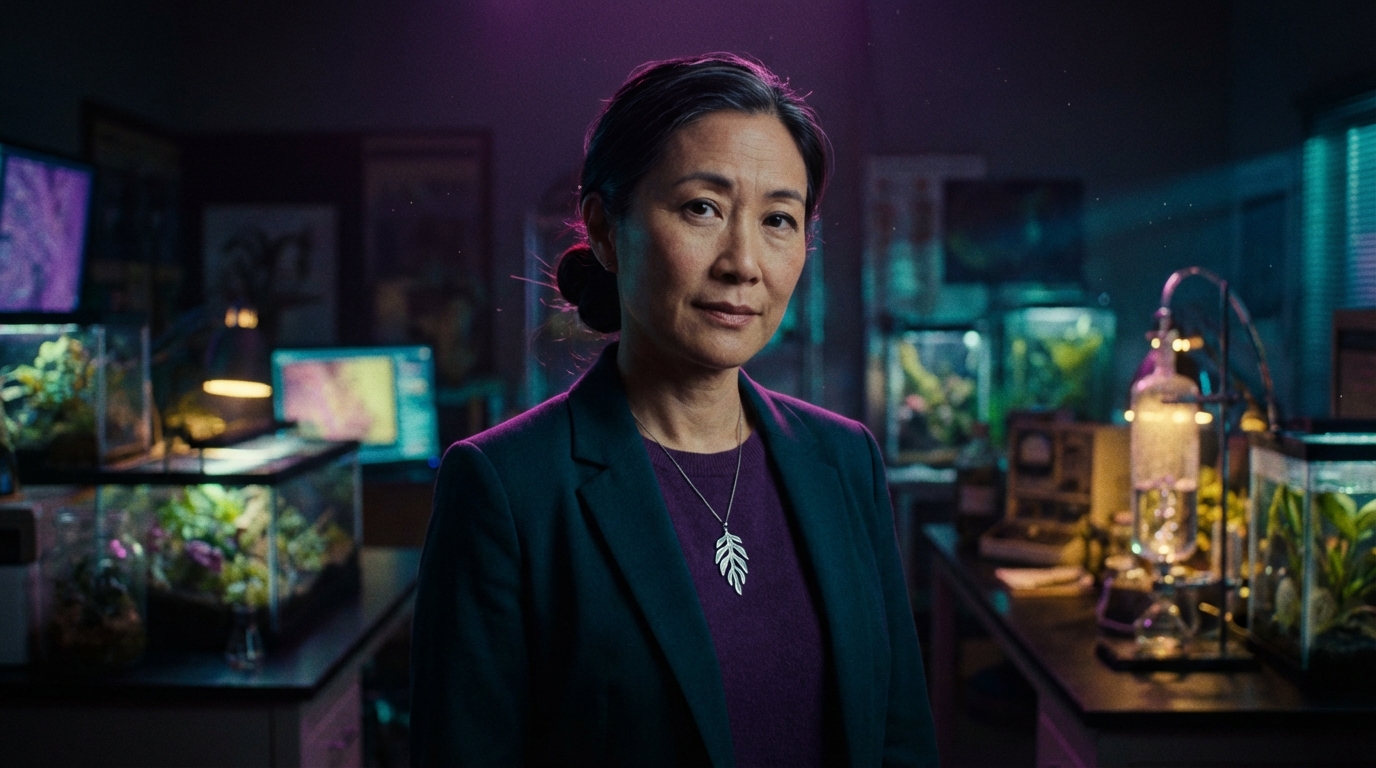
Laura Mei Chen was born in Hobart in 1974 to a marine biologist father and botanist mother whose combined influence made scientific inquiry feel as natural as breathing. Her career in conservation biology — from doctorate research on endangered marsupials to a professorship at the University of Tasmania — established her as one of Australia's leading voices on biodiversity preservation and conservation genetics. What her students, colleagues, and the academic committees that evaluate her publications cannot know is that Laura's conservation work extends beyond any ecosystem mapped on Earth. Recruited by Thaddeus Wainwright in 2011, she became a Guardian of Ender's Climb, her expertise now applied to challenges in a dimension whose existence remains hidden from the scientific community she has spent her life serving.
Birth and Family Origins
Laura Mei Chen was born on 12 March 1974 at Royal Hobart Hospital, the first child of Thomas Wei Chen and Mei Lin Chen (née Wong). Her arrival came during one of Hobart's unpredictable autumn storms, rain lashing the hospital windows while her parents — both scientists who had met through their research — welcomed a daughter whose life would bridge worlds they could not yet imagine.
Thomas Wei Chen had emigrated from Hong Kong in 1965 at age nineteen, following an uncle who had established a modest import business in Melbourne. But Thomas's interests lay not in commerce but in the ocean that had fascinated him since childhood. He worked his way through a marine biology degree at the University of Melbourne, supporting himself through restaurant work and tutoring, before securing a research position at the CSIRO Marine Laboratories in Hobart in 1970. His specialty — the ecology of Southern Ocean kelp forests — would eventually contribute to international understanding of temperate marine ecosystems, though recognition came slowly for a Chinese immigrant in an era when Australian science remained predominantly Anglo.
Mei Lin Wong had arrived in Australia by a different path. Born in Singapore to a family of merchants, she had won a scholarship to study botany at the University of Tasmania in 1968 — one of only three women in her graduating class and the only one of Asian descent. Her research on Tasmanian endemic plant species earned her a position at the Royal Tasmanian Botanical Gardens after graduation, where she would spend three decades cataloguing, preserving, and advocating for the island's unique flora. She met Thomas at a conference on Tasmanian ecosystems in 1971; their courtship proceeded with the careful deliberation of two people more comfortable with data than emotion, culminating in marriage in 1973.
The household Laura entered was bilingual, bicultural, and saturated with scientific thinking. Thomas and Mei spoke Cantonese at home while ensuring their children developed fluent English for school and professional life. The family's modest cottage in Battery Point featured bookshelves overflowing with journals, a microscope on the kitchen table more often than not, and a garden that served as Mei's living laboratory for native plant cultivation. Dinner conversations ranged across ecological relationships, research methodologies, and the politics of scientific funding — topics most children would find bewildering but which Laura absorbed as naturally as other children absorbed fairy tales.
David Wei Chen arrived on 15 August 1977, completing the family. The three-year gap between siblings created natural asymmetry — Laura the studious elder sister who helped with homework and worried about everything, David the more relaxed younger brother who seemed to navigate life with ease that Laura envied without understanding. Their relationship would remain close despite the temperamental differences, David eventually following their father into marine biology while Laura pursued terrestrial and broader conservation concerns.
Childhood and Early Education
Laura's childhood unfolded in the spaces where land met sea, forest met garden, and science met daily life. Weekends often involved expeditions with Thomas to observe coastal ecosystems or with Mei to document plant populations in Tasmania's wilderness areas. These weren't adventures so much as education by immersion, her parents pointing out species, explaining ecological relationships, asking questions that required observation and thought rather than simple memorisation.
Battery Point Primary School (1980-1985) provided Laura's formal education, though teachers quickly recognised that she arrived already knowing more about natural sciences than the curriculum would teach for several years. She was a diligent student — perhaps too diligent, her reports noting a tendency toward perfectionism that sometimes manifested as anxiety when assignments couldn't be completed to her exacting standards. She excelled academically, particularly in mathematics and science, but struggled socially with the casual cruelty children direct toward anyone who seems different. Being Chinese-Australian in 1980s Tasmania meant standing out in ways Laura didn't choose and couldn't change.
The racism she encountered was rarely dramatic — more often the accumulation of small exclusions, assumptions, and comments that reminded her she wasn't quite like everyone else. Classmates asked where she was "really from" despite her Hobart birth. Teachers sometimes expressed surprise at her English fluency. Birthday party invitations arrived inconsistently, their absence teaching lessons about belonging that academic success couldn't erase. Laura responded by retreating into books and study, building competence as armour against rejection she couldn't otherwise prevent.
Her secondary education at St. Michael's Collegiate School (1986-1991) provided more intellectually stimulating environment but continued the social challenges. The school's academic rigour suited Laura's capabilities, and she thrived in biology, chemistry, and mathematics. Her involvement in the science club — eventually becoming its president — allowed connection with peers who shared her interests, reducing though never eliminating the isolation she had felt in primary school. Teachers recognised genuine talent and encouraged her toward university study, though some still seemed surprised that a Chinese girl could perform so well in sciences they unconsciously assumed belonged to different demographics.
The environmental awareness emerging in late 1980s Australia shaped Laura's developing worldview. She followed the Franklin Dam controversy with passionate interest, attended her first conservation rally at fourteen, and wrote letters to politicians advocating for wilderness protection with an earnestness that embarrassed her in retrospect but reflected genuine commitment. By the time she completed Year 12 with marks that would have admitted her to any university in Australia, Laura had determined that her life would serve conservation — though she couldn't yet imagine the dimensions that service would eventually encompass.
University and Academic Formation
Laura enrolled at the University of Tasmania in 1992 to pursue a Bachelor of Science in Biological Sciences. The decision to remain in Hobart rather than seeking mainland opportunities reflected both family attachment and a sense that Tasmanian ecosystems deserved Tasmanian researchers who understood local contexts. Her undergraduate years combined academic intensity with the gradual social development that primary and secondary school had constrained. University provided peers who valued intellectual engagement, reducing the isolation that had characterised earlier education.
Her academic performance was exceptional but achieved through effort rather than effortless brilliance. Laura studied more hours than most classmates, revised assignments repeatedly, and approached examinations with anxiety that sometimes overwhelmed the knowledge she had worked so hard to acquire. The perfectionism that teachers had noted in primary school persisted, manifesting now as inability to submit work she considered inadequate and difficulty accepting grades below distinction. She graduated with First Class Honours in 1995, her thesis examining climate change impacts on native Tasmanian plant species — work that earned praise from supervisors and publication in a respected journal, though Laura focused more on the minor criticisms than the major commendations.
The decision to pursue doctoral study required navigating questions about where and with whom to work. The University of Melbourne's conservation biology programme offered prestige and resources that Tasmania couldn't match, but relocating meant leaving family, leaving familiar landscapes, leaving the island that had shaped her understanding of what conservation meant. She accepted the Melbourne offer in 1996, beginning a PhD that would prove both professionally formative and personally difficult.
Her doctoral supervisor, Professor Richard Hartwell, was brilliant, demanding, and possessed of a temper that could reduce students to tears. He had trained a generation of Australia's leading conservation biologists, but the training came at psychological cost his success obscured. Laura's research focused on the conservation genetics of endangered marsupials — work requiring fieldwork in remote locations, laboratory analysis demanding precision, and writing that Professor Hartwell dissected with criticism that often felt personal rather than professional. She learned enormously from him while developing anxiety patterns that would persist long after the degree was complete.
The four years in Melbourne (1996-2000) also brought personal complications. Laura met James Whitmore — a fellow PhD student in environmental science — during her second year. Their relationship developed through shared interests and the intensity that graduate study creates, progressing to engagement by 1998. But the relationship couldn't survive the pressures both were experiencing: James's growing resentment of Laura's academic success, her inability to provide emotional support while managing Professor Hartwell's demands, and fundamental differences in how they envisioned post-doctoral life. They separated in early 2000, weeks before Laura defended her thesis, the personal failure casting shadow over professional achievement.
She completed her doctorate in May 2000, her thesis on genetic diversity in threatened marsupial populations earning distinction and generating publications that established her scholarly reputation. But Laura left Melbourne exhausted, anxious, and uncertain whether the career she had pursued was worth what it had cost. The return to Tasmania felt less like advancement than retreat.
Early Career and Finding Direction
The postdoctoral fellowship at Australian National University (2000-2003) provided transitional space between doctoral trauma and permanent career. Canberra offered distance from both Melbourne's difficult memories and Hobart's family expectations, allowing Laura to rebuild confidence that Professor Hartwell's supervision had eroded. Her research on population genetics of threatened fauna produced solid publications and collaborative relationships with conservation organisations that would prove valuable throughout her career.
But Canberra also confronted her with academic politics she had naively hoped to avoid. Competition for limited permanent positions meant colleagues were simultaneously collaborators and rivals. Grant applications consumed time that research required. The pressure to publish created incentives for quantity over quality that Laura found ethically uncomfortable. She watched peers cut corners, overstate findings, and engage in the small dishonestries that academic systems seemed to reward. Her own commitment to rigorous methodology sometimes felt like competitive disadvantage.
The lectureship at the University of Tasmania beginning in 2003 brought Laura home — though "home" now meant professional responsibility alongside personal history. Teaching conservation biology, ecology, and genetics to undergraduates revealed capabilities she hadn't recognised: the ability to explain complex concepts clearly, the patience to guide students through confusion, the satisfaction of watching understanding develop in minds she had helped shape. Students consistently rated her courses highly, appreciating both her expertise and her genuine investment in their learning.
Her research programme developed alongside teaching responsibilities, focusing on Tasmanian biodiversity with particular attention to species threatened by climate change, habitat loss, and introduced predators. Grant applications succeeded more often than they failed, funding fieldwork in locations she had explored with her parents decades earlier. Publications accumulated steadily if not spectacularly, her work earning respect for methodological rigour rather than flashy findings. Promotion to Senior Lecturer came in 2007, recognition of sustained contribution rather than singular achievement.
Personal Life and Its Complications
The years following her return to Tasmania brought personal stability that had eluded her during doctoral study, though stability didn't mean simplicity. Laura's relationship with her family deepened as adult understanding replaced adolescent tension. She recognised how much her parents had sacrificed to provide opportunities she had sometimes taken for granted, and made conscious effort to maintain connection despite professional demands that could easily have justified distance.
Thomas's retirement from CSIRO in 2008 and Mei's from the Botanical Gardens in 2010 shifted family dynamics. Her parents remained active in conservation advocacy but increasingly relied on Laura and David for practical support as age brought limitations neither wanted to acknowledge. David's career had taken him to Queensland, where he worked on Great Barrier Reef research, making Laura the local child responsible for ageing parents — a role she accepted without resentment but not without cost to her own time and energy.
Her romantic life remained complicated. The failed engagement to James Whitmore had left scars that made subsequent relationships difficult to sustain. Laura dated intermittently throughout her thirties, each relationship ending when partners wanted commitment she couldn't provide or when her work consumed time that relationships required. She recognised the pattern without knowing how to change it — the retreat into professional achievement when personal connection became frightening, the use of busyness as protection against vulnerability.
By forty, Laura had accepted that marriage and children were unlikely to feature in her life. The acceptance brought relief alongside grief — relief from expectations she hadn't chosen, grief for experiences she would never have. Her colleagues assumed the childlessness was career choice; few understood the complicated mix of circumstance, psychology, and genuine ambivalence that had produced it. She channelled nurturing instincts into mentorship of graduate students, finding satisfaction in their development even as she recognised it wasn't quite the same.
The Approach and Transformation
The invitation came in late 2011, after Laura had been promoted to Associate Professor and established herself as one of Australia's leading conservation biologists. Thaddeus Wainwright appeared at a symposium on climate change adaptation where Laura was presenting research on species migration patterns. His questions during the Q&A revealed knowledge that seemed to exceed what any ordinary academic possessed — understanding of ecological relationships that her own research was only beginning to map.
The subsequent conversations unfolded across several months, Thaddeus revealing truths gradually with the patience of someone who had made such revelations before. The existence of Clivilius. The Portal Keys that enabled dimensional travel. The Guardians who carried these keys and the conservation challenges they faced in ecosystems no Earth-bound scientist had ever studied. Each revelation challenged everything Laura's training had taught her about the limits of biological possibility — but the evidence proved impossible to dismiss.
The Portal Key Thaddeus presented carried weight beyond its physical form. Accepting it meant accepting responsibility for secrets that could never be shared with colleagues, family, or the scientific community that had shaped her career. It meant conservation work that would never appear in publications, could never be discussed at conferences, would never contribute to the academic reputation she had spent decades building. Laura accepted because the alternative — knowing what existed and choosing not to help — seemed impossible for someone whose life had been dedicated to protection.
The Foundation and Dual Purpose
Laura's involvement in establishing the TerraNova Conservation Foundation reflected both her scientific expertise and her growing understanding of how Guardian operations required Earth-based infrastructure. The Foundation needed academic credibility that her position could provide; her research networks offered access to expertise that Clivilius conservation challenges required.
Her role as Deputy Chair placed her at the centre of Project TerraNova's scientific dimensions. She helped design the partnership frameworks that would draw conservation professionals into the Foundation's orbit. She evaluated potential recruits whose expertise aligned with Clivilius needs. She developed the "Phase 0 documentation" that introduced selected individuals to possibilities their training had never contemplated. The work required skills her academic career had developed — evaluating evidence, designing research programmes, mentoring individuals through conceptual transformation — applied to purposes her academic career could never acknowledge.
The dual existence proved more manageable than she had feared, perhaps because academic life already required compartmentalisation. Scientists maintain separation between research excitement and publication caution, between collegial collaboration and competitive ambition, between public confidence and private doubt. Adding another compartment — Guardian knowledge that couldn't be shared — extended patterns already established rather than creating entirely new psychological demands.
But the secrecy exacted costs she hadn't anticipated. Conversations with colleagues increasingly involved evasion, as questions about her research touched areas she couldn't honestly address. Her publications continued but felt increasingly incomplete, describing fragments of understanding while larger truths remained unspoken. The satisfaction of scientific contribution — sharing knowledge that others could build upon — diminished when her most significant discoveries could never be shared.
Academic Achievement and Its Limits
Promotion to Professor in 2015 represented the culmination of academic achievement Laura had pursued since childhood. The title brought recognition, responsibility, and resources that enabled research programmes she couldn't have attempted earlier. Her laboratory grew to include multiple PhD students and postdoctoral researchers, their combined efforts addressing questions about Tasmanian biodiversity that would have required decades working alone.
Her teaching evolved to incorporate insights that Guardian experience had provided — broader perspectives on conservation challenges, deeper understanding of what success and failure might mean across timescales longer than academic careers typically considered. Students responded to passion they couldn't fully explain, recognising genuine commitment without understanding its dimensional sources.
But professorial status also brought responsibilities that constrained the flexibility Guardian work sometimes required. Committee meetings, administrative duties, the institutional obligations that senior academics cannot escape — all competed for time that conservation challenges in multiple dimensions demanded. Laura learned to manage competing priorities, but management meant compromise, and compromise meant that no priority received the attention it deserved.
The academic politics she had observed as a postdoc intensified at professorial level. Disputes over resources, credit for collaborative research, strategic positioning for grants and influence — the petty conflicts that institutional life generates regardless of how noble the institutional purposes. Laura participated without enthusiasm, protecting her research group's interests while recognising that the energy expended on internal competition might better serve actual conservation outcomes.
The Guardians and Found Family
The Guardians of Ender's Climb became, over years of shared purpose and secret knowledge, something Laura had never quite achieved in ordinary life: genuine community. Michael Tan's steady leadership provided structure her own tendencies toward anxiety appreciated. Brad Coleman's practical capability complemented her theoretical expertise. Derek Simmons's technological creativity opened possibilities her training hadn't prepared her to imagine. Abbey Stockton's engineering perspective brought fresh approaches to problems Laura's biological focus sometimes overlooked.
The relationships deepened through experiences that couldn't be shared with anyone outside the group. Portal travel that transformed understanding of what reality contained. Conservation work in ecosystems no scientific paper would ever describe. The weight of secrets that separated them from colleagues, friends, and family who couldn't know what they knew. The Guardians understood each other in ways that conventional friendships couldn't replicate, their bond forged through shared transformation rather than merely shared interest.
Derek's murder in July 2018 devastated Laura in ways that surprised her. She had worked with him for seven years, respected his capabilities, appreciated his humour — but hadn't recognised until his death how much his presence had anchored her sense of Guardian community. The loss removed expertise the group needed, but more than that, it removed someone who understood dimensions of her life that no one else could share. She grieved privately, unable to explain to colleagues or family why the death of a Foundation board member affected her so profoundly.
Character and Contradictions
Those who know Laura Chen professionally describe someone whose expertise commands respect and whose mentorship shapes careers. Her publications are methodologically rigorous, her teaching evaluations consistently excellent, her service to the university and broader scientific community exemplary. She attends conferences, delivers keynotes, serves on editorial boards and grant committees with the dedication expected of senior academics. The professional persona is genuine — Laura cares deeply about conservation and about the students and colleagues who share that commitment.
But the professional persona conceals complexities that professional contexts don't accommodate. The anxiety that has accompanied her since childhood persists despite achievements that might reasonably have quieted it. She still revises manuscripts obsessively, still dreads negative reviews, still experiences conference presentations as ordeals to survive rather than opportunities to enjoy. The perfectionism that drove her academic success also prevents satisfaction with that success, each achievement generating new standards that subsequent achievements must exceed.
Her personal life remains sparse in ways she has stopped trying to change. The Battery Point cottage she purchased in 2008 — just streets from where she grew up — houses books, plants, and the organised solitude she has learned to appreciate. Colleagues assume she spends evenings preparing lectures or writing papers; they don't suspect the portal travel, the dimensional research, the Guardian responsibilities that consume time her teaching load alone couldn't explain. The solitude is partly chosen, partly circumstantial, partly the consequence of secrets that make genuine intimacy difficult to sustain.
Her relationship with her heritage has evolved across decades. The Chinese-Australian identity that marked her as different in childhood has become source of connection as well as complexity. She maintains the Cantonese her parents taught her, visits Hong Kong periodically to reconnect with extended family, and has helped University initiatives supporting international students who face challenges she remembers from her own education. But she also recognises privileges her generation enjoyed that earlier immigrants couldn't — educational access, professional opportunities, social acceptance that her parents' generation fought to establish. The recognition generates gratitude alongside the residual wounds that childhood exclusion inflicted.
The Present and Continuing Purpose
By the mid-2020s, Laura had spent over a decade as both professor and Guardian, navigating demands that would have seemed impossible had anyone described them when she began her academic career. Her official research programme continued producing publications on Tasmanian biodiversity and conservation genetics. Her teaching shaped new generations of conservation scientists. Her administrative responsibilities — chairing committees, evaluating promotions, advising the Vice-Chancellor on environmental initiatives — occupied time that other priorities also demanded.
Her Guardian work had evolved from early wonder toward the steady commitment that long-term conservation requires. The ecosystems she studied in Clivilius were no longer novel but familiar, their challenges understood even when solutions remained elusive. Her role within Project TerraNova had shifted from active recruitment toward strategic planning, helping design the programmes that would cultivate expertise across years rather than personally approaching each potential contributor.
Her parents required increasing attention as age brought limitations. Thomas's mobility had declined, requiring modifications to the family home and conversations about futures that none of them wanted to contemplate. Mei remained sharp but tired more easily, her garden smaller now than in Laura's childhood because maintaining larger plots exceeded her energy. Laura visited weekly, helped with practicalities, provided the support that David's Queensland residence prevented him from offering. The role reversal — child becoming caretaker — felt strange and somehow fitting, continuity across generations that echoed the ecological relationships she had spent her career studying.
The question of legacy occupied increasing reflection. Her publications would persist in databases and library collections. Her students would continue careers she had helped shape. The conservation outcomes her work had supported — both on Earth and in dimensions her publications couldn't mention — would matter beyond her individual lifespan. But the recognition she might have sought earlier in her career seemed less important now than the work itself, the ongoing effort to understand and protect systems whose complexity exceeded any individual comprehension.







