Laura Elizabeth Blackwood (née Carter)
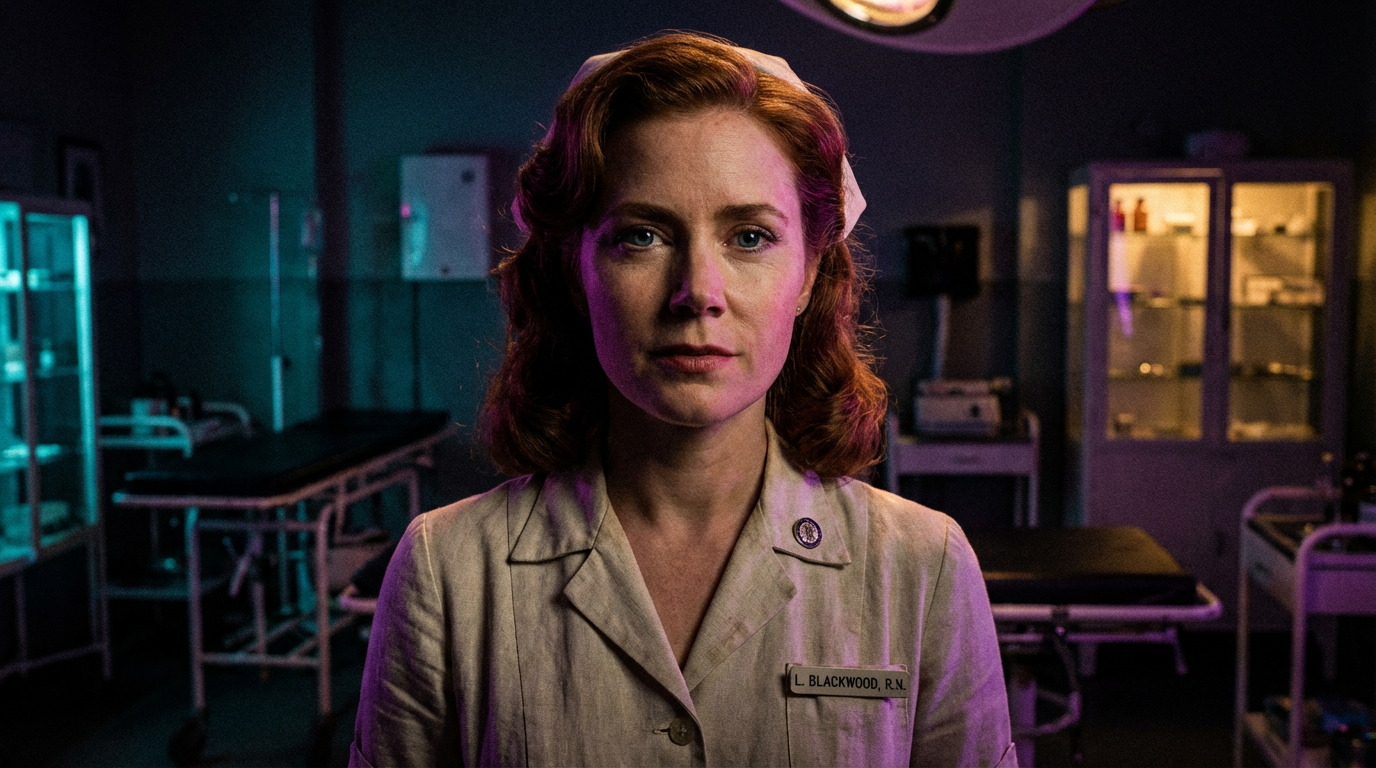
Laura Elizabeth Blackwood, née Carter (1918–1994), was a Sydney-born nurse whose career spanned wartime field hospitals, post-war surgical wards, and the teaching of a generation of Brisbane nurses. The daughter of a Balmain boilermaker, she married the surgeon Edward Thomas Blackwood in 1940, raised their son Alexander during the disruptions of war, survived her husband by twenty-four years, and retired to a widowhood whose length surprised her more than its solitude.
Early Life and Family
Laura Elizabeth Carter was born on 3 May 1918 in a narrow terrace house in Glebe, Sydney, the third of five children born to Henry Arthur Carter, a boilermaker at the Mort's Dock and Engineering works in Balmain, and Margaret Carter, née Wilson, a nurse whose career at Sydney's public hospitals had been interrupted by marriage and motherhood but whose professional identity persisted, through habit and conviction, long after her circumstances had ceased to accommodate it. The Carter household occupied the lower end of Glebe's social gradient — respectable, clean, financially constrained, and governed by the particular economy of pride that working-class families maintained when their neighbours' circumstances were not significantly different from their own.
Henry Carter crossed the harbour to Balmain each morning by ferry, returning in the evenings with the soot of the dockyards embedded in his skin and the fatigue of physical labour expressed through a quietness that his children learned early to distinguish from displeasure. He was a decent man whose capabilities — manual skill, physical endurance, a reliability so consistent that those who depended on it forgot to notice it — had been shaped by the limited opportunities that a working-class childhood in early twentieth-century Sydney provided. Margaret Carter, whose nursing training had given her a professional framework that her husband's trade did not possess, managed the household with a competence whose medical dimensions — the insistence on hygiene, the swift assessment of childhood injuries, the refusal to treat illness with superstition when remedies were available — gave the Carter home a clinical efficiency that its cramped proportions did not otherwise suggest.
Laura's siblings reflected the compressed spacing that working-class families of the period typically produced. Her eldest brother, Henry James, born in 1914, apprenticed as an electrician and enlisted in 1940. Her sister Dorothy, born in 1916, married a railways clerk and settled in Parramatta. Laura herself was followed by twin boys, Arthur and George, born in 1920 — Arthur became a plumber, George a postal worker. The family was close in the unsentimental way that shared space and limited resources enforced, its bonds expressed through practical support rather than verbal affection, its conflicts resolved through temporary silence rather than sustained discussion.
Education and Nursing Training
Laura attended Sydney Girls High School, where she demonstrated the aptitude for science and mathematics that her mother's medical background had encouraged without deliberately cultivating. She was a capable student whose academic performance might have qualified her for university had the family's finances permitted the aspiration, but the Depression — which reduced Henry's hours at the dockyard and compressed the household's already tight budget to the point where every shilling required justification — ensured that Laura's education ended with her school certificate. The limitation did not distress her as it might have distressed a girl whose ambitions were more abstractly intellectual; Laura's orientation was practical, her interest in how things worked expressed through the physical and biological rather than the theoretical, and the path from school to nursing felt less like a compromise than a clarification.
She enrolled at the Royal Prince Alfred Hospital Nursing School in 1936, at the age of eighteen. The training was rigorous, hierarchical, and governed by a discipline that Laura's working-class upbringing had prepared her to accept without the resistance that students from more privileged backgrounds sometimes displayed. She learned surgical nursing, ward management, and the particular combination of physical stamina, emotional steadiness, and rapid assessment that the profession demanded. She graduated in 1939 and entered practice at the hospital whose corridors she would navigate for the next four years, her hands acquiring the competence that would sustain her through a career conducted in operating theatres, military hospitals, and the teaching rooms where she would eventually transmit what she had learned to nurses whose peacetime training could not replicate the conditions under which her own skills had been forged.
Edward
Laura met Edward Thomas Blackwood during her first year of practice at Royal Prince Alfred, where Edward was completing his surgical training. The attraction was not instantaneous in the romantic sense, but it was immediate in the professional one — Laura recognised in Edward a surgeon whose technical precision matched the standard she had been trained to support, and Edward recognised in Laura a nurse whose competence in the operating theatre exceeded what his experience of the profession had led him to expect. The personal connection developed from the professional one, growing through shared shifts, the particular intimacy that medical emergencies create between people who manage them together, and the gradual recognition that the qualities each valued in the other — steadiness, reliability, the capacity to function under pressure without performance or collapse — were the same qualities that sustained a relationship as effectively as they sustained a surgical team.
They married on 19 October 1940. The ceremony was small — wartime conditions discouraged extravagance, and neither Laura's working-class family nor the Blackwood family's reduced Tasmanian presence in Sydney provided the social infrastructure that a larger wedding would have required. Edward had already received his commission with the Australian Army Medical Corps, and the knowledge that the marriage was being compressed into whatever time the war left them added an urgency to the proceedings that substituted, without anyone acknowledging it, for the leisurely courtship that peacetime would have allowed.
Laura understood, upon entering the Blackwood family, that she was marrying into a dynasty whose history and expectations exceeded anything her own background had prepared her for. She met the information with the practical assessment that she brought to most situations: the Blackwood name carried prestige that she could not replicate, but the skills she possessed — nursing, domestic management, the particular resilience that a working-class childhood instilled — were capabilities that prestige alone could not provide. She was not intimidated by the Blackwoods. She was not, for that matter, particularly impressed by them. She assessed Edward on his own merits, married him on the basis of that assessment, and conducted herself within the family according to standards she had established for herself rather than standards the family's history prescribed.
The War
Edward's deployment with the Army Medical Corps left Laura in Sydney with a pregnancy that advanced through the early months of 1941 whilst the war in the Pacific escalated toward the crisis that would bring the conflict to Australia's doorstep. She continued nursing at Royal Prince Alfred until her condition made continuation impractical, then relocated to Brisbane, where Edward was stationed intermittently between deployments and where the military hospital infrastructure provided both employment for Laura and proximity to her husband during his periods of leave.
Alexander Edward Blackwood was born on 10 February 1942 at Brisbane's Mater Hospital. Laura had worked her ward shift until labour made continuation impossible — a decision that reflected less the heroism that subsequent accounts sometimes attributed to wartime nurses than the practical reality that staffing shortages during the Pacific campaign left no margin for early departure. Edward, who had been operating on wounded servicemen for fourteen consecutive hours, arrived at Laura's bedside in time for the delivery but in a state of exhaustion that made his presence more symbolic than functional. Alexander entered the world in a city under blackout conditions, his first hours accompanied by the air raid sirens that had become Brisbane's wartime soundtrack, and the circumstances of his birth — the urgency, the medical context, the parents whose professional lives had already been shaped by the demands of healing under pressure — would prove more formative than anyone present could have anticipated.
The remaining war years were managed with the improvisatory competence that wartime demanded. Laura nursed when she could, cared for Alexander when she could not, and maintained a household whose domestic arrangements changed with each of Edward's deployments and returns. She did not romanticise the experience — she was not a woman inclined toward romanticism in any context — but she endured it with a steadiness that those who knew her recognised as characteristic and that those who did not know her might have mistaken for indifference. She was not indifferent. She was efficient, which in wartime conditions served the same function with rather less waste.
Post-War Life
The family's post-war years were spent in Sydney initially, where Edward returned to the Royal Prince Alfred Hospital, and later in Brisbane, where his appointment at a teaching hospital in the late 1950s required the relocation that Laura managed with the practical adaptability she had demonstrated throughout their marriage. She resumed nursing in Brisbane, working in surgical wards before transitioning in the early 1960s to a teaching role at the hospital's nursing school — a shift that reflected both the physical demands of ward nursing on a woman approaching her mid-forties and the recognition that Laura's experience, accumulated across wartime field hospitals and two decades of surgical practice, constituted a resource more valuable in a classroom than on a ward.
She was an effective teacher whose methods reflected her own training and temperament: direct, practically oriented, impatient with theory that could not be connected to clinical application, and demanding of her students in ways that some found harsh and others — particularly those who later encountered the realities of surgical nursing — recognised as essential. She did not coddle, did not praise excessively, and did not soften her assessments to accommodate the sensitivities of students whose expectations of nursing bore insufficient resemblance to the profession's actual demands. Her students either admired her or resented her, and the former tended to become better nurses whilst the latter tended to discover, eventually, that she had been right.
Her marriage to Edward settled, during the Brisbane years, into the steady companionship that their compatible temperaments had always promised. They were not a demonstrative couple — affection expressed itself through shared routines, the reliable management of domestic responsibilities, and the mutual recognition that each partner's capabilities were both different and necessary. Laura cooked, maintained the house, managed the social obligations that Edward's professional position generated, and accepted without resentment the reality that her husband's surgical career consumed more of his energy and attention than their domestic life received. The acceptance was not resignation; it was the practical assessment of a woman who understood the demands of medical work because she had spent her own career subject to them, and who valued what her marriage provided — stability, respect, a partnership that functioned — without requiring it to provide what its structure could not accommodate.
Widowhood
Edward Thomas Blackwood died on 5 April 1970, in the garden of their Brisbane home, a book open on his lap and an expression of surprise on his face. Laura found him. She checked his pulse — the nurse's reflex preceding the wife's reaction by the fraction of a second that training imposed — confirmed what she already knew, and telephoned the hospital. The professional competence with which she managed the immediate aftermath of her husband's death was noted by everyone who witnessed it, and interpreted variously as admirable composure, emotional detachment, or the particular response of a woman whose career had taught her to defer the processing of crisis until the crisis itself had been managed. The interpretations were not mutually exclusive.
She was fifty-two years old. Alexander was twenty-eight, already established in the cardiology that would define his career. The widowhood that followed — twenty-four years, longer than many marriages — was not the diminished existence that bereavement sometimes imposes. Laura continued teaching at the nursing school until her retirement in 1978, maintaining the professional identity that her marriage had accommodated rather than replaced. She lived in the Brisbane house, managed her own affairs with the competence that her working-class upbringing and her nursing career had both reinforced, and constructed a post-Edward existence whose independence was neither celebrated nor mourned but simply occupied — the way one occupies a room that has become available because someone else has left it.
She missed Edward. The missing was not dramatic — Laura's emotional register did not extend to drama — but it was persistent, expressing itself through the habits of a shared life that continued after the person who had shared it was gone. She set two places at the table for months before the redundancy registered. She caught herself saving items from the newspaper that Edward would have found interesting. She woke in the early hours and reached across the bed before remembering that the space was empty. These were not symptoms of pathological grief; they were the ordinary adjustments that a body makes when the routines of thirty years are interrupted by the permanent absence of the person around whom those routines were organised.
Her relationship with Alexander deepened during the widowhood years in ways that their earlier dynamic — he the dutiful son, she the practically competent mother — had not suggested. Alexander's own marriage failed, and the period that followed brought him closer to Laura than either of them had been since his childhood. She provided, characteristically, practical support rather than emotional counsel — managing his household during the transition, ensuring that the grandchildren, Sebastian and Sienna, experienced continuity and stability during a period when their father's personal life could not reliably provide it. She adored the grandchildren with a warmth that surprised those who had known only the professional Laura, the efficient Laura, the Laura whose competence sometimes obscured the affection it was designed to protect.
Death
Laura Elizabeth Blackwood died on 12 September 1994 in Brisbane, at the age of seventy-six. She had been diagnosed with pancreatic cancer four months earlier — a diagnosis she received with the clinical comprehension of a woman who understood exactly what the words meant and whose professional experience had taught her what the trajectory would involve. She declined aggressive treatment, a decision she communicated to Alexander with the directness that characterised all her communications and that he, as a physician, understood to be medically rational even as he found it, as a son, impossible to accept without protest. She managed her own dying with the same efficiency she had brought to everything else: arranging her affairs, reducing her obligations, and maintaining her household routine for as long as her deteriorating condition permitted.
She died at home, which she had insisted upon, attended by a palliative nurse whose professional capabilities Laura assessed and approved during their first meeting. Alexander was present. The grandchildren visited during the final week. The death was not peaceful in the sanitised sense that obituaries typically employ — pancreatic cancer is not a peaceful disease — but it was managed, which for Laura constituted the closest available approximation of the control she had exercised over every other aspect of her life.







