4128.59 · February 28, 1808 AD
Land Ho
After three hundred days at sea, the cry from the masthead shatters William's grey existence between waking and sleeping—and as the Resolution threads through sandstone cliffs into Sydney Harbour, he glimpses something unexpected beneath the alien birds and burning sun: not merely a prison, but a colony where ambition has carved civilisation from the edge of the known world.
"The sun here will cook you like a joint on a spit if you let it. Learn that lesson quick, lad, or you won't survive your first summer."— Old Tom
The cry came down from the masthead just after dawn, when the eastern sky had barely begun to shed its burden of stars. Two words, bellowed by the lookout with a force that seemed to crack the very air: "Land ho!"
William Jeffries had been dozing in his hammock, suspended in that grey territory between sleep and waking where the ship's endless motion had become indistinguishable from breathing. The shout pierced through the fog of exhaustion like a blade through sailcloth, and he found himself on his feet before his mind had fully registered what he had heard. Around him, the hold erupted into chaos—men who had spent ten months in chains suddenly scrambling toward the ladder, voices rising in a tumult of hope and terror and disbelief.
Land. After three hundred days at sea. After fifteen thousand miles of empty horizon. After storms that had tossed the Resolution like a cork in a washbasin and calms that had left her becalmed for weeks beneath a sun that seemed determined to boil the very ocean. Land.
William pushed his way through the press of bodies with an urgency that surprised him. His legs, weakened by months of confinement, trembled beneath him as he climbed the ladder toward the deck. The manacles at his wrists caught against the rungs, their familiar bite a reminder that whatever lay ahead, he would meet it as a prisoner. Yet even that knowledge could not dampen the desperate need that drove him upward—the need to see with his own eyes the place that would be his prison for the next seven years.
He emerged onto the deck into air that tasted different from anything he had breathed since leaving England. The salt was still there, that constant companion of the voyage, but beneath it lay something else—something green and living and utterly foreign. He drew it into his lungs and felt his chest expand with sensations he could not name, scents that belonged to no landscape his memory contained.
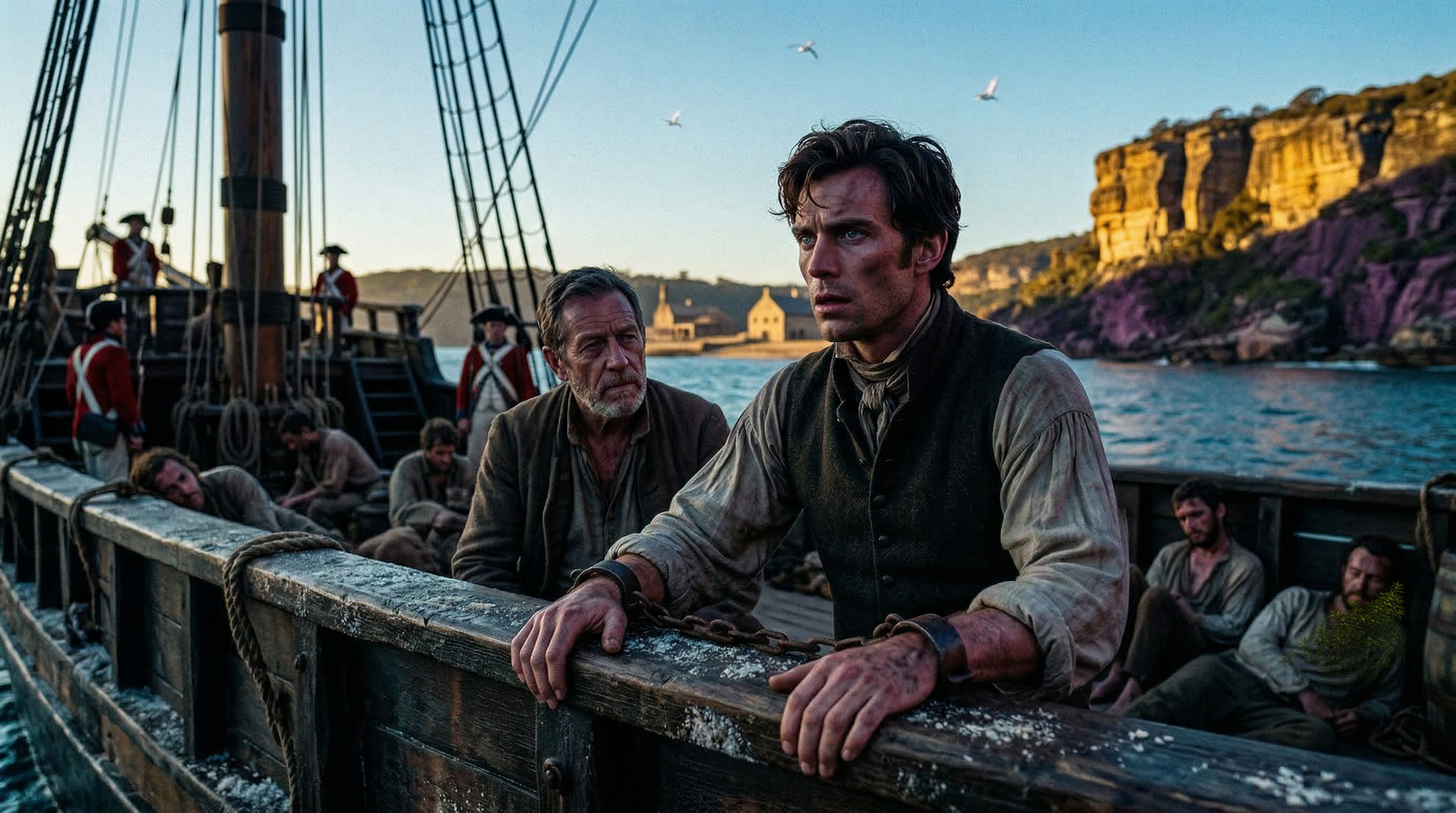
The convicts crowded against the starboard rail, pressing forward until the guards shouted warnings and brandished their weapons. William found a place among them and gripped the salt-crusted timber with fingers that had forgotten the feel of anything that did not pitch and roll beneath them. He squinted against the early light, searching the horizon for the promised land.
At first he saw nothing but the familiar grey expanse of sea meeting sky in a line that seemed to stretch toward infinity. Then, gradually, as the light strengthened and the ship drew closer, shapes began to resolve themselves from the haze. Dark masses rose from the water, their forms indistinct but undeniably solid. Headlands. Cliffs. The unmistakable silhouette of a coastline that had existed only in rumour and imagination for the entirety of the voyage.
Australia. New Holland. The Great South Land. It had been called many things by the men who spoke of it aboard the Resolution—some with hope, others with dread, most with a mixture of both that defied easy categorisation. William had listened to their tales during the long months at sea, had tried to construct in his mind some picture of what awaited them. Nothing he had imagined bore any resemblance to what now revealed itself before his eyes.
The coastline emerged from the morning mist like a creature surfacing from deep water—slowly, reluctantly, revealing itself in fragments that the mind struggled to assemble into coherence. Sandstone cliffs glowed amber and ochre in the strengthening light, their faces scarred by millennia of wind and wave into patterns that suggested ancient script in some language no human tongue had ever spoken. Dark vegetation clung to their summits, trees of a green so muted it appeared almost grey, their shapes twisted and strange against the brightening sky.
The scale of it confounded William's senses. After so many months confined to the Resolution's cramped spaces, where the horizon had shrunk to the distance between one man's hammock and the next, the sheer vastness of what lay before him seemed almost obscene in its excess. The cliffs towered higher than any he had seen along the English coast, yet they were merely the gateway to something larger still—a harbour that opened before the ship like the maw of some tremendous beast, its depths promising either sanctuary or consumption.
Birds wheeled overhead in numbers that defied counting. They were not the gulls William knew from Portsmouth, those grey-and-white scavengers whose cries had provided the constant accompaniment to his childhood. These creatures blazed white against the pale sky, their plumage catching the early light until they seemed to burn with cold fire. Their calls rang harsh and alien across the water—shrieks and cackles and strange chattering sounds that bore no resemblance to any birdsong England had ever produced.
"Cockatoos," muttered a voice beside him. William turned to find Old Tom at his elbow, the grizzled smuggler who had taken him under his protection during the voyage. Tom's weathered face bore an expression William could not quite read—something between recognition and resignation, the look of a man returning to a place he had hoped never to see again. "Sulphur-crested cockatoos. You'll learn to hate that sound soon enough, lad. They start up before dawn and don't stop until you want to tear your own ears off."
"You've been here before," William said. It was not a question. Tom had spoken of his previous transportation during the long nights in the hold, though always in fragments, never as a complete narrative.
"Aye. Served seven years at Norfolk Island before earning my ticket of leave. Went back to England thinking I'd learned my lesson." Tom's lips twisted into something that was not quite a smile. "Seems I hadn't. And here we are again, at the arse end of the world, watching the same bloody birds circle the same bloody cliffs."
William returned his gaze to the approaching shore. The harbour was revealing more of itself now as the Resolution navigated the entrance, her weathered sails straining against a breeze that carried warmth wholly unlike any English wind. The water beneath her hull had shifted from the deep blue of open ocean to something greener, more opaque, as though the land itself were bleeding colour into the sea.
Captain Josiah Haverford stood upon the quarterdeck, his telescope trained upon the waters ahead with the focused attention of a man threading a needle whilst riding a galloping horse. The entrance to Sydney Harbour, William had learned from the sailors' talk, was treacherous to those who did not know its secrets—shoals and rocks lurking beneath the seemingly placid surface, currents that could catch an unwary vessel and dash her against the cliffs before her captain could draw breath to curse. Haverford had navigated these waters before, during his previous voyages as a transport captain, and his commands rang out with the confidence of experience.
"Hands to the braces! Ready about!"
The crew scrambled to obey, their movements practised despite the weariness that ten months at sea had etched into every line of their bodies. The Resolution heeled slightly as she came about, her bow swinging to follow the channel that wound between the headlands. William felt the deck shift beneath his feet and gripped the rail more tightly, his body still anticipating the ship's movements even as his eyes remained fixed upon the landscape sliding past.
The cliffs rose on either side now, close enough that he could see the striations in the sandstone, the dark mouths of caves carved by ancient waters, the stubborn vegetation clinging to every ledge and crevice. The rock glowed in the morning light—bands of cream and gold and rust that seemed to pulse with an inner warmth, as though the stone itself retained some memory of the fires that had formed it. Against this backdrop, the grey-green foliage appeared almost colourless, bleached by a sun far fiercer than any William had known.
A pair of natives stood upon one of the headlands, their dark figures stark against the bright stone. They watched the ship's passage with an stillness that suggested neither fear nor welcome, merely observation—as though they were noting the arrival of yet another vessel in a procession that had long since ceased to surprise them. One of them raised an arm, pointing toward the Resolution, and William saw the glint of something—a spear, perhaps, or merely a fishing implement—before the ship rounded the headland and the figures disappeared from view.
"Don't let them fool you with that peaceful look," Tom said quietly. "They've got no love for us, and who can blame them? We've taken their land, their hunting grounds, their fishing waters. Given them nothing in return but disease and musket balls. If you find yourself in the bush alone, lad, pray you don't meet any of them in a mood for settling scores."
The harbour opened before them like a vast amphitheatre, its waters stretching into innumerable coves and inlets that fragmented the shoreline into a puzzle of bays and peninsulas. William had expected wilderness—a savage coast untouched by human habitation, perhaps marked by nothing more than the crude shelters of the natives. What he saw instead stopped the breath in his throat.
Sydney Cove lay nestled at the harbour's southern shore, a settlement that proclaimed British ambition with every structure it contained. Buildings of brick and stone lined the waterfront, their forms unmistakably European despite the alien landscape that surrounded them. A church spire rose above the rooftops, its cross glinting in the morning sun. Warehouses and storerooms clustered near the water's edge, their doors standing open to receive the commerce that sustained the colony. Streets—actual streets, laid out in something approaching order—climbed the gentle rise behind the cove, lined with structures that ranged from substantial dwellings to rough timber hovels.
A flag flew from a pole atop the highest point of land, the Union colours snapping in the harbour breeze. The sight of it stirred something complicated in William's chest—pride and resentment tangled together in ways he could not begin to separate. That flag represented the nation that had condemned him, the system that had transported him to the far side of the earth for a crime he had not committed. Yet it also represented order, civilisation, the possibility that this strange land might offer something more than mere survival.
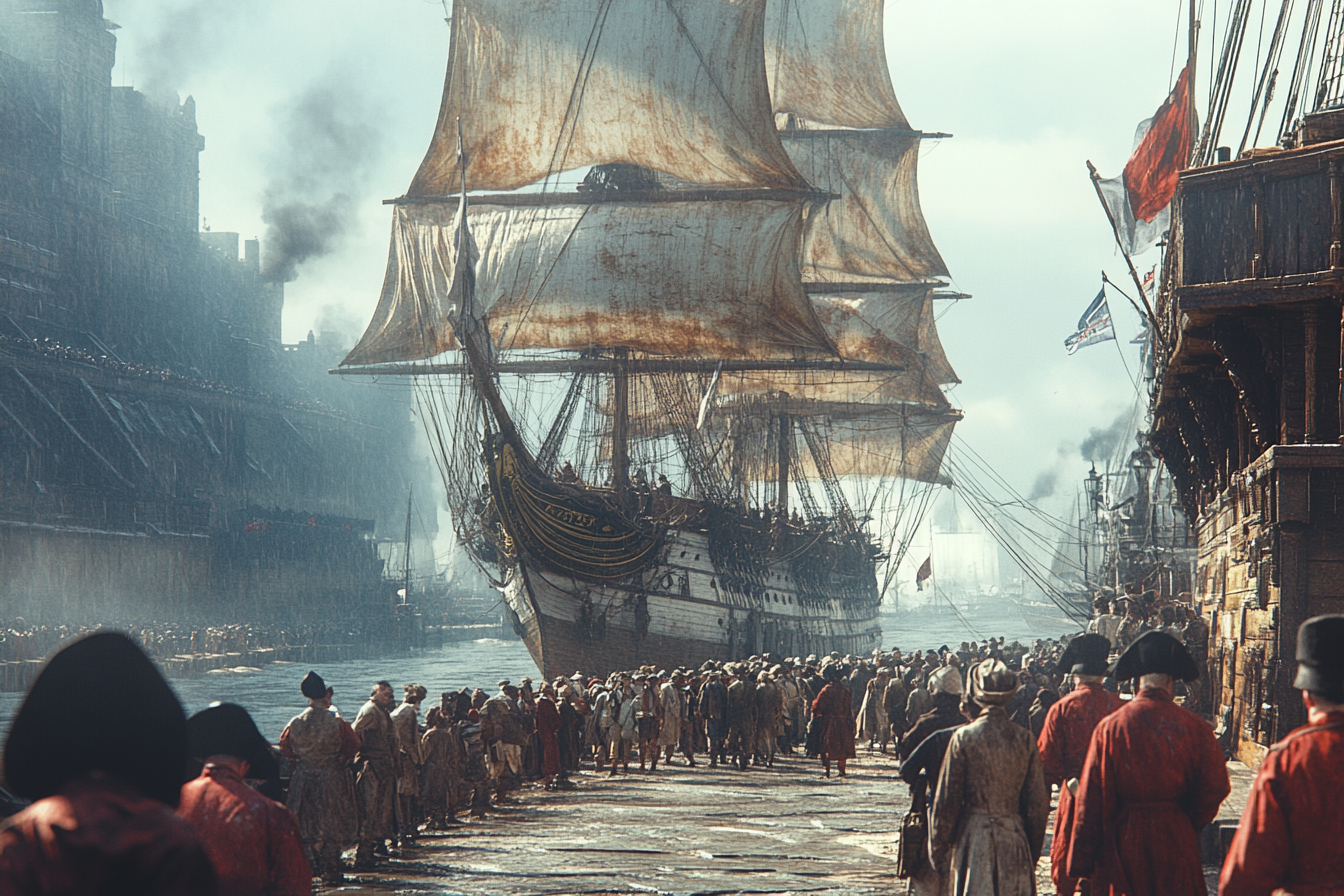
Vessels lay at anchor throughout the cove—merchant ships and naval vessels, fishing boats and the hulking forms of other transports that had completed the same impossible journey. Their masts created a forest of timber against the sky, their rigging a web of lines that caught the light in intricate patterns. Small boats moved between them, carrying goods and passengers on errands William could only guess at. The water itself bustled with activity, as though the entire colony's lifeblood flowed through this single inlet.
"Twenty years," Tom said, something like wonder creeping into his voice despite his earlier cynicism. "Twenty years since the First Fleet dropped anchor in this cove, and look what they've built. When I was here before, half of that didn't exist. The hospital was a tent. The governor's house was barely more than a cottage. Now look at it."
William looked, and what he saw rekindled something in his chest that the voyage had nearly extinguished. This was not the savage wilderness he had been taught to expect. This was ambition made manifest—the determination of men and women to carve civilisation from the edge of the known world. If such transformation could occur in twenty years, what might the next seven bring? What might a man with wit and will accomplish in a place where everything remained to be built?
The Resolution's anchor plunged into the harbour with a splash that echoed across the water like a cannon shot. The chain rattled through the hawsehole, link after link of iron paying out until the flukes bit into the harbour floor and held fast. For the first time in ten months, the ship ceased her endless motion. She settled into a gentle sway, rocking on the harbour's small swells, suddenly still in a way that felt almost unnatural after so long at sea.
William's body, accustomed to constant compensation for the deck's movement, struggled to adjust. His legs trembled beneath him, muscles that had learned one set of rules now confronted with another. Several convicts around him stumbled, clutching at the rail or at each other for support. One man—a pickpocket from Bristol who had survived the voyage through sheer stubbornness—dropped to his knees and remained there, his head bowed, his lips moving in what might have been prayer.
On the shore, the colony had taken notice of their arrival. Figures streamed toward the waterfront from every direction, drawn by the sight of the transport ship at anchor. William watched them gather with the detached fascination of a man observing a play in which he knows he must soon take part. These people—free settlers and emancipated convicts, soldiers and officials and servants—would be his neighbours for the next seven years. Their faces would become as familiar as those he had left behind in Portsmouth. Their judgements would shape his existence in ways he could not yet imagine.
Soldiers in red coats formed ranks along the dock, their movements crisp despite the heat that was already building as the morning advanced. The New South Wales Corps—William had heard much about them during the voyage, little of it flattering. They were said to be as corrupt as they were brutal, more interested in trading rum and exploiting convict labour than in maintaining genuine order. Yet they represented authority in this distant corner of the empire, and authority was something William had learned to approach with careful respect, regardless of the character of those who wielded it.
Behind the soldiers, a more varied assemblage jostled for position. William observed merchants in coats of good broadcloth, their waistcoats straining against prosperous bellies, their eyes already calculating the value of whatever cargo the Resolution might have brought. Women stood among them—some dressed as ladies, others in the plainer garb of servants or shopkeepers—shading their faces against the climbing sun. Children darted between the adults, their excited chatter carrying across the water in fragments too distant to comprehend.
And everywhere, watching from the margins with expressions William recognised all too well, stood other convicts. Men and women whose rough clothing and wary postures marked them as clearly as any brand. Some had served their sentences and remained in the colony as free settlers. Others still laboured under the terms of their transportation, permitted brief respite from their duties to witness the arrival of the newest additions to their ranks. Their eyes held a knowledge that the free colonists' did not—an understanding of what awaited the men currently crowded at the Resolution's rail.
The sun climbed higher, and with its ascent came a heat unlike anything William had experienced in two-and-twenty years of English existence. It pressed down upon the deck like a physical force, as though the sky itself were slowly descending to crush everything beneath it. The tar between the deck planks grew soft underfoot, releasing a sharp smell that mingled with the salt and the strange green scents drifting from the shore. Sweat broke out across William's skin, soaking through his tattered shirt until the rough linen clung to his body in sodden folds.
He had thought he understood heat. The summers of his childhood had occasionally brought days warm enough to make dock labour unpleasant, to send children seeking the shade of doorways and the relief of evening breezes. Those memories seemed laughable now, quaint recollections from a world that had apparently existed in permanent twilight. This heat was something altogether different—a presence rather than merely a condition, an adversary that would have to be reckoned with every day for the next seven years.
The harbour water glittered beneath the assault, throwing back the light in blinding flashes that made William's eyes ache. He raised a hand to shade his face and felt the sun's fury upon his forearm, the exposed skin already prickling with the promise of burns to come. Around him, the other convicts suffered similarly—men whose complexions had gone fish-belly pale during months below decks now confronting a sun that seemed determined to sear them to the bone.
"You'll want to cover up," Tom advised, noting William's discomfort. "I know it seems mad in this heat, but the sun here will cook you like a joint on a spit if you let it. I've seen men's skin peel off in sheets, seen them go mad from the fever that follows. The old hands know to keep covered, to work in the early morning and late afternoon, to find shade when the sun's at its peak. Learn that lesson quick, lad, or you won't survive your first summer."
William nodded, filing the advice away in the growing catalogue of knowledge he would need to survive this place. Every scrap of information, every warning, every hint about the colony's dangers and opportunities—all of it might prove the difference between enduring his sentence and becoming another anonymous corpse in foreign soil.
Captain Haverford descended from the quarterdeck and made his way forward to where the convicts waited. His uniform, despite the heat, remained immaculate—coat buttoned, stock neatly tied, boots polished to a shine that reflected the harbour light. He moved with the easy authority of a man accustomed to command, his grey eyes sweeping across the assembled prisoners with an expression that betrayed nothing of his thoughts.
"You will disembark in orderly fashion," he announced, his voice carrying clearly across the deck. "Any man who causes disturbance will be dealt with severely. You will proceed directly to the processing area, where you will be documented and assigned to your respective stations. This is not England. The rules here are simpler and the punishments swifter. I suggest you remember that."
He paused, and something shifted in his expression—a flicker of something that might have been weariness or might have been something approaching compassion. "Some of you will thrive in this colony. Others will not survive your sentences. The difference lies not in your crimes but in your conduct. Work hard, obey orders, and you may yet build lives worth living. Cause trouble, attempt escape, or shirk your duties, and you will find that New South Wales offers punishments your English courts never dreamed of."
With that, he turned and strode toward the gangway that sailors were even now preparing to lower. William watched him go and wondered what manner of man could deliver such words—threat and encouragement intertwined—with such apparent indifference. Haverford had commanded the Resolution for ten months, had overseen the deaths of thirteen convicts during the voyage, had maintained order through a combination of firm discipline and adequate rations. Whether he was a good man or merely an efficient one, William could not say. Perhaps, in this place, the distinction did not matter.
The gangplank descended with a groan of timber against timber, its far end striking the dock with a thud that seemed to resonate through William's chest. He stared at the narrow bridge of wood that now connected the ship to the shore—a span of perhaps twenty feet that nevertheless represented a crossing more profound than any he had previously made.
On one side lay everything he had known: England, Portsmouth, his parents, the familiar streets and sounds and smells of the only home he had ever possessed. The voyage had stretched that connection thin, attenuating it across fifteen thousand miles of ocean, but some thread had remained—some sense that the place he had come from still existed, still waited for him beyond the curved horizon. Now, looking at the gangplank and the foreign shore beyond, William understood that he was about to sever that thread entirely.
He thought of his mother in their modest dwelling near the dockyards. Elizabeth Jeffries, whose careful stitches had clothed him through childhood, whose voice had taught him his letters, whose face had been the last thing he saw as they led him from the courtroom. Did she know he had survived the voyage? Did she lie awake at night, wondering whether the son she had raised still drew breath on the far side of the world? The thought tightened something in his throat that he refused to acknowledge as grief.
He thought of his father—Edward, the dockworker whose calloused hands and stooped shoulders told the story of a lifetime's labour. Edward, who had sat rigid and silent through the trial, who had reached through the bars to touch William's shoulder in a gesture that said everything words could not express. Edward, who had not wept, because Edward never wept, because some griefs ran too deep for tears to reach.
He thought, unbidden, of Jack Hawley. The flash of copper hair disappearing into the crowd. The stolen watch pressed into his unsuspecting palm. The careless shrug in the courtroom gallery, that gesture of absolute indifference that had seared itself into William's memory with the permanence of a brand. He had thought, during the long months at sea, that the hatred might fade—that distance and time might dull its edge. Instead, he found it had only hardened, crystallising into something cold and patient that could wait years for satisfaction.
But that was for later. That was for after. Now there was only the gangplank, and the shore, and the life that awaited him in this strange land at the bottom of the world.
The guards began organising the convicts into lines, their commands harsh in the humid air. William found himself shuffled into position, the chains at his wrists connecting him to the men before and behind in a human chain that would descend the gangplank together. The iron links clinked with each movement, their music a constant reminder of what he was—not a passenger arriving at a new destination, but cargo being delivered to its appointed place.
The first convicts began their descent. William watched them stumble down the narrow plank, legs unsteady after months at sea, bare feet slapping against wood that must have burned beneath the merciless sun. Some fell to their knees upon reaching the dock, overcome by the sensation of solid ground. Others stood frozen, staring at the alien landscape with expressions of naked terror. The crowd watched their progress with the detached interest of spectators at a livestock auction—assessing, calculating, already determining which of these new arrivals might prove useful and which would likely die before their sentences concluded.
The line shuffled forward. William moved with it, drawn toward the gangplank by the chains that bound him to his fellow prisoners. His heart hammered against his ribs with a force that seemed excessive for such a simple act—merely walking, merely crossing a span of wood from one surface to another. Yet every step carried him closer to a threshold he could never recross. Every step took him further from everything he had been and deeper into whatever he would become.
He reached the head of the gangplank and paused for the space of a single breath. Behind him lay the Resolution, the ship that had been both his prison and his salvation for ten months—the creaking timbers, the stinking hold, the endless motion that had become as natural as breathing. Before him lay New South Wales, Australia, the Great South Land—a place that existed in his imagination as a jumble of contradictions, a prison and a promise, a punishment and perhaps, impossibly, an opportunity.
The guard's hand pressed against his back, urging him forward. William took a breath of air that tasted of salt and eucalyptus and smoke, that carried scents no English lung had ever known, that filled his chest with the unmistakable flavour of exile.
Then he stepped onto the gangplank, and began his descent toward whatever awaited him on the far side of the world.







