Lance Kenneth Cradock
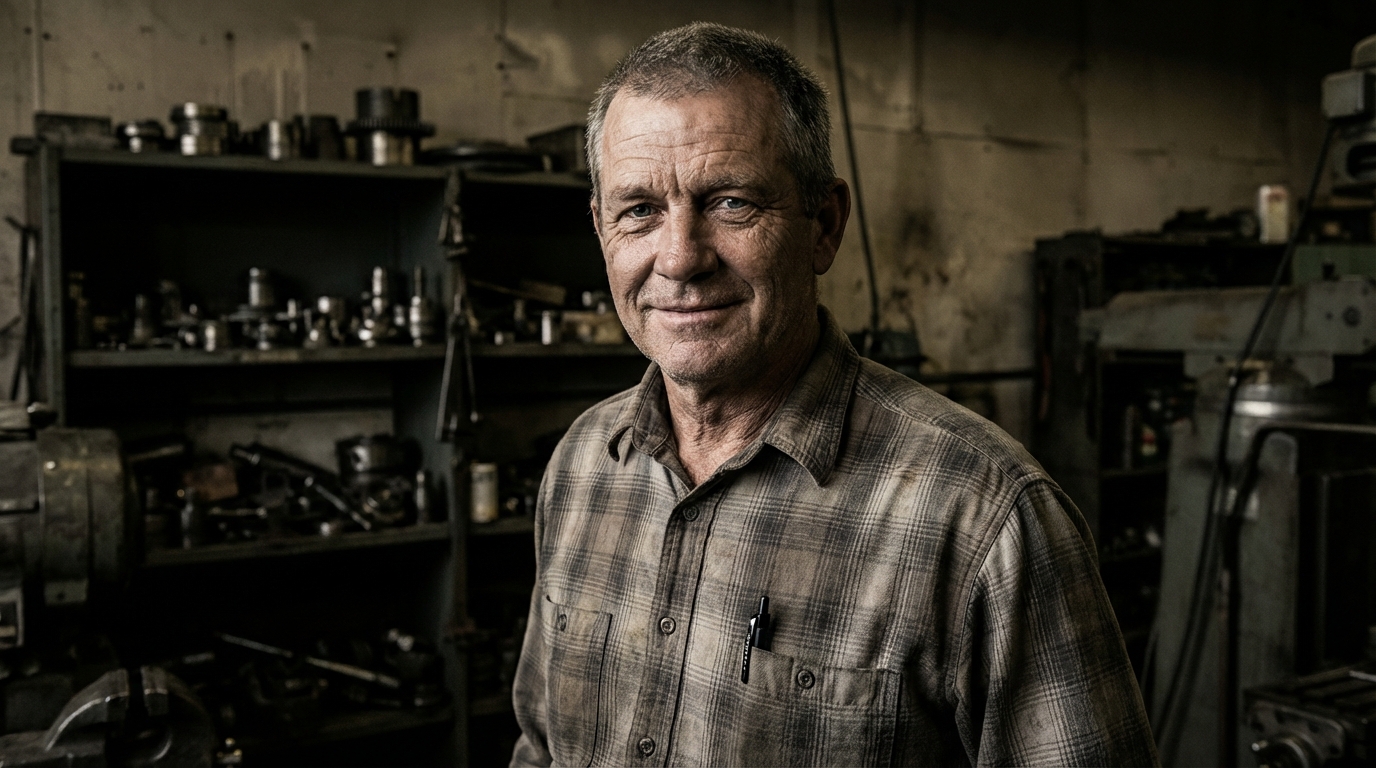
Lance Kenneth Cradock, born 22nd November 1954 in Bicheno, transformed coastal childhood fascination with mechanical systems into four-decade career maintaining aircraft at Hobart Airport. Eldest child of fisherman Kenneth and seamstress Irene, he inherited both parents' meticulous attention whilst escaping fishing's precarity through technical aptitude. His marriage to Amy Louise in 1982 established New Norfolk sanctuary where engineering precision met domestic warmth. As uncle to Gladys and Beatrix, he provided steady reliability—methodical competence that anchored family through impossible revelations about Portal Keys and Guardian politics.
Early Life in Bicheno
Lance Kenneth Cradock entered the world on 22nd November 1954 at Bicheno Hospital, first child of Kenneth Alan Cradock and Irene Lillian Cradock (née Storey). His arrival transformed his parents' two-year marriage from theoretical partnership into practical family requiring immediate adjustment to the demands of infant care, reduced household income as Irene's seamstress work temporarily decreased, and the intensified pressure Kenneth felt to provide for dependants rather than merely supporting a wife.
The weatherboard cottage on Foster Street where Lance spent his first years embodied the tension characteristic of working-class fishing families—his father's modest and unpredictable fishing income meeting his mother's fierce determination that economic limitation wouldn't constrain cultural aspiration. Irene's piano dominated the modest living room, its presence announcing that this household valued education and refinement regardless of the family's working-class circumstances. Books accumulated on makeshift shelves, their presence unusual in fishing community where reading beyond newspapers and practical manuals was often regarded as affectation rather than legitimate pursuit.
Lance's earliest memories would later coalesce around sensory impressions that defined Bicheno childhood—the particular smell of salt air mixing with fish processing from the wharf, the constant background sound of waves against granite shore, the sight of his father departing before dawn in the Irene M, the texture of nets being mended in the cottage's small back room, and most persistently, the sound of his mother's piano practice filling evenings with music that seemed incongruous against the backdrop of fishing village pragmatism.
Kenneth's relationship with his infant son reflected fishing family realities—long absences when weather and catches demanded extended trips, exhausted returns when interaction consisted primarily of sleeping before next departure, and the economic anxiety that shadowed every poor catch. Yet Kenneth approached fatherhood with characteristic methodical attention, teaching through patient demonstration rather than verbal instruction, showing Lance how to read weather patterns by observing clouds and wind, how to identify fish species from their shapes and markings, how to maintain equipment through constant small efforts that prevented expensive failures.
Irene's maternal approach contrasted dramatically. She implemented systematic educational routines learned from her own mother Mabel's pedagogical philosophy—constant verbal engagement even when Lance was too young to respond meaningfully, reading picture books from infancy, singing whilst performing household tasks, treating every activity as potential learning opportunity. By the time Lance reached school age, he possessed vocabulary and general knowledge well beyond typical fishing family children, advantages directly attributable to Irene's determined educational investment.
Sister Wendy and Sibling Dynamics
The arrival of Wendy Elizabeth Cradock on 8th March 1958, when Lance was three years and four months old, introduced sibling dynamics that would shape both children's personalities and future trajectories. The four-year age gap—deliberately planned by Kenneth and Irene to manage economic strain—created relationship where Lance occupied quasi-protective role rather than experiencing the intense competition characteristic of closely-spaced siblings.
Lance's temperament resembled Kenneth's more than Irene's. Where Wendy would develop theatrical flair and creative exuberance, Lance demonstrated quiet methodical nature, preferring to observe systems and understand their operation rather than imagining alternative realities. He dismantled household items to comprehend their mechanisms—clocks, door latches, Irene's sewing machine (much to her alarm)—driven by curiosity about how things worked rather than any destructive impulse.
The siblings' relationship developed complementary rather than competitive dynamic. Lance became Wendy's protector during childhood expeditions around Bicheno, his careful temperament balancing her more impulsive enthusiasms. She provided social facility he lacked, interpreting situations and navigating peer relationships with ease whilst he offered steady reliability and practical problem-solving. Their personalities reflected their parents' partnership in miniature—he the methodical technician, she the creative communicator, both benefiting from the other's complementary strengths.
Irene's parenting approach adapted to each child's inclinations whilst maintaining consistent expectations for educational achievement and cultural literacy. She recognised early that Lance's mechanical aptitude represented genuine talent deserving cultivation, encouraging his systematic dismantling and reassembly of household items whilst teaching him to ask permission and work carefully. For Wendy, Irene nurtured theatrical interests and storytelling abilities, providing audience for impromptu performances whilst ensuring academic fundamentals received equal attention.
Education and Discovering Technical Aptitude
Lance commenced schooling at Bicheno Primary School in February 1960, entering Kindergarten as quiet, observant child whose home education had established solid foundation in literacy and numeracy. Teachers quickly noted his particular facility with spatial reasoning and mechanical comprehension—he excelled at tasks requiring understanding of how parts fitted together, how systems operated, how physical objects related to each other in three-dimensional space.
His academic performance proved consistently solid rather than spectacular. He demonstrated strong capability in mathematics, particularly geometry and practical applications requiring calculation and measurement. His English literacy developed adequately, though he showed little enthusiasm for creative writing or literary analysis—subjects requiring imaginative leaps rather than systematic observation. Science fascinated him, especially topics involving physical processes, machinery, and practical experimentation that revealed underlying mechanical principles.
By upper primary grades (Years 5-6), Lance had developed reputation as the student to consult when equipment malfunctioned, classroom projects required assembly, or teachers needed someone to explain how mechanical systems operated. This role suited his temperament perfectly—providing expertise in domain where he possessed genuine competence, receiving recognition without requiring the social facility or verbal fluency that characterised academic achievement in humanities subjects.
Unlike many Bicheno boys from fishing families, Lance never seriously considered following Kenneth into fishing. He had observed too closely his father's physical exhaustion, the economic precarity that shadowed every season, the grinding monotony of work requiring sustained heavy labour in harsh conditions with unreliable financial return. More fundamentally, fishing offered no outlet for his mechanical interests—whilst boats required maintenance, the work itself involved neither the systematic understanding of complex machinery nor the problem-solving that genuinely engaged him.
In 1967, completing Year 6 at age twelve, Lance faced the critical decision point that separated Bicheno children into different trajectories. Academic high-achievers like his sister Wendy would eventually pursue secondary education in Hobart, potentially leading to university or professional training. Students of moderate ability might complete some secondary education before entering trades or clerical work. Those from fishing families often left school after primary education, entering family trades that required physical capability more than formal qualifications.
Lance occupied middle position—clearly possessing capabilities beyond mere primary education, demonstrating genuine technical aptitude, but requiring practical vocational pathway rather than academic tertiary education. Irene and Kenneth, learning from George and Mabel Storey's experience with their own children, recognised that technical training would suit Lance's abilities whilst providing secure professional prospects exceeding fishing's precarity.
Technical Education and Apprenticeship Path
In February 1968, Lance enrolled at Hobart Technical College (later to become Hobart College), pursuing vocational programme in engineering and mechanics. The decision required him to live with Irene's parents, George and Mabel Storey, in their New Town cottage during term time—arrangement that provided accommodation whilst exposing Lance to more urban environment than Bicheno's coastal isolation offered.
The technical college curriculum combined classroom instruction in engineering principles, mathematics, technical drawing, and materials science with extensive practical workshop training. Lance thrived in this environment—the systematic progression from theoretical understanding to practical application suited his learning style perfectly, whilst the focus on mechanical systems and problem-solving engaged his genuine interests rather than requiring performance in subjects that held no appeal.
Throughout 1968-1970 (Years 7-9 equivalent), Lance's technical aptitude became increasingly evident to instructors. He possessed unusual combination of patient attention to detail, spatial reasoning that allowed him to visualise how three-dimensional assemblies fitted together, and intuitive understanding of mechanical systems that exceeded what formal instruction alone could develop. Teachers noted that he approached problems methodically, thinking through systematic solutions rather than attempting random interventions that characterised less capable students.
During this period, Lance maintained regular contact with Bicheno via weekend and holiday returns. These visits revealed growing divergence between his trajectory and the fishing community's expectations—he spoke enthusiastically about turbine engines, hydraulic systems, and precision measurement instruments whilst childhood friends discussed fish catches and boat maintenance. The gap wasn't hostile, merely reflective of different futures taking shape through education and opportunity.
In January 1971, at age sixteen, Lance commenced formal apprenticeship as aircraft maintenance engineer with Ansett-ANA at Hobart Airport, position secured through technical college placement programme and his demonstrated mechanical aptitude. The apprenticeship combined on-the-job training under licensed aircraft engineers with continued technical education, creating four-year pathway toward professional qualification in one of aviation's most demanding technical specialisations.
Aircraft Maintenance Engineering Career
The apprenticeship years (1971-1975) established foundation for Lance's professional identity. Aircraft maintenance engineering demanded precise combination of theoretical knowledge, practical skill, meticulous attention to detail, and profound awareness that errors could result in catastrophic failures. The work suited Lance's temperament perfectly—he possessed exactly the methodical carefulness, patient systematic approach, and genuine fascination with mechanical systems that characterised successful aircraft engineers.
He learned to perform detailed inspections following rigid checklists that left nothing to chance, to execute routine maintenance with precision that treated every task as critical regardless of apparent simplicity, to troubleshoot complex systems through systematic diagnosis rather than guesswork, and to document everything exhaustively because aviation safety depended on complete maintenance records. The discipline required matched Irene's childhood insistence on proper procedures and Kenneth's fishing-derived understanding that cutting corners invited disaster.
By 1975, completing his apprenticeship at age twenty, Lance had earned his Aircraft Maintenance Engineer's Licence (Category B1 - Mechanical), qualification requiring both practical competency and theoretical knowledge verified through rigorous examination. The licence represented significant professional achievement—aircraft maintenance engineers occupied respected position within aviation hierarchy, their expertise recognised as essential for flight safety, their judgement trusted with decisions carrying genuine life-and-death consequences.
Lance's early career (1975-1985) coincided with significant changes in Australian commercial aviation—introduction of larger aircraft requiring more sophisticated maintenance, increased regulatory scrutiny following several high-profile accidents, and gradual technological advancement that required constant updating of skills and knowledge. He adapted readily to these changes, pursuing additional training in new aircraft types as they entered service, mastering increasingly complex diagnostic equipment, and building reputation for thoroughness that made supervisors trust his work without excessive oversight.
The work provided exactly the secure professional identity and steady income that Kenneth had hoped fishing might offer but never reliably did. Lance earned respectable salary—£3,500-4,000 annually by late 1970s, rising to $18,000-22,000 by mid-1980s—placing him firmly within skilled trades middle class. More significantly, the work commanded genuine respect, offered clear career progression pathways, and provided satisfaction of genuine technical mastery rather than merely performing routine labour.
Marriage to Amy Louise
Lance met Amy Louise Patterson in 1980 at a social gathering in New Norfolk organised by mutual friends. Amy, born 15th September 1956 in Launceston to Edward James Patterson, a clerk with the Hydro-Electric Commission, and Margaret Jean Patterson (née Wilson), a library assistant, brought to the relationship personality that complemented Lance's reserved methodical nature whilst providing social warmth he genuinely appreciated but couldn't generate himself.
Amy had completed commercial training at Launceston Business College, securing position as administrative assistant with a Hobart accounting firm—respectable white-collar occupation that placed her within similar socioeconomic band as Lance despite their different career paths. She possessed the social facility and verbal fluency that Lance lacked, navigating interpersonal situations with ease whilst appreciating his steady reliability and technical competence.
Their courtship through 1980-1981 developed steadily rather than dramatically—two sensible people recognising compatibility without requiring passionate romance to validate the match. Lance provided steadiness, practical capability, and secure professional prospects; Amy offered social skills, domestic management abilities, and the nurturing presence that would eventually transform house into home. Both understood that successful marriages required complementary capabilities more than dramatic declarations, mutual respect more than constant intensity.
They married on 6th March 1982 at St Matthew's Anglican Church in New Norfolk, modest ceremony attended by immediate families and close friends. The reception at a local hall featured simple refreshments and genuine warmth, celebration of practical partnership rather than theatrical romance. Kenneth and Irene attended proudly, seeing their son established in stable marriage and professional career that vindicated every sacrifice they'd made to support his technical education.
Establishing Life in New Norfolk
Lance and Amy purchased their first home in New Norfolk in mid-1982, modest weatherboard cottage on a quiet street that provided affordable entry into property ownership whilst offering reasonable commute to Hobart Airport. The residence represented significant achievement for young couple in early careers—securing mortgage demonstrated financial stability, whilst property ownership signalled transition into established adult life.
Amy transformed the house into genuine home through sustained attention to detail that echoed Irene's domestic management philosophy. She established flower beds along the front path, their seasonal blooms providing visual warmth that distinguished the property from neglected rentals. She maintained interior with systematic care—rooms always clean, furnishings modest but well-kept, atmosphere reflecting working respectability rather than either poverty's resignation or middle-class pretension.
Lance's contribution to household culture expressed itself through different medium. He maintained the property's physical systems with engineer's attention—repairing plumbing before leaks became floods, servicing heating before winter failures, addressing minor structural issues before they required expensive interventions. His small workshop in the garage accumulated tools organised with same systematic precision he brought to aircraft maintenance, space where he could pursue mechanical projects that provided satisfaction beyond merely earning income.
The couple settled into complementary partnership that mirrored their parents' relationships in many respects. Lance worked regular shifts at Hobart Airport—sometimes standard day shifts, sometimes night maintenance when aircraft were grounded, occasionally weekend work when schedules demanded—whilst Amy managed household finances, maintained social relationships with neighbours and extended family, and provided domestic stability that allowed Lance to focus on professional responsibilities without worrying about household management.
Family Relationships and Uncle Lance
Lance's relationship with sister Wendy maintained closeness despite geographic separation and different life circumstances. After Wendy's marriage to Brett Cramer in November 1980 and subsequent births of Gladys in 1981 and Beatrix in 1985, Lance and Amy became Uncle Lance and Aunt Amy—roles they inhabited with genuine affection and regular engagement rather than merely performing obligatory family duty.
Lance recognised in Brett a kindred spirit—both men of practical technical skills, both expressing capabilities through tangible work rather than verbal facility, both possessing methodical temperament that valued systematic approaches over dramatic gestures. Their interactions developed easy comfort of men who communicated through shared activity rather than extensive conversation, working together on household projects where Brett's carpentry and Lance's mechanical expertise complemented naturally.
With nieces Gladys and Beatrix, Lance provided a steady uncle presence characterised by patient instruction in practical skills, quiet reliability, and genuine interest in their development without attempting to supplant parental authority. He taught Gladys basic mechanical principles during visits, explaining how car engines operated and why regular maintenance mattered—lessons that would later inform her systematic approach to professional responsibilities at Aurora Energy. For Beatrix, whose temperament proved more impulsive and less mechanically inclined, Lance offered patient answers to endless questions about how things worked, demonstrating that curiosity deserved encouragement regardless of whether it led to technical careers.
Kenneth's death in April 1996 affected Lance profoundly. He had spent entire life trying to exceed his father's economic circumstances whilst honouring the fishing family work ethic that shaped his approach to professional responsibilities. Kenneth's funeral in Bicheno brought Lance face-to-face with childhood community he'd largely left behind, fishing families whose sons had mostly followed fathers into trade that offered neither security nor prosperity. The contrast between his own professional success and their continued economic precarity validated Irene's educational investment whilst generating complex mixture of satisfaction and survivor's guilt.
Irene's continued presence in New Town (1996-2008, following Kenneth's death) allowed Lance to maintain close relationship with his mother, visiting regularly, assisting with household maintenance, and providing the practical support that aging required. Her death in September 2008 at age seventy-nine marked end of direct parental generation, leaving Lance and Wendy as senior generation responsible for maintaining family connections and transmitting family history to Gladys and Beatrix.
Professional Maturity and Technical Mastery
Throughout the 1990s and 2000s, Lance advanced steadily within Hobart Airport's maintenance hierarchy. He earned additional licence categories and type ratings as new aircraft entered service, pursued continuing education in emerging technologies like computerised diagnostic systems, and accumulated the deep experiential knowledge that distinguished truly expert engineers from merely competent technicians.
By 2000, Lance held senior maintenance engineer position with supervisory responsibilities overseeing junior engineers and apprentices. The role required not merely technical expertise but also judgment about when to ground aircraft for safety concerns despite operational pressure, when to trust subordinates' work and when to verify personally, and how to balance regulatory requirements with practical operational constraints. Lance's methodical temperament and genuine concern for safety over convenience made him well-suited for these responsibilities.
His reputation within Hobart Airport's maintenance department reflected thirty years of consistent performance—he was the engineer supervisors trusted with complex troubleshooting, the mentor apprentices sought for clear explanations, the colleague others consulted when uncertain about proper procedures. This respect derived not from charismatic personality but from demonstrated competence, sustained reliability, and integrity that never compromised safety for convenience.
The work provided professional satisfaction that exceeded Kenneth's fishing career in every dimension—secure income, genuine respect, technical challenges that engaged capabilities, and clear evidence that expertise mattered for outcomes that affected hundreds of passengers daily. Lance had achieved exactly what Irene's educational investment intended: escape from fishing's precarity into skilled profession that rewarded sustained competence with middle-class security.







