Kylie Maree Novak (née Hammond)
Kylie Maree Novak (née Hammond), born 2 February 1978 in Elizabeth Vale, was the only daughter of a Salisbury North working-class family who left school at sixteen for checkout and kitchen work. Married to Stefan Novak at nineteen, she raised their children Taryn and Connor largely alone after his 2010 abandonment, holding the household together on a supermarket wage and the disability support pension. Worn down by decades of physical work, she remained in Elizabeth, defined by an unglamorous, unwavering devotion to her children.
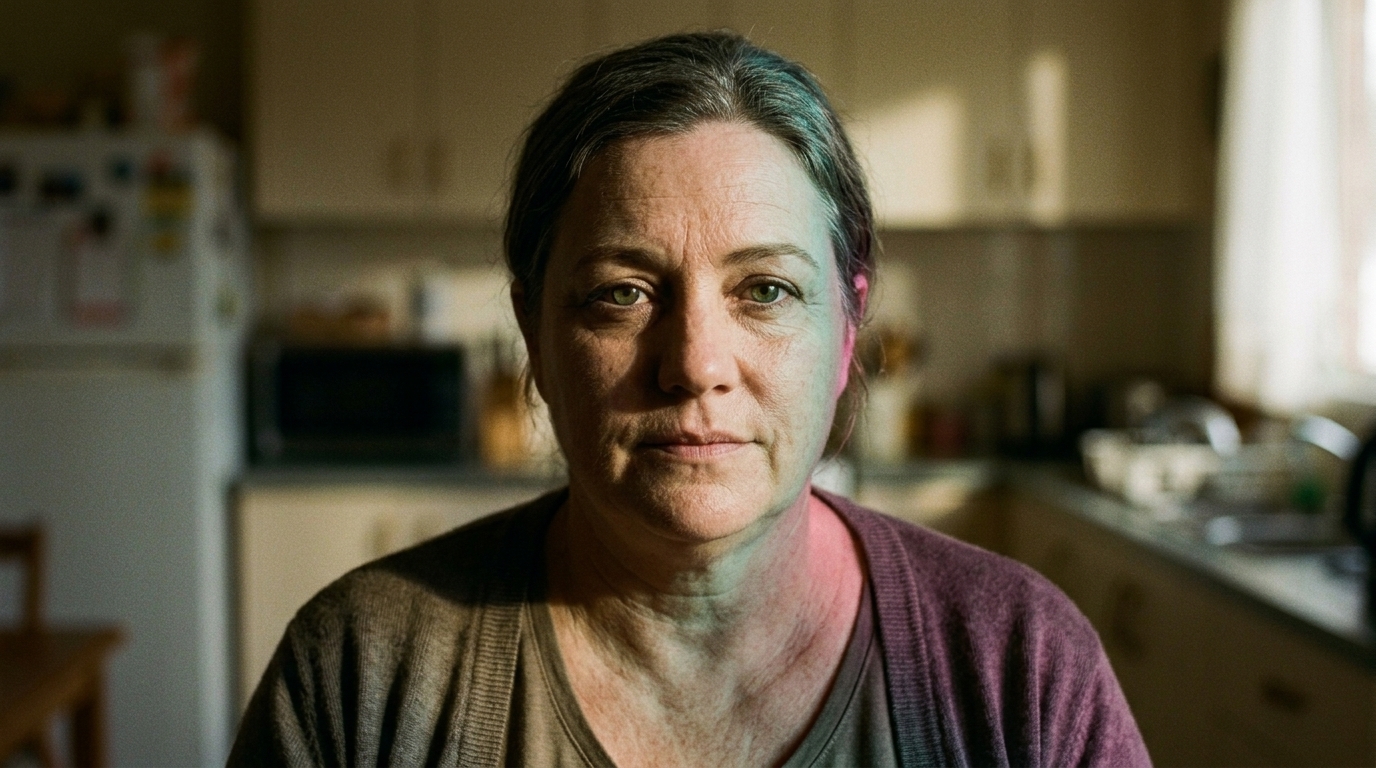
The Youngest Hammond
Kylie Maree Hammond was born on 2 February 1978 at the Lyell McEwin Hospital in Elizabeth Vale, the third child and only daughter of Barry Hammond and Lorraine Hammond (née Castle). Her middle name, Maree, was one that half the girls in her year carried too — a plain, unfashionable inheritance of the Australian working class, spelled the way Lorraine had written it on the form without a second thought. The family lived in a rented fibro house in Salisbury North, on a street where the front lawns were mostly dirt and the men left for work before the sun came up. She arrived after two boys — Darren, born in 1971, and Wayne, born in 1974 — and her sex made her, depending on the day, either the treasured baby of the household or the one most easily lost in the noise of her brothers.
Barry Hammond laid concrete through Kylie's childhood, then took a delivery run for a building-supplies firm when his knees began to go, a job that kept him on the road and short-tempered when he was home. He was not a cruel father, but he was a tired one, and he measured a person's worth chiefly by whether they pulled their weight. Lorraine cleaned at the local primary school in the mornings and took in ironing and alterations in the afternoons, her hands never quite still, her good humour worn thin by a house full of men and a budget that never stretched.
Kylie grew up in the particular liberty of a youngest child whom nobody watched too closely. Her brothers were rough and affectionate by turns, and she learned early to give as good as she got — to stand at the back fence and trade insults with boys twice her size, to take a knock without crying, to make herself useful enough that she was allowed to tag along. It made her quick and a little hard around the edges, but it also made her warm in the unsentimental way of people who have never had much room for delicacy.
Money was the weather of the house, always present, occasionally severe. There were good stretches when Barry's overtime ran long and the fridge was full, and lean ones when Lorraine paid the bills in a careful order known only to herself and fed five people on mince and whatever was reduced at the butcher's. Kylie absorbed, without ever being taught it directly, the working-class arithmetic of making a little go a long way — a skill she would one day need far more than her mother ever had.
Family Tree
A Salisbury Girl
She attended the local primary school where her mother cleaned, a fact that mortified her in the way only a ten-year-old can be mortified, and went on to one of the northern suburbs' big public high schools, an institution doing its best against underfunding and the long shadow of the area's decline. Kylie was not a poor student so much as an uninterested one. She was bright enough when something caught her, sharp-tongued in class, popular in the easy way of girls who are funny and unafraid, and entirely unconvinced that any of it led anywhere worth going.
She left at the end of Year 11, sixteen years old and certain that the sooner she was earning the sooner she would be free. The certainty was half right. She took a job on the registers at a supermarket, then a stint frying chips at a takeaway, then a year in the kitchen of a Salisbury pub, washing up and prepping and learning the particular camaraderie of hospitality's bottom rung. The work was dull and the pay was poor, but she had her own money and her own friends and the nights were hers, and at eighteen that felt very much like enough.
She was, in those years, good company — the girl at the centre of the table, loud and quick to laugh, generous with what little she had. She fell in and out of love the way young people do, with boys who worked at the same places she did and wanted much the same things, which was to say nothing in particular and all of it immediately. None of it was serious. She was in no hurry. She assumed, without ever quite framing the thought, that her real life was somewhere ahead of her, waiting to begin.
The Front Bar
She met Stefan Novak in the spring of 1997, in the front bar of a pub in Salisbury, where she had come with friends on an ordinary Friday and he had come, as he came most nights, on his own. He was twenty-two, three years older than she was, with an accent the years had nearly sanded smooth and a way of holding himself slightly apart from a room. She found the watchfulness in him interesting rather than alarming. He made her laugh; he listened more than he talked; and beneath the rough edges there was a gentleness that the louder boys she knew had never bothered to develop.
For a few months they were happy in the uncomplicated way of two young people with no money and no plans, and Kylie, who had been waiting without knowing it for her real life to start, decided this might be it. When she fell pregnant that summer, the decision to marry felt less like a choice than the obvious next thing, a current they both stepped into without much examining the water. They were wed three months later in a registry office, her mother dabbing her eyes in the front row, her father unsmiling in a tie he resented, the whole thing over inside twenty minutes.
Barry Hammond had not liked the rush of it, and said so, and Kylie had not spoken to him properly for a fortnight afterwards. But the cooling did not last. Whatever doubts her father held, she did not share them. She was nineteen and certain, and the certainty carried her through a pregnancy spent in a cramped flat in Elizabeth, painting a second-hand cot and assembling, piece by hopeful piece, the household she meant to build.
Taryn Elise Novak was born on 3 September 1998 at the Lyell McEwin Hospital, in the same maternity ward where Kylie herself had arrived twenty years earlier. Holding her daughter for the first time, Kylie felt the floor of her life shift beneath her into something solid and terrifying and entirely worth it. Whatever else went wrong in the years to come — and a great deal would — she never once regretted the child. Motherhood was the thing she turned out to be unambiguously good at, and she knew it almost at once.
Two Children and Not Enough
The trouble, when it came, came slowly, in the way of marriages that fail not through any single catastrophe but through a thousand small subsidences. Stefan could never quite hold a wage. The jobs came and went — parts counters, warehouse floors, casual shifts that dried up without warning — and the gaps between them filled with drink and with a silence that Kylie found harder to live with than any argument. The money was always short, and the shortness of it became the subject of every fight, her voice climbing through the thin walls while she tried to keep it from the baby's room.
Their son Connor was born in 2003, during one of Stefan's longer stretches out of work, and his arrival deepened both the love and the strain. Kylie now had two children and a husband who was, increasingly, a third dependant — a man she had to manage rather than lean on. They moved twice in those years, each rental smaller and cheaper than the last, until they landed in a Housing Trust property in Elizabeth Downs, a three-bedroom house on a tired street that Kylie scrubbed and painted and willed into being a home.
She worked the whole time, fitting checkout shifts around school hours and Stefan's unreliable presence, and it was her wage, more often than not, that kept the lights on. She did not think of herself as long-suffering; she thought of herself as coping, which was the only frame her upbringing had given her. You did not complain. You did not let the kids see how close to the edge things ran. You got up, you went in, you came home, and you did it again, and somewhere in the doing of it the years went past.
What wore her down was not the work but the loneliness of carrying it alone inside a marriage. Stefan loved her, in his diminishing way, and he loved the children, but love had become the least useful thing he had to offer. By the end she was running the household as though she were already a single mother, and the discovery, when it came, that she very nearly was would surprise her less than it should have.
The Morning Everything Changed
He left on a Tuesday morning in February 2010. He told her he was going to a shift and he simply did not come back — no note, no telephone call, nothing but the slow dawning over the following hours that this was not lateness but absence. She rang the people he might have been with. She checked the account and found it emptied, the eight hundred and forty-seven dollars that had been the whole of their savings gone with him. After three days she went to the police and reported her husband missing, sick with a fear that curdled, within the week, into something colder.
They found him alive and unhurt in Murray Bridge, living with a woman Kylie had never heard of. The relief and the humiliation arrived together and never fully separated. He had not been taken or harmed; he had chosen, deliberately and quietly, to walk out of the life they had built and leave her holding all of it — the rent, the children, the shame of being the woman whose husband had run off. For a long time afterwards she could not decide which was worse: that he had gone, or the casual completeness with which he had gone.
She allowed herself very little time to fall apart. There were two children watching her — Taryn, eleven and furious; Connor, six and bewildered — and Kylie understood, with the clarity that crisis sometimes grants, that whatever she did next would teach them what to expect from the world. So she did the only thing she knew how to do. She got up the next morning, and the morning after that, and she went to work.
Holding the Roof Up
She found steadier hours as a checkout operator at the Coles in the Elizabeth City Centre, and she took every additional shift she could get, learning to read the roster like a ledger of what the week could afford. The Centrelink payments she had once been quietly ashamed to claim became a structural part of the household budget, a supplement she stopped apologising for once she understood it was the difference between staying in the house and losing it. The years that followed were lean, but they were stable, and stability — after the chaos of the marriage's end — felt almost like wealth.
Her own family helped where it could, which was not much. Her mother Lorraine minded the children when shifts overlapped, and her brother Wayne, a mechanic who had stayed in the northern suburbs, kept her ancient car running for the price of the parts. Her father Barry had softened toward her in the years before he died of a heart attack in 2011, the two of them reaching, late and incompletely, a kind of peace. Her eldest brother Darren had long since gone to the mines in Western Australia and drifted out of regular contact, a voice on the phone at Christmas and little more.
What Kylie built, in place of the marriage, was a fortress of routine. The mornings were timed to the minute, the budget tracked to the dollar, the children's needs met with a fierce and unglamorous competence. She was not a soft mother — she had neither the time nor the temperament for it — but she was an utterly reliable one, and her children grew up knowing, beneath everything, that she would not leave. After Stefan, that certainty was the most valuable thing she had to give them, and she gave it without fail for the rest of their childhoods.
What the Years Took
The cost of it accrued in her body. Years on her feet at the register, eating whatever was quickest, never quite catching up on the sleep she had lost, settled into her joints and her back as a chronic ache that no amount of stubbornness could outwork. She ignored it as long as she could, because ignoring things was how she had survived, and because admitting to pain felt dangerously like admitting she could not cope. By her mid-forties the ignoring had stopped working.
She watched her children become themselves with a pride she rarely said aloud. Taryn — whom she had once got a part-time job alongside her at the supermarket — turned her childhood fury into something formidable, the first Novak or Hammond on either side to reach university, and Kylie, who had left school at sixteen, did not entirely understand the world her daughter was walking into but understood completely what it had cost to get there. Connor found his footing more slowly, drifting through school much as his father had, before an apprenticeship as a mechanic gave his practical hands something to hold.
The old family wound reopened in January 2023, when the wealthy Melbourne Novaks Kylie had married into the shadow of returned, abruptly, to the news. Stefan's cousin Julia, an art collector Kylie had never met, became the subject of a murder investigation, and the tabloids drew their family trees from Prague to the present, dragging the Adelaide branch into the glare. Kylie refused every journalist who rang, but she could not stop reading the coverage, each article reopening the old resentment about the wealthy relatives who had abandoned this side of the family decades before she ever joined it. The stress of it sat badly on a body already failing.
Her health forced the question she had spent decades dodging. With Taryn's help she navigated the move from wages onto the disability support pension, a process that meant confronting, in official language, every limitation she had been refusing to name. It steadied the money and it wounded the pride, and the two things sat uneasily together in her for a long while. Working had been the spine of her identity since she was sixteen; learning to live without it was a grief she had not anticipated and rarely discussed.
Dorothy Hennessy, Stefan's stepmother and the one decent thing the marriage had brought into Kylie's life, died in her sleep in August 2024. Kylie went to the funeral and wept more than she had expected to, mourning not only the old woman but the version of her own future that had died decades earlier. Of Stefan himself she heard almost nothing across those years, and wanted to hear less; he had become, in her telling, simply the man who left, a closed chapter she neither reopened nor entirely escaped.
By 2026 Kylie was forty-eight, and the shape of her life had quietened into something she could almost call peace. She lived still in the Elizabeth Downs house she had held onto through everything, its rooms emptier now that Taryn had moved to a unit in Smithfield, though Connor still came and went with his toolbox and his washing. Her mother Lorraine, frail and in her seventies, lived nearby in a retirement unit, and the two of them had grown closer in the way of women who have both outlasted the men who shaped their lives. Kylie never remarried; after Stefan she had neither the trust nor the appetite for it, and she found, somewhat to her own surprise, that she did not much miss it.
Her relationship with Taryn, fractured for years by the pressures that had shaped them both, settled at last into something approaching friendship between two adult women — the daughter checking in, the mother offering opinions on a life she admired and only half understood. It was not the life Kylie had painted into being in that cramped flat in 1998. But she had kept the roof up, and the children under it had grown into people who would not leave the way their father had, and on her better days she understood that to be an achievement, and not a small one.







