Kronotrop, Istanbul
Kronotrop is a speciality coffee bar and roastery founded by Çağatay Gülabioğlu in Istanbul in 2012, widely regarded as Turkey's first dedicated micro-roastery and a foundational establishment in the country's third-wave coffee movement. Originally operating from a small premises in Galatasaray, the business expanded across multiple Istanbul locations, including branches on Serdar-ı Ekrem Caddesi in Beyoğlu and in the neighbouring Cihangir district.
Origins and Founding
Kronotrop opened in 2012 in a small shop in the Galatasaray area of Beyoğlu, Istanbul, founded by Çağatay Gülabioğlu, a figure already known in Turkish coffee circles through his earlier establishment Locus Solus in Ankara. The original premises was tiny — barely enough room for a counter, a few customers, and the roasting equipment that distinguished Kronotrop from every other coffee operation in the city. The roaster could hold no more than a kilogramme of beans at a time, a limitation that Gülabioğlu treated as a feature rather than a constraint: every batch was fresh because every batch was small, and the shop's customers could watch the roasting process that produced what they were drinking.
The timing was significant. Istanbul in 2012 possessed one of the world's oldest and most deeply embedded coffee cultures — the Ottoman-era kahvehane tradition stretching back centuries, the Turkish coffee brewed in cezves and served in small cups alongside a glass of water, the çay houses whose tulip glasses occupied every social interaction from business meetings to funeral wakes. What Istanbul did not possess, in any meaningful quantity, was speciality coffee in the sense that cities like Melbourne, London, and Portland had been developing for the preceding decade: single-origin beans sourced through direct trade relationships, roasted to highlight regional characteristics rather than masked by dark-roast uniformity, prepared through methods — pour-over, AeroPress, cold drip — that treated extraction as a craft rather than a mechanical process.
Kronotrop introduced this approach to a city that was simultaneously perfectly prepared for it and entirely unfamiliar with it. Istanbul's population understood coffee as a serious cultural artefact. They simply hadn't encountered this particular expression of that seriousness. The response was immediate amongst the segment of the population — young professionals, creative-industry workers, the internationally oriented residents of Beyoğlu and its surrounding neighbourhoods — who recognised in speciality coffee the same combination of quality, craft, and aesthetic self-consciousness that they valued in other domains of consumption.
The Galatasaray Years
The original shop established Kronotrop's identity through constraints that forced clarity of purpose. The space was too small for comfortable seating, which meant customers came for the coffee rather than the atmosphere. The roaster was too small for volume production, which meant freshness was guaranteed by physics rather than policy. The menu was too focused for casual browsing — the offerings read as a geographical list rather than a drinks menu, each origin representing beans sourced through importing partnerships with firms whose networks extended across Colombia, Ethiopia, Kenya, Guatemala, Brazil, Costa Rica, and Yemen.
Gülabioğlu's approach to customer service reflected the establishment's priorities. The coffee was excellent and prepared with visible technical competence. The social experience was secondary to the product — Kronotrop was not a place that performed warmth as part of its offering, and customers who expected the effusive hospitality of traditional Turkish service culture sometimes found the atmosphere cooler than anticipated. This was deliberate rather than negligent: Kronotrop positioned itself as a coffee operation first, a social space second, and the clientele who returned were those who shared that ordering of priorities.
Within two years of opening, Kronotrop had established itself as a reference point for speciality coffee in Istanbul — the place that other operators measured themselves against, that visiting coffee professionals sought out, that local media cited when reporting on the emergence of a café culture that sat alongside rather than replaced the city's traditional coffee and tea traditions. The scene that Kronotrop had helped create remained small — perhaps seven or eight establishments across the city that met the standard by 2014 — but it was growing, and Kronotrop occupied its centre.
Expansion
The acquisition of Kronotrop by Mehmet Gürs's hospitality group provided the capital and infrastructure for expansion that the original single-shop operation could not have achieved independently. Gülabioğlu retained creative and operational control over the coffee programme whilst gaining access to the resources required to scale — larger premises, professional fit-outs, the supply-chain management that multi-location operations demanded.
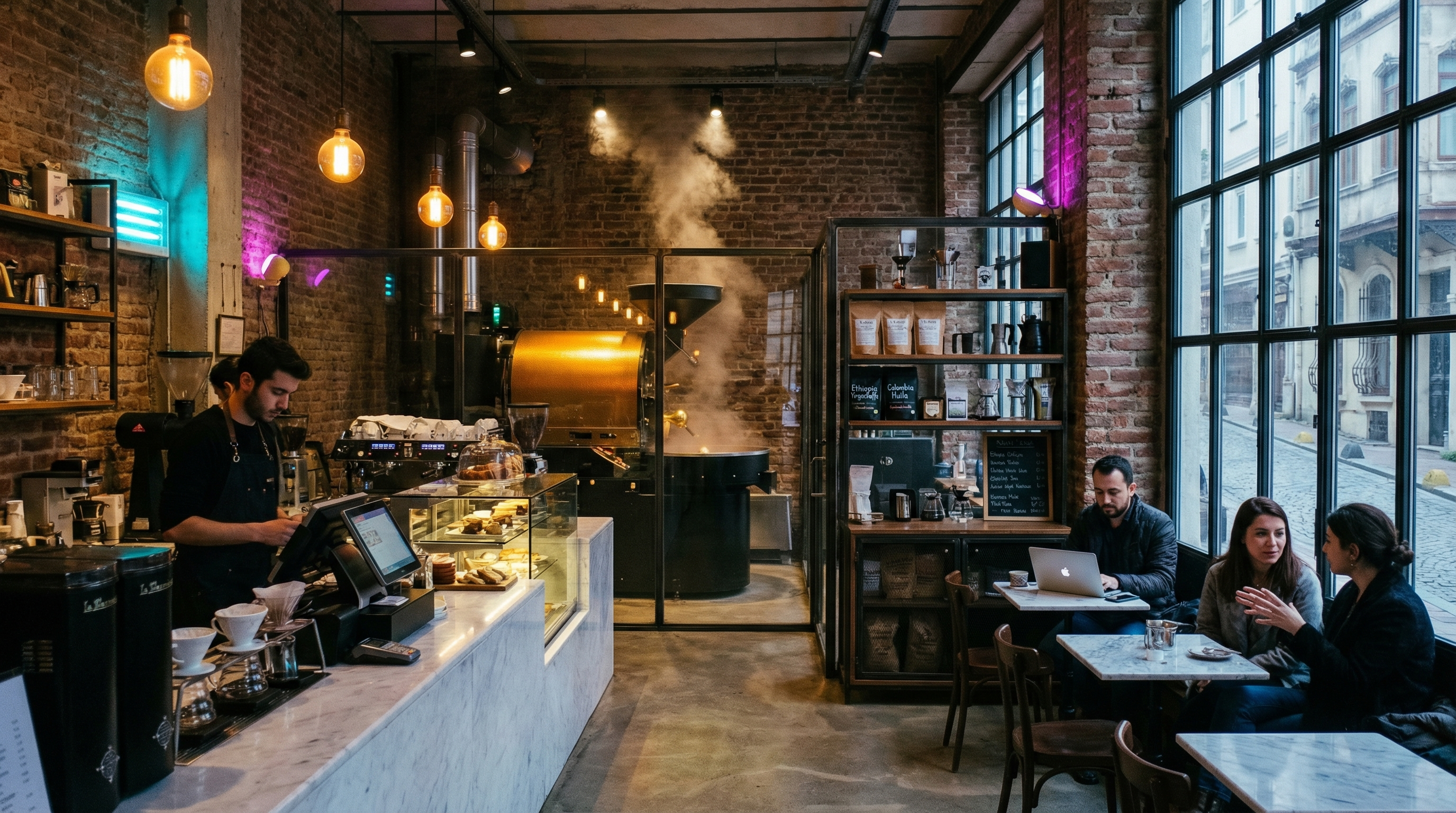
The business relocated its primary Beyoğlu presence from the original Galatasaray shop to larger premises, eventually establishing the branch on Serdar-ı Ekrem Caddesi that placed Kronotrop on one of the district's most curated commercial streets — a narrow pedestrian lane descending from Galata toward Karaköy, lined with boutiques, vintage shops, and design studios whose aesthetic aligned with the speciality coffee culture that Kronotrop represented. Additional locations followed: a branch in Cihangir on Firuzağa Cami Sokak, whose small open terrace offered views of a quiet residential street; a presence in Karaköy itself; outlets in Fatih, Kadıköy on the Asian side, and the commercial district of Ataşehir. Each branch maintained the standards that the original shop had established — in-house roasting, single-origin options, espresso and filter preparation methods, the industrial-contemporary aesthetic that had become Kronotrop's visual signature.
The Cihangir branch drew particular loyalty from the neighbourhood's creative residents, whose professional rhythms — freelance schedules, irregular hours, the need for workspace that wasn't home — aligned with a café whose self-service model and tolerance for laptop-occupied tables made it a functional extension of the domestic studios and cramped flats that the neighbourhood's residents worked from. The Serdar-ı Ekrem Caddesi branch attracted a more transient clientele — visitors to the Galata area, shoppers navigating the street's boutiques, the foot traffic that a well-positioned café on a pedestrian thoroughfare naturally captured.
Equipment and Method
Kronotrop's technical apparatus reflected the investment that serious speciality coffee operations required. A La Marzocco Strada EP espresso machine anchored the espresso programme, its engineering providing the pressure profiling and temperature stability that consistent extraction demanded. A Mahlkönig EK43 grinder — the equipment that the global speciality coffee industry had adopted as something approaching a standard — processed beans for both espresso and filter preparation. The manual brew bar offered Hario V60 pour-over, AeroPress, and Japanese cold-drip methods, each demanding a different grind profile, water temperature, and extraction time that the staff managed with the particular attention to measurement that distinguished craft preparation from routine service.
The beans were sourced through international importing partnerships — Mercanta, Ninety Plus, and other speciality importers whose networks connected producing regions in East Africa, Central and South America, and Southeast Asia to roasters whose volumes were too small for commodity supply chains but whose quality requirements exceeded what commodity channels could provide. The menu rotated as seasonal availabilities changed and as new lots arrived — an Ethiopian Beloya from Ninety Plus one month, a Sumatran Wahana Estate the next — each offering carrying the particular flavour profile that its origin, altitude, processing method, and roast development produced.
The roasting itself remained central to Kronotrop's identity. Beans were roasted in-house at each location, the equipment visible to customers through glass partitions or open floor plans that made the process part of the experience. The smell of roasting coffee — that particular transformation from green, grassy rawness to the complex aromatics of developed beans — permeated the interior and extended into the street outside, functioning as the most effective form of advertising the establishment possessed.
Place Within Istanbul's Coffee Culture
Kronotrop's relationship with Istanbul's existing coffee traditions was complementary rather than competitive. The city's çay houses continued operating as they had for generations — the tulip glasses, the sugar cubes, the backgammon boards, the social rituals that no amount of speciality coffee culture could replicate or replace. The traditional kahvehanes still served Turkish coffee brewed in sand-heated cezves with the thick-bodied, cardamom-inflected intensity that the method produced. These traditions occupied different social and cultural functions from what Kronotrop offered, and the city was large enough and culturally layered enough to accommodate both without either displacing the other.
What Kronotrop represented was an additional register — a way of engaging with coffee that emphasised craft, origin, and sensory precision in the manner that Istanbul's food culture had been embracing across multiple domains since the early 2010s. The same cultural moment that produced speciality coffee bars also produced natural wine shops, artisan bakeries, farm-to-table restaurants, and the broader ecosystem of quality-focused independent businesses that Beyoğlu's neighbourhoods in particular incubated and sustained.
By the mid-2020s, the speciality coffee scene that Kronotrop had helped pioneer had matured considerably. Dozens of establishments across both the European and Asian sides offered single-origin coffees, in-house roasting, and the preparation methods that had seemed novel when Kronotrop first introduced them. The market that one small shop in Galatasaray had served in 2012 now supported a competitive ecosystem whose participants pushed quality standards upward through the pressure of mutual comparison. Kronotrop maintained its position through the combination of consistent quality, established reputation, and the multiple locations that gave it presence across the city's geography that newer, single-site competitors could not match.






