Konstantinos “Kostas” Pafistis
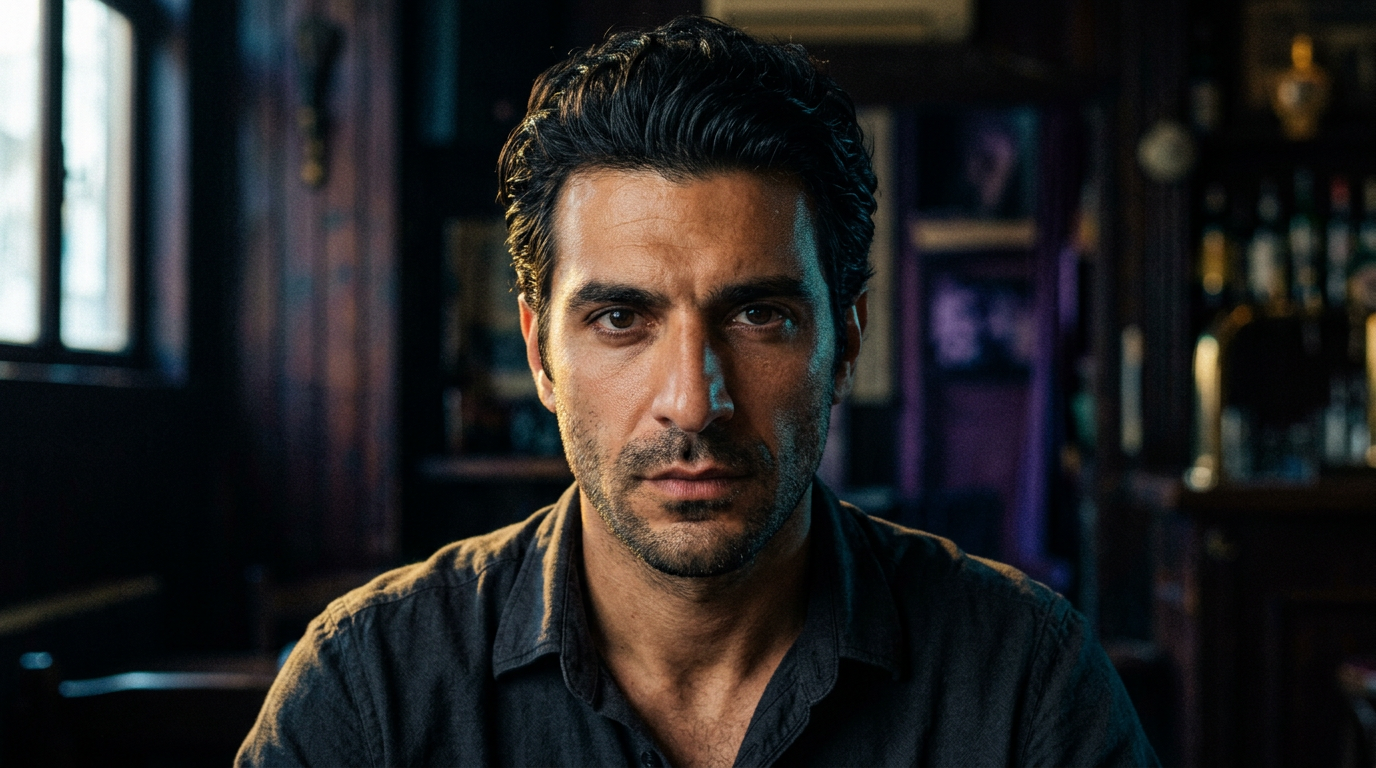
Konstantinos "Kostas" Pafistis, born 17 March 1943 in Thessaloniki, Greece, emigrated to Australia in 1967 under the assisted migration programme. A former mathematics student turned semi-professional poker player, Kostas earned a formidable reputation across Melbourne's inner-north card rooms through analytical precision and controlled silence. His marriage to Scottish-Australian teacher Helen Nicolson created a household balancing calculated risk with intellectual stability, profoundly shaping his three children—particularly his son Adrian, who inherited his father's methodical patience and quiet intensity.
Post-War Thessaloniki: Origins in Complexity
Konstantinos Pafistis was born on 17 March 1943 in Thessaloniki, Greece's second-largest city and northern commercial capital, during one of the darkest periods in the city's long history. His birth occurred during the Nazi occupation, when Thessaloniki's substantial Jewish population—nearly half the city's pre-war inhabitants—was being systematically deported to death camps. The ancient port city, which had for centuries embodied cosmopolitan coexistence between Greeks, Jews, Turks, and others, was being violently transformed into a more ethnically homogeneous place.
Kostas was the third of four children born to Dimitrios Pafistis and Aikaterina Pafistis (née Metallinou). Dimitrios, born in 1908, had worked as a bookkeeper for a textile import firm before the war disrupted normal economic life. During the occupation years (1941-1944), he survived through black market trading and whatever legitimate work could be found in a city whose economy had collapsed under German exploitation. Aikaterina, born in 1912, came from a family of small shopkeepers in Thessaloniki's Ano Poli district and managed household survival through networks of extended family and neighbourhood mutual aid.
The Pafistis family resided in a modest apartment near the port, in a working-class neighbourhood that had historically been mixed Greek and Jewish. The family's apartment building had been partially occupied by German administrative personnel during the war, creating atmosphere of constant tension and suppressed fear. Kostas's earliest memories—though he rarely spoke of them—included air raid sirens, food shortages so severe that malnutrition was widespread, the disappearance of Jewish neighbours whose apartments were then looted or reassigned, and the complex moral compromises that ordinary people made to survive extraordinary circumstances.
His older siblings—Yiannis, born in 1938, and Eleni, born in 1940—remembered the pre-war city and its lost cosmopolitan character more clearly than Kostas, whose consciousness formed entirely within wartime and immediate post-war austerity. His younger sister, Maria, born in 1946, knew only the diminished, traumatised city that emerged from occupation and subsequent civil war.
The liberation of Thessaloniki in October 1944 did not bring immediate peace or prosperity. Greece descended into bitter civil war (1946-1949) between communist and nationalist forces, with Thessaloniki becoming a nationalist stronghold but also a city flooded with refugees from rural areas where fighting was most intense. The Pafistis family, like most urban Greeks, supported the nationalist side more from pragmatism than ideological conviction—the communists threatened private property and traditional social arrangements, whilst the nationalists, despite their authoritarianism and corruption, seemed to promise eventual stability.
Education and Mathematical Aptitude
Despite the disrupted conditions of his childhood, Kostas displayed unusual mathematical aptitude from early age. He excelled in arithmetic at the local gymnasium, showing particular facility with mental calculation, pattern recognition, and logical problem-solving. His mathematics teacher, Petros Karamalis, recognised this talent and encouraged Kostas to pursue advanced studies, understanding that mathematical ability could provide pathway out of working-class circumstances.
In 1961, at age eighteen, Kostas enrolled at Aristotle University of Thessaloniki to study mathematics. The university, Greece's largest, had been re-established after the war and was experiencing expansion as the country slowly recovered from its catastrophic decade. Kostas's enrolment represented significant achievement for working-class family—university education was still relatively rare, particularly for families without professional or commercial backgrounds.
His university years (1961-1965) represented intensive intellectual development but also growing political disillusionment. Greek politics during this period was dominated by conservative forces backed by the military and American Cold War interests. The Centre Union government elected in 1963 attempted modest reforms but faced constant interference from the palace and military. For students like Kostas, who had hoped education would lead to modernised, democratic Greece, the political situation was increasingly frustrating.
Kostas completed his mathematics degree in 1965 with strong marks but uncertain prospects. Academic positions were scarce and typically required political connections his family lacked. Teaching positions in secondary schools were more available but paid poorly and offered little intellectual satisfaction. Private sector opportunities for mathematicians were limited in Greece's underdeveloped economy. He spent two years (1965-1967) working as an accountant's assistant in Thessaloniki, doing routine bookkeeping that used almost none of his mathematical training, watching his university education seem increasingly irrelevant to his actual life.
The Decision to Emigrate
The military coup of 21 April 1967 that established the Greek military junta (the "Regime of the Colonels") crystallised Kostas's decision to emigrate. The coup ended Greece's fragile democracy, imposed censorship and political repression, drove thousands into exile, and convinced many young Greeks that the country offered no acceptable future. Kostas, whilst not politically active, found the junta's combination of authoritarianism, anti-intellectualism, and nationalist bombast intolerable.
Australia's assisted migration programme offered practical pathway out. Following the Second World War, Australia had actively recruited European migrants to increase population and provide labour for industrial expansion. Greek migration to Australia had begun in earnest during the 1950s, with chain migration creating Greek communities in Melbourne, Sydney, and Adelaide. By 1967, Australia's Greek-born population numbered over 150,000, creating networks that facilitated further migration.
Kostas applied for assisted passage in June 1967, receiving approval in September. He departed from Piraeus in November 1967, travelling by ship to Melbourne via the Suez Canal—a three-week voyage that marked definitive break from his previous life. He was twenty-four years old, possessed mathematics degree and some work experience, spoke limited English, carried modest savings, and had distant relatives in Melbourne he had never met but whose addresses provided required sponsorship for migration purposes.
Arrival and Early Years in Melbourne
Kostas arrived in Melbourne in December 1967, entering a city experiencing significant transformation. Post-war migration had made Melbourne increasingly multicultural, with Italian, Greek, and other European communities establishing distinctive neighbourhoods and social institutions. The city's industrial economy was strong, manufacturing employment was plentiful, and opportunities existed for migrants willing to work hard despite language barriers and credential non-recognition.
His first accommodation was in a migrant hostel in West Melbourne, crowded temporary housing where recent arrivals lived whilst seeking employment and permanent accommodation. Within weeks, Kostas found work as factory hand at a textiles manufacturer in Brunswick, doing manual labour despite his university education—a common experience for migrants whose qualifications weren't recognised in Australia. The work was monotonous and physically demanding, but it paid adequate wages and provided pathway toward stability.
Within six months, he had moved to shared accommodation in Brunswick East, a working-class inner suburb with growing Greek population. He continued factory work whilst improving his English through night classes and informal learning. Yet he increasingly found factory employment soul-destroying—the mindless repetition, the lack of intellectual engagement, the waste of his mathematical training, the sense that emigration had merely exchanged one form of limited prospects for another.
Discovery of Poker and Alternative Income
Kostas's introduction to poker occurred through other Greek migrants in Brunswick's social clubs. Card games were common recreational activity in Greek-Australian community, providing entertainment and social connection. Initially, Kostas played casually, using his mathematical abilities to understand probabilities and odds without particular strategic sophistication. Yet he quickly realised that poker rewarded exactly the analytical skills his university education had developed—probability calculation, pattern recognition, logical deduction, emotional control, strategic thinking.
He began studying poker systematically, reading English-language books on game theory and strategy, practising probability calculations, observing experienced players to understand their tells and patterns. He approached poker the way he had approached mathematics—as discipline requiring study, practice, and continuous refinement. His mathematical training gave him significant advantage over most recreational players who relied on intuition rather than calculation, who made decisions based on feeling rather than probability.
By 1970, Kostas had transitioned from casual recreational player to semi-professional gambler. He quit factory work, supplementing poker income with occasional accounting and bookkeeping jobs for Greek businesses. He played primarily in inner-Melbourne card rooms and social clubs—the Metropole Hotel in Carlton, various RSLs in working-class suburbs, private games organised through networks of serious players. He was never officially part of any casino circuit (Crown Casino wouldn't open until 1994), but he became known amongst Melbourne's poker community as formidable player characterised by analytical precision and controlled silence.
His signature approach was methodical patience. He played conservatively, folding most hands, waiting for favourable situations where mathematics gave him edge. He rarely bluffed or engaged in psychological warfare, instead allowing other players' mistakes to generate his profits. He maintained detailed records of his sessions, tracking winnings and losses, calculating his long-term success rate, treating poker as mathematical enterprise rather than emotional competition.
This approach generated steady income—not spectacular wealth but comfortable middle-class living significantly better than factory wages. More importantly, it provided intellectual satisfaction his previous work had lacked. Poker rewarded the mathematical abilities he had developed at university, required continuous learning and adaptation, involved making complex decisions under uncertainty—all challenges that engaged him far more than factory work ever could.
Meeting Helen and Establishing Family Life
Kostas met Helen Nicolson in 1970 at a community education class in Carlton where he was improving his English and she was volunteering as a tutor. Helen, born in 1948 in Carlton North, was the daughter of a Scottish-Australian tram conductor and a librarian. She had graduated from Melbourne College of Education and was teaching Year 3 at Princes Hill Primary School, known for her kindness, firm classroom management, and passion for children's literature.
Their attraction was based on complementarity rather than similarity. Kostas brought intensity, analytical precision, mysterious past in Greece, unconventional career as semi-professional gambler. Helen brought stability, emotional warmth, deep connection to Melbourne's culture and institutions, conventional middle-class respectability. She was initially uncertain about his poker income—her family background emphasised steady employment and financial security—but she came to appreciate that he approached gambling with professional discipline rather than addictive recklessness.
They married in March 1971 in modest ceremony at Carlton's St Jude's Church of England, reflecting Helen's Anglican background whilst accommodating Kostas's Greek Orthodox heritage through priest's participation in blessing. The wedding brought together Helen's Scottish-Australian family and Kostas's small network of Greek migrants, creating atmosphere of cultural mixing characteristic of post-war Melbourne.
Their first home was a small terrace house they rented in Brunswick East, an inner suburb transitioning from Anglo-Australian working-class area to increasingly multicultural neighbourhood with substantial Greek and Italian populations. The location provided Kostas easy access to Carlton's poker venues whilst offering Helen reasonable commute to her teaching position.
Their first child, Sophia Elaine Pafistis, was born in 1972. Her arrival represented significant transition for Kostas—poker income that had seemed adequate for couple now needed to support growing family, responsibilities of fatherhood complicated the irregular hours and income variability that poker entailed. Yet he continued playing, treating it as profession requiring discipline rather than hobby pursued for excitement.
Building the Brunswick East Household
The birth of their second child, Adrian Louis Pafistis, on 15 October 1975, intensified both financial pressures and Kostas's commitment to providing stable family life despite unconventional income source. The family remained in Brunswick East, eventually purchasing a modest weatherboard house on a quiet street where they would raise their children throughout the 1970s and 1980s.
The household balanced Kostas's unconventional career with Helen's conventional teaching employment and middle-class aspirations. Helen's salary provided baseline financial security—covering mortgage, utilities, food—whilst Kostas's poker income funded extras and savings. This arrangement meant Helen bore primary responsibility for household management and childcare despite working full-time, a gender division of labour typical of the period but which created tensions neither fully acknowledged.
Helen brought to the household love of literature and storytelling. The house was filled with books—children's classics like Banjo Paterson and May Gibbs, adventure series like Famous Five and Hardy Boys, fantasy works including Ursula Le Guin and Lloyd Alexander. She read to the children nightly, encouraged imaginative play, treated literature as fundamental to good life rather than mere entertainment. This emphasis on narrative and imagination balanced Kostas's more analytical temperament.
Kostas's influence was quieter but equally profound. He rarely discussed his poker playing with young children, treating it as work he did elsewhere rather than as exciting adventure. Yet children absorbed his approach—the methodical patience, the disciplined record-keeping, the controlled emotional expression, the understanding that success came through calculation rather than luck. When Adrian was older, Kostas would sometimes explain probability concepts using cards, teaching mathematical thinking through concrete examples.
The household's Greek-Australian identity was complex and somewhat attenuated. Kostas had left Greece partly to escape its problems and hadn't maintained strong connections to Greek-Australian community institutions. He spoke Greek at home and with Greek friends, maintained some cultural practices around food and holidays, but didn't emphasise Greek nationalism or Orthodox religious observance. The children grew up with Greek as household language alongside English, ate Greek food prepared by both parents, understood themselves as partially Greek whilst being thoroughly Australian in education and social connections.
Their third child, Marcus Dean Pafistis, was born in 1979, completing the family. Three children in a modest Brunswick East weatherboard, supported by primary teacher's salary and poker player's earnings—it was comfortable but never affluent, requiring careful financial management and occasional stress when poker income dropped during losing streaks.
Parenting Philosophy and Family Dynamics
Kostas's approach to parenting reflected his analytical temperament. He was not warm or emotionally demonstrative, rarely offered praise, seldom engaged in playful interaction. Yet he was reliably present, provided consistent discipline without harshness, demonstrated through actions rather than words that he cared deeply about his children's welfare and development. He emphasised education, treating school achievement as non-negotiable expectation, believing that intellectual development provided best pathway to good life.
He was particularly attentive to teaching children strategic thinking and probability understanding. He would set up board games and card games, explaining mathematical concepts through play, showing how understanding odds and percentages provided advantages. He taught that emotional control mattered—that good decisions came from calculation rather than feeling, that appearing calm provided strategic benefit even when experiencing internal stress.
Adrian, in particular, seemed to absorb these lessons, displaying from early age the quiet intensity and methodical patience that characterised Kostas. Sophia, more extroverted and artistic, seemed less aligned with her father's analytical temperament, though she appreciated his stability and reliability. Marcus, the youngest, would later channel his father's analytical gifts into technology and invention, translating poker-table probability into circuit-board logic.
Helen balanced Kostas's emotional restraint with warmth and verbal affection. She praised achievements, encouraged creative expression, engaged in imaginative play, provided emotional support through childhood difficulties. Yet she also appreciated that Kostas's approach taught children resilience and independence, that not all valuable lessons came wrapped in warm encouragement, that learning to manage emotions and think strategically served children well in demanding world.
Later Years and Gradual Withdrawal
Throughout the 1980s and early 1990s, Kostas continued semi-professional poker playing whilst his children progressed through school and into adulthood. Yet the activity gradually became less central to his life and income. Melbourne's poker scene changed as casinos opened and gambling became more commercialised and regulated. The informal card rooms and private games where Kostas had thrived became less common or moved into grey-legal areas he was uncomfortable navigating.
He also experienced physical changes that affected his playing ability. His eyesight deteriorated, making it harder to read opponents' micro-expressions and body language. His concentration and mental stamina decreased, making long sessions more exhausting. His tolerance for cigarette smoke—endemic in card rooms—diminished, making the physical environment unpleasant in ways it hadn't been when younger.
By the mid-1990s, Kostas had essentially retired from poker, transitioning to part-time bookkeeping work for small Greek businesses and occasional tutoring in mathematics. Helen continued teaching until her retirement in the early 2000s, their combined pensions and savings providing comfortable if modest retirement income.
He watched his children establish adult lives with mixture of pride and occasional puzzlement. Sophia's move to Byron Bay to pursue music therapy seemed unnecessarily unconventional to someone who had valued stability and steady income. Adrian's career in construction was more comprehensible—skilled trade requiring precision and discipline, producing tangible results, providing solid middle-class income. Marcus's eccentric inventions and unconventional approach to IT work reflected the analytical abilities Kostas recognised as family inheritance but deployed in ways he didn't fully understand.
Adrian's relocation to Tasmania in the early 2000s meant less frequent contact, though father and son spoke occasionally by phone and visited when practical. Kostas rarely offered advice or commentary, maintaining the emotional reserve that had characterised their relationship throughout Adrian's life. Yet when Adrian established Pafistis Construction Co. in 2010, Kostas understood immediately what his son was attempting—to build something lasting through meticulous attention to detail, to succeed through discipline and precision rather than through luck or charm, to create structure that would endure beyond its maker.
Present and Reflections
Konstantinos "Kostas" Pafistis at eighty-two years old lives quietly in Brunswick East with Helen, their house now surrounded by neighbourhood transformed by gentrification that has made their modest property surprisingly valuable. He maintains the routines and disciplines that characterised his life—morning walks, careful financial record-keeping, reading newspapers and books, occasional mathematical puzzles that keep his mind engaged.
He rarely speaks of his poker years, treating them as work he once did rather than as adventurous past worth celebrating or lamenting. When asked, he describes poker matter-of-factly—it was profession that used his mathematical abilities, provided adequate income, required discipline and emotional control, eventually became less viable and he moved on to other work. He displays neither nostalgia for past glories nor regret about unconventional career path.
Adrian's mysterious disappearance in 2018 affected Kostas deeply, though characteristically he expressed little openly. His son—the child who most resembled him in temperament and approach—had simply vanished, leaving questions without answers, grief without clear object, loss complicated by uncertainty. Kostas processed this tragedy the way he had processed other difficulties throughout his life—through controlled silence, through continuing daily routines, through emotional discipline that appeared as stoicism but masked genuine pain.







