Kingsford Smith Pub, Gawler
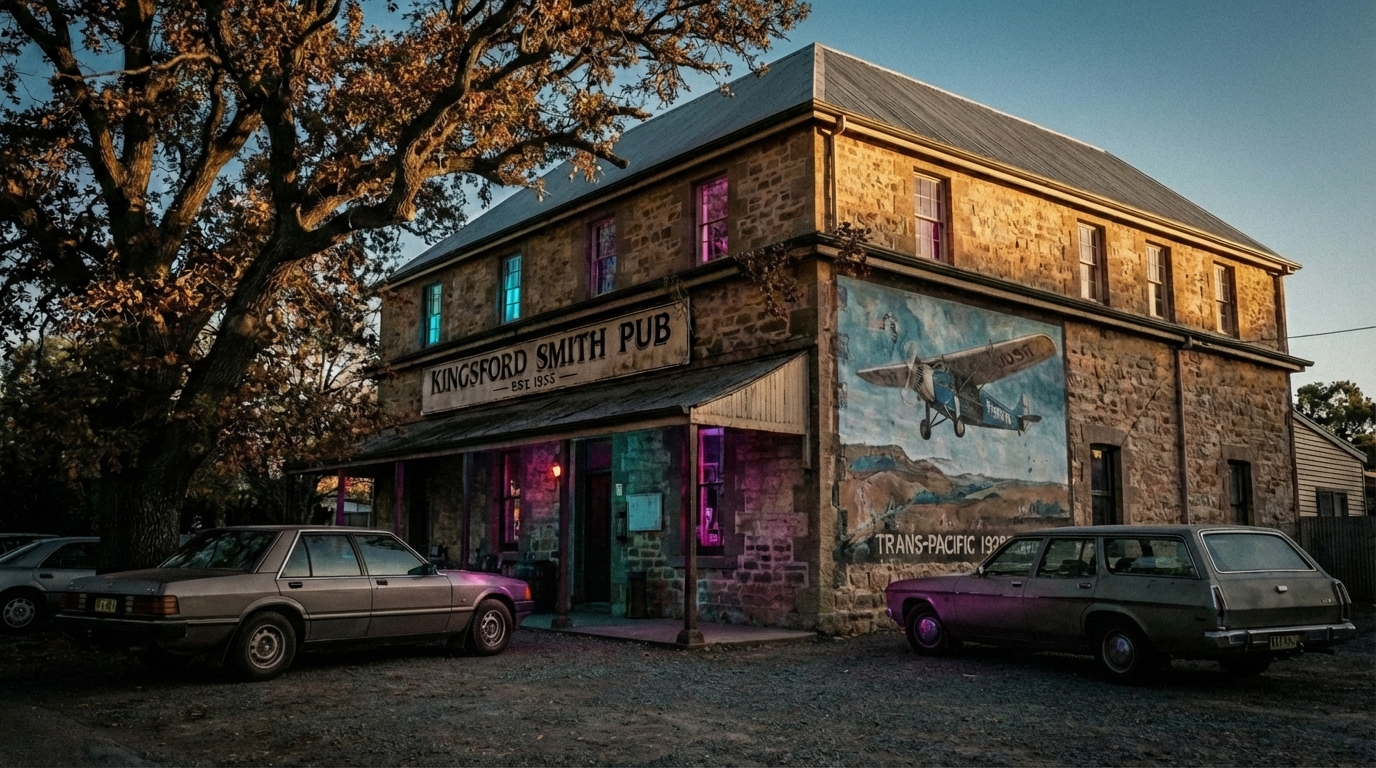
The Kingsford Smith Pub has anchored the farming community of Gawler, South Australia, since 1932, when World War I veteran Jack O'Connor named it for his friend and fellow aviator Sir Charles Kingsford Smith. Beneath its hand-painted mural of the historic 1928 trans-Pacific flight and the spreading branches of an ancient oak, generations of farmers, tradespeople, and travellers have gathered to share stories, settle disputes, and mark the quiet rituals of rural life. On 29 October 1987, within these weathered walls, a chance encounter brought together a restless young farmhand named Cody Jennings and the mysterious Guardian Jeremiah Atkins—a meeting that would prove the threshold to an extraordinary journey between worlds.
Location and Physical Structure
The Kingsford Smith Pub occupies a corner position on Murray Street, approximately two kilometres from Gawler's historic town centre on the road toward the Barossa Valley. The building stands at the junction where Murray Street intersects with Calton Road, a configuration deliberately chosen by founder Jack O'Connor to serve both townspeople travelling outward and farming families descending from the surrounding districts.
The original structure, completed in late 1931 and opened for business on 12 March 1932, was constructed from local limestone quarried near Roseworthy, with red brick detailing around windows and doorframes sourced from the Gawler brickworks on Lyndoch Road. The building stands two storeys tall, with the ground floor dedicated to public areas and the upper storey originally comprising living quarters for the O'Connor family, later converted to storage and a small function room during renovations in 1971. The external walls retain their original lime-wash finish, renewed every five years, which has weathered from pristine white to a warm cream streaked with grey where decades of dust and rainfall have left their marks.
The pub's most distinctive external feature is the sprawling oak tree that dominates the beer garden to the building's north side. Jack O'Connor planted this tree in the spring of 1933, reportedly from an acorn gifted by Charles Kingsford Smith following the aviator's 1932 knighthood celebrations. Whether this origin story is apocryphal has never been established, but the tree—now over ninety years old—has become inseparable from the pub's identity. Its canopy extends approximately eighteen metres in diameter, providing shade that transforms the beer garden into the establishment's most popular gathering space during South Australian summers.
The main entrance opens from Murray Street through double timber doors crafted from South Australian red gum, replaced in 1956 after the originals warped beyond serviceable use. A carved wooden sign hangs above the doorway, depicting the Southern Cross aircraft in bas-relief, the letters "Kingsford Smith" arched above in serif typeface—carved by Gawler woodworker Thomas Morriss in 1932 in exchange for a year's worth of ale.
The main bar occupies the majority of the ground floor, measuring approximately fourteen metres by nine metres with ceiling height of 3.4 metres. Original pressed-tin ceiling panels remain intact, their decorative patterns obscured by layers of nicotine staining accumulated during decades before smoking bans. The bar itself runs along the eastern wall, a substantial L-shaped counter constructed from Tasmanian blackwood commissioned from a Melbourne joiner in 1931. The wood has darkened over nine decades to rich chocolate brown, its surface bearing accumulated marks of countless glasses and elbows. Seven brass beer taps protrude from the counter, their handles worn smooth by three generations of publicans' hands.
Behind the bar, a substantial mirror spans nearly the full wall length, its silvering faded in patches to create ghostly areas where reflections blur. Shelves flanking the mirror hold an assortment of spirits bottles, commemorative glassware, and accumulated curiosities—a cricket ball allegedly signed by Don Bradman, a propeller blade from a Tiger Moth training aircraft, and a collection of military cap badges donated by returned servicemen over the decades.
The pub's most significant interior feature dominates the wall opposite the bar: a hand-painted mural measuring 2.4 metres wide by 1.8 metres tall, depicting Sir Charles Kingsford Smith's 1928 trans-Pacific flight. The painting shows the Southern Cross in flight over stylised Pacific waves, with California receding to the left and Australia's eastern seaboard emerging to the right. The sky graduates from sunset orange to deep purple, with stars of the Southern Cross constellation picked out in metallic gold paint that still catches lamplight. Jack O'Connor commissioned this mural in 1936, one year after Kingsford Smith's disappearance over the Andaman Sea, from Adelaide painter Eleanor Whitfield. The work has been conserved twice—in 1962 following water damage and again in 1989 to stabilise flaking paint—but the golden stars remain original.
Tables and chairs fill the main bar without formal arrangement, their positions shifting according to each evening's congregation. The furniture is deliberately mismatched—some pieces original to 1932, others acquired from estate sales and closing businesses—creating an atmosphere of domestic informality. A dartboard hangs on the southern wall, surrounded by cork panelling bearing decades of wayward throws, with a chalkboard recording ongoing tournament standings.
The beer garden extends from the building's northern wall, approximately 200 square metres dominated by the ancient oak. Weathered wooden benches and tables cluster beneath the canopy, with a low stone wall of Roseworthy limestone defining the perimeter. A modest raised platform in one corner serves as an occasional stage for live music, though the pub's primary entertainment has always been conversation.
Founding and the Kingsford Smith Connection
Jack O'Connor was born in Adelaide on 7 August 1895 to Irish immigrant parents Daniel and Bridget O'Connor. At eighteen, following the outbreak of the Great War in 1914, he enlisted in the Australian Imperial Force and was assigned to the 10th Battalion. He served at Gallipoli and on the Western Front, where he met Charles Kingsford Smith—then serving with the Royal Flying Corps after transferring from the Australian Army. The two men formed a friendship rooted in shared Irish heritage, mutual fascination with aviation, and the particular intimacy that develops between soldiers who have survived what should have killed them.
Jack was wounded twice during the war and received the Military Medal for actions the citation described only as "conspicuous bravery under fire." After the Armistice, he struggled to readjust to civilian life, drifting through various occupations including a brief stint as a commercial pilot with West Australian Airways in the early 1920s, where he worked alongside Kingsford Smith before the famous aviator's record-breaking ambitions drew him toward larger stages.
The trans-Pacific flight of 1928—when Kingsford Smith and crew flew from Oakland, California, to Brisbane via Hawaii and Fiji—electrified Australia, and Jack followed every report with the intensity of someone watching a friend attempt the impossible. This flight crystallised his vision: rather than attempting aviation feats himself, he would create something permanent honouring both his friend and the community he hoped to serve.
Financing proved challenging in Depression-era Australia. Jack secured backing through personal savings, loans from fellow veterans, and a contribution from Kingsford Smith himself, who had earned considerable income from endorsements and aviation ventures. This financial support—meticulously repaid by 1939—represented Kingsford Smith's investment in his friend's dream.
The pub's name was settled before construction began. Jack initially intended "Southern Cross" after the famous aircraft, but Kingsford Smith himself suggested using his name instead, reportedly joking that planes crash but names endure—a quip rendered darkly ironic by the aviator's disappearance in November 1935.
Opening night on 12 March 1932 drew crowds exceeding capacity. Sir Charles Kingsford Smith attended as guest of honour, arriving by motor car from Adelaide and remaining until after midnight. Photographs from that evening, preserved in a glass case near the bar, show aviator and publican standing arm in arm before the as-yet-unmuralled wall.
Proprietorship and Family Legacy
Jack O'Connor's stewardship lasted thirty years, from 1932 until his death on 15 September 1962 at age sixty-seven. In 1938, he married Evelyn Rose Parker, a schoolteacher from nearby Kapunda whose courtship had unfolded across the bar and beneath the oak tree. Evelyn brought culinary expertise to the pub's operations—her lamb roasts became legendary, and her bread-and-butter pudding remained on the menu until her own death in 1989.
The O'Connors had three children: Michael (born 1940), Thomas (born 1942), and Margaret (born 1945). All three grew up in the pub's upstairs quarters, learning from early ages that their home was also a public space requiring negotiation between privacy and community obligation.
Following Jack's death in 1962, his son Michael assumed management but lacked his father's natural affinity for the social demands of pub life. He ran the establishment competently but uncomfortably until 1965, when he gratefully handed operations to his nephew Alfie Harris—Jack's grandson through daughter Margaret, who had married Willaston carpenter Ronald Harris in 1964.
Alfie Harris was born on 14 September 1945. His connection to the Kingsford Smith began in childhood, when visits to his grandfather's establishment offered escape from more conventional household constraints. From earliest memories, Alfie was enchanted by the pub's atmosphere—the murmur of conversation, the clink of glasses, the way strangers became friends across the worn blackwood bar. He began working part-time during high school, and by his formal assumption of management in 1965 at age twenty, the transition felt less like succession than recognition of existing reality.
Alfie married Rosalind "Rosie" Winters in 1969, a childhood sweetheart whose practical temperament balanced his romantic inclinations. Rosie assumed kitchen management, adapting Evelyn O'Connor's recipes to changing tastes whilst maintaining continuity with the establishment's culinary traditions. The couple raised two children in the pub: Emily (born 1973), who would follow her father into the business, and Jack (born 1976), named after Alfie's grandfather, who became a schoolteacher in Adelaide.
By 1987, Alfie had managed the Kingsford Smith for twenty-two years. At forty-two, he had become indistinguishable from the establishment itself—knowing every regular by name, remembering preferences without being told, possessing the publican's essential skill of appearing interested in every conversation whilst monitoring half a dozen others simultaneously.
Operations and Social Function
The Kingsford Smith operated according to rhythms established during Jack O'Connor's tenure. Opening hours ran from 10:00 a.m. until midnight Monday through Saturday, with restricted Sunday hours in accordance with South Australian licensing regulations. These hours shaped daily character: quiet mornings, gradual afternoon accumulation as farmers finished work, and concentrated evening sociability.
Beer remained the primary product. The pub maintained taps for Coopers Pale Ale (a South Australian institution Jack championed from the beginning), West End Draught (the working-class standard), Carlton Draught (for eastern-states visitors), and rotating guest offerings. Pricing in 1987 was deliberately modest—$1.80 for a standard schooner of West End, $2.20 for Coopers—maintained below Adelaide averages in recognition that farming families operated on tight budgets.
The kitchen under Rosie Harris produced counter meals: lamb cutlets, rump steak, chicken schnitzel, fish and chips, and the bread-and-butter pudding now approaching fifty years on the menu. Prices ranged from $6.50 to $12.00, with portions generous enough that farmers could make a single meal serve for the day.
The pub's clientele reflected Gawler's demographics with particular concentration among farming and trades communities. Regular patrons included retired farmers occupying customary seats, young farmhands spending wages perhaps faster than advisable, orchardists maintaining weekly rituals, and the occasional traveller passing through on Barossa Valley business. The establishment served functions beyond drinking: hosting RSL meetings on Tuesdays, dart league matches on Wednesdays, agricultural board gatherings monthly, and operating as informal labour exchange during harvest season when farmers seeking hands posted notices on the corkboard.
ANZAC Day observances represented the pub's most significant ceremonial function. Jack O'Connor established the tradition in 1933—dawn service in the beer garden followed by two-up games and veteran reminiscence—and Alfie maintained it faithfully, ensuring the pub remained central to Gawler's veteran community even as original diggers passed away.
The 29 October 1987 Encounter
On Thursday, 29 October 1987, nineteen-year-old Cody Jennings visited the Kingsford Smith after a day's work on the family farm. A regular patron since reaching legal drinking age, Cody was known to Alfie and the evening crowd—a young man marked by restlessness that exceeded ordinary adolescent dissatisfaction, though its source remained unarticulated.
That evening, a stranger entered the pub—a man in his thirties with weathered complexion and travelling clothes, whose presence registered immediately as anomalous in an establishment where every face was catalogued. This was Jeremiah Atkins, though his identity and purpose would only become clear later. A minor accident at the bar—a spilled pint during an inadvertent collision—created the pretext for conversation between the restless young farmer and the mysterious traveller.
What followed appeared unremarkable to observers: two men discussing agriculture, weather, rural life. Yet the conversation deepened as evening progressed and other patrons departed, eventually leading Cody to offer the stranger accommodation at the Jennings farm rather than see him seek lodging elsewhere.
What occurred subsequently—the discovery of Portals, the revelation of Guardians and Clivilius, Cody's activation of a Portal Key—happened beyond the pub's walls. Yet the Kingsford Smith served its essential function: providing neutral ground where lives could intersect, where hospitality could bridge the gap between ordinary existence and extraordinary destiny.
Significance and Legacy
The Kingsford Smith Pub continues operating under Harris family stewardship, its walls holding memories most patrons never suspect. Alfie Harris, now in his eighties, has largely handed daily operations to his daughter Emily whilst maintaining evening presence behind the bar—a living repository of the establishment's accumulated history.
The mural of Kingsford Smith's trans-Pacific flight remains the centrepiece, golden stars still catching lamplight after nearly ninety years. The oak tree has grown to full maturity, requiring annual trimming to prevent canopy encroachment on the roof. The dartboard occupies its traditional position, the brass taps dispense Coopers and West End, and the blackwood bar bears marks of generations.
The Kingsford Smith remains what Jack O'Connor envisioned in 1932: a gathering place for Gawler's farming community, a repository of local memory, a venue for rural Australian life's small rituals. That it also served as the site where a Guardian's destiny commenced adds significance invisible to most who pass through its doors—but essential to understanding the complex connections between provincial places and forces operating across multiple realms.







