Kelly Jihyun Bales
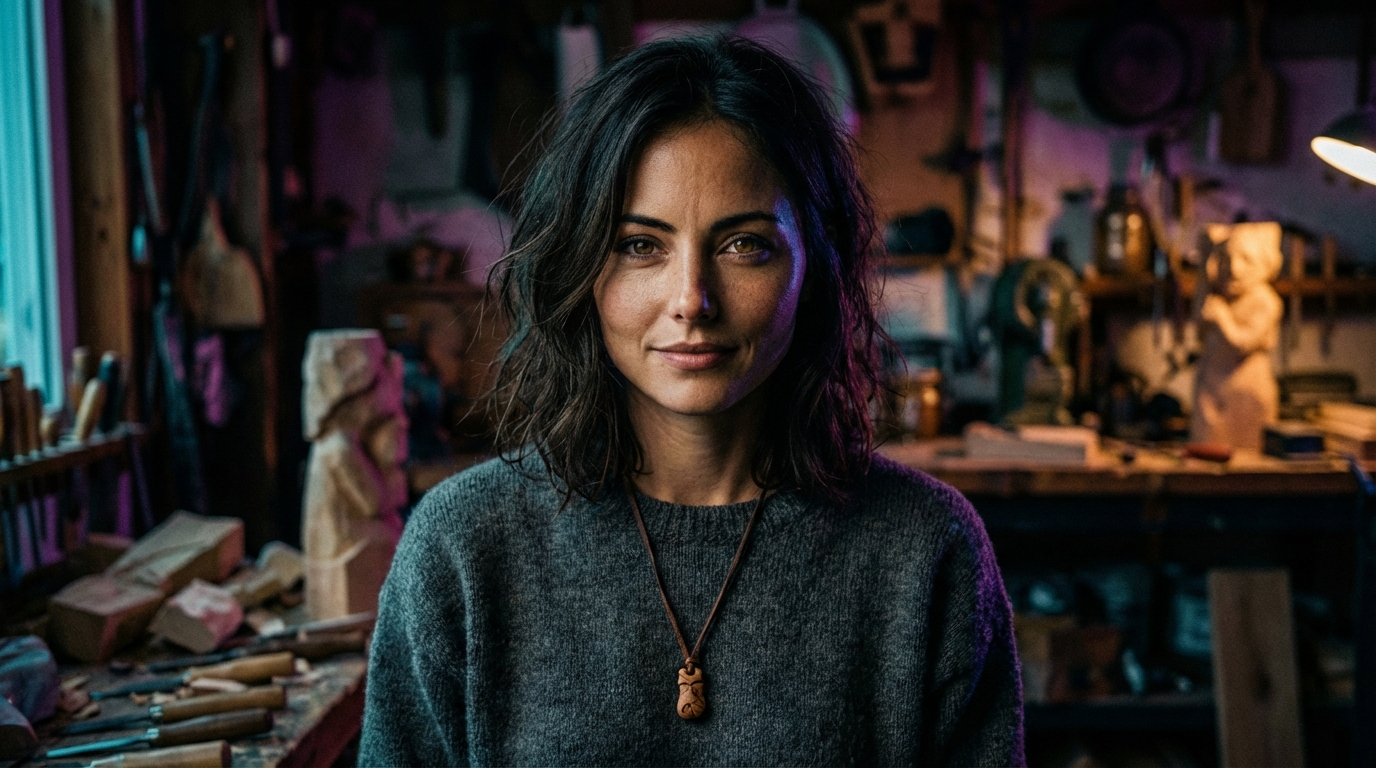
Kelly Jihyun Bales, born on the 8th of February, 1985, in Phoenix, Arizona, embodies the restless spirit of someone caught between worlds—raised between her Korean mother's herbal wisdom and her American father's genealogical mysteries, she fled the desert's heat for Edinburgh's ancient stones in 2015. A barista at Leaf & Bean Café, woodcarver, poet, and herbalist, Kelly moves through life with fierce loyalty masked by sardonic wit, unknowingly carrying ancestral secrets in the white lotus tattoo that marks her skin and destiny alike.
Early Life and Bicultural Heritage
Kelly Jihyun Bales drew her first breath on the 8th of February, 1985, at St. Joseph's Hospital and Medical Center in Phoenix, Arizona, entering a world where desert heat met cultural convergence. She was the eldest of three children born to Christopher James Bales (born 1954), a history teacher and genealogist with deep roots in the Church of Jesus Christ of Latter-day Saints, and Minseo Han Bales (born 1957), a Korean herbalist who had emigrated from Busan in the late 1970s carrying generations of traditional plant knowledge.
The Bales household in Phoenix existed as a study in harmonious contradiction. Christopher's family traced their lineage back to Mormon pioneers who had journeyed westward to Utah in the mid-1800s, though Christopher himself had stepped away from active practice whilst maintaining profound respect for his heritage's emphasis on record-keeping, genealogy, and the weight of historical narrative. His weekends were spent at the Arizona Historical Society, losing himself in archives whilst young Kelly wandered through forgotten documents and old maps, absorbing her father's conviction that history lived in the details others overlooked.
Minseo brought different wisdom to the marriage. Her small herbalism business blended Korean traditional medicine with modern botanical science, and the family home perpetually smelled of drying herbs and brewing tinctures. Evenings found Kelly learning to identify plants by scent and touch, understanding the medicinal properties of leaves and roots, listening to Korean folktales about mountains, spirits, and wise women who held secrets in their hands. This inheritance—practical knowledge passed mother to daughter—would shape Kelly's approach to the world: intuitive, tactile, rooted in the belief that healing required both ancient understanding and present attention.
Between these parents, Kelly grew up bilingual in ways that transcended language. She learned to navigate between Christopher's analytical precision and Minseo's intuitive knowing, between documented history and oral tradition, between the preserved past and the living present. The family dinner table hosted spirited discussions where genealogical debates met herbal philosophy, where Christopher's Mormon pioneer stories intersected with Minseo's Korean folklore, where three children learned that truth wore multiple faces depending on which angle one approached it from.
Kelly's siblings completed the family portrait. Noah Benjamin Bales (born 14th March, 1988) inherited their father's analytical mind, becoming a journalist whose investigative reporting sought truth through methodical research. Eleanor "Ellie" Grace Bales (born 22nd June, 1991) shared Kelly's love of the natural world but approached it through scientific conservation rather than traditional herbalism. The three siblings formed a complementary set: Kelly the intuitive artist, Noah the pragmatic investigator, Ellie the passionate activist—all shaped by parents who valued both rigorous thinking and holistic understanding.
Childhood Fascinations and Emerging Patterns
From early childhood, Kelly demonstrated the restless curiosity that would define her life. Her interests shifted with volcanic intensity—a term chosen deliberately, as Kelly's first passion involved volcanology. At age seven, she became obsessed with lava flows, tectonic plates, and the earth's molten core, begging her parents for trips to natural history museums and geological sites. This fascination with how hidden forces shaped visible landscapes would persist, though its expression would evolve.
At ten, during a local craft fair, Kelly encountered a woodcarver whose gnarled hands transformed blocks of pine into intricate figurines. She begged for lessons until Christopher acquiesced, and soon Kelly's room filled with carved animals, abstract forms, and experimental designs that revealed surprising sophistication. The woodcarving provided something her other interests lacked: the satisfaction of transforming raw material through patient attention, the meditation of knife against grain, the permanence of art carved rather than drawn.
By her teenage years, poetry claimed equal space with carving. Kelly filled notebooks with verses that blended scientific observation with mythological imagery, volcanic metaphors meeting Korean folk wisdom meeting her own emerging voice. She was drawn to the cello—inspired by Korean folk music and classical compositions—but the family's modest income meant formal lessons remained out of reach. Instead, she taught herself through library books and sheer determination, never achieving technical mastery but finding in the instrument's resonant voice something that matched her internal landscape.
Music, poetry, woodcarving, herbalism, volcanology—on the surface, these interests appeared scattered, the enthusiasms of someone unable to commit. In truth, they represented Kelly's consistent drive: the need to understand how hidden structures shaped visible forms, how patience and skill transformed raw materials, how ancient knowledge remained relevant to contemporary questions. She was, without realising it, training herself to see beneath surfaces, to recognise that the most interesting truths lived in liminal spaces between disciplines.
Education and the Restless Years
Kelly graduated from high school in 2003 and enrolled at Northern Arizona University, pursuing Environmental Studies—a degree that allowed her to combine ecological science with cultural preservation. The programme suited her temperament: broad enough to accommodate her diverse interests, structured enough to provide grounding, flexible enough that she could explore connections between traditional ecological knowledge and contemporary conservation.
During her university years, Kelly took a geology course on volcanic activity that deepened her childhood fascination with Iceland's unique landscapes. She briefly worked with an environmental non-profit, developing conservation programmes that integrated indigenous knowledge with modern science. She continued woodcarving and poetry, using them as escapes from academic pressures. But increasingly, Kelly chafed against traditional educational structures. The rigid boundaries between disciplines felt artificial. The emphasis on theory over practice left her restless. She completed her degree in 2007 competently but without particular distinction, already sensing that whatever she was meant to do existed outside conventional academic pathways.
Post-graduation, Kelly initially worked for the conservation non-profit full-time, but the desk-bound nature of the role proved suffocating. By 2010, she had pivoted entirely, launching a small herbal business that sold handcrafted teas, salves, and tinctures at local markets. Drawing on her mother's knowledge, she created products that blended Korean traditional medicine with Arizona's native plants, packaging them in decorative wooden containers she carved herself. The business succeeded modestly, earning enough to sustain her whilst providing the hands-on engagement she craved.
Yet even this success felt incomplete. Kelly had always been a seeker, someone drawn to horizons rather than satisfied with arrived destinations. Phoenix, for all its familiar comfort, had begun to feel constraining. She found herself increasingly drawn to stories of Edinburgh—a city layered with history, steeped in literary and mystical traditions, possessing the kind of atmospheric depth that Phoenix's desert sprawl lacked. When a friend suggested a visit in 2015, Kelly agreed almost impulsively, booking tickets with the vague intention of a fortnight's holiday.
Edinburgh and the Decision to Stay
Kelly arrived in Edinburgh in June 2015, stepping off the train at Waverley Station into a city that felt simultaneously foreign and strangely familiar. The stone architecture, the narrow closes winding through the Old Town, the way history accumulated in visible layers—all resonated with something she hadn't known she was seeking. What was meant to be two weeks extended to a month, then two. Kelly found work at Leaf & Bean Café, securing a visa through a combination of luck and the café owner Daniel Campbell's willingness to sponsor her.
The decision to remain in Edinburgh rather than return to Arizona carried no single dramatic justification. It was, rather, the accumulation of small recognitions: the way the city's scale felt human rather than sprawling, the intellectual culture that valued both rigour and creativity, the sense that Edinburgh's stones held secrets she wanted to understand. Her family, whilst surprised, understood. Kelly had always been the one who left, who sought, who refused to settle into expected patterns. Edinburgh simply made official what had always been true about her temperament.
By 2016, Kelly had established herself in an Edinburgh rhythm. Her flat in Marchmont—shared with Rhona and, later, her brother Noah when he arrived pursuing his own investigative work—became a sanctuary filled with herbs, carved figurines, and books spanning poetry to plant medicine. Leaf & Bean Café evolved from temporary employment to community, particularly through her friendship with Rhona Te Aika-Sutherland, whose dry wit and scholarly precision complemented Kelly's intuitive warmth. The two women formed an unlikely but enduring bond: the New Zealand academic and the Arizona herbalist, both displaced seekers finding unexpected home in Scotland's capital.
Character, Temperament, and Private Contradictions
To understand Kelly requires holding multiple truths simultaneously. She presents herself as pragmatic, using sharp humour as both shield and sword, deflecting vulnerability with sardonic observations that make others laugh before they register the insight beneath. Yet this pragmatism coexists with profound romanticism—evident in her poetry, her woodcarving, her belief that soup constitutes the ultimate comfort food, her fascination with birds (particularly crows and magpies) as symbols of mystery and intelligence.
Kelly is fiercely loyal to those she claims as family, whether bound by blood or choice. Her devotion to her siblings runs deep, though it manifests differently with each: protective concern for Noah's investigative obsessions, admiring delight in Ellie's activist passion. Her friendship with Rhona operates through comfortable silence as much as conversation, the two women capable of sharing space without needing constant engagement. At Leaf & Bean, Kelly functions as the heart of the staff—mediating conflicts, remembering birthdays, ensuring the café feels like community rather than merely employment.
Yet beneath this warmth lives guardedness earned through tumultuous relationships in her twenties. Kelly learned early that her intensity could overwhelm, that her restlessness made commitment complicated, that not everyone appreciated a partner who carved wooden ravens at three in the morning or spent weekends foraging for herbs. She approaches romance now with caution, preferring chosen solitude to compromised authenticity. This doesn't mean she's closed—merely selective, waiting for someone who understands that the apparent contradictions in her character aren't flaws requiring resolution but essential tensions that make her who she is.
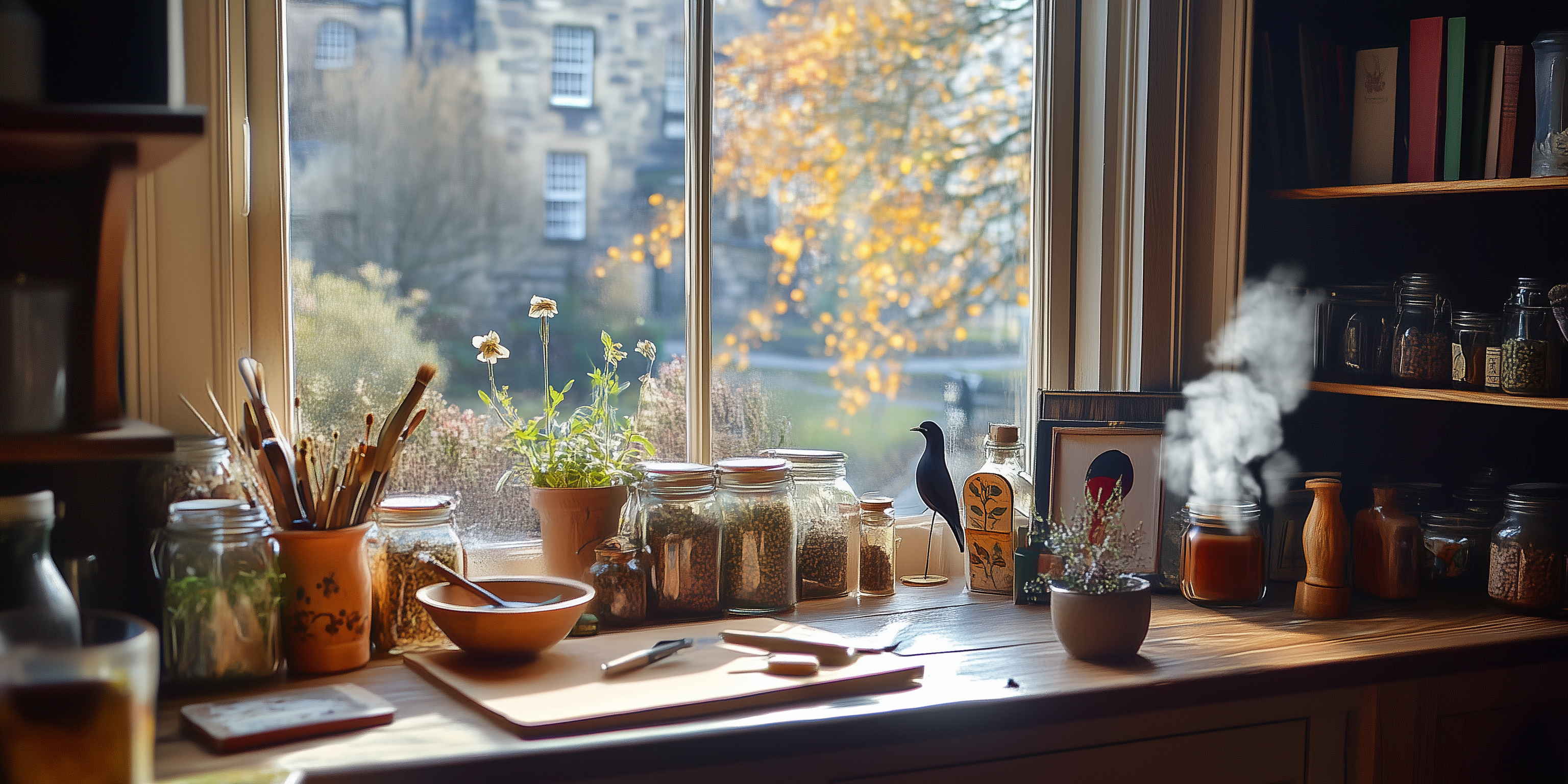
Her creative practices provide both outlet and meditation. The woodcarving continues, her small Edinburgh flat accumulating carved figures that range from realistic birds to abstract forms that emerge from the grain itself. Poetry fills journals she keeps private, verses that blend volcanic imagery with herbal metaphors with observations about Edinburgh's particular quality of light. These aren't pursuits aimed at public recognition—they're necessities, ways of processing experience that conversation or analysis cannot address.
The White Lotus and Hidden Inheritance
Concealed beneath Kelly's clothing, on her left shoulder blade, rests a tattoo: a white lotus rendered in pale ink that becomes visible only when light hits the skin at particular angles. She acquired it during a visit home to Phoenix in her mid-twenties, explaining it to curious observers as tribute to her Korean heritage and her mother's teachings about healing and purity. This explanation carries truth, but not completeness.
The tattoo's origins reach deeper, connected to her maternal grandfather Han Tae-jun—a figure Kelly knew only through her mother's stories and a collection of journals written in Korean that Minseo kept locked in a carved wooden box. These journals, which Kelly has only partially translated, contain fragments about traditional Korean medicinal orders, references to white lotus societies, and cryptic passages about "guardians of ancient knowledge" that read like folklore mixed with historical documentation.
Kelly doesn't fully understand the tattoo's significance. She chose the white lotus partly because it appeared repeatedly in her grandfather's writings, partly because her mother's visible emotion when Kelly showed her the design suggested it carried weight beyond aesthetic preference. What Kelly doesn't yet comprehend is that she's marked herself with a symbol that identifies her to those who understand its true meaning—a mark that will eventually draw attention she neither seeks nor is prepared to handle.
Present Circumstances and Gathering Mysteries
As 2025 unfolds, Kelly occupies a position of comfortable uncertainty. She's been at Leaf & Bean for nine years—longer than she's remained anywhere since childhood. The café has become her anchor point in Edinburgh, providing not just employment but community, purpose, and an unexpected sense of belonging. Daniel Campbell treats his staff as extended family, and Kelly has responded by becoming invaluable—anticipating needs, managing crises with calm efficiency, bringing warmth that transforms the café from business to gathering place.
Yet Kelly has begun noticing patterns she cannot quite articulate. The unusual clientele who speak in hushed tones at corner tables. The Campbell family's protective secrecy around certain plants in their greenhouse. The way conversations pause when she enters particular rooms. Nathan Campbell's intensity, which feels less like ordinary stress and more like surveillance. These observations accumulate without resolving into understanding, creating low-grade unease that Kelly addresses by focusing on immediate tasks whilst her intuition insists something significant remains hidden.
Her relationship with her siblings has evolved through distance. Noah, now also living in Edinburgh pursuing investigative journalism, shares her flat and her city but occupies different worlds—his analytical mind chasing stories whilst Kelly tends herbs and carves wood. Their dinner conversations blend sibling affection with frustrated incomprehension: Noah cannot understand Kelly's comfort with ambiguity; Kelly finds Noah's need for definitive answers exhausting. Yet they remain devoted, their bond strengthened rather than weakened by their differences.
Ellie, still in the United States leading conservation campaigns, maintains connection through video calls and elaborate emails. The two sisters share a language of environmental passion that Noah doesn't speak, though Ellie's scientific approach differs fundamentally from Kelly's traditional herbalism. Regular family calls with Christopher and Minseo provide grounding, reminding Kelly that Edinburgh, however much it feels like home, remains chosen rather than given—a distinction that carries both freedom and weight.







