Kelly Ann Muscat
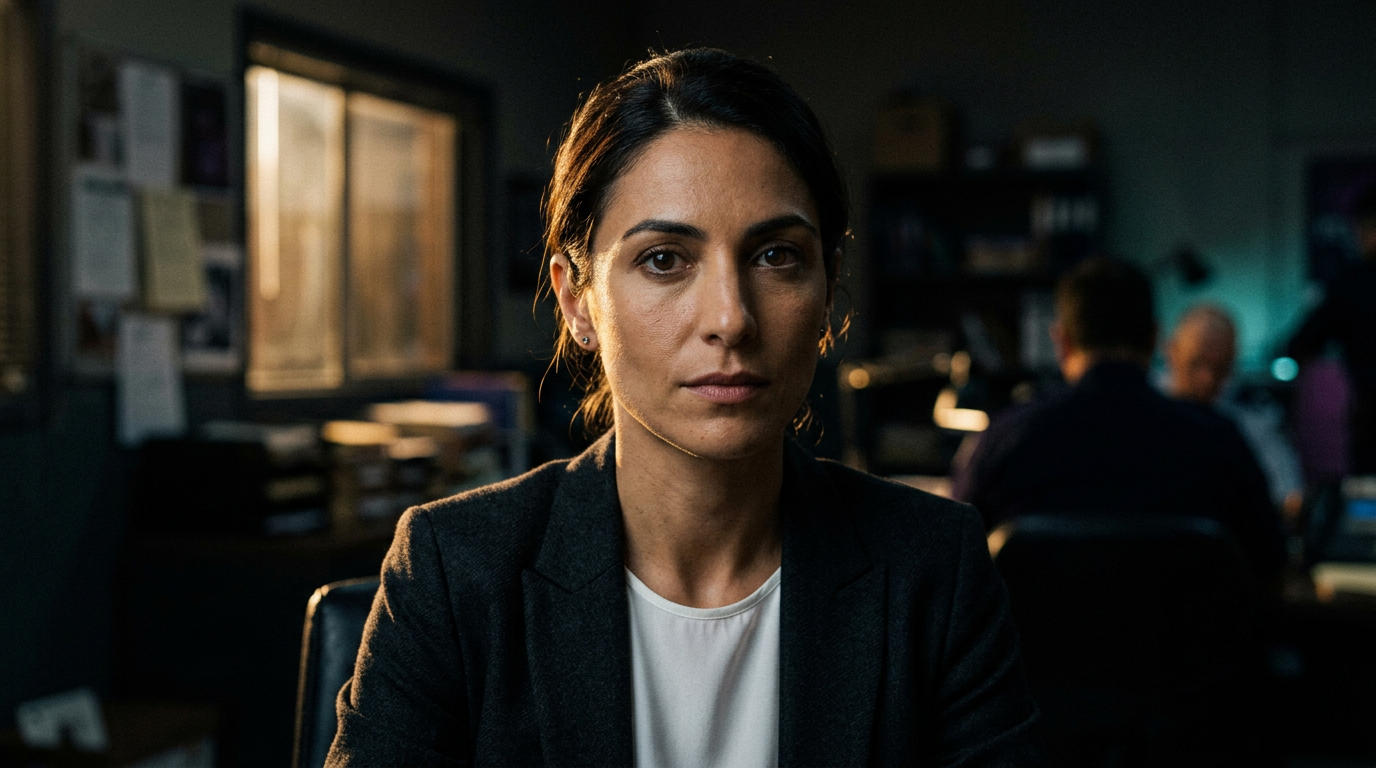
Kelly Ann Muscat, born on 14 February 1990 in Adelaide, was the youngest of three children born to construction foreman George Joseph Muscat and registered nurse Maria Teresa Muscat (née Grech), a Maltese-Australian family in the western suburbs. She joined the South Australia Police in 2008 and was appointed to the Adelaide Criminal Investigation Bureau in 2013, where her partnership with Detective David Santos became one of the unit's most effective. By thirty-six she held the rank of Detective Senior Constable.
The Muscat Kitchen
Kelly Ann Muscat was born on 14 February 1990 at the Queen Elizabeth Hospital in Woodville, the third child and second daughter of George Joseph Muscat, a construction foreman, and Maria Teresa Muscat (née Grech), a registered nurse. The family lived on Doris Street in Findon, in a cream brick house that George had bought in 1983 with money saved from seven years of labouring on commercial building sites across the western suburbs. It was not a large house — three bedrooms, a single bathroom, a concrete driveway where George parked the work ute — but it was owned outright by the time Kelly was born, a point of pride that George mentioned more often than Maria thought necessary.
The Muscats were Maltese. Not in the distant, attenuated way of families who had arrived in Australia generations earlier and retained only a surname and a recipe for pastizzi, but in the immediate, lived way of a community that had rebuilt itself in Adelaide's western suburbs during the postwar decades and kept its structures intact. George's parents, Joseph and Carmen Muscat, had emigrated from Żabbar in 1956 and settled in a fibro house on Grange Road where Carmen raised five children and Joseph worked at the Finsbury meatworks until his knees gave out.
Maria's parents, Paul and Rita Grech, had come from Paola in 1961 and run a small grocery shop in Torrensville for thirty years. Both families attended Our Lady of Mount Carmel in Hindmarsh, the Maltese parish church, and the social world they inhabited — christenings, feast days, Sunday lunches that lasted until evening — was as much Maltese as it was Australian.
Kelly grew up inside this world. The kitchen table on Doris Street seated eight because it had to. George's mother came for lunch every Wednesday. Maria's sisters dropped in without calling. Cousins appeared on weekends. The household operated on a principle that was never articulated because it did not need to be: family was not a sentiment, it was a logistical fact, and you worked around its demands the way you worked around the weather.
Kelly's older brother, Anthony Paul Muscat, born on 6 September 1984, was the first child and the son George had wanted — not because George did not value daughters, but because a Maltese man of his generation measured his life in certain milestones, and a son was one of them. Anthony was built like George: broad, quiet, physically comfortable. He left school at sixteen to take an apprenticeship as a plumber with a contractor in Beverley and never expressed any ambition beyond the work, the ute, the pub on Friday, and the eventual acquisition of a house like his father's. He was not unintelligent. He was simply content, and contentment was a quality Kelly would spend her adult life being unable to replicate.
Francesca Rose Muscat, born on 22 March 1987, was the middle child and the one most like Maria — practical, warm, and capable of holding a conversation with anyone in any room. She trained as a primary school teacher at the University of South Australia, married a surveyor named Daniel Ferrante at twenty-five, and had three children in four years. Francesca was the sibling Kelly rang when something had gone wrong and the sibling who rang Kelly when something needed fixing. The relationship was close in the way of sisters who had shared a bedroom until one of them left home and who understood each other's silences better than most people understood their words.
The Dominican Girls
Kelly attended St. Dominic's Priory College in North Adelaide from Reception through to Year 12, a thirteen-year stretch at a Dominican Catholic girls' school that shaped her in ways she would spend the rest of her life both drawing on and pushing against. The school occupied a sandstone complex on Molesworth Street that looked, from the outside, like something transplanted from an English cathedral town. Inside, it was academically rigorous, socially hierarchical in the way of single-sex institutions, and suffused with a quiet expectation that its students would be accomplished, articulate, and of service.
Maria had insisted on St. Dominic's despite the fees, which stretched the household budget in ways that George resented without openly opposing. Anthony had attended the local state school. Francesca had gone to Findon High. The decision to send Kelly to a private school reflected something Maria had observed in her youngest daughter early: a restlessness, a need for challenge, a tendency to test the limits of whatever structure she was placed within. Maria believed St. Dominic's would channel this. She was partly right.
Kelly was a good student without being a brilliant one. She worked hard, which compensated for the fact that she was not naturally academic in the way that the school's highest achievers were. Her strengths were in the subjects that involved people — psychology, legal studies, history — rather than the ones that dealt in abstraction. She played netball, captained the senior debating team, and ran the school's peer mediation programme in Year 11, a role that required sitting in a room with two girls who hated each other and finding the thing they could agree on. She had an instinct for the mechanics of conflict — not just what people were arguing about, but what they were actually afraid of — that her teachers noted and her peers found slightly unnerving.
She was not popular in the effortless way of girls who occupied the top of the social hierarchy. She was respected, which was different and which she preferred. Popularity required a kind of performance Kelly had no patience for — the management of alliances, the strategic deployment of warmth and withdrawal. Respect required only competence, and competence was something she could control.
She completed her SACE in 2007 with an ATAR in the low eighties — a result that pleased Maria, disappointed Kelly, and prompted a brief, sharp argument about whether Kelly was applying herself or simply applying herself to the wrong things. The argument resolved nothing but established a pattern that would recur throughout their relationship: Maria's expectations were high because she believed Kelly was capable of meeting them, and Kelly's frustration with those expectations was sharpened by the suspicion that her mother was right.
Tarac Road
The decision to join the police was Kelly's own, arrived at during her final year at St. Dominic's and announced to her family with the particular firmness of someone who expected resistance and had prepared for it. George said nothing, which was his way of saying he approved. Maria asked whether Kelly had considered law, or teaching, or anything that did not involve being called to houses where people had been hurt. Francesca said it sounded like Kelly. Anthony said the police were useless, which was not an objection to Kelly joining them so much as a general position he had held since receiving a speeding fine in 2003.
Kelly entered the South Australia Police Academy at Tarac Knoll in early 2008, six months after leaving school. She graduated in November 2008 at the age of eighteen. She was one of the youngest in her intake and one of a small number of women, a combination that attracted a particular kind of scrutiny — from instructors who watched to see if she could keep up, and from male recruits who watched for different reasons. She handled both with a directness that did not invite further testing. Her instructors' reports noted strong aptitude in scenario-based training, above-average performance in evidence handling and procedural law, and a tendency to challenge briefings she considered incomplete. The last point was recorded as both a strength and a developmental area, depending on which instructor was writing.
She was assigned to general duties at the Sturt police station in the southern suburbs, covering Marion and the surrounding areas. The posting was not what she had hoped for — Kelly had wanted the western suburbs, closer to home — but she did not complain. She spent four years in uniform, working the regular rotation of shifts that constituted the first stage of any police career: traffic incidents, shoplifting calls, domestic disturbances, welfare checks, Friday night pub fights, and the slow, unglamorous work of community presence. She was thorough, fast, and impatient with tasks she considered beneath her capability, a quality that made her effective and occasionally difficult to supervise.
By 2011, she had begun applying for investigative attachments. The applications were premature — three years of general duties was the minimum for consideration, and Kelly had barely reached it — but they signalled her intent clearly enough that her station sergeant, a veteran named Colin Draper, took her aside and told her something she did not want to hear: that the best detectives he had known had spent long enough in uniform to understand what policing actually was before they decided they were too good for it. Kelly absorbed the criticism without responding. She did not stop applying.
Santos
In early 2013, Kelly secured a six-month investigative attachment to the Adelaide Criminal Investigation Bureau, working under Detective Sergeant David Santos on a fraud case involving a construction company in the northern suburbs. She was twenty-three. Santos was forty-seven, a career detective whose reputation rested on meticulous case preparation and an interview technique so patient it bordered on glacial. He had been at the CIB for over two decades and had seen enough ambitious young officers rotate through on attachment to recognise the type: bright, eager, convinced they already knew more than they did.
Kelly was the type. She was also, Santos recognised within the first fortnight, genuinely talented in ways that transcended the eagerness. She read witnesses with an accuracy that owed nothing to training and everything to instinct — she knew when someone was lying not because of textbook indicators but because she noticed the thing they were not saying, the pause that lasted a beat too long, the answer that was too polished. Santos valued this. He also spent the first three months of the attachment correcting her tendency to act on instinct before she had built an evidentiary foundation for it.
The attachment became permanent. By mid-2013, Kelly had been appointed to the CIB as a detective constable, a fast-tracked appointment that reflected both Santos's advocacy and her own performance. The partnership that developed over the following years became one of the most effective in the Bureau — Santos providing the methodical, procedurally rigorous framework that investigations required, Kelly providing the interpersonal acuity and operational pace that moved them forward. They were not friends, exactly. The age gap precluded the kind of equality that friendship required. But they trusted each other, and in detective work, trust was more useful than warmth.
Kelly made detective in 2016, a formal recognition of rank that reflected the work she had been doing for three years. The promotion mattered to her more than she admitted. She had been the youngest in her Academy intake, one of few women in the CIB, and a Maltese surname in an institution that still skewed Anglo-Australian in its upper ranks. None of these things had been overt obstacles. All of them had been present, in the way that air is present — invisible until you tried to move through it quickly and felt the resistance.
The House in Craigmore
On 1 August 2018, Kelly led a four-officer team to a residential property in Craigmore, acting on intelligence relayed to Detective Santos by Detective Karl Jenkins of the Tasmania Police. Jenkins had identified Luke Nathaniel Smith as the primary suspect in a series of disappearances in Hobart and had reported that Smith had been sighted at Adelaide Airport that morning, believed to be heading for his parents' home. Santos assembled the team and dispatched Kelly to the scene while he coordinated from the Bureau and prepared to follow. The team comprised Kelly, Senior Constable Mia Chen, Constable Aaron Hughs — who was on a temporary CIB attachment under Santos — and Constable Jack Ridley.
Kelly directed the search. The house was furnished and lived-in but empty. A bedroom had been converted to bulk food storage, largely cleared out. A trolley of toilet paper stood in the hallway. A white barrel sat on the rear patio. The overall impression was domestic eccentricity — a family of preppers, one officer remarked. Kelly noted the assessment without challenging it. There was no sign of violence, no sign of Luke Smith. The intelligence from Jenkins had painted a picture of imminent threat. The house did not match it.
The assessment held until Mia Chen found fresh blood on the garden shed. Kelly contacted Santos, who confirmed he was en route and ordered the scene preserved. Then two men — unseen throughout the search — vaulted the rear fence. Hughs gave chase on foot, pursuing them through a reserve and behind the Craigmore Shopping Centre. He reported losing them in a dead-end alley from which there was no exit. Kelly relayed the loss to Santos.
What remained was a scene that confirmed every element of Jenkins's warning and explained none of it. Santos arrived to a property that offered no answers. The blood was Luke Smith's. The two men were gone. The alley had no through-access and no explanation. Kelly filed her report with the precision Santos had taught her, and the case file remained open in a way that resisted the tidy resolution she preferred. She did not dwell on it the way Hughs did — the impossible geometry of the alley became his particular burden, not hers — but she remembered the gap between what she had expected to find in Craigmore and what she had found, and the gap between what had happened and what could be explained. It was the first case in her career where thoroughness had not been enough.
The Cost of Running
Kelly met Thomas James Moretti at a friend's wedding in McLaren Vale in March 2017, a year before Craigmore. Tom was a paramedic with the South Australian Ambulance Service, thirty at the time, the son of an Italian father and an Irish-Australian mother from the western suburbs. He was calm in the particular way of people whose work required them to be calm in situations that justified panic, and Kelly recognised the quality immediately because it was one she valued in herself. They moved in together in late 2018, renting a two-bedroom house in Torrensville, close enough to both their workplaces and close enough to Doris Street that Maria's Sunday invitations were difficult to refuse.
The relationship was good. It was also, in ways that accumulated slowly, unbalanced. Kelly's career at the CIB intensified through 2019 and 2020, as she took on greater caseload responsibility and Santos began deferring to her judgment on operational decisions. She worked long hours. She brought case files home. She cancelled dinners, missed weekends, forgot to return calls that were not work-related. Tom absorbed this with a patience that was partly temperamental and partly professional — he understood shift work, understood the demands of emergency services, understood the way a difficult case could colonise your thinking until there was no room left for anything else.
What he did not understand, or understood but could not accept indefinitely, was that Kelly's unavailability was not entirely a product of the job. The job provided the excuse, but the pattern preceded it. Kelly had always been the person who was doing something — the school captain, the debating champion, the youngest detective, the officer who volunteered for every task force. Stillness frightened her in a way she could not articulate and had never examined. Sitting on the couch on a Sunday afternoon with nothing to do and nowhere to be produced in her a restlessness so acute it felt like nausea. Tom noticed. Francesca noticed. Maria, who had always noticed, said nothing, which was her way of saying everything.
They did not fight. That was part of the problem. Tom was not a man who raised his voice, and Kelly was not a woman who knew how to argue about feelings rather than facts. The conversations they needed to have — about whether Kelly could slow down, about whether Tom's patience was a kindness or an enabling, about what kind of life they were building together or whether they were building one at all — remained unheld. By 2022, they had been together for five years. They were not engaged. They did not have children. They shared a house and a genuine affection and an increasingly obvious silence about the future.
George Muscat, who had opinions about most things and shared them whether invited to or not, told Kelly at a family barbecue in January 2023 that she was going to wake up one morning and find that the man had gone and she would have nobody to blame but herself. Kelly told her father that her relationship was none of his business. She drove home angry and spent the evening wondering whether he was right.
Prospect Road
Kelly was promoted to Detective Senior Constable in 2021. Santos, who had passed sixty, reduced his caseload through 2022 and moved into an advisory role within the Bureau. The transition altered the dynamic of their working relationship in ways Kelly found disorienting. She had built her professional identity in relation to Santos's: his rigour, his patience, his willingness to slow her down. Without that counterweight, she discovered that her instinct-driven approach, which had always been her greatest asset, was also a vulnerability. She was fast. She was rarely wrong. But when she was wrong, she was wrong at speed, and there was no longer someone beside her whose role was to say, "Wait."
She compensated by working harder, which was not the same thing as working differently. The caseload expanded. She supervised junior detectives with a thoroughness that occasionally tipped into micromanagement — she checked their reports, re-interviewed their witnesses, corrected their scene notes with a specificity that was accurate and demoralising in equal measure. She was aware of the pattern. She did not change it. Trusting other people to do things as well as she could do them required a kind of surrender she had never learned.
At home, Tom had begun training for the paramedic practitioner programme, an advanced qualification that demanded his own long hours and concentration. For the first time in their relationship, he was not simply waiting for Kelly to come home. He had his own absorbing work, his own late evenings, his own preoccupations. The house in Torrensville, which had always been more Kelly's space than a shared one, began to feel like two people's space, and Kelly was not sure she liked the adjustment. She had never wanted Tom to be passive. She had simply grown accustomed to being the centre of gravity, and discovering that gravity could shift was unsettling in ways she was not proud of.
Anthony and his wife had their first child in 2020, a boy named Luca. Francesca's three children were in primary school. Maria, who had retired from nursing in 2019, spent her weeks between grandchildren and the parish, and her capacity for pointed observation about Kelly's childlessness had not diminished with age. The comments were never cruel. They were worse than cruel — they were loving, and they came from a genuine inability to understand why a woman of thirty-five, in a stable relationship with a good man, would choose not to have children. Kelly did not know how to explain that she had not chosen anything. She had simply not stopped long enough to decide.
By thirty-six, Kelly Ann Muscat lived in the house in Torrensville with a man she loved in the distracted, insufficient way of someone who had never learned to be fully present outside of work. She held the rank of Detective Senior Constable at the Adelaide Criminal Investigation Bureau, where she was regarded as one of the sharpest investigators in the unit and one of the most difficult to work under. She drove to Findon on Sundays for Maria's lunch, endured George's opinions and Francesca's gentle questions and the noise of other people's children in the house where she had grown up. She ran five mornings a week along the Torrens Linear Trail, not for fitness but because the rhythm of it — the forward motion, the absence of anyone needing anything from her — was the closest thing she had to stillness.
Tom had not gone. George had been wrong about that, or at least premature. But the silence between them about the future had hardened into something that resembled an agreement, and Kelly was not sure what the agreement was, only that neither of them had signed it consciously. She was good at her job. She was good at most things she attempted. She was less good at the things that could not be attempted — the things that required only that you stop, and sit, and let the life you had built be enough.







