Katrina Stewart
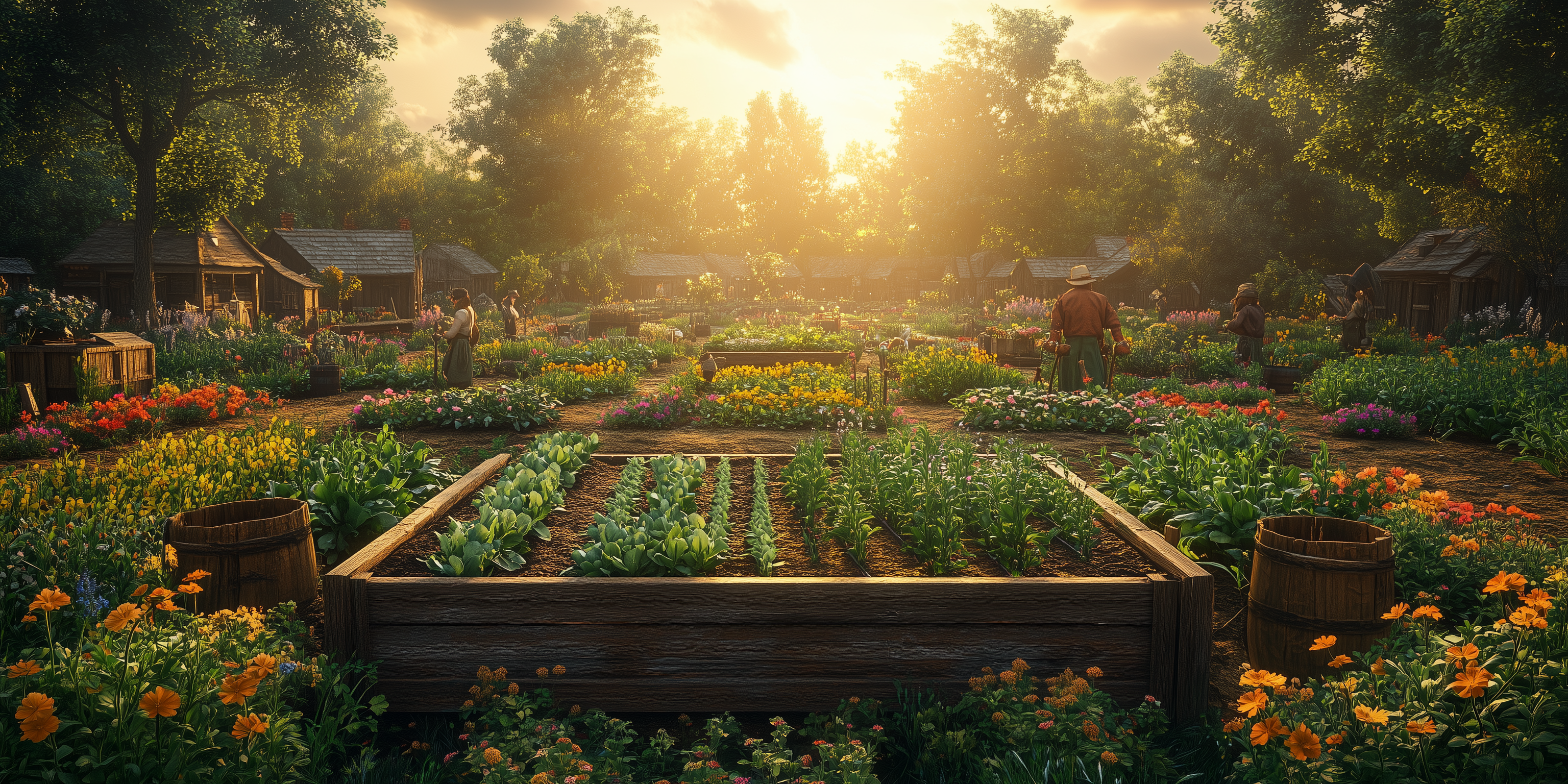
Born in Edinburgh on 12 February 1744, Katrina Stewart developed her passion for cultivation under her mother Morag's guidance, tending gardens with tools her blacksmith father Angus crafted before his death in 1754. Appointed Guardian on 19 May 1762, she transformed New Edinburgh's barren soil into agricultural abundance, pioneering techniques adapted from the ancient Goldenfields ruins. Her marriage to Lars Torsten Solberg of the Norwegian settlement Nordvik united two farming traditions; together they raised five children blending Scottish and Nordic heritage. A founding member of the Directorate, she died on 27 August 1811, her agricultural legacy feeding generations to come.

The Quiet One
Katrina Stewart arrived in the world on 12 February 1744, the third daughter born to Angus Callum Stewart and Morag Stewart née MacKenzie in their Edinburgh home near the Grassmarket. Winter still gripped the city when the midwife placed the infant in her mother's arms—a quiet child from her first moments, watching the world with serious eyes that seemed to absorb everything they encountered.
From earliest childhood, Katrina distinguished herself through temperament rather than appearance. Where her elder sister Elspeth commanded attention through capability and responsibility, and Effie drew eyes with golden beauty and natural charm, Katrina occupied a different space entirely. She was the quiet one, the observer, the child who would sit for hours watching ants carry crumbs across cobblestones or studying the way light filtered through leaves. Adults sometimes mistook her silence for dullness; those who knew her better understood it as something else entirely—a deep attention to the world's workings that would prove invaluable in years to come.
The set of her jaw when faced with adversity reminded observers painfully of her father. That same stubborn determination, that refusal to surrender when circumstances grew difficult, marked Katrina as Angus Stewart's daughter as surely as any physical resemblance. She inherited his patience too—the understanding that worthwhile things required time and careful attention, that rushing produced inferior results whether one was shaping metal or coaxing seeds to sprout.
Mother's Apprentice
While Elspeth gravitated toward needlework and Effie toward the marketplace's social dynamics, Katrina found her calling in the green and growing world. From an early age, she accompanied her mother Morag to Edinburgh's markets, but her attention fixed not on the merchants or their haggling but on their wares—the vibrant arrays of fruits and vegetables, the bundles of herbs whose scents spoke of distant hillsides and careful cultivation, the flowers that brought colour to grey streets.
Morag recognised something in her daughter's fascination that went beyond childish curiosity. Here was a kindred spirit, someone who understood intuitively that growing things required not merely technique but relationship—a dialogue between cultivator and cultivated that could not be rushed or forced. The Highland woman who had learned plant-lore from her own mother in Glenfinnan began passing that knowledge to her Edinburgh-born daughter, teaching Katrina the secrets that transformed seeds into sustenance and bare earth into abundance.
Behind the Stewart home, Katrina established a small garden plot that became her laboratory and sanctuary. Under Morag's patient guidance, she learned which plants thrived in shade and which demanded sun, how to read soil by its colour and texture, when to water and when to withhold. The garden flourished under her care, becoming a lush oasis that drew admiring comments from neighbours and provided herbs for the household's cooking and medicines.
Her father contributed to this education in his own way. Recognising his daughter's passion, Angus crafted a set of gardening tools specifically sized for her smaller hands—a trowel, a weeding fork, a small spade, each fashioned with the same care he brought to his finest commissioned work. These implements became treasures Katrina would carry across worlds, tangible connections to a father whose lessons in patience and precision shaped her approach to cultivation long after his death.
The Forge Falls Silent
On 21 June 1754, ten-year-old Katrina's world fractured beyond repair. The accident at her father's forge—details unclear, outcome devastating—left Angus Stewart lingering for three days while his family maintained desperate vigil. Katrina pressed her lips to his fevered brow in those final hours, watching the strong hands that had crafted her beloved tools grow still, feeling the warmth fade from skin that had always seemed so vital.
The loss struck each Stewart daughter differently. For Katrina, grief expressed itself through intensified connection to the earth her father would never again walk. In the weeks following Angus's burial at St. Cuthbert's Kirkyard, she spent hours in her garden, hands buried in soil as if seeking comfort from the ground itself. The tools he had made became sacred objects—each time she gripped the trowel's handle, she felt his presence guiding her movements, his patience steadying her hands.
The years following her father's death deepened Katrina's understanding of cultivation as metaphor. Grief, she learned, was like soil—it could become barren and hard if neglected, or it could be worked and tended until new growth emerged from apparent desolation. The family's reduced circumstances following the revelation of Angus's debts meant that her garden's produce became genuinely important rather than merely pleasant. Vegetables stretched meals further; herbs reduced the need for purchased medicines; flowers sold at market contributed precious coins to the household's depleted coffers.
The Portal Key
In May 1762, the trajectory of Katrina's life transformed in ways her Edinburgh garden could never have prepared her for. Her elder sisters had already crossed into the realm called Clivilius—Elspeth on 23 April, Effie five days later—when Lizbeth Wilson came to offer the third Stewart daughter her own Portal Key.
On 19 May 1762, eighteen-year-old Katrina received the ancient artefact that would grant her passage between worlds. The ceremony was quieter than her sisters' had been, befitting her nature—no grand declarations, merely the weight of responsibility settling onto shoulders that had carried burdens since childhood. She understood, perhaps better than her more dynamic siblings, what the key truly represented: not adventure or escape but obligation, the chance to apply everything she had learned to challenges greater than any Edinburgh garden had presented.
Three days later, on 22 May, Katrina participated in the formal founding of New Edinburgh alongside her sisters. The settlement that Elspeth had begun establishing now had a name, a purpose, and—with Katrina's arrival—the agricultural expertise it desperately needed to survive.
Coaxing Life from Alien Soil
The challenges Katrina faced in Clivilius dwarfed anything her Edinburgh experience had prepared her for. The soil was unfamiliar, its composition and properties unknown; the climate followed patterns she could not predict; the very plants she had nurtured since childhood might refuse to grow in this strange realm. Everything she thought she knew required testing, adaptation, reimagining.
She approached these challenges with the patient determination her father had modelled. Where others might have despaired at early failures—seeds that refused to sprout, transplants that withered despite careful tending—Katrina simply tried again, adjusting variables, observing results, building understanding through systematic experimentation. The techniques that had worked in Scotland required modification; some proved entirely unsuitable and had to be abandoned in favour of new approaches developed through trial and error.
Gradually, painstakingly, she learned Clivilius's secrets. The soil composition differed from anything she had known, but it responded to amendments she devised through careful testing. Local plants, initially ignored in favour of familiar Earth species, revealed properties that could enhance cultivation when properly understood. The climate's patterns, seemingly chaotic at first, gradually disclosed rhythms she could work with rather than against.
Within years, New Edinburgh's fields and gardens began producing harvests that exceeded mere survival. Katrina introduced crop rotation systems adapted to local conditions, developed composting methods that enriched depleted soil, and experimented with crossbreeding to create varieties better suited to Clivilius's unique environment. The settlement that had scraped by on foraged foods and uncertain supplies became agriculturally self-sufficient, then prosperous enough to trade surplus produce with neighbouring communities.
Goldenfields
On 5 April 1763, less than a year after New Edinburgh's founding, Katrina participated in a discovery that would shape her understanding of Clivilius's agricultural potential. Explorers from the settlement stumbled upon ruins the locals called Goldenfields—remnants of an earlier civilisation whose sophisticated farming techniques had once supported a thriving population.
For Katrina, Goldenfields was revelation. The crumbling irrigation channels, the terraced hillsides, the remains of storage facilities designed to preserve harvests through lean seasons—all spoke of knowledge accumulated over generations, now lying dormant awaiting rediscovery. She spent weeks studying the ruins, piecing together methods from fragmentary evidence, understanding how previous inhabitants had solved problems she was only beginning to encounter.
The lessons of Goldenfields transformed her approach. She adapted ancient irrigation techniques to New Edinburgh's needs, constructed storage facilities based on principles the ruins had revealed, and incorporated terracing methods that maximised productive land on difficult terrain. The vanished civilisation became her teacher across centuries, their agricultural wisdom preserved in stone and soil for someone patient enough to read it.
Marriage to Lars Solberg
In the early years of New Edinburgh's development, Katrina's work brought her into contact with neighbouring settlements whose different origins had produced distinct approaches to the challenges of life in Clivilius. Nordvik lay perhaps a day's travel distant—a community founded by Norwegian families who had crossed through portals from Bergen in the 1720s, establishing a settlement that blended fishing and farming traditions from their homeland.
Lars Torsten Solberg was a farmer from Nordvik, the grandson of original settlers who had carried Nordic agricultural knowledge across dimensional boundaries. His family had spent two generations adapting Scandinavian farming methods to Clivilius conditions—experience that paralleled and complemented Katrina's own work in New Edinburgh. When trade negotiations brought them together in the mid-1760s, the connection was immediate: two people who spoke the same language of soil and seasons, who understood cultivation as calling rather than mere occupation.
Their courtship unfolded through shared labour as much as conversation. Lars visited New Edinburgh to observe Katrina's innovations; she travelled to Nordvik to study techniques his family had developed. They debated crop selection and composting methods, exchanged seeds and strategies, argued about optimal planting times with the comfortable passion of people who cared deeply about the same things. By 1768, debate had become partnership, and partnership had become love.
The wedding united two settlements as much as two individuals. Families from both New Edinburgh and Nordvik attended, bearing witness to a marriage that embodied the connections Effie's diplomacy had been building throughout the region. Lars joined Katrina in New Edinburgh, bringing Nordvik's agricultural wisdom to merge with her own accumulated knowledge, their combined expertise accelerating developments that might otherwise have taken additional decades.
Five Children
The children who followed carried names that honoured both Scottish and Norwegian heritage, each one raised amid the gardens their mother had cultivated and the fields their father helped tend.
Fiona Astrid arrived first, in 1769—a daughter whose middle name honoured Lars's grandmother while her first recalled the Stewart family's Highland connections. She inherited her mother's patience and her father's quiet strength, growing into a capable young woman who would continue their agricultural work.
Angus Lars, born in 1771, carried both grandfathers' names—the Scottish blacksmith Katrina still mourned and the Norwegian farmer who had taught Lars everything he knew about working the land. The boy displayed early aptitude for the physical labour of farming, his sturdy frame and tireless energy assets in a settlement that always needed willing hands.
Astrid Morag followed in 1773, her Norwegian first name balanced by her grandmother's Scottish one. Of all the children, she most resembled Katrina in temperament—quiet, observant, drawn to growing things with an intensity that suggested the gift had passed to another generation.
Eirik James arrived in 1776, his name a compromise between Lars's desire for a traditional Norwegian name and Katrina's wish to honour her late father's memory through the English equivalent of Angus's meaning. The boy proved more adventurous than his siblings, more interested in exploration than cultivation, though he learned the family trade alongside his brothers and sisters.
Flora Sigrid, the youngest, was born in 1779. Named for flowers in both Scottish and Norwegian traditions—Flora the Roman goddess of spring, Sigrid meaning "beautiful victory"—she brought lightness to a household of serious workers, her laughter echoing through gardens her mother had spent decades perfecting.
The Directorate
By 1775, thirteen years of agricultural development had transformed New Edinburgh from desperate survival into genuine prosperity. The informal collaboration between the Stewart sisters that had guided early decisions required formalisation—structures capable of managing increasing complexity while preserving the cooperative spirit that had defined their leadership from the beginning.
On 15 August 1775, Katrina participated in establishing the Directorate alongside her sisters. The governing body divided responsibility among four Guardians, each overseeing aspects of settlement life that matched their particular expertise. Katrina's portfolio was obvious: food production, agricultural policy, the sustainable practices that determined whether New Edinburgh would merely survive or truly flourish.
Within the Directorate's formal structure, Katrina's quiet competence proved as valuable as her sisters' more visible gifts. She rarely dominated discussions, preferring to listen and observe before offering measured opinions. But when she spoke about agricultural matters—or about the patient, long-term thinking that successful cultivation required—her sisters had learned to attend carefully. Katrina understood that settlements, like gardens, required planning that extended beyond immediate seasons into years and generations.
Nurturing Beyond the Garden
Katrina's maternal instincts extended well beyond her own five children. Throughout her decades in New Edinburgh, she developed a reputation for taking in orphaned and abandoned children, providing them with the nurturing attention that had characterised her approach to everything she touched. Her household often contained young people whose circumstances had left them without family—victims of the various disasters and conflicts that periodically afflicted Clivilius settlements, or simply children whose parents had died from illness or accident.
These foster children learned the same lessons Katrina taught her own offspring: patience, attention, the understanding that worthwhile growth required time and care. Many went on to become farmers themselves, spreading agricultural knowledge throughout the region; others pursued different paths but carried with them the values Katrina had modelled. In this way, her influence extended far beyond what any accounting of her direct contributions could capture.
The Passing of Sisters
The final decade of Katrina's life brought losses that tested the resilience she had cultivated through sixty-seven years of challenge and adaptation. On 8 November 1801, Elspeth Stewart—the eldest sister, the First Guardian, the leader whose vision had guided New Edinburgh from desperate founding to thriving community—drew her final breath at sixty-three.
Katrina had spent thirty-nine years working alongside Elspeth, their different gifts complementing each other in ways that had shaped a civilisation. The eldest sister's strategic brilliance had secured the resources and alliances that made development possible; Katrina's agricultural expertise had ensured those resources translated into sustainable prosperity. Now that partnership was severed, and the weight of continuing their shared legacy fell upon those who remained.
In the years following Elspeth's death, Katrina's gardens became memorials as well as productive spaces. She planted trees in her sister's memory, cultivated flowers that had been Elspeth's favourites, created green sanctuaries where the community could gather to remember their founding leader. The work of mourning, she understood, was another form of cultivation—tending grief until it transformed into something that nourished rather than depleted.
Death
On 27 August 1811, Katrina Stewart completed her final act of nurturing. She was sixty-seven years old, her hands worn from decades of work in soil that had rewarded her patience with abundance beyond anything she could have imagined during those early desperate months when survival itself seemed uncertain.
Her passing occurred during harvest season—fitting for a woman whose life had been devoted to the cycles of planting and reaping, growth and decay. The gardens she had cultivated, the fields she had made productive, the orchting techniques she had developed and taught—all continued without her, tended by children and grandchildren and the countless others she had trained in the arts of cultivation.
Lars Solberg, her husband of forty-three years, survived her. So did Effie and Violet, the sisters who had journeyed with her from Edinburgh's familiar streets to Clivilius's uncertain frontier. They gathered at her bedside as she faded, four people whose shared history stretched back to a modest household near the Grassmarket where a quiet girl had first discovered the joy of making things grow.







