Katie Louise Jeffries
Katie Louise Jeffries (born 1996) represented the youngest generation of Tasmania's enigmatic Jeffries dynasty, transforming family darkness into literary art through her award-winning fiction. Born into privilege yet haunted by ancestral secrets, she found sanctuary in her profound bond with great-grandmother Thelma and solace in creative expression. When the 2018 Jeffries Manor Massacre claimed her mother and sisters, Katie vanished alongside Thelma, their mysterious disappearance becoming the family's most enduring enigma.
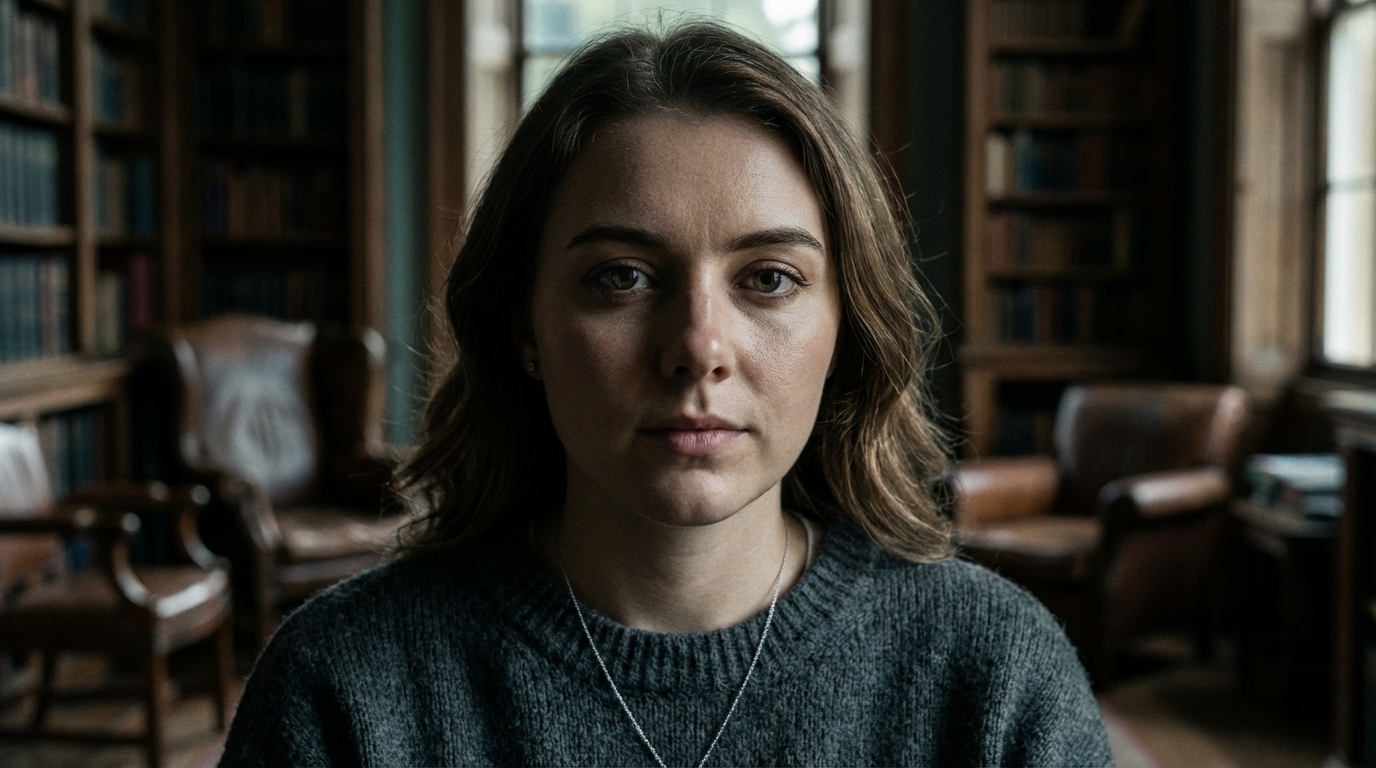
The Youngest Daughter
Katie Louise Jeffries arrived at the Royal Hobart Hospital on the morning of 15 October 1996, the fourth and final child born to Thomas Charles Jeffries and Louise Elizabeth Greyson. Her birth came at a moment of relative stability for the young family—Thomas and Louise had been married for eighteen months, having finally formalised the relationship that had produced their first two daughters before the wedding. Rebecca was six, Emily nearly four, and Kain just eighteen months old. The family dynamic that would shape Katie's childhood was thus already established by the time she entered it.
The Jeffries Manor of Katie's infancy bore little resemblance to the fortress it would become. The Georgian sandstone estate, whilst always imposing, still functioned primarily as a family home rather than a secured compound. Great-grandfather James III and great-grandmother Thelma Rose resided there alongside Thomas, Louise, and the growing brood of children, creating a multigenerational household that provided both support and complexity. For Katie, born into this established structure, the manor's vast grounds and the presence of an elderly great-grandmother offering unconditional affection seemed simply the natural order of things.
Her earliest years unfolded with the privileges that wealth afforded—spacious nurseries, attentive care, beautiful surroundings—but also within the peculiar emotional landscape of a family carrying accumulated secrets. Thomas struggled with the mounting pressures of working under his father Charles's demanding tutelage at Jeffries Industries whilst simultaneously managing the responsibilities of four young children. Louise, twenty-five and balancing her position as a financial analyst at First Point Credit Union with motherhood, found herself increasingly the family's emotional centre, mediating between Thomas's moods and the children's needs.
Katie's position as the youngest created both advantages and vulnerabilities. She received attention from older siblings who found her infant antics entertaining, became Thelma's particular pet amongst the great-grandchildren, and benefited from Louise's accumulated parenting experience. But she also grew up in the shadow of siblings who had already carved out their identities—Rebecca, the brilliant eldest with her sharp social consciousness; Emily, intensely focused on academic achievement; Kain, the only boy bearing the weight of that distinction. Katie would need to discover her own voice amongst these already-established personalities.
The event that fundamentally altered the family's trajectory occurred when Katie was eleven years old. Charles Jeffries' mysterious disappearance in 2008 forced Thomas to assume control of Jeffries Industries whilst moving the family permanently into the manor. For Rebecca, then seventeen and beginning university, the change meant watching her father's paranoia escalate. For sixteen-year-old Emily, it deepened her retreat into scientific studies. For twelve-year-old Kain, it complicated his adolescence with new expectations. For Katie, still in primary school and perhaps too young to fully comprehend the implications, it meant watching the manor transform from ancestral home into something approaching a prison, her father installing security systems and protocols that made everyday life feel surveilled.
Finding Voice Through Words
Katie's enrolment at Fahan School, one of Hobart's most prestigious institutions for girls, marked her entry into an educational environment that would recognise and nurture her particular gifts. Unlike her elder sisters—Rebecca at St. Michael's Collegiate School excelling across subjects with particular strength in law and ethics, Emily displaying exceptional aptitude for sciences and mathematics—Katie's talents emerged primarily in the humanities. Literature and creative writing became her natural domain, spaces where the vivid imagination that sometimes made the manor's oppressive atmosphere bearable found productive outlet.
Her primary school teachers at Fahan noted qualities that distinguished Katie from merely competent students. She possessed an unusual capacity for emotional truth in her writing, creating characters whose inner lives rang authentic despite her youth. Her descriptive passages captured not just visual details but the atmospheres and psychological textures of places and situations. Most remarkably, she displayed an instinctive understanding of narrative structure—how to build tension, when to reveal information, how to craft endings that felt both surprising and inevitable.
These abilities didn't emerge from vacuum. Growing up in Jeffries Manor provided Katie with endless material—the grand old house with its architectural secrets, the family stories whispered and half-told, the sense that every room harboured mysteries if one paid sufficient attention. Her imagination fed on this atmosphere, transforming the sometimes frightening reality of living in an increasingly paranoid household into stories she could control and shape.
The drama programme at Fahan offered another avenue for Katie's creative expression. Like her sister Emily, Katie found theatre provided welcome escape from the constraints of daily life. But where Emily had approached performance with scientific precision—analysing characters, deconstructing motivations, constructing interpretations—Katie inhabited roles more intuitively, channelling emotions through her body and voice in ways that suggested genuine artistic sensitivity rather than merely technical competence.
Her performance as Mary Magdalene in the 2004 Easter play at the local church in Granton, when she was just eight years old, demonstrated this quality. Standing before St. Mary's congregation, her clear voice carrying the themes of resurrection and hope, she conveyed not just the words but genuine feeling. Louise, watching from the pews with Rebecca, Emily, and Thelma, felt that peculiar mixture of pride and protective concern that talented children often inspire—pride in Katie's gifts, concern about how those gifts might expose her to vulnerabilities in a world that didn't always treat sensitivity gently.
The secondary school years brought both flourishing creativity and deepening awareness of the family's troubled dynamics. Whilst Katie excelled in her English literature courses, winning school competitions for poetry and short fiction, she couldn't entirely escape the growing tensions at Jeffries Manor. Thomas's paranoia, already concerning after Charles's disappearance, seemed to accelerate throughout Katie's teenage years. The additional security measures, the constant surveillance, the sense that invisible threats justified increasingly extreme precautions—all created an atmosphere that Katie found simultaneously suffocating and fertile for her dark imagination.
The breakthrough came in 2013, when seventeen-year-old Katie entered a prestigious statewide writing competition with a short story titled "The Ghosts of Jeffries Manor." The piece, ostensibly fiction, drew heavily from her lived experience—creating a narrative about a young woman discovering that her ancestral home harboured not just family secrets but actual supernatural presences, spirits of those who'd disappeared under mysterious circumstances throughout the house's two-hundred-year history. The story balanced psychological realism with gothic atmosphere, suggesting that the true horror lay not in ghosts themselves but in the family's refusal to acknowledge the darkness accumulating in their midst.
The competition judges, impressed by both the technical skill and emotional depth of Katie's writing, awarded her first prize. The recognition brought Katie brief celebrity within Tasmania's literary community—interviews in local publications, invitations to read at bookshops and libraries, encouragement from established authors who saw genuine promise in her work. For Katie, the validation meant something deeper than external success. It confirmed that the writing she'd been doing privately, almost compulsively, throughout her adolescence had value beyond personal therapy. Perhaps she could transform the pain and mystery of her family experience into art that resonated with others.
The Sanctuary of Thelma's Presence
Whilst Katie's siblings each found their own forms of escape from the manor's oppressive atmosphere—Rebecca through social justice work and eventually Harvard, Emily through biochemistry research and the University of Melbourne, Kain through athletics and his relationship with Brianne—Katie's deepest refuge existed within the manor itself, in her relationship with great-grandmother Thelma Rose Jeffries.
The bond between Katie and Thelma transcended typical great-grandparent relationships, becoming something approaching mystical in its intensity. From Katie's earliest memories, Thelma represented stability in a household marked by mounting tensions. Where Thomas grew increasingly paranoid and distant, Thelma offered unconditional acceptance. Where Louise struggled to maintain equilibrium whilst managing her career and four children's needs, Thelma provided patient attention. Where Katie's siblings pursued their various ambitions, Thelma simply welcomed Katie's presence without expectations beyond companionship.
Their afternoons together established rhythms that became sacred to both. There was the memorable day in August 2000, when three-year-old Katie took her first wobbling steps across Jeffries Manor's ancient grounds during a family picnic, Thelma's steadying hand and encouraging voice giving her the confidence to attempt what had seemed impossible moments before. There were the countless hours spent in the manor's kitchen, particularly that September afternoon in 2002 when six-year-old Katie helped Thelma bake cookies, her small hands dusted with flour as she decorated biscuits with the serious concentration that would later characterise her writing. There were the crafts they learned together—Katie mastering knitting under Thelma's patient tutelage during a rainy winter afternoon in July 2006, the rhythmic clicking of needles becoming a meditative anchor against the mounting family stresses.
These seemingly simple activities carried profound significance. In teaching Katie domestic arts that had largely disappeared from modern life, Thelma provided her with tangible connections to continuity and tradition. The quilts they made together, the mittens they knitted, the preserves they canned—each represented a kind of creation that balanced Katie's literary pursuits with practical accomplishment. More importantly, these shared activities created spaces for the kinds of conversations that couldn't happen elsewhere in the increasingly surveilled manor. Whilst their hands worked, their voices ranged across topics both mundane and profound—Thelma's stories from her own youth, Katie's worries about family dynamics, questions about life and mortality and meaning that couldn't be easily answered but deserved the dignity of serious consideration.
The handmade quilt Thelma presented to Katie on her twelfth birthday in October 2008 became one of Katie's most treasured possessions—not merely for its beauty or the obvious labour its creation represented, but for what it symbolised about their relationship. Thelma had sewn into that quilt months of careful work, choosing fabrics that reflected Katie's emerging aesthetic, creating patterns that balanced tradition with innovation. The gift arrived at a particularly difficult moment—just weeks after Charles Jeffries' disappearance had transformed the family's trajectory—and provided Katie with tangible proof that love and care could exist even as the world seemed increasingly unstable.
As Katie moved through adolescence, the conversations with Thelma deepened to address more troubling subjects. There was the arts and crafts fair in November 2010, when Katie's talent for painting was first publicly recognised, Thelma's quiet pride providing validation that Katie's creative gifts deserved nurturing. There were the family dinners where Thelma shared stories from her own youth, creating bridges between generations whilst quietly demonstrating that survival through difficulty was possible. There was the heartfelt conversation in October 2014, shortly after Katie graduated from secondary school, when she confided her dreams of becoming a writer and Thelma encouraged her to pursue that passion despite the practical concerns others might raise.
But their bond also encompassed darker acknowledgements. There was the summer of 2014 when Thelma fell ill and Katie spent long days by her bedside, reading aloud, keeping watch, role-reversing from recipient to guardian of their sacred connection. There was the walk on the manor grounds in July 2015 when Thelma, approaching ninety years old and perhaps sensing that time was limited, shared her concerns about the family's secrets—not revealing specifics (Thelma understood that knowledge could be burden as much as liberation) but acknowledging that the shadows accumulating around Jeffries Manor represented something more substantial than mere paranoid fantasy. There was the April 2018 conversation when Thelma revealed her suspicion that the family harboured dark secrets beyond what anyone openly discussed, preparing Katie for possibilities she'd perhaps intuited but never voiced.
Creative Pursuits and Constrained Horizons
Katie's graduation from Fahan School in 2014, at age seventeen, marked a moment of decision that would fundamentally shape the trajectory of her remaining years. Unlike her siblings, who had each left Tasmania to pursue university education elsewhere—Rebecca to Harvard for legal studies, Emily to the University of Melbourne for biochemistry—Katie chose to remain at Jeffries Manor. The decision surprised those who'd assumed she would leverage her writing talent into university programmes in creative writing or literature at institutions far from Tasmania's confines.
The choice reflected complicated motivations. Practically, Katie recognised that her literary gifts, whilst genuine, didn't guarantee success in competitive academic environments. University creative writing programmes attracted hundreds of applicants with talent and ambition; Katie's single competition victory, however impressive locally, might not translate to broader recognition. Financially, whilst the Jeffries family could certainly afford tuition, Katie was aware that her presence at the manor provided practical assistance to Louise, who balanced professional work with managing an increasingly difficult household.
But the deeper reasons involved emotional attachments that Katie couldn't easily articulate even to herself. Leaving would mean abandoning Thelma, then eighty-seven and increasingly frail. Leaving would mean trusting that the family secrets Katie sensed but didn't fully understand wouldn't erupt in her absence. Leaving would require the kind of bold independence that came naturally to Rebecca but felt foreign to Katie, whose confidence existed primarily within the domains of writing and imagination rather than practical navigation of an often-hostile world.
So Katie remained at Jeffries Manor, enrolling in online creative writing courses that allowed her to develop her craft whilst maintaining her domestic presence. The decision created a peculiar existence—she was simultaneously more trapped than her siblings (bound by the physical limits of the manor and its surrounding area) and more free (able to devote substantial time to writing without the distractions of university social life or academic pressures beyond her chosen focus).
The courses themselves proved valuable if limited. Katie engaged seriously with the readings and assignments, developing technical skills around plot structure, character development, dialogue, and prose style. The online format allowed her to share work with other aspiring writers from around Australia, receiving feedback that helped refine her abilities. But the lack of in-person instruction, the absence of the kind of intensive workshop environment that residential programmes offered, meant Katie's development occurred somewhat in isolation, her primary readers remaining Thelma and Louise rather than professional mentors who might have pushed her towards greater risk and ambition.
Her writing during these years reflected both growth and constraint. She completed several short stories that displayed maturing craft—tighter prose, more sophisticated characterisation, better command of tone and atmosphere. But the subjects remained largely familiar: family secrets, ancestral homes, the weight of inheritance, mysteries lurking beneath surface respectability. Katie was writing variations on "The Ghosts of Jeffries Manor," exploring the same thematic territory from different angles rather than genuinely expanding her range. Whether this represented genuine artistic obsession or merely the limits imposed by her circumstances remained unclear even to Katie herself.
The surprise eighty-ninth birthday party Katie organised for Thelma in February 2016 demonstrated Katie's capacity for complex planning and her deep understanding of what would bring her great-grandmother joy. She coordinated the gathering of family and friends, managed the logistics of refreshments and decorations, orchestrated the revelation that transformed an ordinary afternoon into celebration. The success of the event reflected Katie's social and organisational abilities—capacities that existed alongside her literary gifts but received less recognition because they didn't produce tangible artistic products.
The afternoons Katie and Thelma spent sorting through old family photographs in August 2016 revealed another dimension of their relationship. As they examined images spanning decades—Thelma and James III in their youth, Charles as a boy, Thomas growing up, the grandchildren at various stages—Thelma shared stories that contextualised the frozen moments. For Katie, these sessions provided both family history and narrative education. She observed how Thelma selected which details to emphasise, how she framed events to create coherent story arcs, how she navigated the space between truth and discretion. These lessons in storytelling, delivered informally over fading photographs, perhaps taught Katie more about her craft than any online course could manage.
The Gathering Darkness
The year 2018 began with tensions that had been building throughout Katie's young adulthood finally reaching critical mass. Thomas's paranoia, which had escalated steadily since his father Charles's disappearance a decade earlier, now dominated his behaviour to the point where even family members who'd previously made excuses recognised that something was profoundly wrong. The manor, already heavily secured, received additional surveillance systems. Private security staff moved through the grounds with military efficiency. Thomas spoke increasingly about threats and conspiracies in ways that suggested his grip on reality was loosening.
The New Year's lunch at Jeffries Manor on 14 January 2018 captured the family dynamics at their most strained. Gathered around the dining table—Thomas at the head, Louise to his right managing the meal's logistics, Thelma presiding with the quiet authority of the family's eldest member, the children arrayed according to an unspoken hierarchy that reflected both age and favour—the Jeffries family enacted a performance of normality that fooled no one present. Rebecca, home briefly between legal aid cases, watched Thomas with the calculating assessment of someone trained to recognise danger. Emily, visiting from Melbourne for the holiday, seemed simultaneously present and absent, her mind perhaps already back in the laboratory where molecular mechanisms followed predictable rules. Kain, engaged to Brianne and planning a future beyond the manor's shadows, radiated barely suppressed desire to be anywhere else. And Katie, watching it all with the observational skills of a writer, absorbed the tensions whilst seeking Thelma's calming presence as antidote.
The conversations with Thelma became more urgent during these final months. In February 2018, Katie confided her concerns about Thomas's increasingly erratic behaviour—not merely the security measures, but the quality of his speech, the disconnection in his eyes, the sense that he was responding to stimuli invisible to others. Thelma listened with the patient attention she'd always provided, but her response carried new weight. She acknowledged that the family's troubles extended deeper than any of the children fully understood, that the Jeffries legacy involved darkness accumulated across generations, that sometimes the only response to inherited darkness was escape rather than confrontation.
By April 2018, Thelma had begun preparing Katie for possibilities that neither wanted to name explicitly. During their heart-to-heart conversation that month, Thelma revealed that she suspected the family harboured secrets that might soon become impossible to contain. She didn't provide specifics—perhaps she genuinely didn't know them, or perhaps she understood that the knowledge might burden Katie more than help her. But she ensured Katie understood that if circumstances became dire, Thelma would protect her however possible, that their bond transcended ordinary family loyalty and approached something sacred.
The June 2018 charity event, where Katie's writing talent received recognition from a prominent author, provided brief respite from mounting dread. Katie had submitted several pieces to the event's literary component, not expecting particular notice beyond polite acknowledgement. When one of Tasmania's established novelists singled out Katie's work for specific praise, commending the maturity of her voice and the sophistication of her narrative technique, Katie felt validation that transcended the competition victory five years earlier. This was professional recognition from someone whose judgment carried weight in literary circles.
But the triumph felt hollow against the backdrop of family crisis. Uncle Jamie had been behaving strangely, Louise's concern about her brother creating additional stress that the household could ill afford. Kain seemed increasingly eager to finalise his wedding plans and establish distance from the manor. Rebecca's visits home had become shorter and more strained, her frustration with Thomas's refusal to acknowledge his deteriorating mental state sometimes exploding into arguments that left everyone shaken.
The disappearances began in late July 2018. First Jamie vanished, Louise's panic activating immediate missing persons reports and frantic speculation about what had happened. Then Kain, sent by Louise to check on her brother, also failed to return. The progression from concern to alarm to outright terror occurred with devastating speed. Katie, watching her mother attempt to maintain composure whilst drowning in anxiety, recognised that the family's accumulated darkness had finally manifested in undeniable form.
The period between 28 July, when Louise filed the missing persons report for both Kain and Jamie, and the final horror of 11 August existed in a state of suspended reality. The family continued their daily routines—meals prepared and consumed, conversations conducted, activities pursued—but everyone recognised these as performances of normalcy over a void. Emily returned from Melbourne, abandoning her doctoral research to support the family during crisis. Rebecca remained at the manor rather than attending to her legal aid cases. Thomas, lost in his paranoia, seemed simultaneously convinced that threats were imminent and unable to identify what those threats might be or how to prevent them.
Katie spent these days in Thelma's presence whenever possible, their bond providing the only stable ground in an increasingly nightmarish landscape. Their conversation on 10 August, the day before the massacre, became their final extended exchange. Thelma spoke about the importance of family and the strength of their connection, but also about the necessity of survival above all else. She shared stories from her own youth—the adventures with Jane Lahey and Bob Gangley, the discovery of mysteries that she'd kept secret for decades, the understanding that some knowledge carried too much weight for those unprepared to bear it.
The Night That Changed Everything
The evening of 11 August 2018 unfolded with an ordinariness that would later seem obscene. Dinner proceeded as usual, the family gathered around the table attempting conversation whilst the spectre of Kain and Jamie's disappearance haunted every pause. Louise had prepared a meal with her characteristic attention to others' preferences, though her hands trembled slightly as she served. Thomas presided in silence, his attention seeming divided between the present moment and internal calculations that followed logic no one else could access. Rebecca excused herself early to review legal documents in the library, maintaining her professional commitments even as personal circumstances deteriorated. Emily retreated to the conservatory with a scientific paper, clinging to intellectual routine whilst terror mounted.
Katie helped Louise with the washing up, then sought Thelma's company in the sitting room where the elderly woman often spent her evenings. They settled into their familiar positions—Thelma in the wingback chair that had been hers for decades, Katie on the ottoman beside her, close enough to hold hands, close enough to speak quietly without being overheard. The conversation ranged across subjects both mundane and profound, as their talks always did. But underneath ran the current of knowledge that circumstances had become unsustainable, that something would break soon, that their time together might be approaching its end.
What happened next remains obscured by the simple fact that no one survived to provide coherent account beyond Katie and Thelma themselves. The police reports, assembled from forensic evidence and the limited statements Katie would later provide to investigators, documented the physical facts—the locations where bodies were found, the apparent sequence of events as reconstructed from positioning and evidence—but could not explain the fundamental mystery of how or why the massacre occurred.
What can be stated with certainty is that violence erupted sometime after ten o'clock that evening. Louise was found in the kitchen, Rebecca in the library, Emily in the conservatory—each seemingly caught mid-activity, their deaths swift enough that no prolonged struggle left evidence. Thomas's fate remained unclear; his body was not located at the scene, leading to speculation about whether he perpetrated the violence, fled before or after it occurred, or met a separate end in a location investigators failed to discover.
In those moments of chaos and horror, Thelma acted. However frail her ninety-one-year-old body had become, however limited her physical capabilities, she demonstrated the fierce protectiveness that had characterised her entire life. Taking Katie's hand with the same steadying grip she'd provided when teaching a three-year-old to walk, Thelma led her great-granddaughter through the manor's familiar corridors towards salvation that existed beyond the immediately visible.
The hidden passage beneath Jeffries Manor, whose existence Thelma had known for decades but never revealed, became their escape route. Down stone steps worn by centuries of secret use, through tunnels that ran beneath the estate's foundations, following a path that Thelma navigated with confidence born of previous exploration, they fled the massacre unfolding above them. Katie, in shock and barely able to process what was happening, followed numbly, trusting Thelma's guidance because she had no other option.
The passage led to a location that defied rational explanation—a "shimmering portal," a threshold between worlds that shouldn't exist according to any conventional understanding of physics or reality. Thelma, who had discovered this portal with Jane Lahey and Bob Gangley during their youthful adventures decades earlier, had kept the knowledge secret throughout her adult life, perhaps recognising that some mysteries required protection from those who might exploit or destroy them.
Now, with violence claiming her family and Katie's survival the only priority that mattered, Thelma guided them through that impossible doorway. Whether she fully understood where it led, whether she'd planned for this contingency, whether her earlier conversations with Katie had been preparing for exactly this possibility—these questions remain unanswerable. What's certain is that Katie and Thelma vanished from the Earth that night, leaving behind no trace beyond the questions that would haunt investigators for years.







