Karen Elizabeth Owen (née Tracey)
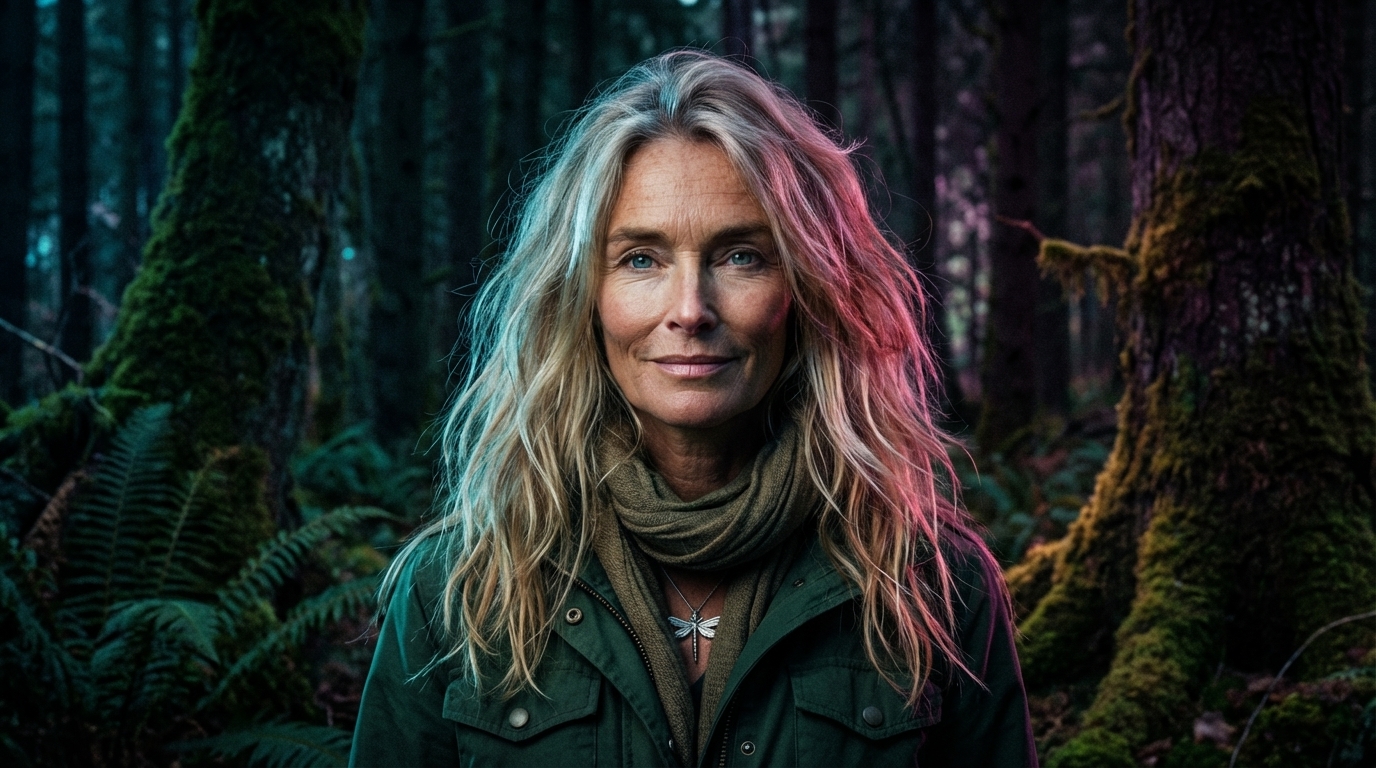
Born in Deloraine, Tasmania, in 1960, Karen Elizabeth Owen built a distinguished career as an entomologist and Associate Professor of Environmental Science at the University of Tasmania, becoming a leading authority on insect ecology and sustainable land use. Her dedication to understanding nature's smallest architects shaped both her professional work and her personal philosophy. On 27 July 2018, Karen and her husband Chris vanished under extraordinary circumstances—a dimensional transition that brought them to Clivilius, where she continues her ecological work in an altered but no less urgent natural world.
Early Life and the Tracey Heritage
Born on 14 September 1960 in Deloraine, Tasmania, Karen Elizabeth Tracey arrived as the eldest of three children to Douglas Henry Tracey and Margaret Joan Tracey (née Ellison). Deloraine, a small agricultural town on the Meander River framed by the Great Western Tiers, provided an ideal setting for a childhood steeped in nature. The town's cool climate, pastoral beauty, and access to native wilderness would shape Karen's understanding of the natural world long before she possessed the vocabulary to articulate it.
Douglas Tracey, born in Sheffield in 1930, worked as a forestry surveyor with the Tasmanian Forestry Commission during the 1950s and early 1960s before becoming a self-employed mapmaker. He was an early advocate for sustainable forestry practices, known for his quiet intellect and fieldcraft. It was Douglas who introduced Karen to insect classification and bush navigation before she could read a compass, kneeling beside her in the undergrowth to examine beetle husks and cicada moults with patient precision. Margaret, born in Launceston in 1933, had worked as a school librarian and was a founding member of the Deloraine Native Flora Circle. Deeply involved in community education on environmental stewardship, she nurtured her children's curiosity with books on Tasmanian ecology and a gentle reverence for living systems.
The Tracey household was modest, warm, and filled with scientific conversation. The family lived in a timber-framed home near the edge of the Meander River, surrounded by native myrtle, dogwood, and stringybark. A large garden at the back hosted compost heaps and homemade insect hotels, reflecting both practicality and a keen ecological awareness that would become foundational to Karen's worldview.
Karen's position as eldest sibling placed her in a particular relationship with her younger brothers and sister. Thomas Andrew Tracey, born in 1963, would become a mechanical engineer and later relocate to Perth, Western Australia. Though not a scientist by training, Thomas shared his sister's fondness for bushwalking and conservation, eventually contributing to renewable energy design in rural infrastructure projects. Emily Susan Tracey, born in 1965, became a visual artist and sculptor based in Hobart, her work often reflecting the natural forms of insects, fungi, and micro-ecosystems—clearly influenced by her sister's early interests. The sisters remained close throughout their lives, exchanging letters and botanical sketches even after Karen's unexplained disappearance from Earth.
Family weekends were spent hiking through the Mole Creek Karst region, camping near Lake Rowallan, or helping Margaret document changes in wildflower distribution across the region—a project Karen would later cite as her first exposure to field research. These early explorations were not simply childhood diversions. They served as a quiet apprenticeship into the workings of the natural world and seeded a lifelong passion that would later define Karen's academic and professional life. From beetle husks to cicada moults, her first collections were catalogued in hand-labelled drawers made by her father—a child's museum of marvels that, in time, became the foundation of a scientific career.
Family Tree
Education and Academic Formation
Karen's early education in Deloraine provided a nurturing environment for her blossoming interest in the natural sciences. Unlike many of her peers, Karen found her greatest excitement not in playground games or sports, but in the tangled undergrowth of the schoolyard, where she kept a handwritten log of ant colonies, beetle behaviours, and moth patterns. Teachers and parents quickly recognised her focus and independence of thought.
At Deloraine Primary School, which she attended from 1966 to 1972, Karen demonstrated a precocious aptitude for observational science. Her Year 4 teacher, Mrs Heather McCullough, encouraged her to maintain a nature journal, which became a formative habit. By Year 6, she had delivered a school assembly talk on 'The Social Lives of Ants,' using chalk diagrams and hand-drawn illustrations. This moment was later cited by her mother as the day the community realised Karen wasn't just curious—she was methodical.
Karen's secondary years at Deloraine High School, from 1972 to 1978, coincided with a growing environmental movement in Australia. Inspired by developments like the Franklin River conservation campaigns and the rise of ecological awareness in Tasmanian politics, she immersed herself in environmental studies. She was awarded Best Student in Environmental Studies in both 1977 and 1978, represented the school at the Tasmanian Youth Naturalists' Forum in 1976, and headed the school's inaugural Eco Club, organising creek clean-ups and awareness talks on native pollinators. In 1978, she co-authored a short article in The Examiner newspaper titled 'What We're Losing in the Leaves,' discussing declining local butterfly populations. Karen graduated in 1978 with High Honours, earning one of the highest academic scores in the school's recent history.
In 1978, Karen enrolled at the University of Tasmania, embarking on a Bachelor of Science with a major in Environmental Science and a minor in Entomology. Her academic career at the university was distinguished by high performance and strong field research contributions. She was mentored by Dr Lionel Brett, a noted insect ecologist who guided her towards in-depth studies of Tasmania's endemic insect life. In 1980, she participated in the Franklin River Ecological Impact Study, conducting soil microinvertebrate sampling in threatened regions. She graduated with First Class Honours in 1982, having been awarded the G.J. Stevenson Prize for Excellence in Ecological Fieldwork in 1981. Her Honours thesis, 'The Role of Insects in Tasmanian Ecosystems: A Comparative Study,' examined the trophic and pollination roles of native beetles, ants, and hoverflies across three ecoregions, contributing to early advocacy efforts around habitat protection legislation in the Tasmanian Central Highlands.
Immediately following her Honours degree, Karen was accepted into the university's competitive Master's programme in Entomology, housed within the Department of Zoology. During this period, from 1982 to 1984, she worked part-time as a research assistant in the university's Ecological Data Lab, helping digitise insect specimen records and map migratory species distribution. Her Master's work was notable for its interdisciplinary approach, integrating climatology and field biology. She conducted multi-seasonal sampling across highland and coastal zones, examining species sensitivity to temperature and humidity gradients. Graduating with Distinction in 1984, her thesis 'The Impact of Climate Change on Insect Populations in Tasmania' was one of the earliest academic attempts to model the effects of projected climate scenarios on Tasmania's invertebrate biodiversity. It later informed the Department of Primary Industries' biodiversity adaptation planning in the late 1980s.
Academic Career and Research Contributions
Karen Owen's professional life was anchored at the University of Tasmania, where she dedicated over three decades to research, teaching, and the advancement of ecological understanding through the lens of entomology. Her work consistently bridged field science, environmental policy, and public engagement, earning her quiet but widespread respect as a principled and meticulous scholar.
Following the completion of her Master's degree, Karen was appointed as a full-time research assistant under Dr Jeffrey Lonsdale, a senior ecologist working on habitat fragmentation in eastern Tasmania. During this formative period from 1984 to 1988, she honed her expertise in sampling methodology, GIS-based ecological mapping, and taxonomic classification. Her work contributed to the Tasmanian Invertebrate Biodiversity Project from 1985 to 1987, conducting site sampling in the Tarkine region that would later become key conservation data during regional logging disputes. She co-authored several peer-reviewed articles in international journals, including publications in Austral Ecology, Journal of Biogeography, and Ecological Indicators. Her precision in field data and calm, observational manner made her a favoured team member among senior academics and postgraduates alike.
Promoted to Lecturer in 1988, Karen began her teaching career, developing and delivering foundational modules in Field Ecology, Introduction to Entomology, and Environmental Systems of Australasia. Her courses quickly gained recognition for their clarity and innovative use of fieldwork. She mentored over fifteen Honours and Master's students, several of whom went on to careers in conservation agencies or academia. She initiated a long-term study of the Velvet Ant and Tasmanian Native Cockroach, examining their functions in soil turnover and nutrient cycling—work that informed regional soil health indicators later used in sustainable farming audits. Working alongside botanist Professor Helen Samuels, she helped develop the interdisciplinary unit 'Plants, Insects, and Ecosystem Interactions,' one of the first such courses at the university.
Appointed Senior Lecturer in 1995, Karen shifted her research focus toward anthropogenic impacts on insect communities, particularly the effects of land-use change, monoculture expansion, and pesticide runoff. From 1996 to 2002, she led the Tasmanian Pollinator Resilience Study, a multi-year, multi-site investigation into the impact of orchard expansion and pasture conversion on pollinator diversity. The research demonstrated a 43% decline in wild pollinator presence in apple-producing regions near Huonville, directly informing Tasmanian agricultural land management guidelines. She presented findings at the 1999 International Congress of Entomology in Florence and was invited to join the editorial board of the Australasian Journal of Insect Conservation. During this phase, Karen began working more closely with policymakers and landholders, serving as a scientific advisor to the Tasmanian Land Conservancy and participating in the Environmental Values Audit Committee from 2001 to 2003.
Karen was promoted to Associate Professor in 2003, a position she held until her departure in 2018. By this stage, she had become a respected national authority in insect ecology, known for her precision, caution, and clear ethical stance on biodiversity protection. She served as Principal Investigator on the Insect Population Decline Monitoring Initiative from 2005 to 2009, funded by the Australian Research Council, and co-led the Cross-Habitat Invertebrate Resilience Project from 2011 to 2016 in collaboration with the University of Canterbury, exploring climate-linked decline in native ant species. Her contributions to integrated pest management provided critical data on beneficial insects in organic farming systems.
Beyond research, Karen served as Chair of the Faculty Committee on Sustainability Initiatives from 2009 to 2013 and was a member of the University Outreach Board, regularly coordinating school visits and public lectures. She created and hosted 'Tiny Architects,' a science communication series aired by ABC Radio Hobart, aimed at promoting insect literacy among the general public. She spoke frequently at Landcare and local government events across Tasmania, her talks often focusing on restoring microhabitats, citizen science insect tracking, and balancing biodiversity with rural land use. Throughout her tenure, Karen was a vocal advocate for ethical science—refusing industry sponsorship that required data control clauses and opposing university partnerships with chemical corporations.
Personal Life and the Partnership with Chris Owen
Karen Tracey met Christopher James Owen in late 1997, during a University of Tasmania field symposium on regenerative land use held in the Huon Valley. Chris, born on 5 March 1973 in Hobart, was a rising figure in sustainable agriculture circles, known for his work in reforestation and permaculture trials. Despite a thirteen-year age difference, their connection was immediate—anchored in a shared reverence for ecological integrity, a distrust of ecological commodification, and a quiet appreciation for the intricate patterns of natural life.
Their relationship deepened not in lecture halls, but in the Tasmanian bush—on long field surveys, streambed studies, and late-night conversations about soil succession, fungal networks, and the ethics of human-nature coexistence. Where Karen's work focused on the microscopic and invertebrate, Chris brought expertise in large-scale land systems and regenerative agriculture. This difference became complementary rather than divisive: Karen brought Chris deeper into the world of entomology and ecological interconnection; Chris grounded Karen's sometimes abstract observations in practical land management reality.
They married in early 1999 beneath the canopy of eucalypts near Myrtle Bank, surrounded by close friends, wildflowers, and the calls of native birds. The ceremony was small, deliberate, and reflective of the lives they hoped to build: simple, principled, and deeply grounded in the natural world. Douglas and Margaret Tracey watched their daughter marry someone who appreciated her scientific precision whilst encouraging her continued engagement with the land beyond academic frameworks.
The Collinsvale Chapter
In 2000, Karen and Chris settled in Collinsvale, a modest rural township north-west of Hobart nestled in the foothills of kunanyi/Mount Wellington. Their chosen home—a small timber cottage at the edge of the Wellington Park Reserve—became both sanctuary and experiment. It was here that the Owens began crafting a life built around permaculture, off-grid resilience, and biodiverse land restoration.
The property, informally known to friends as 'Owens Hollow,' was shaped by their shared ethos. They established a mixed-species garden with companion planting and native pollinator corridors, a greywater-fed wetland system integrated into the landscape, and infrastructure for solar water heating, passive thermal design, and composting. Karen conducted regular invertebrate surveys, wildlife counts, and mushroom cataloguing on the property, treating their home as a living laboratory where theory met practice.
Karen's field notebooks from 2001 to 2016 are filled not only with insect taxonomy and ecological observations but also with philosophical entries—meditations on interdependence, boundarylessness, and the patterns of silence in the natural world. She frequently compared insect ecosystems to moral frameworks: decentralised, adaptable, and symbiotic rather than hierarchical. The cottage held her transformation from academic observer to participant in the very ecosystems she studied.
Their home became a quiet hub for visiting researchers, Landcare volunteers, and postgraduate students. Chris focused on smallholding design and local food networks, whilst Karen mentored young ecologists and contributed to forums on decentralised conservation. The couple remained childless, channelling their nurturing instincts instead into the land, their community, and the generations of students who passed through Karen's classrooms and fieldwork programmes.
The deaths of Karen's parents—Douglas in 2009 and Margaret in 2015—brought profound grief but also deepened her appreciation for the legacy they had left. She inherited her father's precision and her mother's community-minded approach to environmental stewardship, carrying forward their values into her own work with renewed determination. The notebooks Douglas had helped her create as a child remained in her study, a tangible connection to the foundations of her scientific journey.
The Event Known Only as 'The Accident'
On the morning of 27 July 2018, Karen and Chris Owen were at their home in Collinsvale, engaged in routine maintenance on their garden retaining wall. It was a quiet, familiar scene: mud-streaked jeans, morning tea preparations, and light teasing about beetle-watching. They were expecting a visit from Luke Smith, a casual acquaintance with a curious energy and a habit of appearing unpredictably.
Luke arrived late. What followed was, by all measurable accounts, impossible. After a brief, tense conversation in their kitchen and living room, Luke produced a small, unfamiliar device from his pocket. When activated, it projected a swirl of shifting light across the closed living room door—a luminescent field that shimmered with impossible colours. The air changed. Time, or at least its felt rhythm, seemed to distort. Karen described it later as a 'collision of colour and shape that bent the edges of thought.'
Before either she or Chris could fully respond, the room was consumed by light. Their bodies were pulled—stretched, disrupted, reassembled. Karen reached for Chris's hand in the instant before reality fractured, and for a moment they were tethered. Then came the shift. A voice, not heard but implanted directly into Karen's mind, spoke clearly: 'Welcome to Clivilius, Karen Owen.'
What followed remains largely undocumented. The Owens never returned to their Collinsvale home. Their disappearance, whilst officially reported, was never solved. No trace of disturbance remained—save for the absence itself. From that day onward, Karen and Chris referred to the event only as 'the accident.' They declined to elaborate, even in Clivilius. There was no autopsy of meaning, no detailed narrative—only the certainty that what had occurred had dislocated them from Earth and into another world. Their scientific curiosity was not extinguished by this transition. But it was changed—humbled by scale, and recalibrated for a world that responded not just to observation, but to intent.
Arrival and Adaptation in Clivilius
Karen and Chris emerged in Clivilius on the afternoon of 27 July 2018, disoriented but physically intact. The landscape that greeted them was simultaneously beautiful and terrifying—a vast, dusty expanse under unfamiliar skies, silent in ways that made Earth's wildernesses seem crowded by comparison. Guided by a mysterious woman named Glenda, they made their way to Bixbus, the fledgling settlement Luke Smith had established.
Bixbus in 2018 was a frontier settlement struggling toward stability—a handful of tents, a few displaced individuals, and the desperate hope that something sustainable could be built from nothing. Karen arrived to find a community desperately needing her skills but lacking infrastructure to support traditional academic work. She adapted with characteristic resourcefulness, recognising that her decades of ecological knowledge remained valuable even when stripped of institutional context.
Upon meeting the other residents—Paul Smith, Kain, Jamie Greyson, and others who had arrived through various circumstances—Karen declared the barren landscape 'a blank canvas, a beautiful masterpiece waiting to be created.' This visionary optimism, grounded in her understanding of how ecosystems develop from seemingly inhospitable beginnings, became foundational to Bixbus's emerging identity. She patiently corrected Kain's reference to 'bugs' versus 'insects,' revealing not pedantry but the same methodical precision that had built her Earth-bound career. Her expertise was immediately valuable: she understood soil composition, pollinator requirements, and the patient, layered work of building viable ecosystems.
Ecological Pioneer: Building Life in Barren Ground
As Bixbus evolved from desperate frontier outpost to functioning settlement, Karen's role crystallised around ecological development and restoration. Her transition from Tasmania's declining ecosystems to Clivilius's barren landscape represented a profound metamorphosis—from documenting Earth's ecological wounds to healing a world that had barely begun to develop its own biological systems.
Karen became deeply involved with Project Terra Nova, a covert initiative designed to establish wildlife sanctuaries in Clivilius using Earth-based resources and expertise. Her decades mapping Tasmania's invertebrate decline and championing ethical science made her expertise invaluable to the project's visionary scope. Where her Earth research had charted species loss, her Clivilius work now architected species introduction and ecosystem genesis. The sanctuary plans unveiled ecosystems designed not merely as enclosures but as living testimonies to cross-dimensional conservation.
She worked closely with Grant and Sarah Ironbach, renowned conservationists who arrived in Bixbus unaware of the permanence of their journey. Karen was tasked with helping them integrate into the community—a responsibility that required navigating the delicate ethics of withholding truth whilst fostering their contributions to the settlement's ecological development. The experience challenged her commitment to scientific honesty, forcing her to weigh immediate practical needs against principles she had championed throughout her career.
Karen's work at the Bixbus Wildlife Sanctuary represents the culmination of her lifelong devotion to the 'tiny architects' of ecosystems. The sanctuary's butterfly house and specialised habitats echo her decades of research on pollinators and invertebrate ecology, transforming her grief for Tasmania's vanishing biodiversity into hope for Clivilius's flourishing future. At The Verdant Nursery, where she serves as Nursery Cultivator, Karen nurtures the botanical foundations that will support Clivilius's emerging biodiversity—her hands, once cataloguing Tasmania's declining wildflower distributions, now tending alien soil into verdant possibility.



