Karaköy Preservation Archive Facility
The Karaköy Preservation Archive Facility is a covert archival installation operated by The Preservation beneath a shopfront in the Karaköy district of Istanbul, Turkey. Established in the 1820s during the late Ottoman period, the facility extends three climate-controlled sub-levels below street level and houses materials spanning four millennia — including the Kisura contract discovered by Dr Mira Osman on 15 January 2024, the first document bearing Azariel Tiberius Voshtar's name from his wandering years.
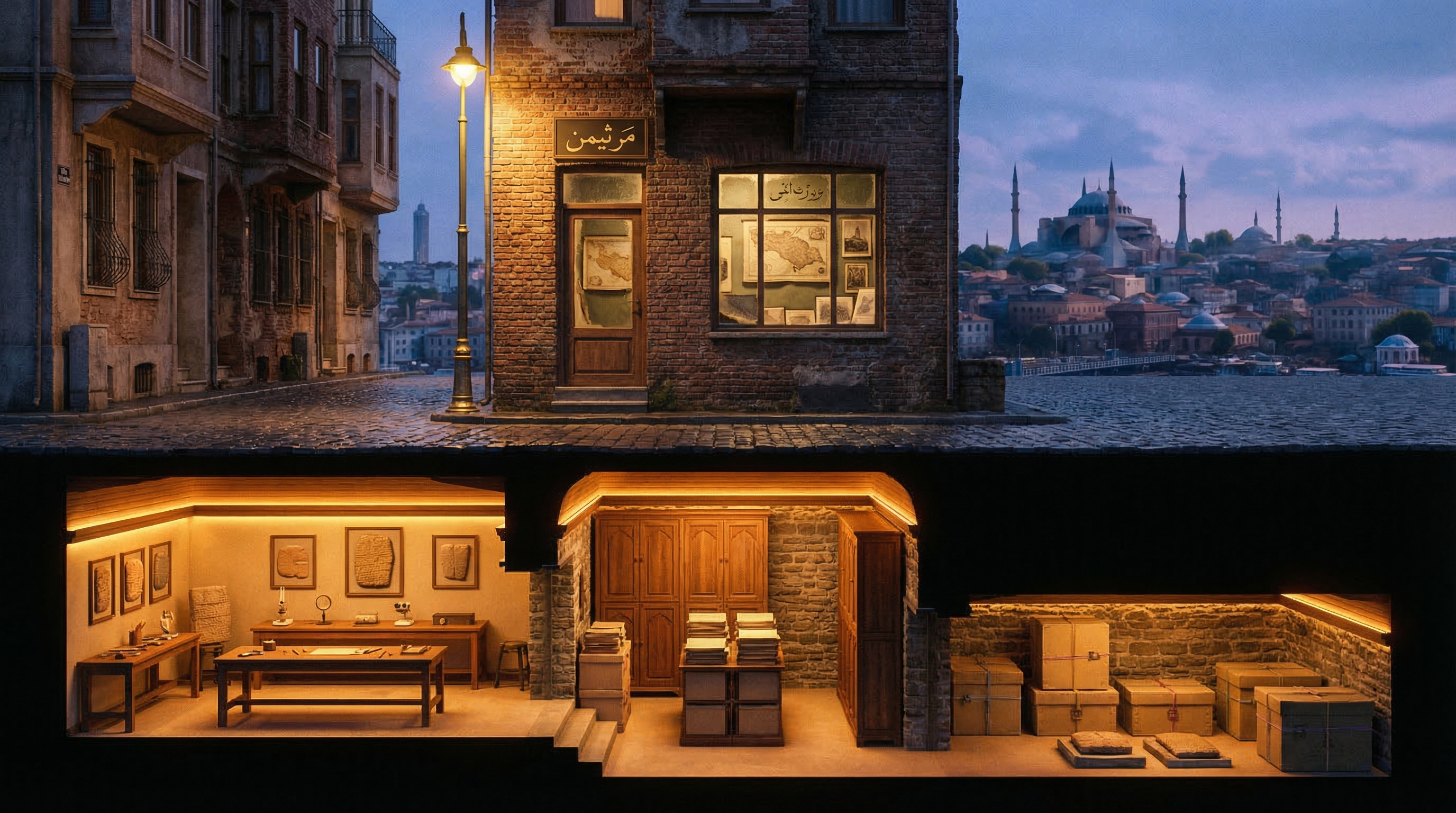
Location and Cover
The facility occupies a narrow commercial building on a side street in Karaköy, the historic port district on the southern shore of Istanbul's Golden Horn. The neighbourhood's character — antique dealers, second-hand bookshops, maritime supply stores, and the particular bustle of a waterfront quarter that has served commerce in various forms since the Byzantine period — provides natural cover for a business whose street-level operation sells antique maps and Ottoman-era prints to tourists and collectors.
The shopfront itself was unremarkable by Karaköy's standards. A recessed entrance with a wooden door that needed shouldering open in damp weather. A display window whose glass carried the faint warping of nineteenth-century manufacture, behind which a rotating selection of cartographic prints and framed Ottoman calligraphy attracted the attention of passing foot traffic without suggesting anything beyond modest commercial activity. The interior was deliberately cramped — shelves of rolled maps, glass-topped display cases, a counter where the shopkeeper conducted transactions with the unhurried courtesy that Istanbul's antique trade cultivated as both style and screening mechanism. Tourists purchased prints of sixteenth-century Mediterranean sea charts. Scholars occasionally enquired about specific Ottoman-era documents. Neither group had reason to suspect that the building extended three levels below the floor on which they stood.
Establishment (1820s)
The Preservation established the Karaköy facility during the 1820s, a period when the Ottoman Empire's gradual administrative loosening created opportunities for private archival operations that would have been more difficult under tighter imperial control. The location was selected for several convergent advantages: Istanbul's position as a crossroads between European, Middle Eastern, and Central Asian trade routes made it a natural consolidation point for materials that had been scattered across multiple regions during previous centuries. The Karaköy waterfront provided discreet access for shipments arriving by sea from archive facilities in Alexandria's successor repositories, European monastery collections, and the private holdings of Ottoman collectors whose estates were being dispersed through inheritance and financial pressure. And the district's commercial character — dense, busy, populated by businesses whose stock-in-trade was old paper and older objects — meant that a shop dealing in antique documents attracted no particular scrutiny.
The building was purchased through intermediaries whose connection to The Preservation was untraceable through conventional property records. The street-level shopfront was established immediately, providing both cover and modest income. Excavation of the sub-levels began within months of acquisition and continued intermittently over the following decade, the work conducted at night by labourers whose compensation included the understanding that questions about what they were building would not be answered.
The construction drew on techniques The Preservation had refined across centuries of building concealed facilities beneath unremarkable surfaces. The sub-levels were lined with stone quarried from demolition sites across Istanbul — material whose provenance was untraceable because half the city's construction industry relied on the same recycled stock. Ventilation shafts were integrated into the building's chimney system, drawing fresh air through routes that appeared to serve heating rather than subterranean occupation. Drainage was managed through connections to the district's existing Ottoman-era water infrastructure, the facility's waste flowing into channels designed centuries earlier to serve a neighbourhood whose relationship with water — the Golden Horn to the north, the Bosphorus to the east — made sophisticated drainage unremarkable.
Physical Layout
The facility's three sub-levels descend approximately nine metres below the shopfront floor, each level accessible through a staircase concealed behind a shelving unit in the shop's back room. The mechanism — a counterweighted section of shelving that pivoted on concealed hinges — was installed during the original construction and had been maintained and upgraded periodically since, most recently in 2003 when the original iron hinges were replaced with modern bearings that eliminated the particular squeal that decades of use had produced.
Sub-Level One served as the working space for active Archive Keeper operations. A central room with a long table provided surface for document examination, translation, and cataloguing. Adjustable lighting — originally oil lamps, later gas, electrified in 1927, upgraded to archival-grade LED in 2011 — allowed precise illumination of materials ranging from intact clay tablets to fragmentary papyrus that could disintegrate under excessive handling. Storage cabinets along the walls held current working materials: documents in active cataloguing, reference texts, the tools of archival work — magnifying instruments, conservation supplies, the particular soft brushes used for cleaning cuneiform tablets without damaging the impressed symbols.
Sub-Level Two housed the bulk of the facility's holdings in climate-controlled conditions that had been progressively refined as preservation technology advanced. Temperature was maintained at seventeen degrees Celsius, humidity at forty-five per cent — parameters established through consultation with conservation specialists whose expertise The Preservation accessed through institutional relationships that the specialists themselves did not recognise as serving purposes beyond conventional archival care. The materials were organised in a system that reflected the accretion of multiple cataloguing conventions across the facility's two-century history. Ottoman-era classification — box numbers, shelf designations, handwritten indices in Ottoman Turkish — provided the primary organisational framework, supplemented by cross-referencing systems that later Archive Keepers had layered over the original structure without fully replacing it. The result was an archive whose logic was navigable by those trained in its particular idiosyncrasies and opaque to anyone approaching it with expectations formed by modern archival standards.
Sub-Level Three contained the oldest and most sensitive materials — documents whose age, fragility, or significance to The Preservation's core mission required the highest level of environmental protection and restricted access. The chamber was smaller than the levels above, its ceiling lower, its atmosphere carrying the particular stillness of spaces that were opened infrequently and disturbed rarely. Box 247, which would yield the Kisura contract in January 2024, sat on a shelf in the chamber's northeastern corner, catalogued by Ottoman-era archivists as containing Roman commercial documents and left largely undisturbed for over a century.
Holdings
The Karaköy facility's collection represented a cross-section of the archival chain of transmission that The Preservation had maintained across four millennia. The holdings were not comprehensive — no single facility could contain the full scope of materials The Preservation had accumulated — but they were strategically significant, holding documents that had survived the successive destructions of the ancient world's great libraries and that had been consolidated in Istanbul through the particular geographic and historical currents that made the city a natural repository for materials flowing between East and West.
The oldest materials dated to the early second millennium BCE — clay tablets and fragments that had passed through Uruk, Babylon, and the successive archive facilities whose destruction and reconstruction marked The Preservation's operational history. These had survived through the organisation's systematic copying and redistribution protocols, which ensured that documents held in vulnerable locations were duplicated to at least three regional caches before the next catastrophe struck. Some of the Karaköy tablets were originals; others were copies of copies, the scribal chain of transmission visible in the slight variations that accumulated across generations of reproduction.
Byzantine-era materials formed a substantial portion of the collection — texts copied by Archive Keepers operating within Constantinople's institutional frameworks before the city fell to Ottoman conquest in 1453. These Archive Keepers had understood that the transition of imperial power would disrupt existing archival structures, and they had spent the decades preceding the fall systematically duplicating priority materials and distributing them to facilities that were likely to survive regime change. The Karaköy facility, established nearly four centuries after Constantinople's fall, had inherited materials that had been stored in interim locations across Istanbul's evolving urban landscape — monastery collections, private libraries, the holdings of Greek-speaking scholars whose families had maintained custody of documents through generations of Ottoman rule.
Ottoman-era additions reflected both The Preservation's deliberate acquisitions and the opportunistic collection that Istanbul's position as an imperial capital facilitated. As estates were dispersed, as private collections came to market, as institutional libraries were reorganised, Archive Keepers embedded in Istanbul's scholarly and commercial networks identified and acquired materials whose significance was invisible to conventional assessment but immediately apparent to anyone who understood what The Preservation was looking for.
Key Personnel
The facility operated with minimal staffing throughout its history — typically one or two active Archive Keepers supplemented by a shopkeeper whose role combined commercial cover with basic security. The shopkeeper position was not always held by Preservation members; in several periods, the street-level operation was managed by individuals who genuinely believed they were running an antique map business and whose ignorance of the sub-levels provided an additional layer of security through authentic obliviousness.
Ayşe Osman served as the facility's primary Archive Keeper for approximately thirty years, from the mid-1980s until her retirement and subsequent death on 21 December 2023. Her tenure represented one of the longest continuous residences the facility had experienced, and her knowledge of the collection's idiosyncratic organisation was irreplaceable in the particular sense that no written guide could capture the intuitive understanding she had developed through three decades of handling the same materials.
Dr Mira Osman, recruited by Ayşe three days after her university graduation in June 2017, assumed junior Archive Keeper responsibilities at the facility whilst completing her doctorate at SOAS. Her work at the facility was interrupted by academic obligations in London but intensified after she completed her doctorate in early 2020, and by the time of Ayşe's death in December 2023, Mira had developed sufficient familiarity with the collection to continue operations independently — though the loss of her grandmother's accumulated institutional knowledge left gaps that no amount of cataloguing could fully address.
The Kisura Discovery
On 15 January 2024, twenty-five days after Ayşe Osman's death, Mira Osman was conducting routine cataloguing in Sub-Level Three when she opened Box 247. The box had been listed in Ottoman-era indices as containing Roman commercial documents — a classification that had discouraged closer examination for over a century, the contents considered too mundane to warrant the careful handling that Sub-Level Three materials required.
Beneath the Roman documents, wrapped in linen whose preservation suggested deliberate conservation rather than accidental survival, Mira found an Early Bronze Age Sumerian contract bearing the name Azariel Tiberius Voshtar. The Kisura contract — named for the town in which the documented transaction had occurred — represented the first physical evidence of Azariel from his wandering years that The Preservation had ever possessed. The organisation had tracked his bloodline for over four thousand years without holding a single document from the man's own lifetime. The clay tablet in Box 247 changed that.
The discovery transformed the Karaköy facility from a routine archival operation into the centre of an active investigation. Mira's subsequent systematic examination of the facility's uncatalogued and under-catalogued holdings, her outreach to Archive Keepers at other facilities, and her cross-referencing of the Kisura contract against materials held in Cairo, Rome, and Athens generated a research programme that continued to operate from the facility's Sub-Level One workroom through 2024 and into 2025.
Present Operations
The Karaköy Preservation Archive Facility continued to operate from its original location, the shopfront maintaining its commercial cover whilst the sub-levels served both their traditional archival function and the expanded research activities that Mira Osman's discovery had generated. The facility's position within The Preservation's global network had shifted — where it had previously been one archive among many, the Kisura discovery elevated it to a site of particular operational significance, drawing attention and resources from the broader organisation at a time when the bloodline collapse had already placed every Preservation facility under heightened urgency.
The antique map shop continued to open each morning. Tourists continued to purchase prints of Ottoman sea charts. The shelving unit in the back room continued to conceal the staircase that descended into three sub-levels of climate-controlled chambers where four thousand years of accumulated documentation sat in boxes whose contents had not all been examined and whose secrets had not all been found.






