Karaköy district, Istanbul, Turkey
Karaköy is a historic port district on the southern shore of Istanbul's Golden Horn, situated on the European side of the city at the base of the Galata hill. Once a Genoese trading colony and later a centre of Ottoman maritime commerce, the district's dense streets of antique dealers, bookshops, and hardware merchants have served continuous commercial activity for over seven centuries, including the covert archival operations that The Preservation has maintained there since the 1820s.
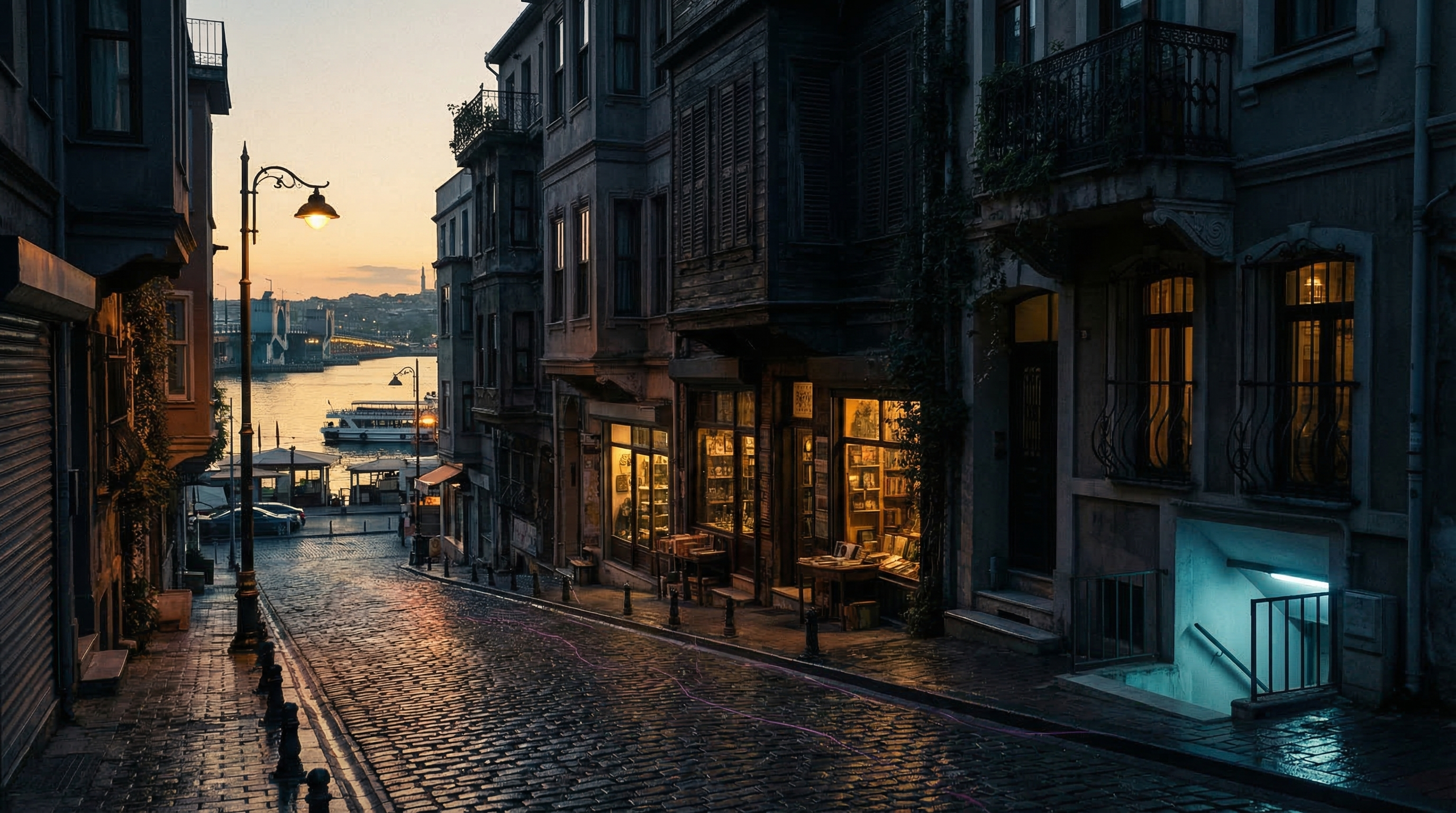
Geography and Position
Karaköy occupied a narrow strip of waterfront on the southern shore of the Golden Horn, the natural inlet that divided European Istanbul into its historic and commercial quarters. The district sat at the base of the Galata hill, rising steeply to the north toward Beyoğlu and the Galata Tower, whilst to the south the Galata Bridge spanned the Golden Horn toward Eminönü and the old city's mosques and palace complexes. The Bosphorus lay to the east, visible from the district's waterfront promenades in the particular way that reminded those who paused long enough to notice that Istanbul had always been defined by the water running through it.
The district's footprint was compact — a few dozen streets compressed between the harbour and the hillside, the buildings stacked tightly in the manner of port quarters that had grown through accretion rather than planning. The streets nearest the water ran roughly parallel to the shoreline; those climbing toward Galata followed the hill's contours with the irregular geometry that centuries of construction and reconstruction imposed on terrain that refused to be straightened. The result was a neighbourhood that rewarded those who knew it and confused those who didn't, where shortcuts existed through courtyards and staircases connecting streets at different elevations, and where a wrong turn could deposit a visitor in a cul-de-sac whose only exit was the way they had entered.
Historical Development
The district's history extended back to the Byzantine period, when the area served as a commercial quarter for foreign merchants whose trading activities the imperial authorities preferred to keep at arm's length from Constantinople proper. The Genoese, granted commercial privileges in the thirteenth century, established a fortified trading colony on the Galata hill whose walls and tower still defined the neighbourhood's silhouette. The colony operated as a semi-autonomous enclave — nominally subject to Byzantine authority, practically governed by Genoese commercial law, its warehouses and counting houses processing the trade that flowed between the Mediterranean and the Black Sea through the straits that Istanbul controlled.
The Ottoman conquest of Constantinople in 1453 brought Galata and its waterfront under Sultan Mehmed II's authority, though the commercial character of the district survived the change of imperial regime. The Genoese trading colony became an Ottoman port quarter, its warehouses repurposed for the goods that the new empire's expanded trade networks generated, its population diversifying to include Greek, Armenian, Jewish, and European merchant communities whose coexistence was managed through the Ottoman millet system. The district acquired its Turkish name — Karaköy, derived from the Karaite Jewish community that had settled there, or possibly from the Turkish words for "black" and "village," the etymology disputed by scholars whose arguments generated more heat than resolution.
Through the eighteenth and nineteenth centuries, Karaköy consolidated its position as Istanbul's primary commercial waterfront. Banking houses established themselves along the main thoroughfare. Maritime supply firms serviced the vessels that docked at the quays. The district became a centre of international commerce in a city that had always been defined by trade — the goods changing over centuries whilst the essential function remained constant. It was during this period, in the 1820s, that The Preservation established an archival facility on one of the district's side streets, the organisation's choice of location exploiting the same commercial density and cosmopolitan traffic that had drawn the Genoese six centuries earlier. A shopfront selling antique maps and Ottoman-era prints attracted no scrutiny in a neighbourhood where half the businesses traded in objects from previous centuries, and the building's sub-levels — excavated over the following decade — provided the climate-controlled storage that materials spanning four millennia required.
Character and Streetscape
By the twentieth century, Karaköy had settled into the particular character that distinguished it from Istanbul's other neighbourhoods. The main roads carried the traffic and commerce that connected the ferry terminals and bridge crossings to the city's broader transport network. But the back streets — the narrow lanes climbing toward Galata, the side alleys running between larger thoroughfares — preserved an older character that the main roads' modernisation had not reached.
These back streets housed the businesses that gave Karaköy its texture. Antique dealers whose shopfronts displayed Ottoman calligraphy and Byzantine-era coins alongside objects whose provenance was more hopeful than verifiable. Second-hand bookshops whose stock accumulated through decades of estate purchases and institutional clear-outs, the shelves holding materials in Turkish, Arabic, Greek, French, Armenian, and occasionally languages that the shopkeepers could not identify. Hardware merchants selling maritime fittings, rope, and the particular brass implements that ships' chandlers had supplied from these streets for centuries. Ironworkers whose workshops produced the ornamental metalwork that Istanbul's older buildings required for maintenance and whose hammering provided a rhythmic backdrop to the neighbourhood's daily noise.
The architecture reflected the district's layered history. Ottoman-era commercial buildings with projecting upper floors stood beside nineteenth-century European-style bank facades. Genoese stonework survived in fragments — a doorway here, a cellar wall there — embedded in structures that had been rebuilt repeatedly over the buildings' lifetimes. Basements and sub-levels were architecturally common, the district's sloping terrain making underground storage a practical feature of commercial buildings since the medieval period. The overall impression was of a neighbourhood that had never been designed as a whole but had assembled itself over centuries through the individual decisions of merchants, landlords, and craftspeople whose primary concern was function rather than aesthetics.
The Modern District
The early twenty-first century brought changes that altered Karaköy's character without entirely displacing it. The gentrification that transformed Istanbul's historically commercial neighbourhoods into destinations for design studios, speciality coffee shops, and boutique hotels reached Karaköy in the 2010s, introducing a layer of contemporary aesthetic that sat alongside — and sometimes on top of — the district's older commercial identity. Former hardware shops became galleries. Maritime supply stores gave way to restaurants whose menus reflected global culinary trends rather than the district's port-quarter heritage.
The back streets retained much of their earlier character. The antique dealers continued trading from premises whose lease terms predated the neighbourhood's fashionability. The bookshops persisted, their stock rotating at the pace that second-hand book commerce had always operated — slowly, unpredictably, governed by the availability of estates to purchase and the tastes of buyers who preferred browsing to searching. The hardware merchants maintained their ground-floor premises through the simple economics of owning rather than renting, their presence on streets where property values had increased ensuring their financial security even as the neighbourhood around them transformed.
This layered quality — the contemporary visible above, the historical persistent beneath — made Karaköy a district where old things existed without attracting the attention that novelty would have drawn. A building whose street-level shopfront sold antique maps was unremarkable in a neighbourhood where half the businesses traded in objects from previous centuries. A basement extending below ground level was architecturally standard in a district built on a slope where cellars and sub-levels had served commercial storage since the Genoese period. Unusual deliveries aroused no curiosity in a quarter where unusual materials — old paper, salvaged metalwork, architectural fragments — constituted standard stock-in-trade. It was in one such building, on a side street indistinguishable from a dozen others in the immediate vicinity, that Archive Keeper Ayşe Osman spent three decades maintaining the Karaköy Preservation Archive Facility's holdings — and where, on 15 January 2024, her granddaughter Dr Mira Osman opened Box 247 in Sub-Level Three and found the first document bearing Azariel Tiberius Voshtar's name from his wandering years.
The ferries continued crossing the Golden Horn. The antique dealers continued their trade. The back streets continued climbing toward Galata with the irregular geometry that centuries of accretion had produced. Karaköy absorbed what was placed within it — commerce, history, secrets — with the particular indifference of a neighbourhood that had been doing so for seven hundred years and saw no reason to stop.






