Josiah Haverford
Born on 14 May 1776 in Portsmouth to a distinguished naval captain and his wife, Josiah Haverford followed his father's path into maritime service, rising from midshipman to captain through the crucible of the French Revolutionary Wars and the Battle of Trafalgar. As commander of the convict transport HMS Resolution, he delivered 150 prisoners to New South Wales in 1808, thereafter transitioning into colonial administration. His tenure as Superintendent of Convict Labour and Commandant of Norfolk Island shaped early Australian infrastructure before his retirement to Sydney, where he died on 12 September 1834.
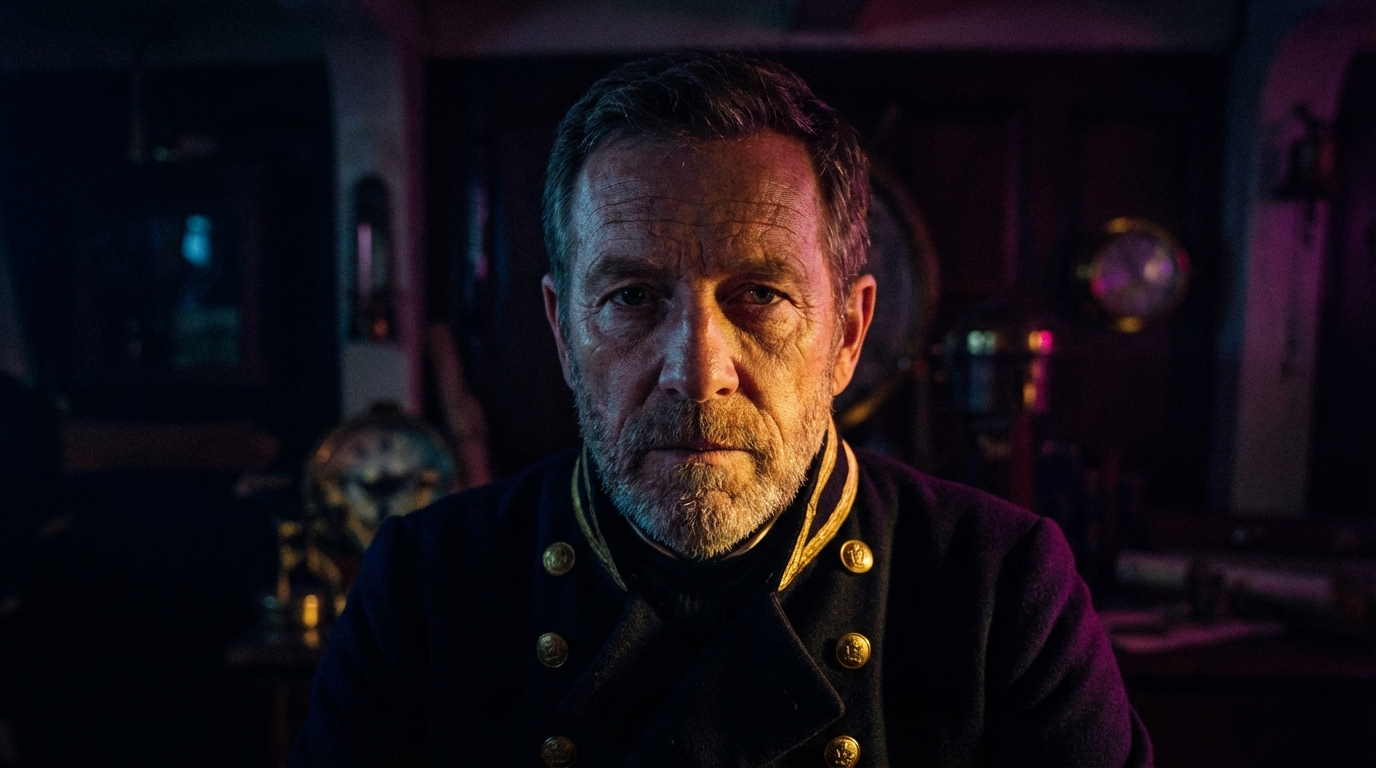
A Naval Inheritance
The dwelling into which Josiah Haverford was born on 14 May 1776 stood within sight of Portsmouth's Royal Dockyard, its windows offering views of the masts and rigging that would define his life's trajectory. His father, Captain Henry William Haverford, had achieved distinction in the Seven Years' War and continued serving in various capacities that kept the family rooted in England's premier naval port. The household breathed salt air and spoke in the language of ships, a world where tide tables held more significance than social calendars and a man's worth was measured in nautical miles sailed.
Henry Haverford had married Elizabeth Margaret Thornton in 1774, uniting two families with deep maritime connections. Elizabeth's father had served as a naval surgeon, her brother currently held a lieutenancy aboard a frigate patrolling the Channel, and her own childhood had been shaped by the rhythms of naval life—the long absences, the anxious waiting for ships to return, the celebrations when husbands and sons came home safely. She brought to her marriage an understanding of what naval service demanded from families, a resilience that would prove essential in raising children destined for the same uncertain profession.
Josiah was the couple's second child, an elder sister named Charlotte having arrived in 1775. A younger brother, Edward, followed in 1779, completing a family whose domestic arrangements revolved around Henry's periods of shore leave and sea duty. The children grew up absorbing their father's stories of distant waters and naval engagements, tales that transformed abstract geography into vivid reality. Henry spoke of Caribbean hurricanes and Mediterranean calms, of French ships encountered and prizes taken, of the camaraderie that bound officers and crews through months of shared hardship. These narratives kindled in Josiah an ambition that required no parental encouragement: he would follow his father to sea.
The boy's physical development suggested he was suited for the life he craved. By his tenth birthday, Josiah already showed signs of the height and robustness that would characterise his adult frame. His green eyes, inherited from his mother's side, possessed an intensity that adults found either compelling or unsettling depending on their temperament. He moved with a confidence unusual in children his age, a self-possession that his father recognised as essential for command but his mother sometimes worried might shade into arrogance.
Harrow and the Forging of Discipline
In 1787, at eleven years of age, Josiah departed Portsmouth for Harrow School in London, an institution whose ancient stones and rigorous traditions would shape the intellectual foundations upon which his naval career would rest. Henry Haverford had chosen Harrow deliberately, recognising that naval officers increasingly required education beyond mere seamanship. The complexities of modern warfare demanded men who could calculate trajectories, understand logistics, and communicate effectively with authorities ashore. A Harrow education would provide these capabilities whilst instilling the discipline that distinguished effective officers from merely competent ones.
The transition from Portsmouth's maritime atmosphere to Harrow's academic intensity challenged Josiah in ways his earlier life had not prepared him for. The curriculum emphasised classical languages, literature, and rhetoric—subjects that seemed remote from the practical concerns of naval service. Yet he applied himself with the determination his father had counselled, recognising that obstacles overcome in youth prepared one for greater challenges ahead. His facility with mathematics proved particularly strong, the abstract calculations translating readily into the navigational problems he would later solve at sea.
The school's cadet training programme offered relief from purely academic pursuits, providing instruction in drill, discipline, and the fundamentals of military bearing. Josiah excelled in these exercises, his natural physical confidence finding appropriate expression in formations and manoeuvres. The programme's instructors noted his leadership potential, the way other boys naturally deferred to his judgments during exercises, the composure he maintained under the simulated pressures they devised. These observations found their way into reports that would later support his naval application.
Five years at Harrow transformed the eager boy into a disciplined young man whose intellectual capabilities matched his physical presence. He departed in 1792, aged sixteen, with academic credentials that exceeded what most naval aspirants possessed and a maturity that belied his years. The school had served its purpose: Josiah was prepared for the Naval Academy and the professional training that would convert potential into expertise.
The Naval Academy and Professional Formation
The Naval Academy at Portsmouth, founded in 1733, represented the formal gateway through which aspiring officers entered the Royal Navy's professional ranks. Josiah enrolled in 1793, returning to his birthplace with credentials that ensured favourable consideration. The Academy's curriculum combined theoretical instruction with practical application, its students learning navigation, ship management, and naval warfare through a programme designed to produce officers capable of independent command.
The timing of his enrolment coincided with the outbreak of war against Revolutionary France, a conflict that would dominate the next two decades and provide the crucible in which his generation of officers would be tested. The Academy's instructors adjusted their teaching accordingly, emphasising skills that immediate deployment might require rather than leisurely theoretical exploration. Josiah absorbed these lessons with an intensity that distinguished him from classmates who treated their studies as obligations rather than opportunities.
His performance earned recognition from instructors whose assessments would influence his subsequent assignments. They noted his strategic thinking—the ability to see beyond immediate tactical problems to their broader implications. They observed his command presence—the quality that made subordinates want to follow rather than merely obey. They recorded his technical proficiency—the thorough mastery of navigation and seamanship that underpinned effective leadership. When he graduated with honours in 1796, aged twenty, their recommendations ensured assignment to a ship where his abilities might be tested and developed.
Trial by Fire: The French Revolutionary Wars
The HMS Vanguard, a seventy-four-gun ship of the line, received Midshipman Josiah Haverford in the autumn of 1796. Captain John Thompson, a veteran of numerous engagements, commanded the vessel with the steady competence that decades of service had cultivated. Under his supervision, Josiah would experience the realities of naval warfare that no Academy instruction could adequately convey—the chaos of battle, the terror of broadsides exchanged at close range, the awful responsibility of decisions made amidst smoke and screaming.
The French Revolutionary Wars provided ample opportunity for such education. The Vanguard participated in several skirmishes during Josiah's two years aboard, engagements that ranged from brief exchanges with enemy frigates to more sustained actions involving multiple vessels. He witnessed death at close quarters, saw men he had eaten with reduced to wreckage by enemy fire, learned to function effectively whilst surrounded by horror. These experiences hardened him without brutalising him, teaching the emotional discipline that combat command required whilst preserving the humanity that distinguished good officers from mere efficient ones.
His conduct during these actions earned commendations that accelerated his advancement. Superiors noted his coolness under fire, his ability to think clearly when others succumbed to panic, his instinctive grasp of tactical situations. By 1799, these qualities had secured his promotion to Lieutenant and transfer to the HMS Indomitable for service in the Caribbean.
Caribbean Service and the Anti-Piracy Campaign
The Caribbean presented challenges distinct from European waters. The region's complex geography—countless islands, hidden coves, treacherous reefs—provided refuge for pirates and privateers who preyed upon merchant shipping. The HMS Indomitable, a seventy-four-gun ship of the line under Captain Edward Stanton, had been assigned to suppress these depredations, a mission requiring different skills than fleet engagements against national navies.
Lieutenant Haverford proved well-suited to this work. The boarding actions that anti-piracy operations demanded called upon physical courage, tactical flexibility, and the ability to inspire men facing close-quarters combat. He led numerous such actions during his Caribbean service, personally commanding parties that seized enemy vessels and liberated captured merchantmen. His negotiations for the release of prisoners and cargo demonstrated diplomatic capabilities that complemented his martial skills, qualities that superiors recognised as marking him for eventual independent command.
The Caribbean years also exposed him to the human dimensions of colonial enterprise. He saw enslaved populations labouring under conditions that troubled his conscience, witnessed the casual brutalities that sustained plantation economies, observed the disparities between colonial rhetoric and colonial reality. These observations did not transform him into an abolitionist—his social position and professional obligations precluded such radicalism—but they planted seeds of reflection that would influence his later approach to convict management.
Trafalgar and Its Aftermath
By 1802, Josiah had risen to First Lieutenant aboard the HMS Resolute, a position that placed him second in command and responsible for the ship's daily operations. The vessel joined the fleet that would ultimately confront the combined French and Spanish navies at Trafalgar on 21 October 1805, the engagement that secured British naval supremacy for the century to come.
The battle tested every capacity Josiah had developed over his decade of service. The Resolute engaged enemy vessels at close range, her guns thundering in the controlled chaos that characterised Nelsonian tactics. Josiah managed crew discipline amidst the carnage, ensured ammunition supply continued despite casualties, coordinated damage control as enemy fire struck home. When the captain fell wounded during the engagement, he assumed temporary command, maintaining the ship's position in the line until the action concluded.
The victory at Trafalgar brought national celebration but also personal loss. Many officers Josiah had known, men whose careers had paralleled his own, did not survive the engagement. The triumph was shadowed by grief, the satisfaction of victory complicated by awareness of its cost. These emotions, common among Trafalgar veterans, contributed to a reflectiveness that tempered his natural confidence with something approaching wisdom.
The battle's aftermath brought recognition but also reassignment. The Navy, having secured supremacy, required fewer combat officers and more administrators. Josiah returned to the Naval Academy at Portsmouth in 1806 as an instructor, tasked with preparing the next generation of officers for service. He approached this duty with the thoroughness that characterised all his work, developing curricula in advanced navigation and leadership that reflected lessons his own experience had taught.
Command of the HMS Resolution
The year 1807 brought the appointment that would redirect Josiah's career from combat to colonial service. He was named Captain of the HMS Resolution, a three-masted barque assigned to transport convicts to the penal settlements of New South Wales. The assignment represented neither promotion nor demotion but rather recognition that his administrative capabilities might serve the Empire as effectively as his martial ones.
The Resolution departed Portsmouth in April 1807, her holds containing one hundred and fifty convicts sentenced to transportation. Among them was William Jeffries, a young Portsmouth dockworker convicted of theft, whose subsequent colonial career would far exceed anything his humble origins or criminal conviction might have predicted. Captain Haverford, processing the manifest that recorded Jeffries alongside scores of others, could not have imagined the transformation that awaited this particular prisoner.
The ten-month voyage tested Haverford's leadership in ways different from combat but equally demanding. He was responsible for delivering his human cargo alive and in condition to labour, a task requiring attention to sanitation, nutrition, discipline, and morale. Disease threatened constantly; despair could spread through the convict population with epidemic speed; violence simmered beneath the surface of enforced order. He managed these challenges with the systematic attention to detail that had characterised his naval service, maintaining mortality rates below the average for convict transports and arriving at Sydney Cove on 28 February 1808 with most of his charges intact.
Colonial Administrator
The arrival at Sydney Cove marked Josiah's transition from naval officer to colonial administrator. Standing on the sun-baked dock, he oversaw the processing of convicts with the same methodical precision he had applied to naval operations. Each prisoner was documented, assessed, and assigned to appropriate labour details. William Jeffries, shuffling down the gangplank with the other transportees, received assignment to the government farm at Parramatta, one entry among many in ledgers that recorded human potential reduced to administrative categories.
The efficiency Haverford demonstrated during this processing attracted attention from colonial authorities struggling to manage a penal settlement whose population continued growing whilst administrative infrastructure lagged behind. In 1809, he accepted appointment as Superintendent of Convict Labour for New South Wales, a position that placed him at the centre of the colony's economic and social organisation.
His tenure as Superintendent brought systematic improvements to convict management. He implemented record-keeping procedures that tracked individual prisoners through their sentences, enabling more effective allocation of labour and more accurate assessment of rehabilitation. He established protocols for housing, feeding, and disciplining the convict workforce that reduced mortality and increased productivity. His belief that convicts might be reformed through structured labour and gradual privilege restoration—radical for its time—influenced policies that would shape Australian penology for decades.
Norfolk Island and Van Diemen's Land
The success of his New South Wales administration led to appointment as Commandant of the Norfolk Island Penal Settlement in 1813. The island, located over a thousand miles from Sydney, housed the most recalcitrant prisoners—men whose behaviour in other settlements had proven unmanageable. Previous commandants had maintained order through severity alone; Haverford introduced alternatives.
His reorganisation of Norfolk Island combined firm discipline with unprecedented attention to convict welfare. He improved housing, established educational programmes for prisoners capable of benefiting from instruction, and created systems of graduated privilege that rewarded good behaviour. These reforms proved controversial among those who believed transportation should punish rather than rehabilitate, but the reduction in violence and the improvement in productivity silenced most critics.
By 1816, his reputation for effective colonial administration had spread throughout the Australian settlements. The Governor of Van Diemen's Land requested his services as Colonial Administrator, a position advising on defence and convict management in the island colony that would later become Tasmania. Haverford accepted, spending four years developing infrastructure and administrative systems that supported the colony's expansion.
Retirement and Final Years
The year 1821 brought retirement from active service. Josiah was forty-five years old, his health sound but his energy diminished by decades of demanding work in challenging climates. He settled in Sydney, the city where his colonial career had begun, establishing a residence that became a gathering place for naval veterans and colonial officials.
Retirement did not bring idleness. He involved himself in veteran affairs, advocating for former servicemen whose circumstances required assistance. He contributed to maritime heritage preservation, working to document the naval history that his generation had created. He provided mentorship to young officers, sharing the wisdom his experience had accumulated. These activities sustained him through years that might otherwise have felt purposeless.
He never married, a circumstance that some attributed to the demands of his career and others to a temperament better suited to professional relationships than domestic intimacy. The women who might have become his wife had passed through his life during periods when duty precluded the attention marriage required; by the time retirement permitted such considerations, habit had hardened into preference. He maintained correspondence with his sister Charlotte and her family in England, his brother Edward having died of fever during Caribbean service in 1810.
Captain Josiah Haverford died on 12 September 1834, aged fifty-eight, at his Sydney residence. The funeral drew mourners from across the colony—naval officers, colonial administrators, former convicts whose lives his policies had shaped. They gathered to honour a man whose career had spanned the transformation of Australian settlement from desperate penal experiment to functioning colonial society. His contribution to that transformation, documented in the ledgers and protocols he had established, would influence Australian administration long after those who remembered him personally had themselves passed into history.







