John Thomas Whitmore
John Thomas Whitmore (1801–1875) was the elder son of the Guardian-vintner George Whitmore and his wife Emma, and the second master of Brierly's vineyards. Trained at his father's side, he married the Leeds-born Catherine Birkett in 1822 and, after inheriting the estate around 1850, expanded its acreage and carried its wine to wider acclaim across the Brierly Plains. A devoted keeper of the harvest tradition, he outlived his brother, his parents, and his wife, and died having secured the Whitmore craft for his son Henry George.
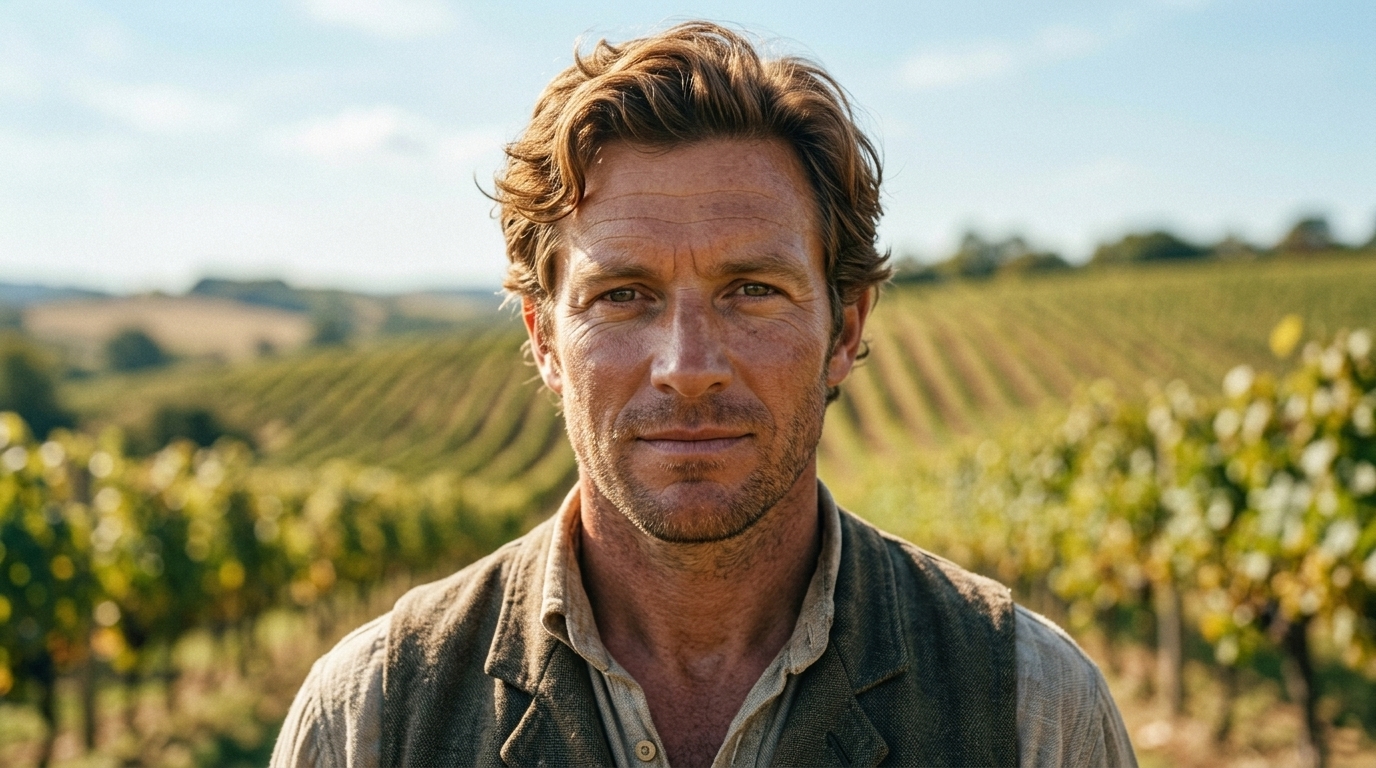
The Vintner's Heir
John Thomas Whitmore was born on 14 June 1801, in the thick of the summer pruning, the elder son of the master vintner George Henry Whitmore and his wife, Emma Jane Whitmore née Clark. He came into a family whose whole life was the vine, and from his earliest years the vineyard was less a place he lived beside than the medium he grew up in, its seasons setting the rhythm of his childhood as surely as they set his father's work.
He took to it by instinct. Where his younger brother, Henry, drifted towards building and machinery, John shadowed George through the rows, soaking up the long apprenticeship of soil and weather and fermentation that could not be hurried. His father, recognising the rare thing of a son who genuinely loved the craft, trained him in earnest from the age of fourteen and came in time to treat him less as an apprentice than as a partner, weighing the boy's ideas — especially on pruning for Clivilius's longer growing season — as the suggestions of an equal.
His mother shaped him as deeply in her own way. From Emma he learned the practical conservation that frontier life demanded and the sense of community that would mark his whole life, the understanding that a settlement survived by what its people held in common. The hard years, when frost or drought took a season's crop and tested the family's resolve, taught him the lesson his father had carried from Somerset: that disaster met with knowledge rather than despair could be turned, in the end, to something like fortune.
Catherine Birkett
John met Catherine Anne Birkett during a season of trade between settlements, the slow commerce that knit Clivilius's scattered communities together. Leeds-born and carrying the organisational sharpness and botanical knowledge of a practical, well-schooled woman, she caught John's attention first by her intelligence and only then by everything else, and he courted her with the patient determination he brought to the vine. They married on 15 October 1822.
The move to Brierly asked a great deal of her. The settlement was remote and largely turned in on itself, a world away from the bustle she had known, and the adjustment was not easy. But Catherine had resilience to match her competence, and she found her feet quickly, turning her gifts on the vineyard itself — bringing order to its operations, applying what she knew of plants to the cultivation, making herself an indispensable partner rather than merely a vintner's wife. In the pattern of John's own parents, the marriage became a working partnership as much as a domestic one, each the other's equal in the labour that sustained them.
Family Tree
The Next Generation
John and Catherine had three children. Henry George came first, on 15 March 1825, and took his grandfather's name into a new generation; Clara Jane followed in 1828, and Thomas Edward in 1832. John proved a devoted and deliberate father, set on giving his children both a thorough education and the practical skills the vineyard and the settlement required, so that whichever path they chose they would not be helpless in it.
It was Henry George who inherited the old Whitmore gift. From boyhood he showed the same feel for the vine that had run from George to John, and John trained him as he himself had been trained, in the expectation that the craft and the estate would pass to him in turn. The boy would more than justify the faith, growing into a vintner of real distinction who carried Brierly's wine to new heights long after his father was gone — but that lay decades ahead, and for now he was simply the eldest of three, learning the rows.
A Brother Lost
The family's hardest blow fell in 1835, when John's brother, Henry, was killed in a construction accident, crushed by a collapsing beam as he raised new fermentation buildings for the estate. He had followed mechanism and building where John had followed the vine, and the very aptitude that made him valuable to the vineyard had placed him under the beam that killed him. George never wholly forgave himself for having steered the boy towards the work, and the grief settled over the whole household.
For John, already a married man of thirty-four with children of his own, the loss reshaped his place in the family. He was now his parents' only surviving son, the sole heir to everything George had built, and the weight of that succession — once shared, at least in prospect — came to rest on him alone. He drew closer to his ageing father in the years that followed, and the vineyard's future, and the Whitmore name with it, became his to carry.
The Weight of the Vineyard
When George, slowed by age and bound close to home by Emma's failing health, began handing the vineyard to John towards the end of the 1840s, the transfer went smoothly, a measure of how thoroughly the son had been prepared and how clearly the father saw when his time had come. By the time George died in 1850, and Emma the year after, John had long since taken up the running of the estate in earnest.
Under his hand the vineyard flourished as never before. He expanded its acreage across the Brierly Plains, experimented with new grape varieties, and pushed steadily at the quality and yield of the wine, building on his father's methods rather than departing from them. Brierly wine, already the settlement's pride, won a wider acclaim under John and settled into its place as the keystone of the local economy — the craft on which the whole community's prosperity increasingly turned.
His life was not without its trials. The settlement's isolation deepened as the last of the Guardians passed and the old road back to Earth closed for good, and John, like every vintner of his generation, learned to make do entirely with what Clivilius and his own ingenuity could provide. The estate weathered its share of disasters, among them the lightning fire that nearly took the 1834 harvest and gave rise, from the little that was salvaged, to the celebrated smoky red that the settlement still spoke of long after — a year of fire and fortune that passed into Brierly's legend, and which John lived through as one of the rising men of the vineyard.
Master of Brierly Wine
For the better part of four decades John was the steward of the Whitmore vineyard and, by extension, one of the steady hands of Brierly itself. He gave to the settlement the same energy his mother had, throwing himself into its common life, organising its gatherings and lending his weight to the work that held a small and isolated community together. The respect he earned was not for the wine alone but for the man, who had taken a great inheritance and enlarged it without ever losing the sense that it existed to serve more than his own name.
He carried, too, the traditions his parents had helped to shape. The harvest celebrations that Emma's first tables had quietly seeded, and that had grown into the settlement's dearest festival, found in John a devoted keeper, his wine at the centre of the First Pour year on year. He was there, an honoured elder of the craft, through the great festivals that marked the passing decades, a living link between the founding generation that had crossed from Earth and the Brierly-born generations who would never see it.
Without Catherine
Catherine died on 12 January 1870, after forty-seven years of marriage, and her loss struck at the foundation of John's life. Her organisational command and her knowledge of growing things had been woven through every success the vineyard had known, and her absence was felt across the whole estate as much as in the house. John, who had leaned on her judgement as his father had leaned on his mother's, found the work harder and lonelier without her.
That same year, still in mourning, he took his place at the great Golden Vintage festival that autumn, the golden anniversary of the settlement's first harvest, when every vineyard in Brierly gave a cask to a single commemorative pour and the largest festival fire in the settlement's history burned through the final night. For John it must have been a bittersweet triumph — the craft his family had carried across worlds honoured at its height, in the first year he had to witness it without Catherine at his side. In the time left to him he leaned more and more on Henry George, easing the estate towards the son who would carry it on.
Death and Burial
John Thomas Whitmore died on 23 April 1875, at the age of seventy-three, having given his whole life to the vineyard his father had planted and his grandfather's vines had begun. He had outlived both his parents by a generation and his wife by five years, and he went to his rest having seen the Whitmore craft secure in the hands of his son.
He was buried beside Catherine in the plot above the vineyard, near the graves of George and Emma, the four of them gathered at last on the rise that overlooked the rows they had all, in their different ways, given their lives to. The estate passed to Henry George, who would tend it for another two decades and more, and the vines that had crossed from a limestone hill in Somerset went on growing, three generations deep now in the soil of another world.







