John Patrick "Jack" O'Connor
John Patrick "Jack" O'Connor was born on 7 August 1895 in Adelaide, South Australia, to Irish immigrant parents Daniel and Bridget O'Connor. A World War I veteran awarded the Military Medal for bravery at Gallipoli and on the Western Front, Jack's wartime friendship with Charles Kingsford Smith led to his serving as navigator on the historic 1928 trans-Pacific flight from Oakland to Brisbane. Following Kingsford Smith's disappearance over the Andaman Sea in 1935, Jack channelled his grief into the pub he had established three years earlier in Gawler—a living memorial where his friend's adventurous spirit would endure. His thirty-year stewardship transformed the Kingsford Smith into the heart of the farming community, and his marriage to Evelyn Rose Parker produced three children whose descendants continue operating the establishment today. He died on 15 September 1962, aged sixty-seven.
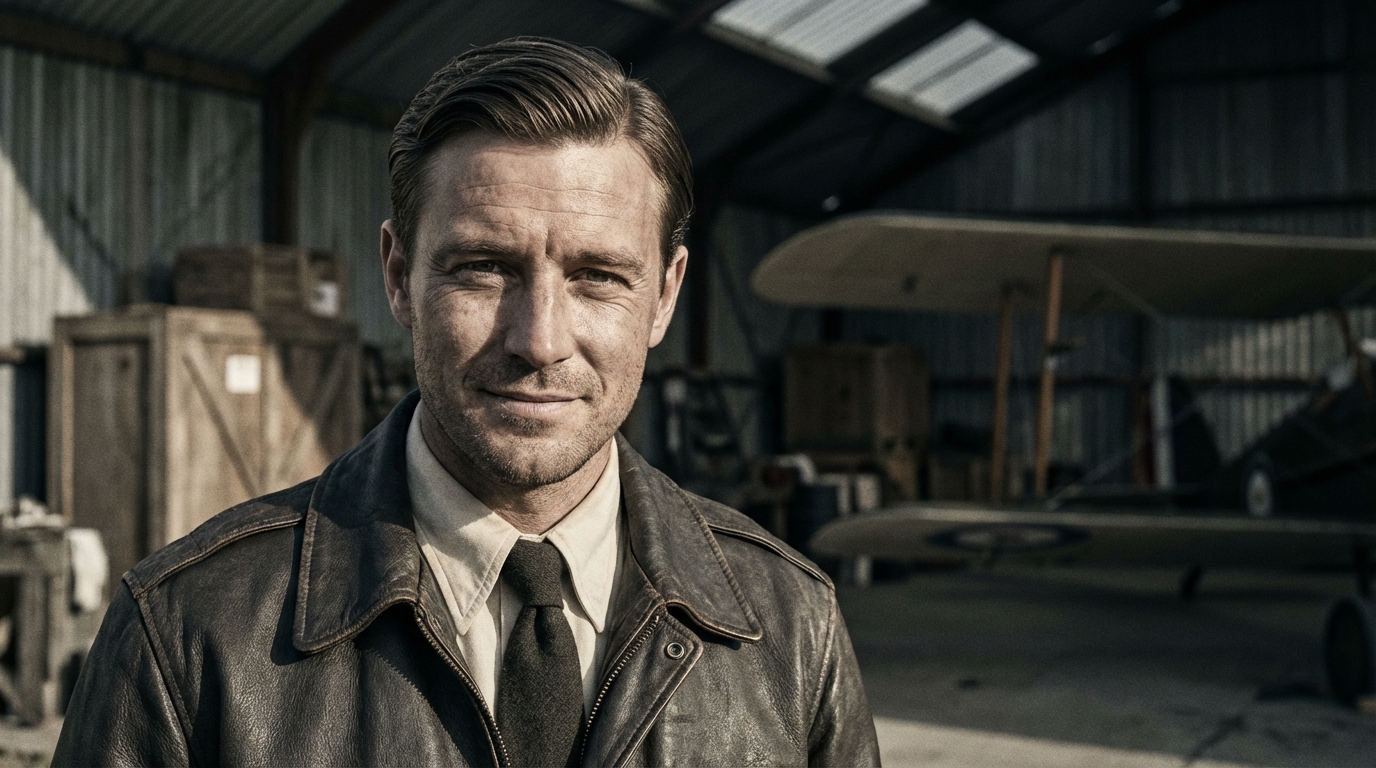
Early Life and Family
John Patrick O'Connor was born on 7 August 1895 at the Adelaide Lying-in Hospital, South Australia, the second child of Daniel Joseph O'Connor and Bridget Mary O'Connor (née Fitzgerald). Both parents had emigrated from County Cork, Ireland, during the 1880s—Daniel in 1882, Bridget in 1885—meeting through Adelaide's tightly knit Irish Catholic community and marrying at St Patrick's Church in 1891.
Daniel worked as a blacksmith, initially employed at a forge on Hindley Street before establishing his own modest workshop in the suburb of Brompton in 1898. The trade provided steady if unspectacular income, sufficient to support a growing family in respectable working-class circumstances. Bridget managed the household with the practical competence expected of women in her position, supplementing the family income through occasional laundry work for wealthier households in the eastern suburbs.
Jack was the second of four children. His older brother Patrick Daniel O'Connor was born in 1893; his younger sister Mary Catherine "Molly" O'Connor followed in 1897; and the youngest, Seamus Francis O'Connor, arrived in 1900. The O'Connor household operated according to the rhythms of Irish Catholic immigrant life in turn-of-the-century Adelaide: Mass on Sundays at St Patrick's, modest meals stretched to feed growing children, the expectation that sons would learn trades and daughters would marry respectably.
The family's Brompton home—a small weatherboard cottage on Chief Street—provided cramped but adequate accommodation. Jack shared a bedroom with Patrick until his older brother departed for an apprenticeship in 1908; thereafter he shared with young Seamus, an arrangement that persisted until Jack's own departure for military service. The cottage's proximity to Daniel's forge meant the rhythms of blacksmithing—the ring of hammer on anvil, the hiss of hot metal plunged into water—formed the acoustic backdrop of Jack's childhood.
Education and Early Interests
Jack attended St Patrick's Primary School from 1901 to 1908, receiving the standard Catholic education of the era: reading, writing, arithmetic, religious instruction, and sufficient discipline to prepare working-class boys for lives of manual labour. His academic performance was adequate without being distinguished, though teachers noted his facility with storytelling and his ability to hold classmates' attention during oral presentations.
His fascination with aviation emerged during adolescence, sparked by newspaper accounts of the Wright Brothers' achievements and the growing international excitement surrounding powered flight. Adelaide's public library became a regular destination, where Jack consumed every book and periodical concerning aviation he could locate. He constructed crude model aircraft from scrap wood and fabric, testing them in the lane behind Chief Street to the amusement and occasional irritation of neighbours.
Upon completing primary education, Jack was apprenticed to his father's forge in 1909. The arrangement was practical rather than passionate—Daniel needed assistance, and Jack required a trade. For five years, Jack learned blacksmithing whilst his imagination remained fixed on the sky. He proved competent at the work, developing the physical strength and manual dexterity that would later serve him in aircraft maintenance and cockpit operations, but his heart was never in the sparks and smoke of the forge.
Military Service
The outbreak of war in August 1914 offered Jack escape from a future he had never chosen. At nineteen years old, he enlisted in the Australian Imperial Force on 21 August 1914, joining thousands of young Australians who saw in the conflict both patriotic duty and personal adventure. He was assigned to the 10th Battalion, which formed part of the 3rd Brigade of the 1st Australian Division.
Training at Morphettville Racecourse and later at Broadmeadows in Victoria transformed the blacksmith's apprentice into a soldier. Jack adapted readily to military discipline, finding in the structured hierarchy and clear purpose something that civilian life had failed to provide. His physical conditioning from forge work served him well during route marches and weapons training; his sociable nature made him popular among fellow recruits.
The 10th Battalion departed Australia in October 1914 and, after additional training in Egypt, participated in the Gallipoli landings on 25 April 1915. Jack's war began in the chaos of that dawn assault—wading ashore under Turkish fire, scrambling up steep ravines, watching men he had trained with fall before they reached the ridgeline. The campaign that followed was eight months of trenches, snipers, dysentery, and the gradual erosion of the romantic notions of warfare that had drawn so many young men to enlist.
It was at Gallipoli that Jack first encountered Charles Edward Kingsford Smith, a signals officer serving with the Australian and New Zealand Army Corps. The two men discovered shared interests during the long hours between actions—both fascinated by aviation, both dreaming of flight, both temperamentally inclined toward adventure rather than the grinding attrition of trench warfare. Their friendship, forged in the particular intensity of combat conditions, would shape both their lives.
Following the Gallipoli evacuation in December 1915, Jack's battalion transferred to the Western Front, where the nature of warfare proved even more brutal than the Turkish campaign. He fought at Pozières in July 1916, where a shell fragment tore through his left thigh during the assault on the German trenches. The wound required three months' recovery in England before he could return to active service.
His second wounding came at Passchendaele in October 1917, when a shell concussion left him temporarily deaf in his right ear and suffering persistent headaches that would trouble him intermittently for the remainder of his life. Again he recovered; again he returned to his unit. By the Armistice in November 1918, Jack had risen to the rank of sergeant and been awarded the Military Medal for actions during the Battle of Polygon Wood—the specific circumstances described in his citation only as "conspicuous bravery and devotion to duty under heavy enemy fire."
Aviation Career
Demobilisation in 1919 presented Jack with a choice he had anticipated throughout four years of warfare: return to his father's forge, or pursue the aviation dreams that had sustained him through trenches and hospitals. The decision proved simple. Using savings accumulated during military service and a small loan from his father—who had grown to accept that his second son would not continue the family trade—Jack enrolled in a pilot training programme run by the Australian Aircraft and Engineering Company in Sydney in early 1920.
His wartime comrade Charles Kingsford Smith had made similar choices, pursuing aviation with the single-minded determination that would later make him famous. The two men reconnected during Jack's training period, their friendship resuming as though the intervening months had not occurred. They flew together whenever opportunities arose, sharing the particular bond of men who had survived war and now pursued the same improbable dream.
Jack proved a natural pilot, his spatial awareness and calm temperament well-suited to the demands of early aviation. He earned his commercial licence in late 1920 and subsequently worked for several fledgling aviation companies, ferrying passengers and cargo across Australia's vast distances. The work was dangerous—aircraft of that era were unreliable, navigation aids primitive, and emergency landing sites often nonexistent—but Jack thrived on precisely the challenges that made lesser pilots hesitate.
His association with Kingsford Smith deepened throughout the 1920s. When Kingsford Smith began planning the trans-Pacific flight that would cement his place in aviation history, he recruited Jack as navigator—a role that demanded the precise mathematical calculations and steady nerves Jack had developed across years of commercial flying. The friendship had evolved into professional partnership; the wartime bond would now be tested across the largest ocean on Earth.
The Trans-Pacific Flight
On 31 May 1928, the Southern Cross departed Oakland, California, carrying four men toward what many considered an impossible destination: Australia, some 11,500 kilometres distant across open Pacific waters. Charles Kingsford Smith commanded the aircraft; Charles Ulm served as co-pilot and relief pilot; James Warner operated the radio equipment; and Jack O'Connor navigated, his calculations determining whether the aircraft would reach its island refuelling stops or vanish into the trackless ocean.
The flight proceeded in three stages: Oakland to Wheeler Field, Hawaii; Hawaii to Suva, Fiji; and Fiji to Brisbane, Australia. Each leg presented distinct challenges. The first crossing, 3,900 kilometres of open water, required Jack to maintain precise course calculations despite equipment limitations and variable winds. The second leg, 5,100 kilometres to Fiji, pushed the aircraft's fuel capacity to its limits and demanded navigation accurate to within a few kilometres across featureless ocean. The final stage brought them to Brisbane, where an estimated 25,000 people awaited their arrival.
The Southern Cross touched down at Eagle Farm Aerodrome in Brisbane on 9 June 1928, completing the first trans-Pacific flight from the United States mainland to Australia. The achievement made instant celebrities of all four crew members—their names appearing in newspapers worldwide, their accomplishment celebrated as proof that aviation had conquered even the planet's greatest oceanic barrier.
For Jack, the flight represented the culmination of dreams that had begun in Adelaide's public library two decades earlier. He had crossed the Pacific, navigated by stars and dead reckoning, participated in an achievement that would endure in aviation history. The subsequent publicity tour—receptions, speeches, meetings with dignitaries—proved exhausting for a man whose preference ran to action over ceremony, but he endured it as the necessary price of accomplishment.
Return to South Australia
The years following the trans-Pacific flight brought Jack continued involvement in Australian aviation, though increasingly he felt the pull of his South Australian roots. Commercial flying remained his primary occupation, but the relentless pace of the industry—the constant travel, the accumulating physical toll of cockpit hours, the strain of repeated long-distance flights—began to wear on a man approaching forty whose body still carried shrapnel from Pozières and whose hearing had never fully recovered from Passchendaele.
In the early 1930s, Jack made the decision to return permanently to South Australia. His parents had aged; his father's forge had closed following Daniel's death in 1929; his mother Bridget, now widowed, required the support of family nearby. Adelaide held too many memories of the constrained life Jack had escaped through enlistment, but the nearby town of Gawler—close enough for family obligations, distant enough for fresh beginnings—presented possibilities.
The idea of establishing a pub emerged gradually through 1930 and 1931, taking specific shape when Jack identified a suitable property on Murray Street, on Gawler's outskirts where the road toward the Barossa Valley began. The location would serve both townspeople and the farming community beyond; the establishment would provide income whilst allowing Jack to remain rooted in one place after years of constant movement.
Financing proved challenging. Banks in Depression-era Australia approached new ventures cautiously, and Jack's assets were limited despite his fame. He assembled backing through personal savings, loans from fellow veterans, and a substantial contribution from Charles Kingsford Smith himself—by then earning considerable income from endorsements and aviation ventures. This financial support, which Jack meticulously repaid by 1939, represented Kingsford Smith's investment in his friend's future.
The Kingsford Smith Pub
Construction commenced in early 1931, with Jack personally supervising the builders and contributing labour where his skills permitted. The building rose from local limestone quarried near Roseworthy, with red brick detailing and the solid construction that Jack insisted upon—he had seen too many poorly built structures during his travels to accept anything less than permanence for his own establishment.
The pub's name was never in question. Jack chose to honour his friend and fellow aviator, initially considering "The Southern Cross" before Kingsford Smith himself suggested using his name instead. The choice would acquire additional significance after November 1935, when Kingsford Smith and co-pilot Tommy Pethybridge disappeared over the Andaman Sea during an attempted England-to-Australia flight. The pub Jack had named for a living friend became a memorial to a dead one.
The Kingsford Smith Pub opened its doors on 12 March 1932, with Charles Kingsford Smith attending as guest of honour. The evening drew crowds exceeding the new establishment's capacity—local farmers, Gawler townspeople, curious visitors from Adelaide, and fellow aviators who had gathered to celebrate Jack's achievement. Photographs from that night, preserved in a glass case near the bar, show the two friends standing arm in arm before the wall where Eleanor Whitfield's mural would later hang.
Jack commissioned that mural in 1936, one year after Kingsford Smith's disappearance. The Adelaide artist spent three weeks in Gawler completing the work—a 2.4-metre-wide depiction of the Southern Cross in flight over stylised Pacific waves, with the stars of the constellation picked out in metallic gold paint. The mural became the pub's centrepiece, a daily reminder of the friendship and adventure that had shaped Jack's life.
Marriage and Family
Jack's marriage to Evelyn Rose Parker in 1938 came relatively late in life—he was forty-three, she thirty-two—but proved a partnership of deep compatibility. Evelyn was a schoolteacher from the nearby town of Kapunda who had first visited the Kingsford Smith during a teaching colleagues' excursion and returned with increasing frequency over the following months. Their courtship unfolded across the bar and beneath the oak tree Jack had planted in 1933, witnessed by regular patrons who placed informal wagers on when the publican would finally propose.
The wedding took place at St George's Anglican Church in Gawler on 18 June 1938, followed by a reception at the pub that reportedly exhausted the entire beer supply and required emergency restocking from Adelaide. Evelyn brought domestic stability and culinary expertise to the establishment—her lamb roasts and bread-and-butter pudding becoming as integral to the pub's identity as the aviation mural and the ancient oak.
The couple had three children: Michael Patrick O'Connor (born 12 March 1940), Thomas Daniel O'Connor (born 7 September 1942), and Margaret Rose O'Connor (born 3 January 1945). All three grew up in the pub's upstairs quarters, absorbing the rhythms of hospitality from their earliest years. Michael would briefly manage the pub following Jack's death; Thomas would pursue a career in agricultural sales in Adelaide; and Margaret would marry Reginald Harris, a Willaston carpenter, in 1964—their son Alfred "Alfie" Ronald Harris eventually assuming management of his grandfather's establishment.
Community Leadership
Jack's role in Gawler expanded well beyond pub proprietorship during his three decades in the town. He served on the Gawler Town Council from 1945 to 1958, contributing to decisions about post-war development, infrastructure improvements, and the management of population growth as Adelaide's suburbs crept northward. His practical experience and direct manner made him effective in council debates, though he never sought higher office or leadership positions.
His most significant community contribution was helping establish the Gawler branch of the Returned Servicemen's League in 1946. Jack's military credentials—the Military Medal, the wounds, the service at Gallipoli and on the Western Front—gave him standing among fellow veterans, whilst his pub provided natural premises for meetings and commemorations. The RSL branch held its weekly gatherings at the Kingsford Smith from 1946 onwards, a tradition that persisted long after Jack's death.
ANZAC Day observances at the pub began in 1933 and expanded under Jack's leadership into the town's primary commemoration. Dawn services in the beer garden, conducted beneath the oak tree as the sky lightened, drew veterans and their families from across the district. The two-up games and increasingly emotional reminiscences that followed became annual rituals—opportunities for men who had shared experiences they could discuss with no one else to reconnect in the company of those who understood.
Character and Legacy
Those who knew Jack O'Connor remembered him in consistent terms: warm, generous, possessed of endless stories, fiercely loyal to friends, and marked by the particular quietness that sometimes descended on men who had seen too much during the war years. His blue eyes—piercing in photographs, described as sparkling with mischief by those who encountered him in person—could shift rapidly from engagement to distance, suggesting depths of experience he rarely discussed directly.
His physical presence was imposing—tall and broad-shouldered, with the weathered complexion of a man who had spent years in open cockpits and the calloused hands of someone who had worked forge, aircraft, and pub with equal competence. His hair, rich brown in youth, had turned silver by his fifties, lending him a distinguished appearance that suited his role as community elder. The shrapnel wound in his thigh caused a slight limp that became more pronounced in cold weather; the hearing damage from Passchendaele meant he sometimes asked patrons to repeat themselves, particularly in the noisy evenings when the main bar filled with conversation.
Jack O'Connor died peacefully in his sleep on 15 September 1962, one day after his grandson Alfie Harris's seventeenth birthday. The timing felt cruelly symbolic to those who knew both men—as though Jack had held on just long enough to see Alfie reach the threshold of adulthood before releasing his grip on life. Complaints of chest pain the previous day had been dismissed as indigestion; the heart attack that took him came without warning in the early hours of morning.
His funeral at St George's Anglican Church drew hundreds of mourners—veterans who had served with him, aviators who remembered the trans-Pacific triumph, farmers and townspeople who had gathered at his bar across three decades, family members spanning three generations. The Gawler Chronicle devoted its entire front page to his obituary, recounting the arc of a life that had taken a blacksmith's son from Adelaide's working-class suburbs to Pacific skies and back to the South Australian earth he had ultimately claimed as home.
The Kingsford Smith Pub passed to his son Michael, who managed it competently but without his father's natural affinity for the role. Within three years, management transferred to Jack's grandson Alfie, who proved to possess the warmth, storytelling ability, and community dedication that had made his grandfather beloved. The mural of the Southern Cross continues hanging above the bar; the oak tree Jack planted in 1933 continues shading the beer garden; and the establishment he created as memorial to a lost friend continues serving the community he adopted as his own.







