
Joel Elijah Gibbons
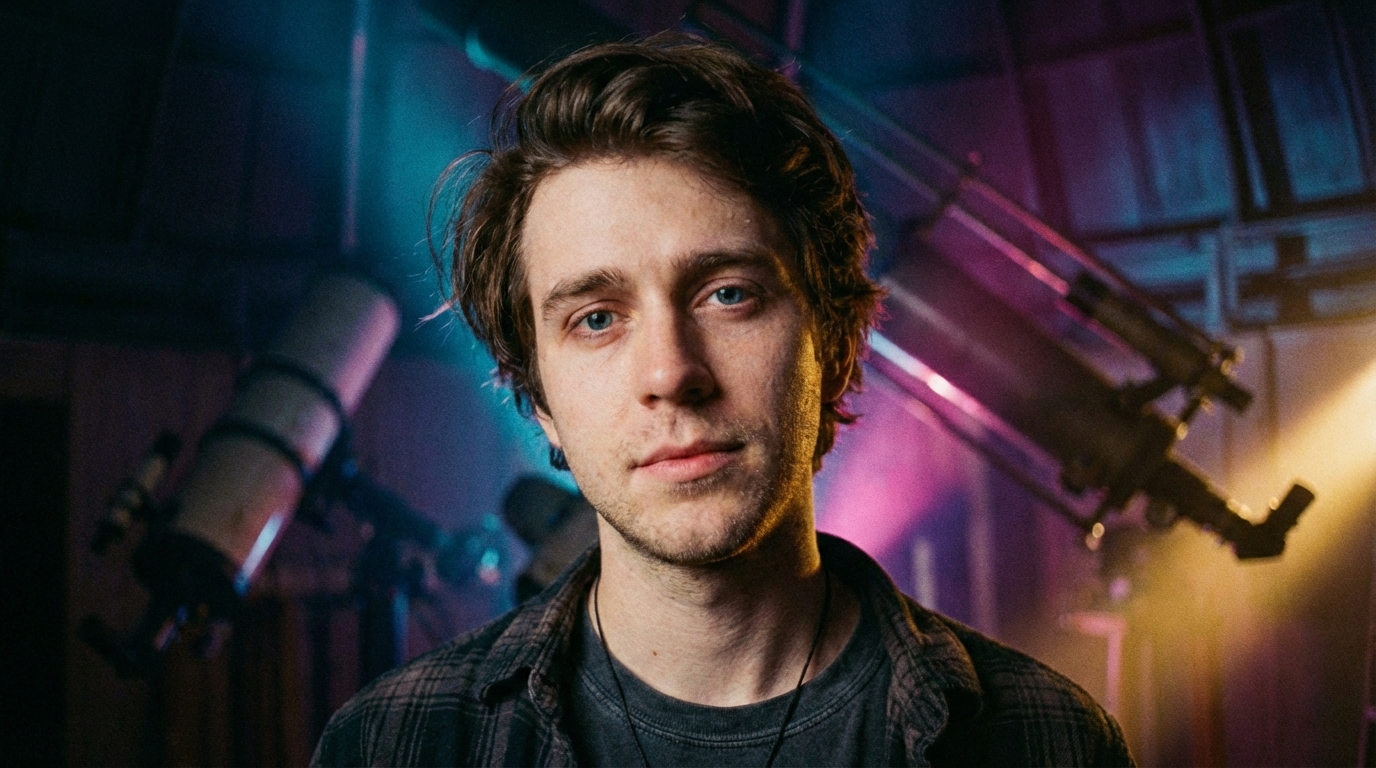
Joel Elijah Gibbons (born 1999) was a thoughtful young Hobartian whose quiet life of origami, astronomy, and filial devotion shattered when he discovered his father wasn't dead but alive. A courier driver supporting his mother after leaving school at seventeen, Joel's quest for identity led him to a swirling inter-dimensional portal where a violent attack severed his throat—only to awaken resurrected in Clivilius, transformed into something no longer entirely human.
Born into Modest Circumstance
Joel Elijah Gibbons was born on 3 October 1999 in Hobart, Tasmania, the only child of Kate Elizabeth Gibbons, who raised him alone in the northern suburbs. His birth came at a particularly challenging time for Kate, then twenty-three years old and grappling with the aftermath of a brief, intense romance with Jamie Nigel Greyson—a relationship that had ended with Jamie's family relocating interstate, leaving Kate to navigate pregnancy and motherhood without support or acknowledgement.
From his earliest days, Joel's world was shaped by absence and love in equal measure. Kate had told him his father died before he was born, a fiction she crafted to protect him from the complicated truth: that Jamie had been barely seventeen when they'd conceived Joel, that their relationship had been inappropriate from the start, that she'd never managed to find Jamie again—or perhaps hadn't tried hard enough, too ashamed of what had transpired between them.
The modest home Kate maintained in Glenorchy became Joel's entire universe—a place of carefully rationed resources but abundant affection. He grew up watching his mother work multiple jobs, stretch every dollar, sacrifice her own needs for his wellbeing. This early exposure to financial precarity shaped Joel's character profoundly, teaching him gratitude, resourcefulness, and a premature understanding of life's harsh realities.
A Restless, Thoughtful Child
Joel possessed an unruly mop of dark hair that often fell over his intense, thoughtful brown eyes—eyes he'd inherited from Kate, along with her contemplative nature and moral compass. He stood at modest height with a youthful, somewhat wiry frame, his fair skin still bearing faint traces of adolescence well into his late teens. His face was expressive, often revealing more than he intended, with a natural, unassuming charm that made him approachable despite his inherent shyness.
There was an inherent restlessness in Joel's posture, a physical manifestation of the myriad thoughts and dreams that constantly occupied his mind. He rarely sat completely still, always fidgeting with something—a pen, a piece of paper, whatever lay within reach. This restless energy found perfect outlet in origami, a hobby that discovered him during a quiet afternoon in the dusty corners of Hobart's public library when he was twelve years old.
Origami became Joel's sanctuary, his means of imposing order on chaos, of creating beauty from simple materials, of finding tranquillity in a life that often felt overwhelming. Each fold, each crease, was a step into meditation, a momentary escape from the cacophony of the world. He kept his creations displayed throughout the small Glenorchy home—delicate cranes perched on windowsills, complex geometric forms adorning bookshelves, tiny flowers scattered across surfaces like paper petals fallen from impossible gardens.
Kate encouraged this passion, recognising that Joel needed an outlet for his restless mind. She'd saved carefully to buy him proper origami paper for birthdays and Christmas, watching with quiet pride as his skills developed, as his creations grew more intricate and technically accomplished. The precision required by origami suited Joel's temperament perfectly—the careful attention to detail, the patience demanded by complex folds, the satisfaction of transforming a flat sheet into three-dimensional art.
Dreams of Distant Stars
Alongside origami, Joel developed a profound fascination with astronomy and science fiction that spoke to something deeper in his nature—a yearning for vastness, for possibilities beyond the constrained circumstances of his daily life. His small bedroom became a shrine to these passions, adorned with celestial maps, models of spacecraft, glow-in-the-dark stars arranged in accurate constellations across the ceiling.
He devoured science fiction novels borrowed from the library—tales of time travel, interstellar adventures, alternate realities. These stories offered him respite and ignited his imagination with possibilities that transcended the ordinary limitations of life in suburban Hobart. Whilst his mother worried about bills and work schedules, Joel's mind roamed the cosmos, exploring fictional universes where ordinary people discovered extraordinary destinies.
This fascination wasn't mere escapism, though it certainly served that purpose. Joel possessed genuine intellectual curiosity about the mechanics of the universe, about physics and cosmology, about humanity's place in the vast expanse of space and time. He'd watch documentaries about black holes and quantum mechanics, struggling with concepts well beyond his formal education but persisting because they mattered to him, because understanding even fragments of universal mysteries felt important.
Education Abbreviated
Joel attended local government schools, moving through primary and early secondary education with unremarkable results that belied his actual intelligence. Academic pursuits never quite captured his spirit the way origami and astronomy did—mathematics felt abstract and disconnected from meaning, science classes moved too slowly through material he'd already explored independently, history seemed to focus on all the wrong questions.
Literature and art were his refuges within the formal education system, spaces where he could immerse himself in otherness and explore creativity without the rigid constraints of other subjects. He excelled in English when allowed to write creatively, his essays and short stories showing flashes of genuine talent. Art classes gave him permission to create without judgement, to experiment with form and meaning in ways that resonated with his origami practice.
But formal education ended abruptly for Joel when he was seventeen, during Year 11. The decision wasn't sudden—it had been building for months as Kate's health deteriorated, as financial pressures mounted, as the gap between what education promised and what survival demanded became impossible to ignore. Joel left school not because he'd failed but because adult responsibility arrived prematurely, demanding he trade potential futures for immediate necessity.
He took a position with CityDirect Couriers, sorting parcels in a tin-roofed depot out near the Brooker. The work was physically demanding, repetitive, poorly paid—but it brought in money the household desperately needed. His hands, which had once created delicate paper sculptures, now came home raw and blistered from handling boxes, from loading trucks, from the relentless physical labour of keeping parcels moving through Hobart's arteries.
Kate had wanted desperately for him to continue education, to have opportunities she'd been denied, to build a life less constrained by financial precarity. But Joel made the decision without consultation, simply arriving home one day and announcing he'd taken the job. She'd cried that night, though she'd tried to hide it from him. He'd heard her through the thin walls of their home, and the sound had confirmed what he already knew—that this sacrifice was necessary, that sometimes love demanded setting aside dreams for survival.
The Rhythms of Courier Work
After proving himself reliable at the depot, Joel moved into delivery driving, piloting a 2006 Toyota Corolla through Hobart's suburbs with parcels and packages in tow. The job unveiled the multifaceted character of the city in ways his childhood had never revealed. Each delivery was a new narrative, each suburb a different scene in the day's unfolding story—from the affluent eastern shore to struggling northern estates, from university precincts to industrial zones.
Joel found unexpected satisfaction in this work. Not in the labour itself, which remained tedious and poorly compensated, but in the glimpses it offered into other lives, other possibilities. Each doorstep represented a different existence, a different set of choices and circumstances. He delivered everything from birthday presents to essential supplies, each package carrying its own small story of want, need, celebration, or connection.
His supervisor, Garry, ran a small operation that struggled to compete with larger courier companies. The work environment was perpetually understaffed, perpetually strained, operating on thin margins that left little room for error or absence. Joel's recent string of late arrivals had been noticed, noted, creating tension he could feel but which Garry never directly addressed—just disappointed glances, pointed comments about reliability, the unspoken threat of replacement hovering over every interaction.
Joel tried to be responsible, to demonstrate commitment, to prove himself worthy of the opportunity. But the weight of his mother's illness, the mounting questions about his father, the sense that his life was somehow on hold rather than moving forward—all of it made punctuality feel like an impossible demand, a performance of normality when everything felt fundamentally abnormal.
The Weight of Partial Truth
Throughout Joel's childhood and adolescence, his father's absence was explained simply: he'd died before Joel was born. Kate maintained this fiction consistently, never wavering, never allowing cracks to appear in the story. There were no photographs, no mementoes, no relatives to complicate the narrative. Just an absence that Kate filled with love, with sacrifice, with the determined belief that protecting Joel from complicated truth was worth the burden of sustained deception.
Joel accepted this explanation because children accept what their parents tell them, because he had no reason to question it, because Kate's evident pain when the subject arose suggested that pursuing details would only cause harm. Yet the absence created a void in his sense of self, a fundamental question mark about his origins that no amount of maternal devotion could entirely fill.
As he grew older, that void became more pronounced. He'd watch friends interact with fathers—the easy physical affection, the shared interests, the particular quality of paternal presence—and feel the ache of something missing, something he couldn't quite name because he'd never experienced it. Kate tried to fill both roles, tried to be enough, and in many ways she succeeded. But she couldn't give him what she didn't have, couldn't answer the unasked questions that accumulated in Joel's mind about who he was, where he'd come from, what traits and tendencies he'd inherited from the ghost who'd fathered him.
The Birth Certificate Revelation
Everything changed on the morning of 24 July 2018. Joel, then nineteen years old and planning a holiday to Bali with friends Morgan and Dale, needed his birth certificate for a passport application. It was such an ordinary request, such a mundane administrative necessity, yet it would prove catastrophic to the carefully constructed fiction Kate had maintained for his entire life.
He found her at five-thirty in the morning in their cold Glenorchy kitchen, sitting in darkness with the unopened envelope in her lap. The scene was deeply unsettling—his mother, who was always up early for work, who moved through life with determined efficiency, simply sitting motionless in the dark, clutching a piece of mail as though it were a ticking bomb.
The conversation that followed shattered nineteen years of careful protection. As they opened the envelope together, Joel's eyes found what Kate had spent nearly two decades concealing: his father's name. Not "deceased". Not "unknown". Just Jamie Nigel Greyson—a real, specific person with a birthdate that revealed he'd been only sixteen when Joel was conceived, making Kate twenty-three and their entire relationship inappropriate from the start.
The revelation transformed Joel's understanding of everything instantly. His mother hadn't been a tragic widow mourning a lost love—she'd been lying to him his entire life. His father hadn't died—he'd simply never known Joel existed, or perhaps had known and chosen not to be involved. The story Joel had built his identity around dissolved like paper in water, leaving him flailing for purchase on any solid truth.
Kate tried to explain, her words tumbling out between tears: how much she'd loved Jamie, how inappropriate their relationship had been, how she'd tried to find him but failed, how she'd thought protecting Joel from abandonment was better than exposing him to rejection. But Joel heard these explanations through the filter of betrayal, each word confirming that his mother had chosen deception over honesty, had decided he couldn't be trusted with truth about his own existence.
He left for work that morning without resolution, the birth certificate a physical weight in his pocket, his mother's tear-stained face burned into memory. The betrayal sat heavy in his chest—not anger, exactly, but profound disillusionment, the recognition that the person he'd trusted most in the world had built their entire relationship on fundamental untruth.
The Fatal Investigation
Over the following days, Joel couldn't let it rest. He searched for Jamie Greyson online, finding a Facebook profile that seemed to match—the right age, connections to Tasmania, a life that had continued whilst Joel grew up believing his father dead. The discovery was both thrilling and terrifying: Jamie Greyson existed, lived in Hobart, was real and findable.
Then fate intervened through pure coincidence. On 25 July 2018, Joel's delivery manifest included a name that made his heart stop: Luke Smith, with an address in Berriedale. The order was substantial—tent equipment again, following a previous delivery just days earlier. Joel's instincts screamed that this was connected somehow to Jamie, though he couldn't articulate why.
Arriving at the house on Wallcrest Road, Joel made a decision that would prove fatal: he asked to use the toilet, using the pretext to investigate the house for signs of his father. What he found in the master bedroom confirmed his suspicions—a small framed photograph of Jamie, and hidden behind it, a message in Kate's distinctive handwriting: "Yours forever. Kate Gibbons." The reverse side showed his mother, young and beautiful, staring at the camera with unmistakable love.
The discovery was devastating. His mother knew. She'd known Jamie was alive, had perhaps maintained contact, had chosen to sustain the fiction of his death even whilst knowing the truth. The betrayal compounded exponentially—this wasn't just protective deception but active, ongoing falsehood about something fundamental to Joel's identity.
But Joel's investigation was interrupted by chaos. Luke's dog Duke escaped whilst Joel was inside, leading to a frantic chase. When Joel finally returned Duke to the house, he encountered something impossible: a gate at the rear of the property, its surface a swirling mass of colours that defied physics, that seemed to exist in violation of every natural law.
He watched, stunned, as Luke and both dogs simply walked through the impossible gate and vanished. The sight broke something in Joel's understanding of reality—this wasn't metaphor or hallucination but observable impossibility unfolding before him. When he approached the gate himself, extending a trembling hand towards the swirling colours, an ethereal voice spoke directly to him: "Clive sees you, Joel Gibbons."
Before he could process this impossibility, Joel was attacked from behind. Two men—one heavily bearded and commanding, another unseen but holding a knife to Joel's throat—demanded to know if he was "the Guardian", asked where "they" had gone. Joel, paralysed by terror and ignorance, could only deny knowledge of what they wanted.
The bearded man disappeared through the gate. The other man received an order: "Take care of him."
What followed happened with brutal speed. Joel felt the blade slice across his throat, felt the spray of his own blood spattering against the delivery truck, felt his legs give way beneath him as shock and blood loss overwhelmed his system. His final coherent thoughts were of his mother—her tear-stained face in the kitchen, her whispered declaration of love that echoed across his consciousness as darkness claimed him.
"I love you, my son," Kate's voice seemed to whisper, whether memory or dying hallucination Joel couldn't distinguish.
His vision blurred, consciousness fragmented, and Joel Elijah Gibbons died on the driveway of 2 Wallcrest Road, Berriedale, his throat severed, his blood pooling on concrete, his nineteen years of life ending violently before he'd barely begun to understand who he was or where he'd come from.
Death and Resurrection
But death wasn't the end. Joel's body was discovered by Luke, Paul, and Jamie—the latter unknowingly encountering his own son for the first time as a corpse. Carried through the Portal into Clivilius, Joel's mortal remains became subject to forces that defied earthly biology, earthly physics, earthly understanding of what constituted the boundary between life and death.
Jamie, driven by Luke's cryptic assurances and Clivilius's whispered guidance, brought Joel's body to a luminescent lagoon where impossible healing occurred. The waters, glowing with otherworldly light, knitted severed flesh, restored lost blood, reanimated systems that should have remained permanently stilled. Joel's throat, slashed open and emptied of life, healed until only a scar remained as testament to the violence that had killed him.
Yet the Joel who eventually opened his eyes in that alien landscape wasn't quite the same person who'd died on a Hobart driveway. His body breathed despite having no pulse, moved despite remaining unnaturally cold, existed in defiance of every biological principle that should have governed human life. The lagoon had granted resurrection, but at a cost Joel was only beginning to comprehend—he'd been transformed into something that existed between categories, neither fully alive nor entirely dead, human but fundamentally altered by forces he couldn't begin to understand.
His first whispered word upon awakening was "Dad"—spoken to a man who'd never known he existed, whose face held mixture of wonder and terror and desperate hope that this impossible resurrection meant something, that Joel's survival justified the guilt that had consumed Jamie since discovering he'd fathered a child he'd never met.
Transformed Existence
In Clivilius, Joel's contemplative nature found new outlets and challenges. His origami practice had taught him to navigate complexity through patient observation and careful manipulation—skills that proved invaluable in a world where nothing followed expected rules, where survival demanded adaptability rather than adherence to known frameworks.
He recovered slowly from his death and resurrection, the physical wounds healing faster than the psychological trauma of having been murdered, of having crossed the threshold between life and death, of existing now in a state that defied categorisation. His body moved and breathed and seemed functional, yet lacked the fundamental warmth and rhythm that characterised human life. He was something new, something unprecedented—a bridge between worlds, between states of being, transformed by forces that answered to no earthly authority.
Joel's relationship with Jamie developed in this strange new context—two strangers bound by biology and circumstance, navigating fatherhood and sonhood without any of the normal progression that usually shaped such bonds. Jamie's care, awkward and uncertain but genuine, provided Joel with what he'd spent his entire life missing. And Joel, despite everything, found himself responding to this belated paternal attention with a yearning he'd tried to suppress since childhood.
Yet the shadow of Kate's death—which Joel wouldn't learn about until much later—hung over everything. Whilst Joel struggled to survive in Clivilius, his mother had died searching for him, shot by police after entering the very house where he'd been murdered, clutching a bloodied knife in hysteric terror after encountering horrors that shattered her mind. Mother and son, separated by dimensional barriers, had both confronted death on the same August evening—but only Joel had been granted resurrection, only Joel had been transformed into something that could survive the impossible.




