Jerome Malachi Smith
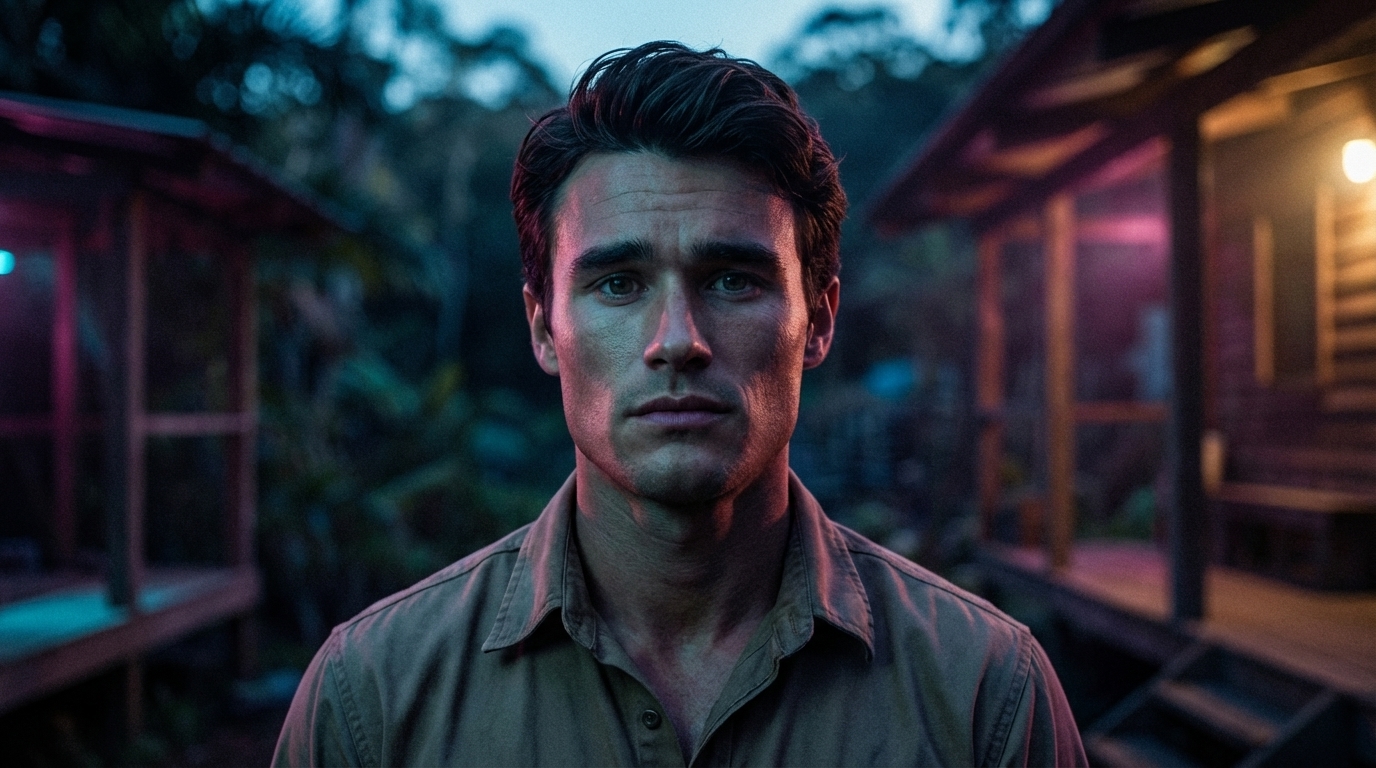
Jerome Malachi Smith, born 16 February 1997 in Broken Hill, New South Wales, is a compassionate conservationist whose quiet dedication to wildlife has shaped both his character and destiny. Raised in a devout Mormon family, Jerome developed an early passion for the natural world that led him to study zoology at the University of Adelaide. In August 2018, he followed his family through a dimensional Portal to Bixbus, where he became instrumental in establishing the Bixbus Wildlife Sanctuary under Project Terra Nova. After several years contributing to conservation efforts, Jerome made his way to the Black Hallows Breeding Facility, where his expertise found its fullest expression.
Birth and Early Childhood
Jerome Malachi Smith was born on 16 February 1997 at the Broken Hill Base Hospital in New South Wales, the fifth child of Noah James Smith and Greta Anne Smith (née Morrison). His arrival completed the pattern of a large, devout Mormon household already shaped by the complexities of blended family life—his older half-brothers Paul and Luke from Noah's first marriage, and his full siblings Lisa and Eli. The Smith family home in Broken Hill, a remote mining town where red dust coated everything and the nearest city lay hours distant, provided the backdrop for Jerome's earliest years.
The household operated according to rhythms both religious and practical. Noah ran Broken Hill Auto Solutions, a mechanics workshop that had become essential to the local community, whilst Greta managed the domestic sphere with the organisational precision required by a family of seven. Faith structured their weeks—Family Home Evening on Mondays, church attendance consuming much of Sunday, morning and evening prayers bookending each day. Yet alongside these spiritual disciplines ran the practical demands of outback life: water conservation during drought years, dust storms that swept through with little warning, the particular resilience required to thrive in such an unforgiving environment.
From his earliest years, Jerome gravitated toward the natural world rather than the mechanical or artistic interests that occupied other family members. Whilst Noah taught his sons basic mechanics and Greta cultivated her elaborate garden, Jerome found his attention drawn to the creatures that inhabited the scrubby bushland surrounding their property. He collected injured insects, attempted to nurse fallen nestlings, and spent hours observing the behaviour of the birds and reptiles that populated the harsh landscape. These early fascinations, though dismissed by some as childish preoccupations, represented the first stirrings of what would become his life's calling.
Childhood and Family Dynamics
Jerome's position as the fifth of six children—Charles would arrive in September 2001—placed him in the often-overlooked middle ground of family dynamics. Paul and Luke, already teenagers when Jerome was born, occupied a separate generational sphere, their relationship with their stepmother Greta carrying complexities that the younger children only dimly understood. Lisa, as the eldest of Greta's biological children, assumed responsibilities and received attention that naturally accompanied her position. Eli, just two years older than Jerome, carved out his own identity through academic achievement and religious dedication.
Charles's arrival when Jerome was four created a natural pairing between the youngest boys. They shared bedrooms, adventures, and the particular bond that develops between siblings close in age and temperament. Charles, with his vivid imagination and willingness to follow Jerome into the bushland on exploratory expeditions, became his primary companion during childhood. Together they built cubby houses from salvaged materials, tracked animal footprints through the red dust, and created elaborate games that transformed the harsh outback into landscapes of wonder and possibility.
Greta's influence on Jerome manifested primarily through her garden—that remarkable cultivation she had created from the unforgiving Broken Hill earth. She taught him the names of plants, both native and cultivated, showed him how to nurture seedlings and compost organic matter, explained the delicate balance required to maintain life in an environment that seemed designed to extinguish it. These lessons in patience, observation, and careful stewardship would later prove foundational to his conservation work, though neither teacher nor student could have anticipated how dramatically those skills would eventually be applied.
Family Tree
The Move to Adelaide
In 2006, when Jerome was nine years old, the Smith family relocated from Broken Hill to Adelaide. The move was motivated by several factors: the desire to provide the younger children with broader educational opportunities than the remote town could offer, Noah's parents' advancing age requiring closer proximity, and the sense that Broken Hill, whilst meaningful for a season, was no longer the right setting for the family's next chapter.
For Jerome, the transition represented both loss and opportunity. He left behind the familiar landscapes that had shaped his early fascination with wildlife—the red earth, the vast skies, the particular creatures adapted to that harsh environment. Yet Adelaide offered compensations: access to proper libraries with books about animals and ecology, proximity to the Adelaide Hills with their different but equally fascinating ecosystems, and educational resources that Broken Hill simply couldn't match.
The family settled into a home that would serve as their base for the next twelve years. Noah found work at a specialist garage focusing on vintage engine restoration, whilst Greta re-engaged with the Adelaide artistic community she'd known as a university student. The children enrolled in local schools, each navigating the challenges of establishing new friendships and adapting to urban rhythms after the slower pace of outback life.
Secondary Education and Growing Passion
Jerome's secondary schooling in Adelaide revealed a student of focused but narrow interests. Whilst competent across subjects, he excelled specifically in biology and environmental science, demonstrating the kind of concentrated attention that teachers recognised as genuine passion rather than mere academic ambition. He joined the school's environmental club, participated in local bushcare programmes, and spent weekends exploring the Adelaide Hills with the systematic curiosity of a naturalist in training.
His approach to learning was characterised by patience and careful observation rather than flashy brilliance. He preferred fieldwork to classroom theory, hands-on experience to textbook knowledge. Teachers noted his ability to remain still and quiet for extended periods—a skill that proved invaluable when observing wildlife but sometimes appeared as disengagement in more traditional educational settings.
The family's religious practice continued throughout these years, though Jerome's relationship to Mormonism grew increasingly ambivalent during adolescence. He attended church services, participated in expected programmes, and maintained the outward forms of faithful observance. Yet something in his nature resisted the certainties that seemed to come naturally to others in his family—particularly to Eli, whose religious commitment deepened with each passing year, and to his parents, whose faith remained the bedrock of their marriage and worldview.
University Years
After completing his secondary education at the end of 2015, Jerome enrolled at the University of Adelaide in 2016 to study zoology. The three-year course felt like a natural progression from childhood fascination through adolescent dedication toward professional focus. University opened intellectual worlds beyond what he'd encountered previously. He studied animal behaviour, ecology, evolutionary biology, and conservation science, finding in these disciplines frameworks for understanding the natural patterns he'd observed since childhood.
During his university years, Jerome volunteered extensively at the Adelaide Hills Wildlife Haven, gaining hands-on experience with injured and orphaned native animals. His supervisors noted his exceptional patience with traumatised creatures, his intuitive understanding of animal stress responses, and his willingness to undertake the unglamorous work that wildlife rehabilitation demanded—the cleaning, the feeding, the overnight monitoring of critical cases. By mid-2018, he was midway through his final year, his future in conservation work seemingly assured.
Millie
It was during his second year of university, in mid-2017, that Jerome encountered Millie—a Border Collie rescued from an abusive situation who arrived at a local shelter skittish, fearful, and mistrustful of humans. Something in her frightened eyes spoke to Jerome's particular sensibilities. He began visiting regularly, then adopted her, taking on the challenge of rehabilitation with the same patient dedication he brought to his wildlife work.
The process was gradual. Millie's trauma manifested in panic responses to sudden movements, inability to trust physical affection, and hypervigilance that left her exhausted. Jerome applied his knowledge of animal behaviour systematically, creating consistent routines, respecting her boundaries, building trust through small, reliable gestures. Over months, Millie's personality began to emerge—intelligent, loyal, capable of play and affection once she felt safe.
About a year into their life together, Millie was diagnosed with epilepsy. Her seizures were severe, leaving her disoriented and exhausted afterwards. Jerome learned to manage her condition, adjusting medication, recognising warning signs, creating environments that minimised triggers. On 31 July 2018, she suffered a particularly intense episode that required emergency veterinary care. Jerome rushed her to the clinic, leaving her overnight for observation—not knowing that by the following morning, everything would change.
Entry to Clivilius
On 1 August 2018, Jerome's life was upended by events that defied rational explanation. His half-brother Luke, estranged from the family for years, had arrived unexpectedly and was closeted with Noah in the study. When Jerome investigated, he witnessed his parents step through a shimmering Portal that had manifested in the room. Driven by instinct and the impossibility of separation from his family, Jerome followed them through.
He emerged into the region that would become known as Bixbus—a harsh landscape where a fledgling settlement of equally displaced people was struggling to establish basic survival infrastructure.
Early Days in Bixbus
The settlement in those first weeks was little more than a collection of shelters and desperate people. Jerome's practical skills proved immediately valuable. Whilst others debated governance structures and spiritual meanings, he focused on concrete problems: locating safe water sources, identifying which local plants might be useful, constructing shelters suited to the unfamiliar conditions. His university training in ecology provided frameworks for observing and understanding this strange environment, even when the specific details diverged from anything Earth had taught him.
The initial disorientation gave way gradually to grim acceptance. The dimensional Portals, he learned, could only be traversed by certain individuals called Guardians. Jerome was not one of them. His parents were not Guardians. For most of the settlement's inhabitants, there was no returning to Earth.
One of Jerome's deepest griefs during those early weeks was uncertainty about Millie's fate. She had been at the veterinary clinic when he crossed through the Portal, her future unknown. Days later, through Guardian transport arranged with Beatrix Cramer, Millie was brought through to Bixbus. The reunion provided a steadying anchor amidst the chaos—her simple companionship offering grounding that helped Jerome navigate the strangeness of his new reality.
Establishing the Bixbus Wildlife Sanctuary
In the months that followed, Jerome channelled his displacement into work he understood. When Project Terra Nova began—a covert initiative to translocate Earth species to this world through Guardian transport—Jerome became an essential participant. Working with Grant and Sarah Ironbach, conservationists from Tasmania's Bonorong Wildlife Sanctuary who had also found themselves in Bixbus, he helped establish what would become the Bixbus Wildlife Sanctuary.
The work provided purpose when everything else felt uncertain. Animals didn't care about dimensional Portals or the frameworks that some settlers imposed on their circumstances. They needed food, shelter, appropriate environments, patient care. Jerome could provide these things. In caring for creatures transplanted from Earth—as confused and displaced as the human settlers—he found connection to the world he'd lost and meaning in the world he'd gained.
The sanctuary grew through careful work and gradual expansion. Jerome designed enclosures suited to local conditions, adapted feeding regimes to available resources, and monitored the health of species facing unprecedented environmental pressures. His quiet competence earned respect from the practical-minded, whilst his obvious dedication created trust with those who might otherwise have viewed conservation work as a luxury in survival conditions.
Family and Personal Life in Bixbus
Life in Bixbus reshaped Jerome's family relationships in complex ways. His parents, Noah and Greta, threw themselves into community building—Noah's mechanical skills proving essential for infrastructure as he took on the role of Drop Zone Coordinator, Greta's organisational abilities helping transform chaos into a functioning settlement. They maintained their religious observance, gathering for prayers and creating spaces for worship even in these circumstances.
Jerome found himself unable to share their faith. Whatever spiritual meaning others found in their displacement, Jerome could access only quiet scepticism. The religion that had structured his childhood felt disconnected from the practical realities of building a life in this strange place. He maintained respectful distance from religious discussions, neither confronting his parents' beliefs nor pretending to share them.
His relationship with Charles remained his closest familial bond. The youngest Smith children navigated their new reality together, supporting each other through the challenges of adaptation. Luke, whose visions had precipitated the family's crossing, remained an enigmatic figure whose role in Bixbus's governance Jerome observed with complicated feelings.
Millie remained Jerome's constant companion, her presence providing emotional stability as he worked through the implications of his permanent exile from Earth. Her epilepsy required ongoing management, but she thrived in the sanctuary environment, accompanying Jerome on his daily rounds and offering the uncomplicated loyalty that helped anchor him through difficult periods.
Departure to Black Hallows Breeding Facility
After several years contributing to Bixbus's conservation efforts, Jerome made his way to the Black Hallows Breeding Facility, a larger operation where his expertise found fuller expression. The transition represented natural career progression—the skills and experience he'd developed at the Bixbus Wildlife Sanctuary qualifying him for work at greater scale and complexity.
At Black Hallows, Jerome continued the patient, methodical conservation work that had defined his contribution to the settlement. The breeding facility's broader scope allowed him to engage with species translocation and habitat development at levels impossible in Bixbus's more limited context. His reputation for quiet competence and genuine dedication to animal welfare followed him, earning respect in his new environment as it had in the old.







