4338.10 · January 10, 2018 AD
Jasmine and Tyre Smoke
A laneway off Collins Street in Hobart's CBD becomes the stage for a brief, fractured reunion. An unmarked white van conducts surveillance of Cornerstone Café minutes before Seth materialises from the wrong direction — unshaven, trembling, bearing the marks of days without sleep. The exchange lasts less than two minutes. What passes between the two men is a padded yellow envelope, a valediction, and the unmistakable impression that a friendship has just been converted into something closer to a last will and testament.
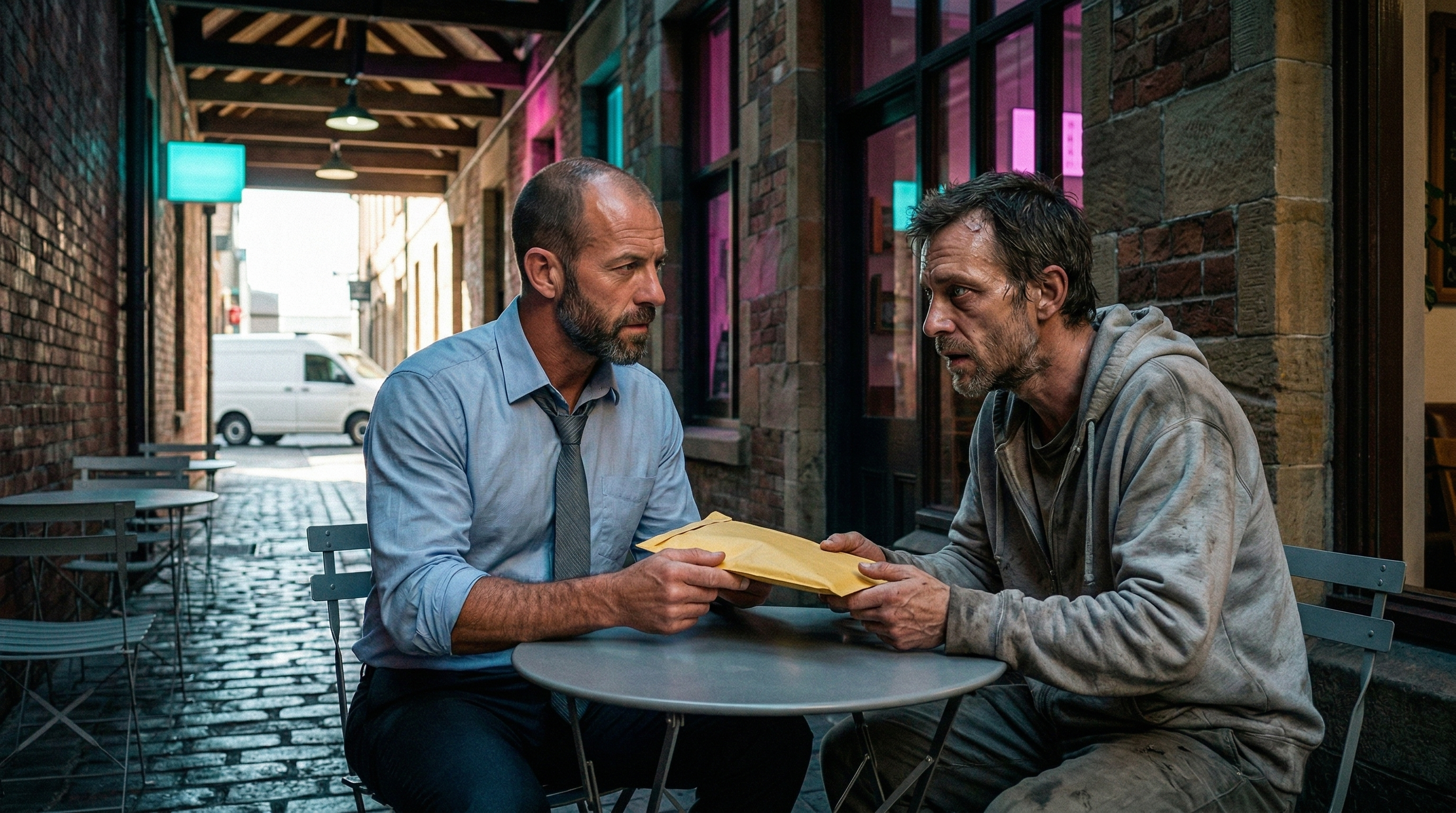
Cornerstone Café occupied its laneway with the quiet authority of an establishment that had outlasted the trends that reshaped the city around it. The narrow passage off Collins Street sheltered it from the midday glare, sandstone walls rising on both sides to create a corridor of relative cool where cobblestones worn smooth by decades of foot traffic caught the light in uneven patches. Hanging baskets trailed jasmine and honeysuckle from the café's entrance, their sweetness threading through the earthier notes of old stone and fresh coffee. A hand-painted sign. A chalkboard menu. Small metal tables arranged on the cobbles outside with the comfortable irregularity of a place that did not measure the distance between its furniture.
The lunchtime crowd had begun to fill the laneway's limited capacity — office workers shedding their building personas over flat whites, tourists photographing the historic façade, a courier threading a bicycle between tables with practised geometry. The scene possessed the self-contained warmth of a city performing its midday rituals, each participant absorbed in the comfortable fiction that the world beyond the laneway walls operated according to predictable and benign principles.
The white van that stopped at the Collins Street entrance did not belong to this picture. It arrived without announcement, pulling to a halt at the laneway's mouth with the precision of a vehicle that knew exactly where it was going. The whiteness of it was conspicuous in its anonymity — no signage, no logos, no company livery, not even the personality of accumulated road grime to suggest ordinary commercial use. Two figures occupied the front seats, their postures communicating something tighter and more deliberate than the relaxed sprawl of delivery drivers consulting an address.
The passenger disembarked and walked the length of the laneway with a gait that worked hard to appear casual and failed. He was constructed for forgettability — medium everything, clothing that would leave no impression, the kind of face that resisted description — but his movements betrayed him. Each café window received the same methodical sweep, his eyes tracking across the interior with a systematic thoroughness that no genuinely idle browser would employ. The reflections in the glass doubled his image, superimposing a translucent spectre over the patrons within, as though he were already inside and searching among them.
A horn blast from the van shattered the laneway's composure. Pigeons erupted. The man abandoned his pretence and jogged back to the vehicle with the controlled urgency of someone who had received an order rather than a suggestion. The van accelerated away with a screech that ricocheted off the sandstone walls, leaving behind a brief silence that the lunchtime crowd filled immediately, seamlessly, as though the interruption had never occurred.
Nathan Cowdrey, seated at one of the outdoor tables with a coffee going cold between his hands, had watched the entire performance. The men had been looking for someone. The systematic nature of the search, the abrupt departure, the disciplined movement — none of it belonged to the vocabulary of lost tourists or impatient couriers. And the timing, measured against the cryptic instructions on a yellow Post-it note discovered that morning, resisted any comfortable interpretation.
Seth arrived from the wrong direction.
Not from the Collins Street entrance where anyone approaching the café would logically appear, but from somewhere behind — the café's interior, perhaps, or one of the secondary passages that connected to adjacent streets through gaps in the surrounding architecture. He materialised at Nathan's shoulder without warning, close enough that his presence registered as a physical intrusion before it registered as a person, close enough that he had clearly been observing the laneway — and the van, and its occupants — from a vantage point he had chosen for its concealment.
The man who stood beside the table bore only a structural resemblance to the Seth who had occupied a decade of Nathan's friendship. The business attire was rumpled and sweat-darkened, the cotton shirt carrying the particular staleness of clothing worn too long without change. The beard that Seth maintained with near-vanity had grown wild, its careful lines dissolved into something unkempt and desperate. Beneath the natural olive of his skin, a greyish pallor had settled — the complexion of someone who had not eaten properly, slept properly, or existed in sunlight for days. A cut on his jawline, partially hidden by the overgrown beard, had dried without being cleaned. The bruise-dark hollows beneath his eyes held a depth that spoke not of one missed night but of several, stacked upon each other until exhaustion had become a permanent condition rather than a temporary state.
His hands trembled. The vibration was fine but visible, the kind produced by sustained adrenaline rather than cold or caffeine — the body's machinery running at a frequency it was not designed to maintain. When he seized Nathan's hands across the table, the grip carried a desperation that transmitted through skin and bone, his pulse racing at a tempo that felt medically concerning even through the contact of interlocked fingers. His palms were slick with the clammy perspiration of fear held too long without release.
The exchange occupied less than two minutes. Seth's eyes moved constantly — flicking to the laneway entrance, to the café windows, to the pedestrians passing within earshot — the perpetual surveillance of someone who had learned to treat stillness as vulnerability. He spoke in compressed bursts, each phrase stripped to its essential instruction, the elaborate discursive style that had characterised a decade of conspiracy-fuelled lunch conversations replaced by something closer to operational brevity.
From his battered leather satchel — a bag Nathan had seen a hundred times, now scuffed and stained with the evidence of rough handling and hard travel — Seth produced a padded yellow envelope. The object was unremarkable in itself, the kind available in any office supply shop, but its weight shifted as it changed hands, its contents settling with a soft internal rustle that suggested something more substantial than paper. Seth placed it in Nathan's grip with a deliberateness that invested the transfer with the gravity of a ceremony — not a gift but a commission, not a favour but a burden voluntarily imposed.
The final words Seth spoke before he rose from the table carried the unmistakable cadence of valediction. Not the casual sign-off of a friend departing for the afternoon, not the standing promise of a next time, but the particular weight of language chosen by someone who understands they are speaking for the last occasion. The phrasing landed between the two men with a finality that the surrounding café noise — the clink of cutlery, the murmur of conversation, the distant hiss of the espresso machine — could not absorb or soften.
Seth left as he had arrived — not through the laneway's public entrance but deeper into its recesses, moving with the hunched urgency of a man navigating by threat rather than destination. His shoulders carried a defensive compression. His head turned in small, constant arcs, scanning the spaces between buildings, the windows overhead, the faces of strangers who did not look back. Within seconds the lunchtime crowd had absorbed him, his figure dissolving into the ordinary flow of pedestrian traffic as completely as though he had never been present at all. A young couple with a tourist map occupied the space where he had stood, their cheerful obliviousness completing the erasure.
The yellow envelope sat on the table in the shade of the laneway, warm from the sun and from the hands that had carried it. Nathan did not open it. The instinct that kept his fingers from the seal was not curiosity's opposite but its disciplined companion — the recognition that whatever the envelope contained had driven a man to infiltrate a secured building, sever himself from digital communication, and conduct a rendezvous with the operational caution of someone who believed himself watched. Whatever was inside belonged to a context that the open air of a laneway café, with its windows and its sightlines and its memory of a white van's methodical scrutiny, could not safely provide.
He tucked the envelope inside his shirt, where it pressed against his chest with the warmth and weight of a second pulse. A ten-dollar note left on the table covered the coffee and the questions it would have been dangerous to ask. The cobblestones received his departing footsteps without comment, their worn surfaces indifferent to the fact that something had just changed hands in their laneway that would prove considerably heavier than its padded paper suggested.







