Jane Amelia Jeffries (née Barwick)
Jane Amelia Barwick (1850–1895), the eldest daughter of shipping magnate Edward Francis Barwick and Amelia Catherine Thompson, was born at the family's Salamanca Place residence in Hobart, Tasmania. Shaped by childhood loss, maternal illness, and premature responsibility, she married William Jeffries III in 1872 and became the gracious mistress of Jeffries Manor. Through philanthropy, quiet financial acumen, and fierce devotion to her four children, she held together a family increasingly consumed by inherited obsession.
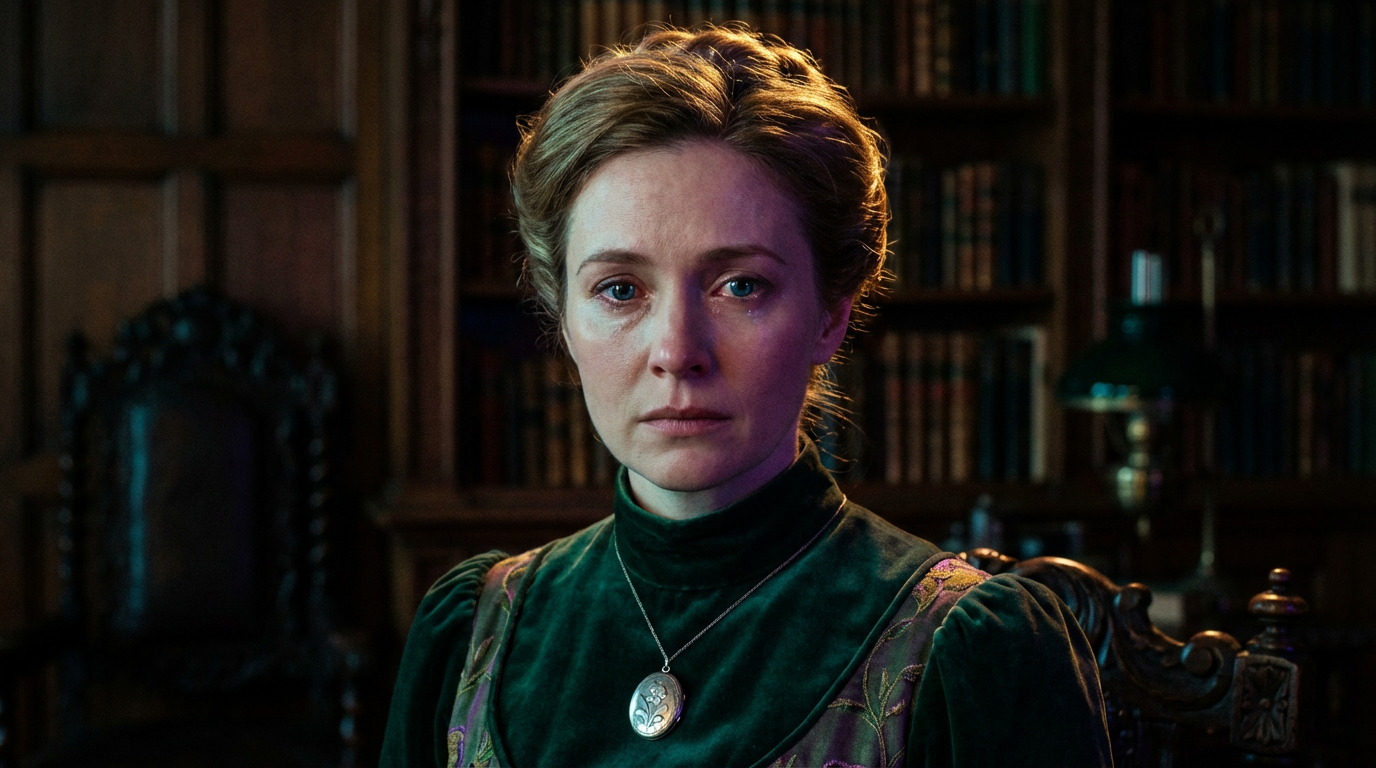
Early Childhood and Family Shadows (1850–1858)
Jane Amelia Barwick was born on 5 April 1850 at the family's Salamanca Place residence in Hobart, the eldest child of Edward Francis Barwick and Amelia Catherine Barwick (née Thompson). Her father, the son of a corruption investigator turned merchant, had built one of Tasmania's most ambitious shipping enterprises, establishing maritime routes that stretched from Hobart's familiar wharves to the ports of India and beyond. Her mother, the daughter of a Sydney merchant, had brought to the marriage both commercial connections and a gentle temperament that proved poorly suited to the loneliness of life as a shipping magnate's wife.
Edward had been at sea when Jane's labour began, returning three days after the birth to find not the son he had anticipated but a daughter whose arrival he greeted with poorly concealed disappointment. This initial rejection, though swiftly transformed into a fierce protectiveness that surprised even Edward himself, left an invisible imprint upon a child whose instinct for reading adult emotions developed earlier and more acutely than it should have needed to. Jane's earliest memories centred upon waiting — for ships to return, for her father's attention, for her mother's emergence from the bedroom where she increasingly retreated. The Salamanca Place house, with its harbour views, became a watchtower where three-year-old Jane stood at windows, inventing stories about the vessels that carried her father away and occasionally brought him back bearing gifts that could not compensate for absence.
The death of her brother Thomas William in April 1852, when Jane was barely two, created a ghost that haunted the household for years. Though too young to retain clear memories of the boy himself, Jane absorbed the consequences of his loss with the sensitivity that characterised her from infancy. Her mother Amelia's grief, managed through steadily increasing laudanum use, meant that Jane learned early to interpret adult moods, to anticipate needs before they were expressed, and to maintain the fragile equilibrium of a household whose emotional foundations had been damaged beyond easy repair. The patterns she developed in response — hypervigilance, self-effacement, premature competence — would prove both her greatest strength and her most persistent vulnerability throughout the decades that followed.
The arrival of siblings brought complexity rather than relief. Robert Francis came in January 1854, Sarah Elizabeth in November 1855, and Margaret Helen in September 1857, each new child adding to the demands upon a household whose nominal mistress was increasingly incapacitated and whose master was frequently at sea. By seven, Jane was functioning as a surrogate mother during Amelia's laudanum hazes and Edward's prolonged absences, managing responsibilities that would have taxed an adult. She learned to mix her mother's doses with careful precision, to handle household accounts with a competence that impressed and unsettled the servants in equal measure, and to maintain the fiction — for visitors, for neighbours, for the younger children — that the Barwick household operated as normally as any other on Salamanca Place.
Education and Premature Adulthood (1858–1868)
Jane's enrolment at Miss Carmichael's Academy in 1858 provided respite from the domestic burdens she carried, though even within the structured environment of the schoolroom she could not entirely shed her caretaker's instincts. Her teachers noted an unusual maturity — an ability to mediate disputes amongst the other girls, to maintain composure under pressure, and to present an appearance of calm that belied whatever difficulties awaited her at home. Her academic performance was solid without being exceptional, constrained less by ability than by the frequency with which household crises called her away from her studies. She read widely and wrote with a clarity that suggested genuine intellectual capacity, but the sustained concentration that academic distinction required was a luxury her circumstances rarely permitted.
The death of her youngest sister Margaret Helen from scarlet fever in July 1863 marked Jane's definitive passage into adulthood at the age of thirteen. With her father in Bombay and her mother incapacitated by the combined weight of grief and laudanum, Jane managed the funeral arrangements, comforted Robert and Sarah, and maintained for the outside world the pretence that the Barwick family remained functional. Her diary from this period — discovered years after her own death — revealed a girl calculating medication doses, tracking household expenses, and noting which merchants would extend credit despite overdue accounts. The entries carried no self-pity, only the meticulous record-keeping of a child who had learned that survival depended upon accuracy rather than emotion.
Her years at Miss Carmichael's provided compensation beyond academic instruction. The friendships she formed there, though constrained by the social performance that was second nature to her, offered glimpses of the warmth she might have expressed more freely had her childhood permitted it. She played Chopin with technical precision and genuine feeling, spoke French and German with a facility that suggested an ear for nuance, and developed the social graces that would later distinguish her in Hobart's drawing rooms. Yet her accomplishments always carried a quality of restraint — she played well enough to impress but never so brilliantly as to overshadow potential suitors, conversed fluently enough to engage but never so boldly as to intimidate. This calibrated modesty, which observers attributed to natural feminine propriety, was in fact a survival strategy refined across years of managing a household where attracting attention to oneself invited scrutiny that the family's private difficulties could not withstand.
Society Debut and Courtship (1868–1872)
Jane's formal debut into Hobart society in 1868 was a carefully orchestrated performance that concealed the ongoing chaos at home. At eighteen, she possessed a beauty that photographers struggled to capture — not conventional prettiness but an arresting quality that hinted at depths beneath the composed surface. Her auburn hair caught the light in ways that made her seem alternately warm and remote. Men were drawn to an apparent vulnerability that they mistook for fragility; women, more perceptive, recognised the steel beneath.
The preparations for her debut season coincided with one of Amelia's most serious crises. Jane managed both the domestic emergency and the social demands of the season with a composure that astonished those who knew enough of the family's circumstances to appreciate what it cost her. She danced every dance at the Governor's ball without apparent fatigue despite having spent the previous night sitting with her mother through a laudanum episode. She accepted compliments with a graciousness that gave no hint of the anxiety she carried about the household accounts her father's extended absence had left in disarray. The performance was flawless, and it exhausted her.
Several suitors presented themselves during the 1868 to 1870 seasons. Thomas Hartley, the son of a wool merchant to whom Amelia had once been promised, offered stability and uncomplicated devotion. James Mitchell, a rising banker's son, represented financial security and social respectability. Jane encouraged neither, understanding that marriage would mean abandoning her younger siblings to their parents' dysfunction — a calculation that revealed both her sense of duty and the limits of what even duty could demand indefinitely. Her rejection of Mitchell's proposal in December 1869 caused minor scandal, as he was considered an excellent match, but Jane's explanation that she felt "too young for such commitment" satisfied society whilst concealing the truth.
The Government House ball of March 1871, where Jane first encountered William Jeffries III, was intended as nothing more than another social obligation in a season of obligations. At twenty-one, she had perfected the art of appearing engaged whilst remaining emotionally distant, of suggesting availability whilst maintaining the protective barriers that her childhood had taught her to construct. William, recently returned from Oxford and his continental tour, represented everything Jane had learned to distrust — the casual confidence of wealth, the easy assumption that the world would arrange itself to accommodate one's desires, the charm that might mask any number of concealed inadequacies.
Their first conversation disrupted these assumptions. William's interest extended beyond the standard social pleasantries; he asked what she thought about Tasmania's future rather than merely complimenting her accomplishments. When he mentioned his grandfather's mysterious disappearance, Jane found herself genuinely engaged for the first time in years, recognising in the Jeffries family mystery an echo of her own household's carefully maintained secrets. Two people shaped by the experience of families whose public reputations required constant curation had found, in one another, someone who understood the particular exhaustion of sustaining that performance.
The courtship that unfolded over the following year was marked by careful negotiation between attraction and self-preservation. William's letters showed intellectual depth and emotional accessibility that Jane found both appealing and alarming — appealing because they suggested a man capable of genuine connection, alarming because genuine connection required lowering defences she had spent a lifetime building. William's visits to Salamanca Place demanded careful staging to conceal Amelia's condition and Edward's absence, though Jane sensed that William perceived the performance without directly challenging it. His proposal in February 1872 came with an understanding — spoken obliquely but clearly — that he knew she carried burdens beyond her dowry, and that he was offering not merely a marriage but a partnership in which those burdens might be shared.
Marriage and Jeffries Manor (1872–1873)
Their wedding on 15 June 1872 at St. David's Cathedral was the social event of the Hobart season, though shadowed by Amelia's visibly declining health. Edward Barwick's behaviour at the reception — his slurred, bitter speech about loyalty and desertion — humiliated Jane but also, paradoxically, freed her. His public display of the resentment he felt at her "abandonment" of the family released her from the guilt that might otherwise have poisoned her departure from Salamanca Place. She arrived at Jeffries Manor that evening carrying both the relief of escape and the knowledge that the household she had left behind would deteriorate without her management.
Six weeks later, on 26 July 1872, Amelia Catherine Barwick died at the age of forty-one, her laudanum-weakened constitution finally succumbing to pneumonia. Jane managed her grief with the composure that had become her defining characteristic, mourning not merely the woman her mother had been at the end but the woman she might have been had circumstance and dependency not eroded her so thoroughly. The loss carried a particular complexity — Jane had served simultaneously as her mother's caretaker, her protector, and, in many practical respects, her parent. The death severed a bond that had been as much about duty as about love, and the relief Jane felt alongside her sorrow introduced a guilt that she would carry, unspoken, for the remainder of her life.
The early months at Jeffries Manor revealed both promise and troubling familiarity. William was attentive and genuinely affectionate, delighted by his young wife's intelligence and determined to make their marriage succeed where so many around them had faltered. Yet he was also absorbed in the vast Jeffries enterprises, and Jane found herself once again managing household complexities — though now with resources and competent staff that her childhood home had lacked. The manor itself, with its locked rooms and portraits of ancestors whose stories carried shadows, suggested secrets that resonated uncomfortably with her experience of hidden truths and unspoken agreements. She had married into a family whose capacity for concealment rivalled her own, and the recognition was both comforting and unsettling.
Her mother-in-law Ellen Amelia Jeffries proved a genuine ally during these early months. Ellen's own experience of managing a household shaped by masculine obsession — William Jr.'s fixation upon his father's disappearance had defined their marriage — gave her an understanding of Jane's situation that transcended mere sympathy. The two women developed a rapport grounded in shared pragmatism, each recognising in the other the particular competence that comes from managing families whose public dignity depends upon the invisible labour of the women who sustain them. Ellen's charitable networks provided Jane with both social introduction and purposeful occupation beyond the domestic sphere, establishing patterns of philanthropic engagement that would intensify as the marriage progressed.
Motherhood (1873–1881)
The birth of William Jeffries IV on 12 August 1873 triggered an anxiety that Jane had not anticipated. The safe arrival of a healthy son — the heir William desperately wanted — should have brought uncomplicated joy, but instead recalled her brother Thomas's brief life and the devastation his death had wrought upon her parents' marriage. She found herself checking the baby obsessively through the night, unable to trust his continued breathing, developing insomnia that she treated with small doses of laudanum — a horrifying echo of her mother's trajectory that she recognised clearly but felt powerless to halt. The recognition itself became a form of torture: she understood exactly what she was doing, knew precisely where the path led, and yet the terror of losing her child overwhelmed the rational knowledge that she was replicating the pattern she had spent her childhood managing in others.
She controlled the dependency through sheer force of will, limiting her use to the smallest effective doses and maintaining strict schedules that prevented the escalation her mother had experienced. This discipline, forged in the same crucible of premature responsibility that had shaped everything else about her, kept the laudanum from consuming her as it had consumed Amelia. But it never disappeared entirely, remaining a private negotiation between her anxiety and her resolve that persisted throughout the years of childbearing and beyond.
Edward arrived on 10 September 1875, his birth easier than his brother's — perhaps because Jane had survived one son's infancy, or perhaps because William's evident delight in having "an heir and a spare" reduced the pressure that had intensified her anxiety the first time. Alice's birth on 15 March 1878 brought the daughter Jane had secretly hoped for — someone who might one day understand the particular pressures of being a woman within a powerful family. The delivery was complicated, however, requiring forceps intervention that left Alice with a slight facial asymmetry. Jane's fierce protectiveness of her daughter — ensuring Alice was never made to feel diminished by a feature that colonial society's narrow standards of beauty would inevitably notice — revealed the depth of her understanding of how appearance governed a woman's possibilities and how cruelly the world punished deviation from its expectations.
Henry's arrival on 8 November 1881 completed the family but also coincided with the beginning of William's withdrawal into the obsession that would dominate the remainder of his life. His father's death the previous year had placed in William's hands both the Jeffries empire and the accumulated research into William Sr.'s disappearance, and the investigation that began as a rational inquiry was already showing signs of the compulsive character it would eventually assume. Jane watched her husband's attention shift from the living family that needed him toward the dead grandfather who could offer nothing in return, and the familiarity of the pattern — the absent father, the household sustained by a woman's invisible management — settled over her with the weight of a prediction confirmed.
Philanthropy and Hidden Work (1878–1892)
Jane's establishment of charitable initiatives through the 1880s served purposes that operated on multiple levels simultaneously. Publicly, her involvement with the Hobart Children's Hospital, the Widows' Assistance Fund, and the Educational Endowment for Girls positioned her as one of Tasmania's most respected philanthropists, a reputation that placed the Jeffries name above the reach of gossip. Privately, the work provided both purposeful occupation beyond Jeffries Manor's increasingly oppressive atmosphere and the satisfaction of applying her organisational talents to endeavours whose outcomes she could measure and influence — a counterweight to the domestic situation over which she exercised diminishing control.
Her work with the Children's Hospital revealed the compassion that her carefully maintained composure sometimes obscured. She insisted upon protocols ensuring that no child was left alone during medical procedures, drawing upon memories of her own childhood illnesses when her mother had been too incapacitated to provide comfort. The playground she funded — revolutionary for its time — reflected her conviction that healing required joy alongside medicine, though critics dismissed the expenditure as sentimental extravagance. Jane bore the criticism with the equanimity she applied to all public scrutiny, understanding that the capacity to absorb disapproval without visible distress was itself a form of power.
The most remarkable dimension of her philanthropic work remained entirely hidden during her lifetime. Private records discovered after her death revealed that Jane had established a clandestine network assisting women fleeing domestic violence — a cause far too controversial to support openly in colonial Tasmania, where a husband's authority over his wife carried the weight of both law and social expectation. She diverted personal funds to provide new identities and passage to other colonies for women whose circumstances had become unbearable, using charity events as cover for planning sessions and leveraging her social position to create connections that no one thought to scrutinise. The operation displayed the same meticulous organisational intelligence she had developed managing the Barwick household as a child — the capacity to sustain complex, multi-layered arrangements whilst presenting to the outside world an appearance of serene simplicity.
Her father's death on 23 May 1874 had already severed her most significant remaining connection to the Barwick family. Edward Francis Barwick died at forty-five — the same age Jane herself would reach — leaving behind the shipping empire he had built and the fractured household he had neglected. Jane's grief was complicated by the same ambivalence that had characterised her mourning for Amelia: sorrow for the father she had loved despite his absences, relief from the obligation to maintain the pretence that his neglect had not caused lasting damage, and the unsettling recognition that she was now, at twenty-four, an orphan whose remaining family connections offered little of the support that the word "family" was supposed to imply. Robert and Sarah maintained intermittent contact, but the Barwick siblings had been shaped too differently by their shared childhood to sustain the closeness that their mother's decline and father's absences had prevented from developing naturally.
Managing the Decline (1885–1895)
As William's investigation into his grandfather's disappearance consumed an ever-larger share of his attention, Jane assumed responsibilities that extended well beyond the domestic sphere. His prolonged absences — trips to Sydney, Melbourne, London, each journey lasting longer than planned — left her managing not merely the household and children but the business operations and social obligations upon which the Jeffries family's position depended. The estate manager, Thomas Crawford, initially resisted taking direction from a woman, assuming that Jane's involvement was temporary and her competence limited. Her response was characteristic: she studied the account ledgers, agricultural reports, and investment portfolios with the same methodical thoroughness she had once applied to managing her mother's medication schedules, and within months had mastered the estate's operations sufficiently to restructure several failing investments. She presented these improvements as fortunate coincidences rather than deliberate strategy, understanding that her effectiveness depended upon allowing others to believe that the household's continued prosperity owed more to luck than to her management.
The 1895 title deed that formally transferred Jeffries Manor into the joint names of William and Jane captured, in the dry language of property law, a relationship whose complexity no legal document could adequately represent. Jane's name inscribed alongside William's acknowledged what had been true in practice for years — that the estate's management depended as much upon her competence as upon his ownership. The document arrived just months before pneumonia would claim her life, rendering the formal recognition both overdue and heartbreakingly brief.
William's paranoia deepened through the late 1880s and into the 1890s. He installed locks on doors that had stood open for decades, hired guards to patrol the estate grounds, and began carrying a revolver — behaviour that frightened the children and tested Jane's capacity for diplomatic interpretation. She shielded the younger children from their father's worst episodes, explaining his absences as business necessities, reframing his erratic behaviour as eccentricity rather than deterioration, and absorbing the anxiety that his paranoid accusations generated so that Edward, Alice, and Henry could experience something approaching a normal childhood. William IV, old enough to see through these protective fictions, developed a premature gravity that Jane recognised as a mirror of her own childhood — another eldest child learning to manage a household's emotional economy at an age when such management should have been unnecessary.
Her own health, strained by decades of vigilance and carefully controlled laudanum use, began to falter after 1890. The medication she had kept at maintenance doses throughout her adult life provided diminishing relief against mounting pressures, though she never permitted the escalation that had destroyed Amelia. Her discipline held, but at a cost that manifested in exhaustion, diminished appetite, and an air of fragility that photographs from this period captured with uncomfortable clarity. The Christmas ball of 1891, remembered by guests as one of the most spectacular entertainments in Jeffries Manor's history, produced photographs in which Jane's smile did not quite reach her eyes — the expression of a woman whose performance had become so habitual that she could sustain it even as the energy to maintain it was failing.
Final Illness and Death (1895)
The pneumonia that struck in August 1895 found a constitution already weakened by years of accumulated strain. Dr. Harrison's treatments — the standard arsenal of mustard plasters, bloodletting, and experimental preparations — produced little improvement, and Jane, who had spent a lifetime assessing situations with unflinching accuracy, recognised her own prognosis before her physicians were willing to articulate it. The fever that should have brought delirium instead seemed to sharpen her perception, burning away the layers of diplomatic restraint that had governed her public interactions and leaving her capable of truths she had suppressed for decades.
To William, she expressed what she had long believed: that his grandfather's disappearance, whatever its explanation, mattered less than the living family his investigation was destroying. To William IV, she revealed the location of private journals documenting the family's true financial position — information she had maintained independently as a safeguard against her husband's increasingly erratic decision-making. To Alice, she offered the permission she wished someone had given her: the freedom to refuse marriage if acceptance meant tolerating less than genuine respect. These conversations, conducted in the intervals between fever and exhaustion, carried the weight of a lifetime's accumulated wisdom delivered under the pressure of diminishing time.
Jane Amelia Jeffries died on 8 September 1895, surrounded by her family and the household staff who had served as the closest approximation of friends her position permitted. Her final words — reported publicly as "The children know they are loved" — were, according to Alice's private account, actually "The performance is finished." The ambiguity was characteristic: a statement that could be read as surrender, as liberation, as commentary upon the elaborate fiction her life had required her to sustain, or simply as the recognition that the particular form of endurance she had practised for forty-five years had reached its natural conclusion.
The funeral on 12 September drew all of Hobart's colonial elite. The eulogies praised her beauty, her charity, and her devotion to family — descriptions that captured the surface of a life whose depths remained, as Jane would have preferred, invisible. The Hobart Mercury called her "an angel of mercy" and "the perfect wife and mother," formulations that would have provoked in Jane the private, slightly melancholy amusement she reserved for moments when the world confirmed its preference for flattering simplification over uncomfortable truth. She had understood, better than most, that perfection was performance and that mercy often meant managing the damage that others had caused. The performance was finished. What remained — in her children, in the institutions she had built, in the women she had quietly helped to escape — was the substance beneath it.







