4301.73 · March 14, 1981 AD
James Henrik Willems
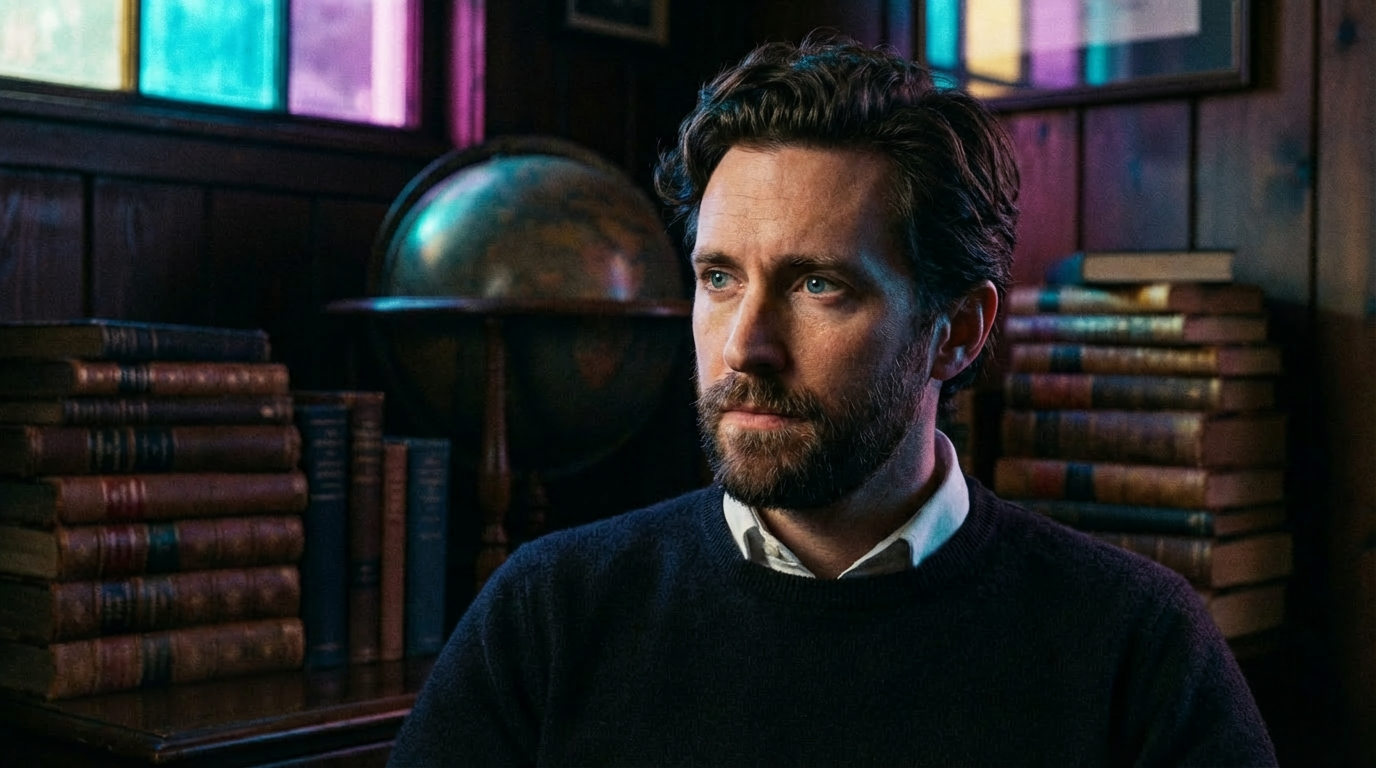
James Henrik Willems (born 14 March 1981, Brierly, Clivilius) was Dean of the Faculty of Philosophy at Clivilius National University — a philosopher born and raised in Clivilius who encountered Earth's philosophical traditions only in his late thirties. The son of a vintner father and a librarian mother descended from Brierly's founding settlers, James grew up within the settlement's multi-generational "inquiry" tradition before moving to Bixbus in 2019 to help build CNU's philosophy programme. He was lead author of the Self-Referential Systems research programme and the proposed Reflexive Logic framework.
Birth and Early Childhood
James Henrik Willems was born on 14 March 1981 in Brierly, Clivilius — the only child of Henrik Andries Willems and Catherine Elise Willems (née Carrington). His birth took place in the family cottage on Vineyard Row, attended by Brierly's sole midwife, Agnes Thornton, who had delivered more than half the settlement's children over the preceding three decades. Henrik, who had been pruning in the eastern vineyard when Catherine's labour began, arrived with dirt still under his fingernails and wine-stained hands that he scrubbed raw at the kitchen basin before Agnes would allow him near his wife.
The Willems cottage sat at the southern edge of the Brierly Vineyards, a stone-and-timber structure that Henrik's grandfather had built in the 1890s and that had been extended twice since — once to accommodate a second bedroom, and once to add the covered porch where Henrik stored his pruning tools and fermentation equipment. The house smelled permanently of oak and tannin, scents that James would associate with home for the rest of his life.
Henrik Willems was a third-generation vintner — a quiet, physically powerful man who spoke rarely and worked methodically. His family had been part of Brierly since the 1810 founding, though the Willems name had arrived through a Dutch-descended settler in the second generation rather than among the original English party. Henrik's world was the vineyard: he understood soil composition, canopy management, and the behaviour of grape varieties across Clivilius's seasons with an intuitive precision that required no formal education to sustain. He had little patience for abstraction, regarding the settlement's philosophical traditions with a respectful indifference that he never troubled to articulate.
Catherine Carrington had grown up in a different household entirely. She was a direct descendant of Elizabeth Carrington, the botanist who had arrived with Brierly's founding settlers in 1810, and the Carrington family had maintained Elizabeth's intellectual curiosity across nearly two centuries. Catherine worked in the Brierly Library — a stone building adjacent to the Town Hall that housed the settlement's accumulated written records — and she brought to the Willems cottage a quality that Henrik's family had never prioritised: books. By the time James was old enough to notice, every surface in the cottage not occupied by winemaking equipment was covered with volumes: botanical illustrations, agricultural manuals, handwritten journals from previous generations, and the fragmentary records from the founding period that Catherine considered her most important responsibility to preserve.
The Library and the Founding Documents
James's earliest memories centred on the library. Catherine brought him to work from the age of three, setting him up with paper and charcoal at a small table in the archive room whilst she catalogued and maintained the collection. The archive room was cool, dim, and smelled of old paper and the cedar oil Catherine used to treat the shelves against insects. James drew pictures of the vineyard, of the river, of the hills beyond the settlement — but increasingly, as he grew old enough to recognise words, he was drawn to the documents on the shelves around him.
The oldest documents in the Brierly Library dated to the 1810s — journals kept by the founding settlers during their first years in Clivilius. Catherine had spent years organising these records, and she introduced James to them gradually, reading passages aloud during quiet afternoons when no other patrons visited. The journals described the founders' bewilderment at a world that looked solid but felt different — their attempts to determine whether the soil, the water, the air were "real" in the sense they had known on Earth, and their gradual, uneasy acceptance that the question might not have an answer. One passage, written by Elizabeth Carrington herself in August 1811, stayed with James permanently: "The ground holds my weight. The water quenches thirst. The grapes grow and ripen. But I cannot shake the feeling that the world is watching me as I watch it — that the land knows it is being walked upon."
James asked his mother, at age seven, what Elizabeth Carrington had meant. Catherine sat with the question for a long time before answering. "She meant that she didn't know what kind of world she was living in," Catherine said. "And neither do we. That's the most important thing the library teaches, James. Not answers. The question."
Education at the Brierly Academy
James entered the Brierly Schoolhouse at age five for primary education, where the curriculum covered reading, writing, mathematics, natural history, and agricultural science — the practical knowledge required to sustain a community of 250 in a world with no external supply chains. He was a capable but unremarkable student in most subjects. Mathematics held his attention; agriculture did not. His teachers noted that he asked questions that went beyond the scope of the lesson — not disruptively, but with a persistence that sometimes left them without answers.
At fourteen, James progressed to the Brierly Academy — the small institution of higher learning that had existed in one form or another since 1840. By the 1990s, the Academy operated with fewer than a dozen instructors and perhaps thirty students at any given time, offering education in natural history, agriculture, mathematics, literature, and what was informally called "the inquiry."
The inquiry had no formal curriculum. It was a tradition — a habit of sustained philosophical questioning that had been part of Brierly's culture since the founding. The questions were always the same, refined across generations but never resolved: What is the nature of this world? What was here before us? What does it mean to be born here rather than on Earth? Are we the same kind of being as the people who came through the Portal? The inquiry was conducted through reading circles, debates, contemplative walks along the river, and conversations that might begin over dinner and continue until dawn. It was not, by any Earth standard, academic philosophy. There was no formal logic, no systematic argumentation, no engagement with any philosophical canon — because no such canon was available. What there was, instead, was a community of people who had lived with genuine ontological uncertainty for nearly two centuries and had developed, through sustained collective attention, a remarkably sophisticated set of intuitions about the nature of reality, identity, and experience.
James excelled in this environment. He had Catherine's curiosity and Henrik's patience — the ability to sit with a question for hours, days, or years without forcing it toward a premature answer. His Academy mentor, an elderly inquiry leader named Thomas Ashworth, recognised in James a quality he had seen rarely in fifty years of teaching: the capacity to hold contradictory ideas in mind simultaneously without collapsing them into false resolution. Ashworth described James, in a note preserved in the Academy's records, as "the first student I have taught who is genuinely comfortable not knowing."
Early Adulthood in Brierly
James completed his education at the Academy in 1999, at age eighteen. He had no career path available to him in the conventional sense — Brierly offered work in the vineyards, in agriculture, in the library, in the schoolhouse, and in the various trades that sustained the settlement. He took a position assisting his mother in the library, cataloguing and preserving the archive, whilst spending increasing amounts of time leading inquiry sessions.
By his early twenties, James had become the informal intellectual centre of the inquiry tradition. He organised weekly reading circles in the library, monthly debates in the Town Hall, and seasonal contemplative retreats along the river where participants walked in silence before gathering to discuss what they had observed — in the landscape, in their own minds, and in the relationship between the two. These retreats drew participants from across the settlement, including people who had never previously engaged with the inquiry, and they established James's reputation as someone who could make abstract questions feel urgent and personal.
Henrik Willems observed his son's growing preoccupation with what he called "the thinking" with characteristic reserve. He never criticised James's work, but he made clear through small gestures — leaving pruning shears by James's bed, mentioning labour shortages in the vineyard — that he regarded the inquiry as an indulgence that a settlement of 250 could not indefinitely afford. Catherine mediated between them without taking sides, understanding both her husband's practical concerns and her son's intellectual vocation. The tension was never hostile, but it was permanent — a low hum of mutual incomprehension between a man who understood the world through his hands and a son who understood it through questions.
James's personal life during this period was quiet. He had a brief relationship in his early twenties with a woman named Ruth Hadley, a teacher at the schoolhouse, but it ended amicably when Ruth recognised that James's deepest attachment was to the inquiry rather than to any person. He formed a close friendship with David Ashworth, Thomas Ashworth's grandson and a carpenter by trade, who attended the inquiry sessions with genuine interest despite having no philosophical ambitions of his own. David provided James with something essential: a companion who valued his thinking without sharing it, and who reminded him regularly that most people experienced the world through action rather than contemplation.
The Arrival of Bixbus
The discovery of Brierly by the Bixbus exploration team on 13 August 2018 transformed every aspect of James's life. He was thirty-seven years old. Within weeks of contact, as materials, technology, and books began flowing between the two settlements, James encountered the Western philosophical tradition for the first time.
The experience was electrifying and disorienting in equal measure. He read Whitehead's "Process and Reality" in a single sleepless week in October 2018, and the effect was seismic. Here was a philosopher — a mathematician, no less — who had articulated, with formal rigour that James could barely follow, the processual understanding of reality that James had arrived at through lived experience alone. He had never heard of Whitehead. He had never heard of process philosophy. And yet the book described, in precise technical language, a worldview that James recognised as his own.
The same pattern repeated across his reading. He encountered Husserl and recognised something close to the contemplative attention the inquiry had practised for generations. He encountered Chalmers and found that the hard problem of consciousness — why does subjective experience exist at all? — gave precise expression to a question that had haunted Brierly's thinkers since the founding. He encountered the Buddhist philosophical tradition and felt a kinship so deep that he initially suspected some historical connection between the inquiry tradition and Buddhist thought, though no evidence for such a connection existed.
The discovery was simultaneously validating and humbling. Validating, because it confirmed that the questions were real — that the deepest minds on Earth had found them worthy of lifetimes of investigation. Humbling, because the sophistication of the Earth tradition revealed how much further the questions could be pushed with formal tools that the inquiry lacked: symbolic logic, set theory, the mathematics of quantum mechanics, the precision of analytic philosophy.
Recruitment to Clivilius National University
When Clivilius National University began its initial recruitment in early 2019, James was approached by members of the founding academic team who had heard about the Brierly inquiry tradition through the growing network of contacts between the two settlements. His position was unusual: he had no formal qualifications by any Earth standard, no publications, no academic credentials of any kind. What he had was something no Earth-trained philosopher could offer — a genuinely original philosophical perspective developed entirely outside Earth's intellectual traditions, rooted in direct, lifelong experience of the questions that academic philosophy studied from the outside.
James moved to Bixbus in March 2019 to take up a position on the founding staff of what was then the Department of Philosophy within the Faculty of Humanities. He was thirty-eight years old. The move was the first time he had left Brierly for more than a few days, and the scale of Bixbus — already a rapidly growing settlement of thousands, with construction everywhere and a pace of development that bore no resemblance to Brierly's unhurried rhythms — was initially overwhelming. He found lodgings near the CNU campus along the southeast banks of the Bixbus River and spent his first months in a state of accelerated self-education, reading voraciously across the Western philosophical canon whilst simultaneously helping to design the university's philosophical curriculum.
Henrik Willems travelled to Bixbus by road — the railroad had not yet been built — to see his son's new home in June 2019. He walked the campus, inspected James's small office, and said very little. Before leaving, he pressed a bottle of the family's 2017 vintage into James's hands and told him, "Don't forget that thinking isn't the same as knowing." James kept the bottle on his desk, unopened, for three years before finally sharing it with a colleague on the evening the Faculty of Philosophy was formally established as an independent faculty.
Building the Faculty of Philosophy
The early years at CNU were formative and exhausting. James recruited staff from two pools: Earth-born academics who had come through Portals and brought formal training in philosophy, logic, and the sciences, and Clivilius-born thinkers who, like himself, brought perspectives shaped by direct experience of the questions the faculty would investigate. He insisted from the beginning that the Faculty of Philosophy should not replicate an Earth philosophy department. Earth's traditions were essential — they provided the formal tools, the historical depth, and the rigorous argumentation that the inquiry tradition lacked. But the Clivilius context demanded something more: a philosophy that took seriously the questions that only arose when one lived in a world whose fundamental nature was genuinely uncertain.
Under James's leadership, the philosophy programme was elevated from a department within the Faculty of Humanities to its own independent faculty — a structural decision that reflected his conviction that philosophy was not a branch of the humanities but the discipline that interrogated the foundations of every other discipline. Two departments were established initially: the Department of Consciousness Studies and the Department of Metaphysics. James assumed the role of Dean, a title he accepted with visible discomfort — he had spent his entire life in a community of 250 where leadership was exercised through moral authority rather than institutional position.
His teaching reflected this discomfort with hierarchy. James never lectured in the traditional sense. He posed questions, waited, and listened — recreating, in a university lecture hall, the inquiry tradition he had grown up with in Brierly's library and along its river walks. His seminars drew students from across the university, many of whom had enrolled in other faculties entirely but found themselves returning to James's sessions because of his ability to make abstract philosophical questions feel urgent and personal. Students who expected answers left frustrated. Students who wanted to learn how to think stayed.
The Self-Referential Systems Programme
The research programme that would become James's most significant intellectual contribution began in early 2025 with a series of conversations — initially informal, later increasingly structured — with Dr Suki Nakamura, a logician in the Department of Logic and Formal Systems within the Faculty of Formal Sciences.
James had been thinking for years about a pattern he had noticed across his reading: that self-referential systems — systems that referred to themselves — seemed to produce the same kind of behaviour across very different domains. Russell's Paradox in set theory, the Liar's Paradox in logic, the halting problem in computation, quantum superposition in physics, and the self-observation problem in consciousness all involved a system attempting to evaluate itself and producing oscillation, undecidability, or indeterminacy rather than a stable result. Earth's philosophical and scientific traditions had treated each of these as a separate problem in a separate discipline. James suspected they were the same phenomenon.
What he lacked was the formal training to test this intuition rigorously. He could see the pattern, but he could not prove it. He needed a logician — someone who could examine the structural claims with the precision of formal logic and determine whether the parallels were genuinely structural or merely analogical.
The collaboration with Nakamura — who brought formal expertise in paraconsistent logic, non-well-founded set theory, and the Buddhist Catuṣkoṭi — produced the Self-Referential Systems research programme and its central proposal: Reflexive Logic, a logical framework designed to accommodate oscillatory truth values as a genuine formal property of self-referential propositions. The resulting working document, "Self-Referential Systems: Toward a Unified Framework," was completed in March 2026. Parts of the research were conducted with the assistance of an AI system, which provided disciplinary knowledge verification, formal articulation support, and structural organisation — a methodology the authors described as augmented collaborative inquiry.







