James Edward Collins
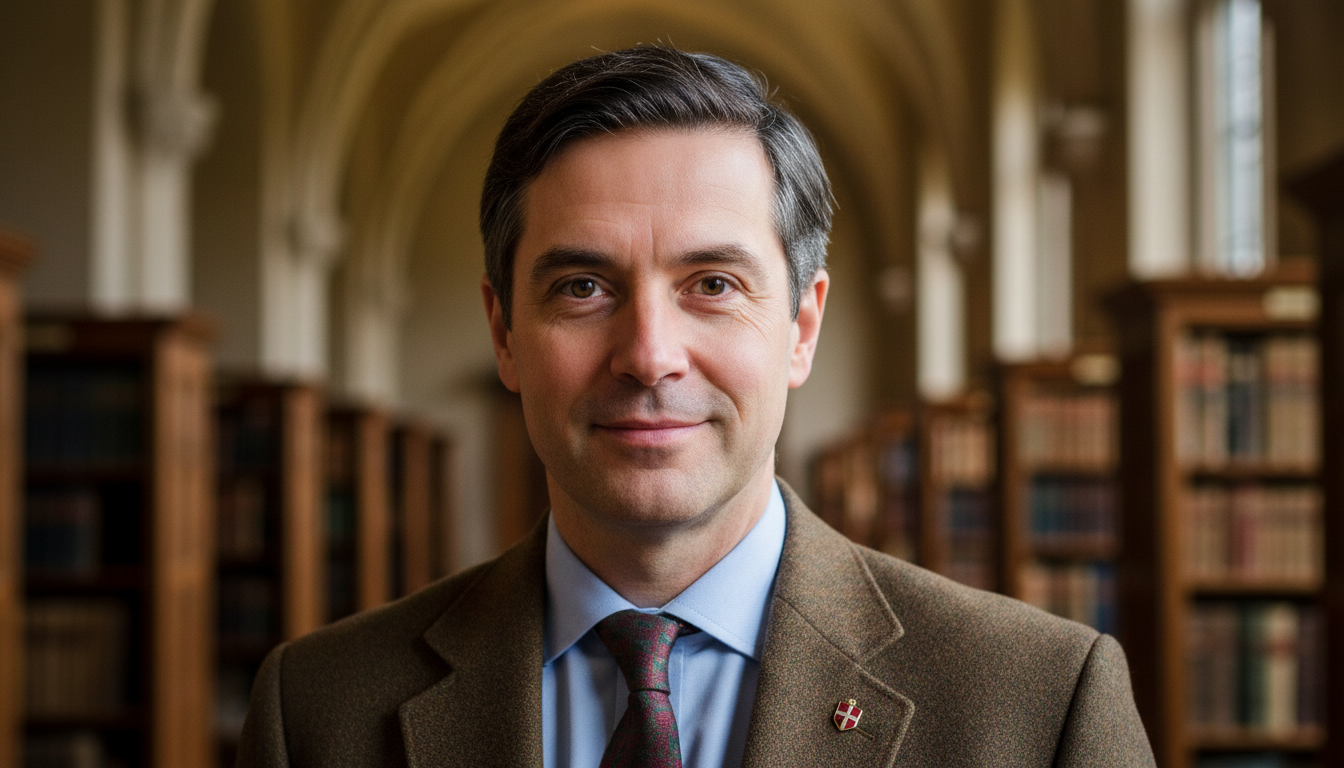
James Edward Collins, born on 22 July 1940 in London, dedicated his life to preserving Britain's architectural heritage through scholarship and conservation. Educated at Oxford and Cambridge, he spent decades at Historic England before becoming Professor of British Architectural History at Cambridge University. His groundbreaking work on Victorian architecture and adaptive reuse influenced generations of preservationists. Married to barrister Elizabeth Bennett, James fathered Bradley and Laura, passing his passion for heritage to the next generation.
Birth and Intellectual Inheritance
James Edward Collins was born on 22 July 1940 in London, arriving into a world on the cusp of unprecedented upheaval. The Battle of Britain raged overhead that summer, the Blitz would soon begin, and the city of his birth stood as both target and symbol of British resilience. His father, Henry Collins, practised as a prominent barrister at Lincoln's Inn, bringing to the household the analytical rigour and argumentative precision of the law. His mother, Charlotte Collins, earned distinction as an author of historical fiction, her novels meticulously researched and vividly rendered, bringing Tudor courts and Georgian drawing rooms to life for popular audiences.
The Collins family home, a substantial Victorian townhouse in Kensington, provided James's first lessons in the power of architectural heritage. The house itself, built in the 1870s, embodied High Victorian confidence with its ornate brickwork, stained glass, and elaborate plasterwork. Charlotte often pointed out architectural details to her children, explaining how the decorative elements reflected the values and aspirations of the society that created them. Henry, meanwhile, approached buildings with a lawyer's eye for evidence, teaching James to read structures as historical documents that revealed social, economic, and cultural truths about their eras.
James grew up alongside his younger sister Mary, who would later establish herself as a distinguished art historian specialising in Pre-Raphaelite painting. Their childhood unfolded amidst dinner table conversations that ranged across history, literature, art, and architecture, their parents fostering an environment where intellectual curiosity was the highest virtue and rigorous thinking the expected standard. The household weathered the war years with typical middle-class British stoicism, Charlotte's historical novels providing income when Henry's practice suffered war-time disruption, whilst both parents volunteered in various civil defence capacities.
Harrow and the Awakening of Historical Consciousness
In 1951, at age eleven, James entered Harrow School, following his father and grandfather through Tudor corridors that had witnessed centuries of British education. Harrow's physical fabric—from the Old Schools building to the chapel where Byron had worshipped—provided constant reminder that institutions accumulated history through their very stones. James excelled particularly in History and English Literature, his essays demonstrating unusual capacity to synthesise broad cultural movements with specific manifestations in architecture, art, and literature.
His History master, Dr. Edmund Cartwright, recognised in James a genuinely scholarly temperament—not merely the ability to memorise facts and regurgitate them, but the capacity to think historically, to understand how societies changed over time and how these transformations manifested in material culture. Cartwright encouraged James to look beyond political and military history towards social and cultural history, towards understanding how ordinary people lived and how their values shaped the physical environments they inhabited.
During his Harrow years, James developed particular fascination with Victorian Britain, that extraordinary period when industrialisation, urbanisation, imperial expansion, and social reform transformed virtually every aspect of British life. He became captivated by Victorian architecture's extraordinary range and ambition—from Joseph Paxton's revolutionary Crystal Palace to George Gilbert Scott's Gothic Revival churches, from the vast railway terminals that remade British cities to the workers' housing that embodied competing visions of social order. James understood that Victorian buildings weren't merely aesthetic objects but physical manifestations of a society wrestling with unprecedented change.
Oxford: The Scholarly Formation
James matriculated at the University of Oxford in 1958, entering Balliol College to read History. Oxford in the late 1950s remained a largely traditional institution, its tutorial system preserving centuries-old pedagogical methods whilst its scholars engaged with increasingly sophisticated historical methodologies. James thrived in this environment, his tutorials with distinguished historians pushing him to develop rigorous analytical frameworks whilst his own wide reading exposed him to emerging approaches in social history, architectural history, and material culture studies.
His undergraduate dissertation examined Victorian architecture's social dimensions, analysing how railway station design, for instance, negotiated between functional requirements and symbolic aspirations, or how workers' housing embodied middle-class anxieties about working-class behaviour and morality. The work demonstrated sophisticated understanding that buildings don't merely reflect social forces but actively shape them—that architecture is both product and producer of cultural meanings.
James graduated with First Class Honours in 1961, his examiners noting that his work displayed "unusual maturity of thought and exceptional capacity for synthetic analysis." His tutors strongly encouraged him to pursue doctoral research, and James accepted a place at Cambridge to undertake advanced study under the supervision of Professor Sir Michael Worthington, one of Britain's leading architectural historians.
Cambridge and the Doctoral Years
James's move to Cambridge in autumn 1961 marked the beginning of his most intellectually intensive period. Professor Worthington specialised in Victorian architecture and had been instrumental in shifting scholarly attention from purely aesthetic analysis towards understanding architecture's social, economic, and cultural contexts. Under Worthington's rigorous supervision, James developed his doctoral thesis on "The Preservation and Adaptive Reuse of Victorian Architecture in the United Kingdom."
The thesis proved groundbreaking in several respects. First, it took seriously the question of how Victorian buildings—many of which were falling into disrepair or facing demolition in the modernisation fervour of the 1960s—could be preserved for future generations. Second, it argued that preservation couldn't mean simply freezing buildings as museum pieces, but required finding appropriate new uses that respected original character whilst serving contemporary needs. Third, it examined specific case studies where adaptive reuse had succeeded or failed, identifying principles that distinguished genuine preservation from mere exploitation or destruction through inappropriate alteration.
The research required James to become expert not merely in architectural history but in planning law, conservation practice, structural engineering, and property economics. He spent considerable time interviewing architects, developers, conservation officers, and property owners, understanding the practical constraints and opportunities that shaped preservation outcomes. He examined buildings firsthand, learning to distinguish between original fabric and later alterations, between sympathetic additions and destructive interventions.
James completed his doctorate in 1964, his dissertation earning the Cambridge Historical Society Prize and establishing his reputation as a scholar of exceptional promise. The work would eventually be published as a monograph, becoming a foundational text in the emerging field of heritage conservation and influencing policy discussions about how Britain should manage its architectural inheritance.
Marriage to Elizabeth and Early Family Life
In 1966, James married Elizabeth Bennett, a brilliant barrister he had met through mutual friends in London's legal and academic circles. Elizabeth practised family law at Lincoln's Inn, specialising in complex custody cases and advocating for vulnerable women and children. Their marriage represented a union of complementary passions—James's dedication to preserving Britain's physical heritage and Elizabeth's commitment to protecting society's most vulnerable members.
The couple established their home in a Georgian townhouse in Bloomsbury, a building that James restored with meticulous attention to historical appropriateness. The house became a gathering place for scholars, lawyers, conservationists, and artists, dinner parties featuring spirited debates about heritage policy, social justice, and the relationship between past and present. James and Elizabeth cultivated an intellectual household reminiscent of the one in which James had been raised, where ideas mattered and rigorous thinking was expected.
Their son Bradley was born in November 1968, followed four years later by daughter Laura in 1972. James proved a devoted father who took seriously the responsibility of nurturing his children's intellectual development. Weekend expeditions to historic sites became family tradition, James explaining architectural features to his children with the same patience and enthusiasm he brought to teaching university students. He believed passionately that heritage conservation required not merely technical expertise but genuine love for the past, and that this appreciation needed to be cultivated from childhood.
Professional Career at Historic England
James's professional career began in 1964 when he joined Historic England (then the Historic Buildings Council) as a Graduate Trainee. The organisation was responsible for identifying, assessing, and protecting England's architectural heritage through the statutory listing process and provision of grant aid for restoration works. James quickly demonstrated exceptional ability in conducting building surveys, identifying architecturally and historically significant features, and articulating the case for preservation in clear, compelling terms.
Over his decade at Historic England, James advanced to Senior Conservation Officer, overseeing increasingly complex and high-profile projects. His 1968 direction of the Waverly House restoration in Lancashire—transforming a derelict Victorian mansion into a thriving community arts centre—demonstrated his thesis principles in practice, showing that appropriate adaptive reuse could preserve architectural integrity whilst serving vital community functions. The project earned widespread praise and established James's reputation for practical effectiveness alongside scholarly distinction.
His 1972 preservation proposal for Houghton Square in London became a model for integrating historic buildings into urban renewal schemes. The square, surrounded by Georgian terraces threatened with demolition for comprehensive redevelopment, seemed doomed until James articulated a compelling alternative vision. His proposal demonstrated that preserving the historic fabric whilst improving internal conditions and inserting discreet modern services could create more humane, sustainable, and ultimately more economically viable urban environments than wholesale clearance and reconstruction. The proposal's success influenced planning policy across Britain, helping shift attitudes towards heritage conservation in urban contexts.
During these years, James built extensive networks across the heritage sector, collaborating with architects, planners, property developers, and community groups. He developed reputation for diplomatic skill—the ability to find common ground between preservationists and developers, to negotiate solutions that satisfied multiple stakeholders, and to articulate heritage arguments in terms that resonated with those motivated primarily by economic rather than cultural considerations.
Academic Career at Cambridge
In 1980, Cambridge University appointed James as Professor of British Architectural History, a position that allowed him to combine teaching, research, and continued practical engagement with heritage conservation. Over his twenty-one years on the Cambridge faculty, James became one of Britain's most influential voices in architectural history and heritage preservation, his lectures renowned for combining scholarly rigour with engaging narrative, his publications setting research agendas, and his practical involvement in conservation projects ensuring that academic theory remained grounded in real-world application.
James's teaching philosophy emphasised experiential learning alongside textual study. He regularly took students on field trips to examine buildings firsthand, teaching them to read architectural evidence, to distinguish between original fabric and later alterations, and to understand how structures evolved over time through successive interventions. His supervision of doctoral students was demanding but supportive, pushing them to develop rigorous methodologies whilst encouraging intellectual risk-taking. Many of his students went on to distinguished careers in academia, heritage organisations, and architectural practice, spreading his influence across the field.
His 1985 monograph "Victorian Visions: The Influence of Architecture on British Society" synthesised decades of research and thinking about how Victorian buildings both reflected and shaped their cultural moment. The book examined diverse building types—railway stations, churches, workers' housing, country houses, public buildings—analysing how each embodied specific social anxieties and aspirations. James argued that understanding Victorian architecture required grappling with the society's fundamental contradictions: its confidence and anxiety, its progressivism and nostalgia, its imperial ambitions and domestic concerns, its celebration of industry and yearning for pre-industrial harmony.
The book received widespread acclaim, reviewed positively in both scholarly journals and popular media. It demonstrated James's gift for making sophisticated historical analysis accessible to general audiences without sacrificing intellectual substance. The work influenced how historians, preservationists, and the public understood Victorian architecture, encouraging appreciation for buildings that had often been dismissed as ugly, over-decorated, or simply too recent to merit preservation.
His 1992 article "Preserving the Past: Strategies for Adaptive Reuse in British Heritage" returned to the themes of his doctoral research, updating them with three decades of additional practical experience. The article proposed frameworks for assessing which buildings merited preservation, how to identify appropriate new uses, and what principles should guide intervention in historic fabric. The work influenced heritage policy discussions and planning guidance documents, helping establish adaptive reuse as accepted best practice rather than controversial compromise.
Retirement, Continued Influence, and Final Years
James retired from his Cambridge professorship in 2001, aged sixty-one, but retirement meant only that he no longer drew a university salary. He continued writing, lecturing, and serving as consultant on major conservation projects. His expertise was sought for restoration schemes across Britain, from Victorian town halls to Georgian terraces to medieval churches. He served on the boards of numerous heritage organisations, bringing to policy discussions the combination of scholarly depth and practical experience that had characterised his entire career.
These final fourteen years also brought profound personal joy. In September 2005, James welcomed Jasmine Dallow to the family home, immediately recognising in Bradley's Australian fiancée someone who shared the values he and Elizabeth had worked to instil in their son. The September 2006 wedding at Sudeley Castle represented a deeply satisfying moment—seeing Bradley marry in a setting that embodied everything James had spent his life championing, historic architecture serving contemporary life, past and present harmoniously united.
James delivered the father-of-the-groom toast with characteristic eloquence, praising Jasmine for matching Bradley's passion whilst complementing his vision, and expressing pride that his son had chosen to devote his life to heritage preservation through the innovative medium of boutique hospitality. Though James's health had begun failing, he remained determined to witness this moment, his presence a final gift to his son and a testament to the enduring bonds of family.
James Edward Collins died on 15 March 2015 at age seventy-four, his passing marking the end of a life devoted to preserving Britain's architectural heritage. His funeral at Cambridge's Great St. Mary's Church drew scholars, preservationists, former students, and colleagues from across Britain and beyond, all gathering to honour a man whose influence on heritage conservation had been profound and lasting. Elizabeth, Bradley, Laura, and James's grandchildren mourned a husband, father, and grandfather whose intellectual gifts had been matched by personal warmth and deep commitment to family.







