Jade Dragon of Hangzhou
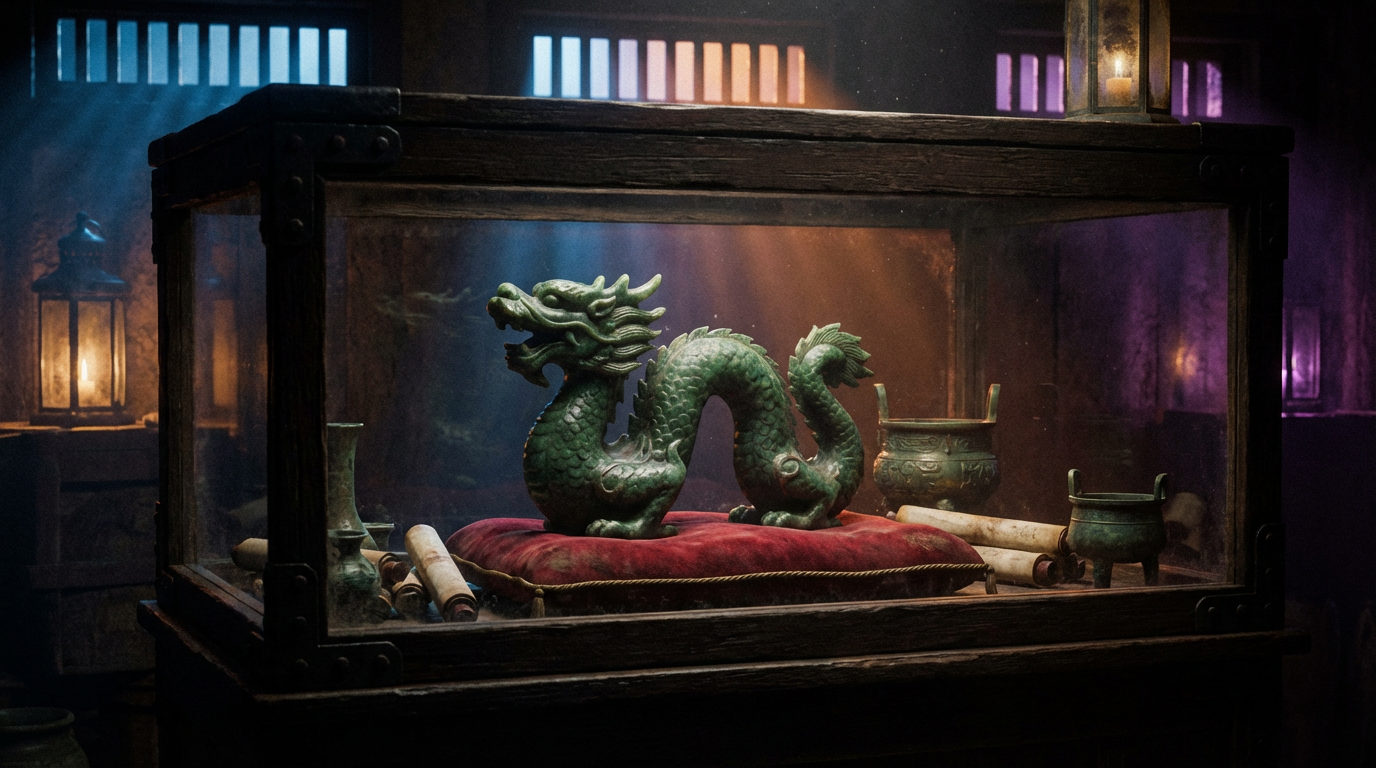
A coiled dragon carved from a single piece of Hotan nephrite jade by the imperial jade master Chen Zhonghe at the Southern Song court in Hangzhou on the 9th of September 1174. Commissioned by Emperor Xiaozong to commemorate the Mid-Autumn Festival, the figurine displays the pinnacle of Song Dynasty jade-carving technique, with individual scales so finely rendered they appear to ripple when light moves across the surface.
Description
The figurine depicts a five-clawed dragon — the imperial dragon, reserved exclusively for objects associated with the emperor — coiled in a tight spiral with its head raised and jaws slightly parted. Carved from a single piece of Hotan nephrite of exceptional quality, the jade displays the prized "mutton fat" translucency — a warm, creamy white with the faintest green undertone — that was the most valued colour during the Southern Song period.
The piece measures approximately eighteen centimetres in height and twelve in diameter at its widest coil. The carving demonstrates the full range of Southern Song jade-working technique: the dragon's scales are individually rendered using the piercing and abrasion method, each one slightly concave and polished to a different finish than the surrounding surface, creating the optical illusion of movement when light shifts across the figurine. The eyes are carved in high relief, the whiskers extend in flowing lines that follow the natural grain of the stone, and the tail curls beneath the body in a complex interlocking pattern that required extraordinary precision to execute without fracturing the jade.
The underside of the base bears the imperial workshop seal and a four-character inscription identifying the piece as a Mid-Autumn Festival commission.
Historical Setting
The figurine was carved by the imperial jade master Chen Zhonghe at the court workshops in Lin'an (present-day Hangzhou), capital of the Southern Song Dynasty, completing the work on the 9th of September 1174 (the 11th year of the Chunxi reign era of Emperor Xiaozong). Chen Zhonghe was the foremost jade carver at the Southern Song court, holding the title of Imperial Jade Artisan First Rank — a position occupied by only one craftsman at any given time. He had served the court since 1161 and was renowned for his ability to exploit the natural qualities of nephrite to produce carvings of extraordinary delicacy.
The Hotan nephrite from which the dragon was carved originated in the jade quarries of the Kunlun Mountains in the Xinjiang region, transported overland via the Silk Road to the Song capital — a journey of several thousand kilometres that could take upwards of a year. Jade of this quality was exceedingly rare even by imperial standards, and the block from which the dragon was worked was selected personally by Chen Zhonghe from the court's reserves.
Emperor Xiaozong commissioned the piece to mark the Mid-Autumn Festival of 1174, a celebration of particular significance that year as it coincided with the fifteenth anniversary of his accession to the throne. The dragon was displayed in the imperial reception hall during the festival ceremonies before being placed in the emperor's private collection.
Provenance
Following the fall of the Southern Song Dynasty to the Mongol invasion in 1279, the imperial collections were dispersed. The jade dragon was among objects seized during the sack of Hangzhou and entered the collection of the Yuan Dynasty court in Dadu (present-day Beijing). It remained in imperial Chinese hands through the Ming Dynasty, passing through several private collections following the transition of power in 1368. By the mid-seventeenth century, it had left China — most likely through the maritime trade networks operating out of Macau and Canton — and surfaced in the inventory of a Dutch East India Company factor in Batavia (present-day Jakarta) in 1658.
The figurine subsequently passed through Dutch, Portuguese, and British trading hands across the following century and a half, appearing in a London auction catalogue in 1791 before being withdrawn from sale under circumstances that remain unclear. By 1818, it had been acquired by intermediaries connected to William Jeffries Sr.'s network in Van Diemen's Land, arriving at Jeffries Manor as payment for services rendered. It was among the first artefacts placed in the Blue Room.






