Jacob Daniel Thomas
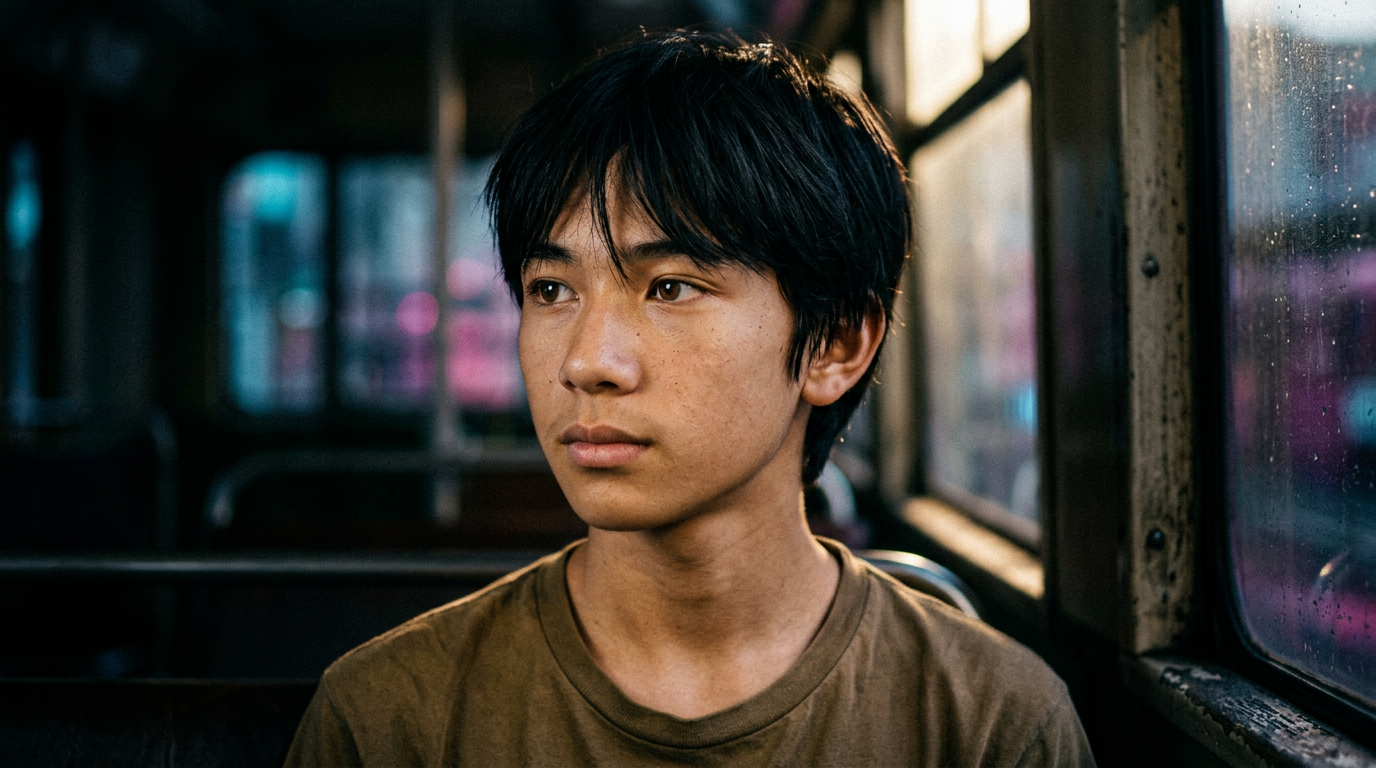
Jacob Daniel Thomas, born on 17 March 2010 in South Brisbane, was the second child of Daniel Thomas, a fly-in-fly-out mine electrician, and Rachel Thomas, a dental nurse of Vietnamese-Australian heritage. Raised in Gaythorne, Brisbane, he developed an unexplained passion for botany from early childhood, carrying a battered field guide as his constant companion. He was eight when the school bus passed through a Portal into Clivilius on 5 August 2018. His botanical knowledge, rebuilt from nothing in unfamiliar terrain, made him invaluable to the Verdant Nursery and Orchard of Abundance operations at Bixbus.
The Plant Book
Jacob Daniel Thomas was born on 17 March 2010 at the Mater Mothers' Hospital in South Brisbane, the second child of Daniel James Thomas, a fly-in-fly-out electrical technician who worked at a coal mine near Moranbah in Central Queensland, and Rachel Anne Thomas (née Hoang), a dental nurse at a practice in Windsor. His sister, Sophie Lin Thomas, had been born on 14 August 2007, and the three-year gap between them had been neither planned nor prevented — the product of Daniel's roster pattern and Rachel's pragmatic view that children arrived when they arrived and there was no point pretending otherwise.
The family lived in a weatherboard Queenslander on stilts in Gaythorne, in Brisbane's inner north-west, on a street where the jacarandas shed purple carpets across the footpath every October and the houses were close enough together that you could hear your neighbour's television through the louvres. Daniel had bought it before the wedding, in 2006, when a mine electrician's salary still stretched to a three-bedroom house within ten kilometres of the city. Rachel had painted the kitchen yellow and planted a frangipani in the front yard, and these were the only renovations that had been completed in the years since, because Daniel's fortnightly absences made sustained domestic projects a theoretical exercise.
Daniel worked a pattern that the mining industry called two-and-one — two weeks on site, one week home — and the rhythm of his presence and absence defined the household more than any other single fact about it. When he was home, he was fully home: cooking Vietnamese-inspired dishes Rachel's mother had taught him, driving Sophie to gymnastics, taking Jacob to the hardware store where the boy showed no interest in hardware and considerable interest in the garden section. When he was away, he existed as a voice on the phone at six-thirty each evening and a bedroom that smelled faintly of coal dust and aftershave, and the house recalibrated around his absence with the practised efficiency of a family that had done it a hundred times.
Rachel managed this with less resentment than her mother thought appropriate. She had grown up in Darra, the youngest of three children of Minh Hoang, a Vietnamese refugee who had arrived in Australia in 1982 and spent thirty years running a small grocery in Inala, and Lan Hoang (née Tran), who worked beside him in the shop and raised three children in a flat above it. Rachel's older brothers, David and Andrew, had both become accountants — a source of considerable satisfaction to Minh and Lan, who had crossed an ocean so their children could sit at desks instead of behind counters. Rachel's decision to become a dental nurse rather than a dentist had been a minor disappointment absorbed with good grace, and her marriage to Daniel, who was not Vietnamese, had been a larger one absorbed with slightly less.
Sophie was a practical, self-directed child who took after her mother in temperament and her father in colouring — dark hair, brown eyes, a face that could shift from laughter to withering assessment in a fraction of a second. At eleven, she ran the household during Daniel's absences with an authority that Rachel tolerated because it was useful and Sophie exercised because she enjoyed it. She organised the morning routine, supervised Jacob's homework with a rigour that exceeded his teachers' expectations, and maintained a mental calendar of which bills were due and which permission forms needed signing that would have impressed a project manager.
Jacob was not like Sophie. Jacob was not, in fact, like anyone in the family, and nobody could account for it.
He was quiet, watchful, and fascinated by plants in a way that had no obvious origin. Rachel did not garden. Daniel mowed the lawn when he was home and ignored it when he was not. Minh and Lan had spent their working lives surrounded by tinned goods and rice sacks, not seedlings. But Jacob, from the age of four, had been drawn to anything green and growing with an intensity that his parents found charming and inexplicable. He spent his afternoons in the back garden, crouching beside the frangipani Rachel had planted and examining the leaves with the focus of a jeweller assessing a diamond. He brought home seedpods from the footpath and lined them up on his windowsill. He asked questions about root systems that Rachel could not answer and Daniel, to his credit, looked up on his phone during night shifts at the mine.
The plant book arrived at a garage sale in Mitchelton when Jacob was five. Rachel had been browsing a trestle table of paperbacks when Jacob pulled a hardcover from a cardboard box on the ground — A Field Guide to Australian Native Plants, battered, with a cracked spine and water stains on the cover. He held it with both hands and did not put it down. Rachel paid two dollars for it and did not think about it again until she realised, weeks later, that Jacob had memorised the first thirty pages.
The book became his companion in a way that other children's toys or blankets were companions. He carried it to school. He carried it to his grandparents' flat in Darra. He carried it on walks and stopped every few metres to compare what he saw with what the book described, cross-referencing leaf shapes and bark textures with a patience that was remarkable in a five-year-old and became, by seven, a genuine competence. He could identify a Eucalyptus tereticornis from a Eucalyptus crebra at a distance. He knew which native plants were edible and which were not. He corrected an interpretive sign at the Brisbane Botanic Gardens with such polite certainty that the volunteer on duty did not know whether to be impressed or offended.
He entered Brisbane Grammar School in Year 3, in 2018. The school's science programme and its field excursions had been the draw — Daniel had heard about it from a colleague at the mine whose son attended, and the bursary scheme made the fees manageable, though Rachel noted that "manageable" and "comfortable" were not the same word and that the difference between them was the holiday they would not be taking that year. Jacob took to the school without fuss. He was not popular in the way that confident, physical children were popular, but he was liked — a quiet boy with straight black hair and brown eyes who knew the name of every plant on the school grounds and who would, if asked, explain the difference between a monocot and a dicot with an earnestness that his classmates found either endearing or baffling.
The Green Nothing
The overnight field trip to D'Aguilar National Park departed from Brisbane Grammar School on the morning of Saturday, 4 August 2018. For Jacob, the trip was the reason he had agreed to attend Grammar in the first place — not the classrooms, not the uniform, not the other boys, but the promise of a weekend in subtropical rainforest with a field guide in his backpack and nobody telling him to hurry up. He packed the plant book. He packed a magnifying glass Rachel had given him for his eighth birthday. He packed a small notebook and a pencil with a broken eraser, and he did not pack a change of socks, an omission Sophie discovered at the last moment and corrected with the exasperated efficiency of an older sister who had been correcting her brother's oversights since he was old enough to have them.
He sat near the front of the bus, the plant book open on his lap before they had cleared the school gates. At D'Aguilar, he was methodical where other children were exuberant. He did not run ahead on the guided walk. He moved slowly, stopping at every unfamiliar species, crouching to examine understorey plants that the other children stepped over without seeing. Susan Clarke, who was leading the nature walk, found herself answering Jacob's questions with increasing specificity as the afternoon progressed, because the questions were increasingly specific — not "what is that?" but "why is this growing here and not fifty metres back where the soil is different?" He filled four pages of his notebook with sketches and labels. He pressed a leaf of Doryphora sassafras between the pages of his plant book with the care of someone archiving something precious.
The bus departed D'Aguilar on the morning of 5 August for the return to Brisbane. Jacob was seated near the front, his plant book open, his notebook beside him.
The bus passed through a Portal opened across a road in the Brisbane suburbs and collided with vehicles on the far side, in the landscape of Clivilius. The impact threw Jacob forward into the seat back. He sprained his right wrist when he braced against the fall, and heavy bruising spread across his left side where his ribs struck the armrest. The plant book flew from his lap and landed in the aisle, its spine cracking further on impact, pages splayed open to an illustration of Banksia integrifolia that would be stained with someone else's blood by the time Jacob retrieved it.
He was not among the most seriously injured. His wrist swelled and throbbed and his left side bloomed purple over the days that followed, but he could walk, he could breathe without the sharp catch that signalled cracked ribs, and the shock that settled over him in the first hours was the kind that receded rather than deepened. He was eight years old, he was in pain, and he was quiet — but Jacob had always been quiet, and the adults triaging more urgent casualties did not immediately recognise the difference between his habitual stillness and the paralysis of a child trying to comprehend something incomprehensible.
The landscape of Clivilius was, for Jacob, a particular kind of devastation. It was not the sky, which was wrong in a way he registered without the words to articulate. It was the ground. The open terrain around the crash site was sparse, dry, and unfamiliar — nothing like the dense subtropical bush he had left behind at D'Aguilar, nothing like the garden in Gaythorne, nothing like anything in the plant book that was now tucked against his chest, its cracked spine held together by his good hand. He looked at the vegetation and did not recognise it. For a child who had built his entire sense of competence around knowing what things were, the not-knowing was a loss as immediate and as visceral as any physical injury.
What Grew
The wrist healed within four weeks. The bruising faded. The plant book survived, though its spine required repair with salvaged adhesive tape and its pages were no longer flat but buckled with the memory of impact. Jacob carried it for the first year in Bixbus the way other children carried comfort objects — not reading it, not consulting it, just having it close. Its contents were useless in Clivilius. Every entry described a plant that grew on the other side of a Portal that had closed behind them. But the book was the last object his mother had touched, the last artefact of a life in which he had known the names of things, and he could not let it go.
He attended the Learning Grove from its opening in late August 2018, a solemn eight-year-old with a strapped wrist and a battered hardcover he would not leave in the shelter. Jenny Triffett placed him in a group with children of similar ability — his reading was strong for his age, his numeracy adequate, his concentration exceptional when the subject held his interest and merely average when it did not. The afternoon practical sessions at partner sites across Bixbus gave him his first encounter with Clivilius plant life under conditions that were not defined by grief and disorientation. At the Verdant Nursery, where the settlement's earliest agricultural efforts were taking shape, Jacob crouched beside unfamiliar seedlings and began, with painful slowness, to learn new names.
It was not the same. The flora of Clivilius bore no relation to the Australian native species he had memorised, and the field guide that had been his map to the world was now a relic of a world that no longer applied. The process of building new knowledge from nothing — of looking at a plant and having no category for it, no Latin binomial, no entry in any book — was humiliating in a way that Jacob experienced as a physical sensation, a tightness behind his sternum that he could not explain to the adults around him because it sounded absurd: he was grieving his competence, and eight-year-olds did not have the vocabulary for that.
But he watched. He had always watched, and the habit reasserted itself over the weeks and months that followed. He watched what grew where. He watched which soils supported which plants. He watched which seedlings thrived in full sun and which required shade, and he began, in his notebook — now repurposed, the D'Aguilar sketches preserved in the front pages like pressed flowers — to record what he observed. The entries were meticulous, labelled with dates, locations, soil descriptions, and drawings that improved as his wrist healed and his confidence returned. Nobody asked him to do this. Nobody assigned it. He did it because observation was the only tool he had ever trusted, and it had not failed him yet.
The transition to Bixbus School in late 2019 formalised what the Learning Grove had begun. Jacob's mornings were spent in academic classes where his reading comprehension was among the strongest in his cohort and his mathematics was reliable without being exceptional. His afternoons, under the community mentorship programme, settled firmly at the Verdant Nursery and, increasingly, at the Orchard of Abundance, where the settlement's food production was becoming both larger and more systematic. He was ten when one of the nursery supervisors noticed that Jacob could predict, with surprising accuracy, which planting beds would produce strong yields and which would struggle, based on his observations of soil drainage and light exposure. The supervisor asked how he knew. Jacob showed him the notebook — two years of daily entries, cross-referenced by location, annotated with weather observations and growth rates.
The notebook was not science in any formal sense. Jacob had no training in botany, no understanding of plant physiology beyond what he could observe, and his methodology was intuitive rather than systematic. But the data it contained — accumulated through the sheer persistence of a child who could not stop watching things grow — was useful, and in a settlement where food production was not a hobby but a matter of survival, usefulness was the currency that earned respect.
By twelve, Jacob was a fixture at the nursery. By thirteen, he was involved in planning planting rotations for the Orchard of Abundance, cross-referencing his observations with the practical knowledge of the adults who managed the operation. He was not the strongest worker — he was lean and unmuscular, built for patience rather than labour — but his value lay in what he noticed. He could spot nutrient deficiency in a leaf before it yellowed. He could identify a drainage problem before it became a flood. He had developed, through years of attentive watching, an understanding of Clivilius plant life that was empirical and detailed and entirely self-taught, and the adults who worked alongside him had learned to take his observations seriously even when they could not always explain them.
His social life was shaped by the same qualities that defined his work. He was quiet, patient, and capable of long silences that some people found restful and others found unnerving. He had a small group of friends — children who shared his practical orientation or who were comfortable with someone whose idea of an exciting afternoon involved monitoring germination rates in a planting bed. He was not awkward, exactly, but he operated at a different tempo from most teenagers, and the gap between his pace and theirs produced misunderstandings he did not always notice and could not always repair. He said things that were true and specific and sometimes unwelcome — pointing out that a planting plan would fail, or that a soil composition was unsuitable, with the same matter-of-fact tone regardless of whether the person he was correcting was a peer or an adult three times his age.
He did not intend offence. He did not always understand that it had been taken.
His relationship with his father's absence was the thing about Jacob that nobody discussed and everybody sensed. He had spent his first eight years in a household defined by a rhythm of presence and disappearance — Daniel there, Daniel gone, Daniel there again — and the pattern had taught him something that the other children on the bus had not learned: that people you loved could vanish for weeks at a time and that the appropriate response was to continue as normal and wait. When the bus went through the Portal and the adults did not come to collect them, Jacob's body knew how to respond. He settled in. He waited. He did not cry in the first weeks, and the adults who cared for the children interpreted his composure as resilience, which it partly was, and as detachment, which it was not.
The truth was that Jacob had been waiting for his father to come home for as long as he could remember, and the waiting in Clivilius felt, in its rhythms if not its scale, like a version of the same thing. The difference — that Daniel's absences had always had return dates and this one did not — was a fact Jacob understood intellectually and refused emotionally, and the refusal calcified over the years into something that looked, from the outside, like acceptance but was, on the inside, an ongoing negotiation with a hope he could neither justify nor abandon.
He missed his mother most. He missed her in specific, sensory fragments: the smell of jasmine rice from the kitchen, the sound of Vietnamese she spoke with Minh and Lan on the phone, the way she tucked the blanket under his chin with one practised hand. He missed Sophie's brisk authority. He missed the flat in Darra where his grandparents lived, the grocery shop smell of cardboard and dried noodles, and the particular tenderness with which Lan handled fresh herbs — as though they deserved gentleness, as though growing things were owed a debt of care. Jacob had inherited that tenderness. He expressed it with the plants at the nursery, his hands moving among the seedlings with the same unhurried attention his grandmother had given to coriander and Thai basil in a shop eight thousand dimensions away.
He was fifteen, approaching sixteen, and he lived in the shared quarters at Bixbus with the contained self-sufficiency of a boy who had always known how to wait. His mornings were spent at Bixbus School, where his academic work was strong in the sciences and adequate elsewhere. His afternoons were spent at the nursery and the orchard, his notebook — now the fourth in a series, the originals stored beneath his bed like a botanical archive — open on whatever surface was nearest, his pencil moving with the practised hand of someone who had been recording the natural world since he was five years old and a battered field guide had taught him that knowing the names of things was the first step toward understanding them.
The plant book sat on a shelf beside his bed. He had not opened it in years. Its pages described a flora that did not exist in Clivilius and a life that did not exist any more, and Jacob, who understood better than most the difference between what could grow in a given soil and what could not, had let it rest. But he had not thrown it away. He would not throw it away. It was the first book he had loved, and it had taught him to look at the world with attention, and everything he had built since — the notebooks, the knowledge, the quiet competence that the nursery supervisors relied on without fully understanding where it came from — grew from that root.







