Isabelle Brooklyn Thompson (née Longey)
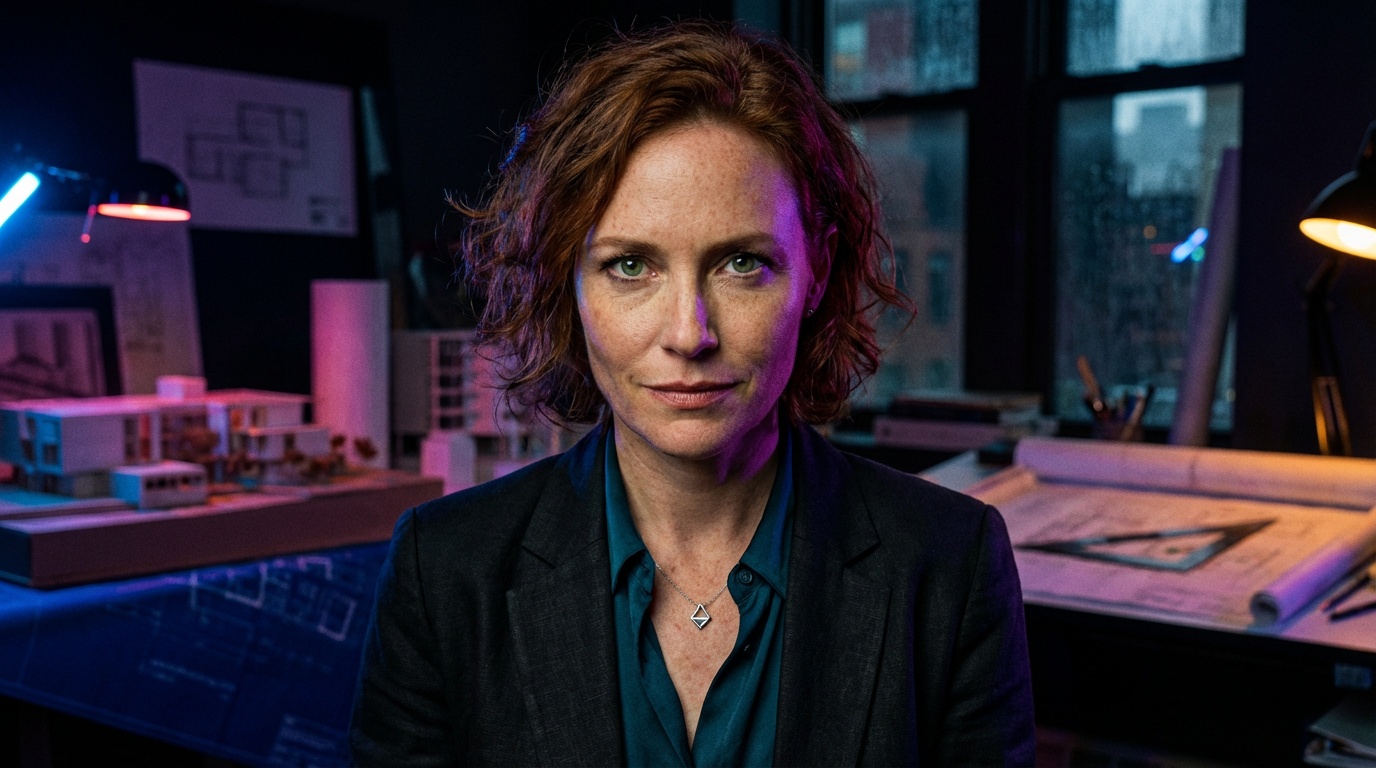
Isabelle Brooklyn Longey was born 19 August 1983 in Melbourne, Victoria, into a family where architecture and environmental activism merged seamlessly. Growing up surrounded by her father Robert's sustainable designs and her mother Emily's artistic environmental campaigns, Isabelle developed a distinctive architectural philosophy that would later flourish at Pafistis Construction Co. Following Adrian Pafistis's mysterious disappearance in 2018, she assumed co-leadership with Nathaniel Grant, ensuring the company's continued excellence whilst navigating the complex challenges of building without its visionary founder.
Born into Creative Conscience
Isabelle Brooklyn Longey entered the world on 19 August 1983 at the Royal Women's Hospital in Melbourne, Victoria, the only child of Robert Michael Longey and Emily Jane Longey (née Smith). Her birth represented the convergence of two passionate vocations—her father's architectural practice dedicated to sustainable design, and her mother's artistic environmental activism. The name Brooklyn, chosen by her mother, reflected Emily's affection for New York's artistic bohemian culture, a name that suggested creative nonconformity even as it graced a child who would grow up in Melbourne's more conservative professional circles.
The Longey household, located in a renovated Edwardian terrace in Carlton North, was itself a demonstration of Robert's architectural philosophy. The home featured passive solar design decades before such concepts became mainstream, with carefully positioned windows maximising natural light whilst minimising heat gain, a rooftop water collection system that irrigated Emily's extensive native garden, and interior spaces that blurred boundaries between inside and outside through glass walls and connecting courtyards. For Isabelle, this wasn't merely a house but a three-dimensional textbook in how buildings could serve both human needs and environmental imperatives.
Robert Longey, born in 1952, had established his architectural practice in the late 1970s, pioneering sustainable design approaches when such work was considered eccentric rather than prescient. He was a quiet, methodical man whose passion for environmental responsibility found expression through careful material choices, energy-efficient systems, and buildings that sat lightly on their sites. His practice, Longey Associates, specialised in residential projects for clients who valued environmental performance as much as aesthetic appeal—academics, artists, environmental professionals who could articulate why they wanted buildings that honoured rather than exploited natural systems.
Emily Smith, born in 1955, was an artist and environmental activist whose work combined visual art with political engagement. Her installations—often using found objects and recycled materials—appeared in Melbourne galleries and outdoor public spaces, offering pointed commentary on consumer culture and environmental degradation. She was also deeply involved in local environmental campaigns, organising community opposition to inappropriate developments, advocating for green space preservation, leading tree-planting initiatives that transformed neglected urban areas. Emily's activism wasn't merely abstract principle but lived practice, visible in her refusal to own a car, her commitment to vegetarianism, her insistence on buying second-hand rather than new.
Growing up as the only child of these committed professionals meant Isabelle's childhood was both privileged and unusual. Weekends weren't spent at shopping centres or theme parks but at art gallery openings, architectural tours, community environmental projects. Family holidays meant camping in national parks rather than resort stays, with Robert pointing out geological formations and discussing how indigenous architecture adapted to local conditions, whilst Emily sketched and painted the landscapes they traversed.
The Carlton North terrace was always filled with visitors—architects, artists, environmental activists, academics—creating atmosphere of intellectual engagement and political consciousness that shaped Isabelle's worldview from earliest age. Dinner conversations ranged from critiques of Melbourne's development policies to discussions of particular artists' work to debates about the most effective strategies for environmental advocacy. Isabelle learned early that adults could be deeply engaged with ideas, that work could be about more than money, that one's professional life could serve values beyond personal advancement.
Education and the Formation of Architectural Vision
Isabelle's formal education began at Carlton North Primary School, a state school serving Melbourne's inner north, where she displayed early aptitude for both visual arts and mathematics—the dual capacities that would later serve her architectural career. Teachers noted her unusual ability to visualise spatial relationships, to understand how two-dimensional drawings represented three-dimensional forms, to grasp geometric principles intuitively whilst also possessing strong analytical skills.
In 1999, Isabelle began secondary education at Melbourne Central Girls' Grammar, an independent school with strong academic reputation and emphasis on developing confident, intellectually engaged young women. The decision to send Isabelle to private school represented tension between Robert and Emily's progressive values and their desire to provide their daughter with educational advantages. They resolved this tension by viewing the school as investment in Isabelle's future capacity to influence systems from within, though the contradiction between their anti-establishment politics and private school privilege was never entirely comfortable.
At Melbourne Girls' Grammar, Isabelle excelled in art, environmental science, and mathematics—subjects that would form the foundation of her architectural education. She was particularly drawn to her final-year art teacher, Ms Caroline Hitchens, whose own background in industrial design helped Isabelle understand that creativity could be applied to functional objects, that aesthetic decisions carried ethical implications, that design was never merely about appearance but always about values made material.
Her environmental science coursework, taught by Dr Patricia Romano, a passionate advocate for climate action, deepened Isabelle's understanding of how human activities—particularly building and development—contributed to environmental degradation. She completed a major project examining the environmental impact of Melbourne's suburban sprawl, researching how low-density development patterns increased car dependence, destroyed native habitats, and created inefficient infrastructure demands. The project won the school's Environmental Studies Award and was displayed at a local environmental conference, giving seventeen-year-old Isabelle her first taste of public intellectual engagement.
Despite her academic strengths, Isabelle's school years weren't without challenges. She sometimes felt torn between her family's progressive values and her peers' more conventional aspirations, uncomfortable with the casual materialism and social hierarchies that characterised private school culture. She was never part of the popular crowd, never the student who dominated social situations, instead occupying that middle ground of general respect without particular social prominence. Her friend group was small and selective, consisting primarily of other intellectually curious girls who shared interests in art, politics, or environmental issues.
In 2001, Isabelle enrolled at the University of Melbourne to study architecture, following her father into the profession though with determination to develop her own distinctive approach rather than simply replicating his practice. The five-year Bachelor of Architecture programme was demanding, combining intensive design studios with technical coursework in structures, materials, building systems, and construction methods. Isabelle thrived in this environment, appreciating the rigour and the way architecture required integration of aesthetic sensibility, technical competence, and problem-solving ability.
Her architectural education coincided with growing mainstream awareness of environmental issues and sustainable building practices. What had been her father's eccentric specialisation was becoming industry standard, with green building certifications, energy ratings, and environmental performance requirements increasingly shaping architectural discourse. Isabelle found herself well-positioned for this shift, bringing family knowledge about sustainable design that many classmates lacked, whilst also engaging with emerging technologies and approaches that went beyond her father's generation's methods.
Her final-year thesis, completed in 2006, examined "Adaptive Reuse and Material Circularity in Urban Residential Architecture," exploring how existing buildings could be transformed rather than demolished, how construction waste could become resource rather than disposal problem, how architecture could move from linear "take-make-waste" models toward circular systems that minimised environmental impact. The thesis earned high distinction and was commended by the university's architecture faculty as exemplary research combining theoretical sophistication with practical application. Several panels from her thesis exhibition were later featured in an environmental design conference in Sydney, bringing Isabelle recognition beyond university context.
Early Career and Professional Development
Following graduation in November 2006, Isabelle accepted a position as Junior Architect with Urban Elements Design, a Melbourne firm specialising in contemporary residential architecture with emphasis on environmental performance. The firm, led by founding partners Marcus Chen and Dr Fiona Burrell, had established reputation for innovative design that didn't sacrifice livability for environmental credentials, creating homes that were both beautiful and sustainable.
Her first years at Urban Elements (2007-2010) involved the typical progression of junior architectural roles—producing detailed drawings, coordinating with consultants, attending site meetings, learning the administrative and practical aspects of architectural practice that university education hadn't fully addressed. She worked on projects ranging from small residential additions to significant custom homes, gaining experience across various building types and client personalities.
In 2010, Isabelle was promoted to Design Associate, leading small teams on medium-scale residential projects primarily in Melbourne's inner suburbs and bayside areas. This period represented significant professional development, requiring her to manage client relationships, coordinate consultants, make design decisions within budget constraints, and translate conceptual visions into buildable realities. Her projects during this period were characterised by careful site analysis, thoughtful material palettes emphasising natural and recycled materials, and spatial strategies that maximised natural light and ventilation whilst maintaining privacy and comfort.
Yet by 2012, Isabelle felt growing restlessness with Urban Elements and Melbourne's architectural scene more broadly. The firm's projects, whilst competent and environmentally conscious, felt increasingly formulaic—serving clients whose primary concerns were property values and contemporary aesthetics rather than genuine environmental commitment. She was also experiencing the particular frustrations of being a young woman in male-dominated profession, dealing with contractors who automatically deferred to male colleagues, clients who questioned her authority, subtle patterns of exclusion from social networks where significant professional relationships developed.
When she encountered a posting for Lead Architect position at Pafistis Construction Co. in Hobart, Tasmania, Isabelle was immediately intrigued. The firm's work, which she researched extensively, represented exactly the kind of architectural practice she aspired toward—rigorous craftsmanship combined with genuine environmental commitment, projects that served clients whilst also contributing to broader community and environmental goals, a scale of operation that allowed personal involvement in every project rather than bureaucratic distance between designer and built reality.
Joining Pafistis: Finding Professional Home
Isabelle's interview with Adrian Pafistis in June 2012 represented meeting of kindred spirits—two architects whose commitment to sustainable design wasn't merely professional positioning but genuine conviction, who understood buildings as long-term environmental interventions rather than short-term financial investments, who believed architecture could and should serve purposes beyond client satisfaction and designer ego.
Adrian was immediately impressed by Isabelle's combination of technical competence, design sensibility, and environmental knowledge. Her portfolio demonstrated mature understanding of how buildings functioned as systems, how material choices cascaded through environmental impacts, how good design required integration of multiple competing demands rather than privileging any single consideration. More significantly, Adrian recognised in Isabelle someone who could help elevate Pafistis Construction Co.'s design ambitions, who possessed architectural sophistication that his own builder's training hadn't fully developed.
Isabelle accepted the position in July 2012 and relocated to Hobart, a move that represented both professional opportunity and personal adventure. At twenty-eight years old, she was leaving Melbourne's familiar landscape, her family, her established social networks, moving to smaller city where she knew no one, taking significant risk on firm she'd only learned about months earlier. Yet the opportunity to work directly with Adrian, to contribute meaningfully to every project rather than being minor contributor to large-firm productions, to live in Tasmania's distinctive environment—all these factors outweighed the risks.
Her first major project was Franklin Manor, the luxury multi-residential development in Sandy Bay that had commenced construction earlier in 2012. Isabelle's role involved refining the design during construction, addressing unexpected site conditions, coordinating with structural engineers and services consultants, and ensuring the building's environmental systems functioned as intended. The project became intensive education in how architectural intentions translated into built reality, how construction processes revealed design problems that drawings hadn't captured, how good buildings required constant attention and adjustment rather than simply following predetermined plans.
Franklin Manor's successful completion in December 2012 and its subsequent recognition through the Tasmanian Master Builders Award validated both Adrian's decision to hire Isabelle and her own choice to relocate. The project demonstrated that Pafistis Construction Co. could deliver sophisticated architecture that didn't compromise environmental performance, that the firm's commitment to sustainability could produce buildings clients genuinely wanted rather than merely tolerated for environmental credentials.
The Creative Partnership and Green Living Initiative
The years 2012-2018 represented the most professionally fulfilling period of Isabelle's career. Working alongside Adrian Pafistis and, from 2014, project manager Nathaniel Grant, she was part of collaborative leadership team that combined complementary skills and shared values. Adrian provided vision and technical mastery rooted in decades of building experience, Nathaniel ensured practical execution and financial discipline, and Isabelle contributed architectural innovation and design refinement.
The Aurora Business Centre (2016) marked significant expansion of the firm's capabilities and Isabelle's own professional development. The four-storey commercial building required navigating complex commercial building codes, coordinating multiple building systems, creating flexible spaces that could accommodate diverse tenant needs, and achieving environmental performance standards in building typology—commercial office—that typically prioritised cost minimisation over environmental responsibility. Isabelle's design balanced these competing demands through strategies like modular planning that allowed tenant customisation without compromising building efficiency, rooftop gardens that provided amenity whilst managing stormwater, and building systems that monitored and optimised energy use in response to actual occupancy patterns.
In 2017, Isabelle and Adrian formalised their long-standing commitment to sustainable design through launching the Green Living Initiative, comprehensive programme that standardised environmental practices across all Pafistis projects. The initiative represented translation of their shared values into operational procedures, ensuring that sustainability wasn't dependent on individual designer's interests but was embedded in firm's fundamental practices. Isabelle played central role in developing GLI's material circularity standards, establishing relationships with suppliers of recycled and reclaimed materials, and creating documentation systems that tracked environmental performance of completed buildings.
Yet this period wasn't without professional tensions and personal challenges. Isabelle occasionally clashed with Nathaniel over design decisions that complicated construction sequences or exceeded budgets, her architectural ambitions sometimes conflicting with his pragmatic instincts about what was buildable within constraints. She also struggled with being only woman in firm's leadership, dealing with subtle gender dynamics in interactions with male-dominated subcontractor networks, and navigating client assumptions about her authority that her male colleagues didn't face.
Her personal life during these years was somewhat limited, the demands of establishing herself professionally leaving little energy for developing deep friendships or romantic relationships in still-unfamiliar city. She dated occasionally but never seriously, her work absorbing most of her attention and passion. Her closest friendships were with colleagues—particularly Adrian and his wife Sharon, who welcomed Isabelle into their social circle and helped her feel less isolated in Tasmania.
Crisis and Transformation: Leading Through Loss
Adrian Pafistis's disappearance in July 2018 shattered the professional and personal world Isabelle had built over six years. The man who had hired her, mentored her, collaborated with her on every significant project, whose judgment had guided firm's direction—was suddenly gone without explanation or warning. The loss was simultaneously professional catastrophe and personal grief, complicated by circumstances that defied comprehension and offered no possibility of closure.
Isabelle's response to this crisis revealed both her strengths and her struggles. Alongside Nathaniel Grant, she immediately focused on maintaining operational continuity, ensuring current projects continued without disruption, communicating with clients to provide reassurance, managing staff who looked to leadership for guidance about firm's future. Her architectural decisions became more conservative during this period, choosing proven approaches over experimental ones, prioritising successful completion over innovation, understanding that the firm couldn't afford mistakes whilst navigating leadership transition.
Yet the emotional toll was significant and sustained. Isabelle had genuinely admired Adrian—his integrity, his commitment to craft, his ability to balance commercial success with environmental values, his mentorship that had elevated her own capabilities. His disappearance felt like abandonment even as she understood intellectually that he hadn't chosen to leave. She found herself alternating between determination to honour his legacy and resentment that he had left her responsible for sustaining vision that had been primarily his creation.
Her relationship with Nathaniel became more complex during this period. They shared leadership responsibilities whilst processing grief differently—Nathaniel focusing on systematic operations and avoiding emotional dimensions, Isabelle struggling with loss whilst trying to maintain creative direction. Their collaboration was functional but not warm, characterised by mutual respect and shared commitment to firm's survival rather than by genuine friendship or emotional connection.
Marriage and Personal Evolution
In November 2019, Isabelle married Marcus Thompson, a mechanical engineer she had met through project consultancy work in 2018. Marcus, three years her senior, provided emotional stability during a personally and professionally tumultuous period. Their relationship developed gradually, initially focused on project collaborations before evolving into romantic partnership. Marcus appreciated Isabelle's intelligence and dedication without feeling threatened by her professional success, whilst Isabelle valued his steady temperament and practical intelligence that complemented rather than competed with her own work.
The marriage, whilst solid and supportive, lacked the passionate intensity of some partnerships. Both were somewhat reserved emotionally, finding comfort in companionship and shared interests—particularly bushwalking, independent cinema, and quiet weekends in Tasmania's countryside—rather than in dramatic expressions of feeling. They maintained separate professional identities, Marcus continuing his engineering consultancy work, Isabelle fully absorbed in Pafistis Construction Co.'s operations. They discussed children occasionally but without urgency, both feeling that current circumstances—the demands of co-leading firm, the ongoing uncertainty about Adrian's fate—made parenthood impractical.
Major Projects and Evolving Identity
The Cascade Brewery Redevelopment (2021-2022) represented Isabelle's most significant post-Adrian project and her own emergence as architect of national standing. The heritage-sensitive transformation of Australia's oldest operating brewery into multifunctional civic and commercial space required navigating complex stakeholder relationships, balancing preservation requirements with contemporary needs, and creating architecture that honoured industrial history whilst serving current functions.
Isabelle's design approach emphasised what she termed "visible honesty"—exposing rather than concealing the building's structural and material reality, celebrating rather than apologising for industrial heritage, creating interventions that were clearly contemporary rather than attempting historical mimicry. The malting house museum featured custom displays made from Huon pine salvaged from the Derwent River, the event space preserved the bottling shed's skeletal steel framing whilst inserting acoustic systems and modern services, the boutique brewery incorporated original fermenting vats as functional bar elements.
The project's critical and popular success—earning the 2022 Tasmanian Award for Heritage Design from the Australian Institute of Architects and achieving Green Star 6 Certification—validated both Isabelle's architectural capabilities and the continuing viability of Pafistis Construction Co. without its founder. Reviews praised the design's sensitive balance between preservation and innovation, its environmental performance despite heritage constraints, and its contribution to Hobart's cultural infrastructure.







