Irons in the Fire
As Elspeth settles into the workroom and learns the delicate art of pressing silk, she discovers that Moira MacKenzie knows far more about her family's disgrace than she had hoped to hide. When a noblewoman's scandalous visit reveals the Emporium trades in secrets as readily as silk, Elspeth begins to suspect she has stepped into something far more dangerous than a dress shop.
"My father always said my curiosity would either make my fortune or see me hanged. After two hours in the Emporium, I was beginning to see his point."
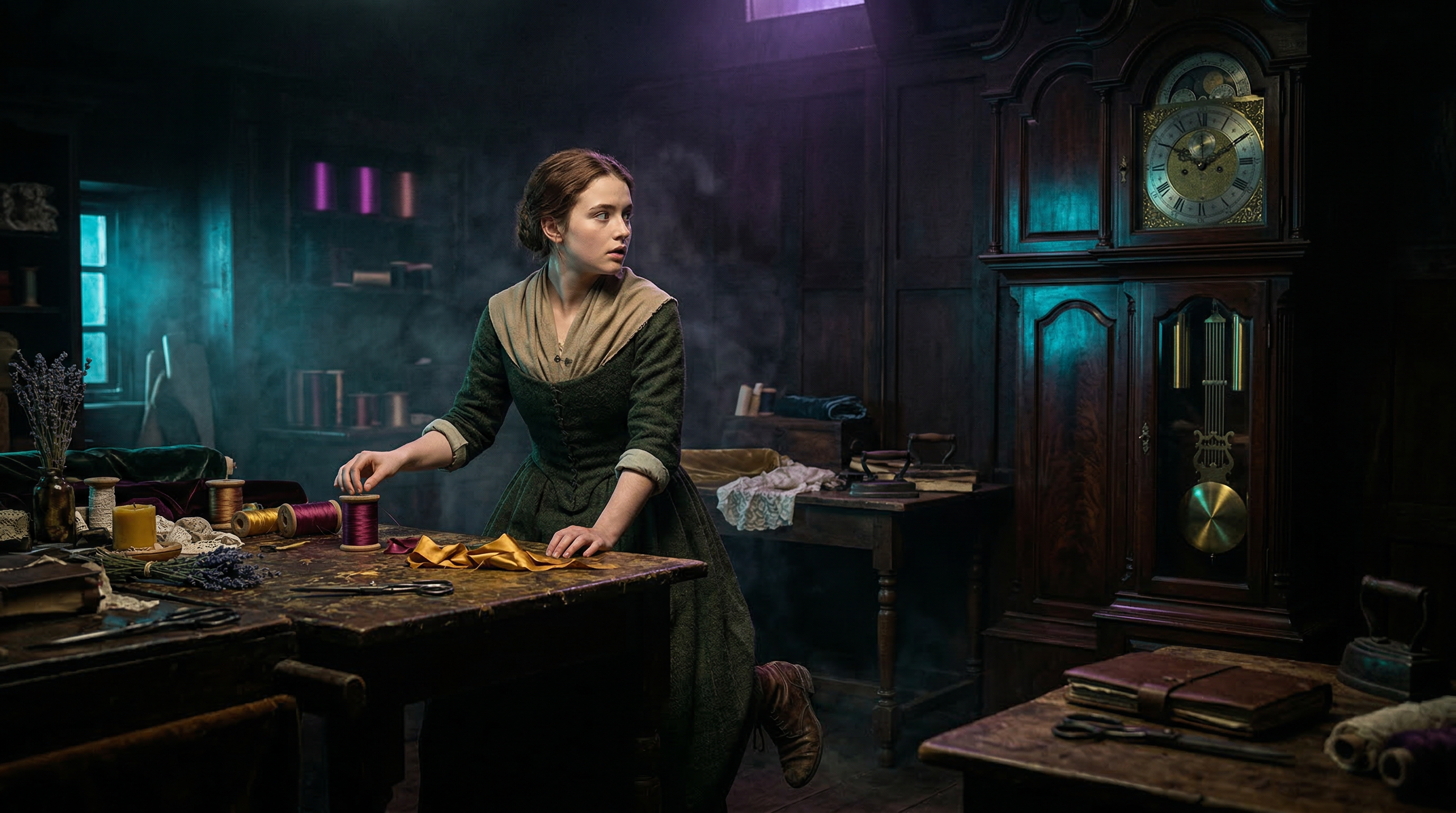
The grandfather clock in the corner of the workroom chimed the hour, and I started so violently that I nearly dropped the silk threads I had been sorting. The deep, sonorous tones reverberated through the hushed atmosphere, each resonant bong seeming to echo the rapid beating of my own heart. The timepiece itself was a magnificent thing—ornately carved mahogany, darkened with age to the colour of strong tea, its face bearing numerals of such intricate design they resembled tiny works of art rather than mere symbols. I wondered briefly how many secrets it had witnessed in its long vigil, how many whispered confidences had passed beneath its watchful gaze.
I glanced about, half-expecting to see Moira's piercing grey eyes fixed upon me, scrutinising my every move with that uncanny intensity that seemed capable of peering straight into one's very soul. But the proprietress was nowhere to be seen, having swept out of the workroom some time earlier with the same enigmatic air that seemed to cling to her like an invisible cloak. In her absence, the room seemed to breathe a collective sigh, as if the very air had been holding itself still under her exacting gaze.
"Pay it no mind, lass," came a voice from across the table. I looked up to find Martha peering at me over the rim of her spectacles, her needle paused mid-stitch. The older woman's face was creased with what might have been amusement, though it was difficult to tell beneath the severity of her expression. "That clock has startled many a new girl. Moira's grandfather brought it back from Amsterdam, or so the story goes. Been marking time in this room longer than any of us have been alive."
"It has a rather commanding presence," I admitted, feeling the heat rise to my cheeks at having been so obviously unsettled.
"Aye, that it does." Martha returned her attention to her work, but not before adding, "Everything in this place has a commanding presence, one way or another. You'll grow accustomed to it. Or you won't." The last words carried a weight that suggested the latter outcome would not be tolerated for long.
Taking a steadying breath that filled my lungs with the commingled scents of the workroom—beeswax used to smooth thread, lavender sprigs tucked between folded garments to keep moths at bay, and the faint metallic tang of scissors and needles—I turned my attention back to the task at hand. The second hour of my new position stretched before me, a span of time that felt both interminable and fleeting, like the strange distortion of moments in a dream.
After sorting through the silk threads, a task that had left my fingers tingling with the memory of their ethereal softness—each strand a different jewel-tone that seemed to capture light and transform it into pure colour—Agnes had instructed me to acquaint myself with the workroom whilst she attended to a matter in the front of the shop. I was determined to do so with the meticulousness that had become my hallmark in these trying times since my father's passing, a careful attention to detail that I had honed through necessity as I had taken on the mantle of responsibility for my family.
The workroom was a world unto itself, a sanctum of craft and creation that stood in stark contrast to the ostentatious display of the shop front. Here, the artifice fell away, revealing the bones of the operation, the skeleton upon which all that glamour and allure was built. It was here that dreams were given form, that the visions of Edinburgh's finest ladies were translated from whispered desires into tangible reality.
The large table that dominated the centre of the room was a battlefield of sorts, its surface a patchwork of scars and stains that told stories I could only imagine. I ran my fingers lightly over the table's edge, feeling the smoothness worn into the wood by years of use, the grain polished to a soft gleam by the brush of countless hands and forearms.
"That mark there," said Jane, nodding towards a dark stain near my hand without looking up from her work. Her fingers, I noticed, were stained with indigo dye that had worked its way into the very whorls of her fingerprints. "That's from Lady Carmichael's daughter's wedding trousseau. Three years past, now. Ink spilled during a late-night rush—we worked until dawn for a fortnight to have everything ready." She shook her head, a ghost of a smile playing about her lips. "The young lady wept when she saw the finished gown. Happy tears, mind. Said she'd never felt more beautiful in all her life."
"And those nicks?" I asked, pointing to a series of small gouges in the wood a little further along.
Jane's expression shifted, becoming more guarded. "Best not to ask about those, hen. Some stories are better left in the past where they belong."
I filed this away in my mind, another small mystery to add to the growing collection I had begun accumulating since crossing the Emporium's threshold. It seemed every surface, every object in this place held secrets, layers of history that revealed themselves only to those patient—or perhaps foolish—enough to seek them out.
Elizabeth, who had been humming softly to herself as she worked on what appeared to be a gentleman's waistcoat of dove-grey silk, suddenly broke off her tune. "You've sisters, haven't you?" she asked, her voice gentle as morning mist. "I thought I heard you mention them to Agnes earlier."
"Aye," I replied, surprised by the question. "Three of them. Effie, Katrina, and Violet."
"Pretty names," Elizabeth said, resuming her humming for a moment before adding, "I had sisters once. Two of them. The fever took them both in the winter of forty-nine." She said it matter-of-factly, without self-pity, her needle never faltering in its steady rhythm. "Cherish them whilst you can, lass. Time has a way of slipping through our fingers like these threads we work with—beautiful and strong, but so easily lost if we're not careful."
The words struck me, though Elizabeth had not intended them unkindly. I thought of my sisters, their faces appearing in my mind's eye with such clarity it was almost painful. What would Effie make of such finery as surrounded me now? The thirteen-year-old had always had an eye for beauty, even in our reduced circumstances, finding elegance in the simplest things—a wildflower tucked behind her ear, a ribbon salvaged from an old bonnet and repurposed to adorn her fiery curls. I could almost hear her excited chatter, could almost see her running her hands over the sumptuous fabrics with wide-eyed wonder.
And Katrina, with her practical nature and sharp wit, would likely scoff at the extravagance whilst secretly longing to wrap herself in the luxury of it all. She would calculate the cost of each bolt, her quick mind working out how many mouths could be fed with the price of a single yard of the finest silk, yet her eyes would betray her appreciation for the craftsmanship. I smiled to myself, imagining her attempts to maintain her air of aloof disdain even as her fingers itched to touch the fine materials.
Little Violet, bless her innocent heart, would probably be more interested in building a fort from the bolts than in the garments they could create, turning the workroom into a playground for her boundless imagination. She would ask a thousand questions—"What's this fabric called? Where does it come from? Why is it so soft? Can I keep this ribbon? What does this button do?"—until someone, laughing, would have to gently shoo her away from the more delicate materials.
The thought of my youngest sister, with her gap-toothed grin and irrepressible spirit, brought a sudden lump to my throat. Despite being only nine when our father died, Violet had been his special darling, and sometimes I feared the child's memories of him would already be fading, blurring around the edges like watercolours left too long in the rain, leaving only stories and the portrait that hung in our parlour to remind her of the man who had bounced her on his knee and called her his "wee blossom."
I swallowed hard, pushing down the homesickness that threatened to overwhelm me. There was no time for such sentimentality, no space for the luxury of such emotions. I had a job to do, a future to secure for myself and my loved ones. The weight of responsibility settled over me like a mantle, heavy but not unwelcome. It was a reminder of why I was here, of the stakes that rode on my success, of the hungry mouths and hopeful eyes that awaited my return home each evening.
With renewed determination that straightened my spine, I turned my attention to examining the tools of my new trade. They were arranged along one wall—scissors of various sizes, their blades glinting in the soft light like silent sentinels, each pair designed for a specific purpose; needles so fine they seemed to disappear when held at certain angles; thimbles of silver and brass, some bearing the worn imprints of fingers long gone. Each implement was within easy reach, the arrangement speaking to years of refinement and efficiency.
My gaze was drawn to a particularly ornate pair of scissors, set apart from the others on a small velvet cushion as though they were crown jewels rather than mere tools. Their handles were inlaid with mother-of-pearl that caught the light and threw it back in iridescent flashes, like rainbows trapped within the surface. The blades looked wickedly sharp, the junction where they met fitted with such precision that not even a single thread could pass between them when closed.
I felt a strange compulsion to touch them, to test their edge against my skin, to feel the cold metal that had cut fabric for perhaps generations. There was something almost magical about them, an aura of significance that transcended their function as mere implements. Without quite meaning to, I found my hand reaching towards them, my fingers stretching out as if drawn by some invisible force—
"I wouldn't if I were you, lass."
I whirled around, my heart leaping into my throat with such force I half-expected it to emerge from my mouth. Agnes Fraser stood in the doorway, having returned from her errand without my noticing, her arms crossed over her chest in a gesture that managed to be both protective and faintly threatening. Her expression was stern, the lines around her mouth deepened by disapproval, but there was a glimmer of something—warning? understanding?—in her honey-coloured eyes that prevented me from shrivelling entirely under her gaze.
"Those scissors," Agnes continued, stepping into the room with a grace that belied her years, her skirts swishing against the floorboards like the softest of whispers, "belonged to Moira's grandmother. They're said to be enchanted—able to cut through any fabric without ever dulling, to find the perfect line as if guided by an invisible hand." She paused, and when she spoke again, her voice had dropped to something barely above a murmur. "Moira's rather protective of them. The last girl who touched them without permission..." She let the sentence trail off, but her meaning was clear enough.
I snatched my hand back as if the scissors had suddenly burst into flame, my cheeks flushing with embarrassment until I felt they must be the same shade as the bolt of crimson silk that lay nearby. "I... I'm sorry," I stammered, cursing my own curiosity. "I didn't mean to—"
Agnes waved away my apology, her weathered hand moving through the air like a bird taking flight. "No harm done, lass. But it's best you learn quickly: everything in this place has a history, and some of those histories are best left undisturbed." Her voice dropped further still, and her eyes darted briefly to the doorway, checking for shadows or movement that might betray a listener. "The Emporium holds many secrets, Elspeth Stewart. Not all of them are stitched into the garments that leave through its doors."
There was something in Agnes's tone that made my skin prickle, tiny bumps rising along my arms despite the warmth of the room. "What manner of secrets?" I asked before I could stop myself.
Agnes studied me for a long moment, her gaze appraising, weighing something I could not quite fathom. The other seamstresses had gone very still, their needles paused, their eyes carefully fixed upon their work in a way that suggested they were listening intently to every word.
"You're a clever one," Agnes said finally. "I could see it the moment you walked in—the way you watch, the way you listen. Moira saw it too, I'd wager. It's why she hired you, despite..." She gestured vaguely at my worn dress, my patched shoes, the visible evidence of my family's reduced circumstances.
"Despite what?" I asked, lifting my chin slightly.
"Despite you having no formal training, no references from any establishment of note, and a father who died leaving debts that nearly swallowed your family whole." Agnes said the words without cruelty, merely stating facts as one might observe that it was raining or that Tuesday followed Monday. "Oh, aye, Moira knows all about the Stewarts of Canongate. She makes it her business to know everything about everyone who passes through these doors—whether they come seeking employment or seeking a new gown for the season's first ball."
I felt the blood drain from my face even as my cheeks burned with shame. I had hoped—foolishly, it now seemed—that my family's disgrace might not have reached the ears of Edinburgh's fashionable set. But of course Moira MacKenzie would know. Of course she would have investigated the background of any potential employee. I suddenly felt exposed, vulnerable, as if all the careful armour I had constructed around myself had been stripped away with a few casually spoken words.
"Then why—" I began, but Agnes held up a hand.
"Why did she hire you anyway?" The older woman's expression softened almost imperceptibly. "Because she saw something in you, lass. The same thing I see. Determination. Intelligence. A willingness to do whatever it takes to protect those you love." She stepped closer, lowering her voice so that only I could hear. "Those are valuable qualities in this place. More valuable than you yet know."
Before I could press further, before I could formulate the dozen questions that rose to my lips, the velvet curtain at the entrance to the workroom was swept aside. A young woman I did not recognise hurried in, her face flushed, her cap slightly askew.
"Agnes," she said breathlessly, "Mistress MacKenzie requires you in the fitting room. Lady Drummond has arrived for her appointment, and she's brought... a guest." There was something in the way she said the word "guest" that suggested this was no ordinary social call.
Agnes's expression shifted, becoming businesslike and brisk. "Right then. Martha, you're in charge until I return. Elspeth—" She fixed me with a look that brooked no argument. "—you'll press fabric. Jane will show you how it's properly done. And for heaven's sake, keep away from those scissors."
With that, she was gone, the curtain swishing closed behind her with a finality that left me standing amidst the quiet industry of the workroom, my mind churning with questions that had no answers.
Jane rose from her seat and crossed to where I stood, still somewhat dazed from my exchange with Agnes. "Come then," she said, not unkindly. "The pressing table's over here, and there's a mountain of silk that won't smooth itself."
She led me to a smaller table set against the far wall, upon which sat two heavy irons and a stack of fabric in various states of disarray. A small brazier glowed nearby, keeping the irons at the ready. Jane selected one, testing its heat with a practiced gesture—a quick lick of her finger touched to the metal surface, withdrawn almost before contact was made.
"Not too hot, not too cold," she explained, handing me the iron. It was heavier than I had expected, the weight of it pulling at muscles in my arm that were unused to such labour. "Too hot and you'll scorch the fabric, leave marks that can never be removed. Too cold and you'll waste your time and energy with no result. Finding the balance—that's the trick of it."
"How do you know when it's right?" I asked.
"Experience, mostly. And instinct." Jane smiled, revealing a gap where one of her front teeth should have been. "You'll develop both, given time. For now, watch me."
She took back the iron and demonstrated the proper technique—long, smooth strokes that followed the grain of the fabric, never lingering too long in one place, applying just enough pressure to coax out the wrinkles without crushing the delicate fibres beneath. As she worked, the emerald silk transformed from a rumpled mass into a smooth expanse of pure colour, shimmering like sunlight on leaves after a spring rain.
"Your turn," she said, handing me a length of sapphire-blue damask. "Start with this. It's more forgiving than silk—the weave is tighter, less prone to scorching. If you make a mistake, it won't be a disaster."
I took the fabric reverently, acutely aware of its value. This single length of damask likely cost more than my family's monthly rent. My hands trembled slightly as I positioned it on the pressing table, but I steadied them through sheer force of will. I could not afford to fail. Not at this. Not at anything.
The iron was warm and solid in my grip as I began my first stroke. The fabric resisted at first, its wrinkles stubborn, but gradually it began to yield, smoothing out beneath the pressure like water calming after a stone has been cast into it. There was something meditative about the work, something soothing in the repetitive motion and the gradual transformation of chaos into order.
"You've a natural touch," Jane observed, watching me with an appraising eye. "Some girls come in here all heavy-handed, try to force the fabric into submission. But you understand—the fabric has to want to lie flat. You have to convince it, gentle-like."
"My mother taught me," I said, not looking up from my work. "Before... before things changed. She always said that fabric was like people—treat it with respect and it will serve you well. Treat it roughly and it will fight you at every turn."
"Wise woman, your mother." Jane returned to her own seat, picking up the waistcoat she had been working on. "The same could be said of this place, you know. Respect its ways, its secrets, and it will be good to you. Try to fight against it, try to uncover what's meant to stay hidden..." She let the warning hang in the air, unfinished but unmistakable.
As I worked, my mind wandered to what Agnes had said. The Emporium holds many secrets. Not all of them are stitched into the garments that leave through its doors. What had she meant by that? And what was it about Lady Drummond's "guest" that had caused such a flurry of activity?
The shop was more than just a business; that much was becoming increasingly clear. It was a nexus of power and influence in Edinburgh society, a place where fortunes and reputations could be made or broken with the cut of a dress or the whisper of a word. Noblewomen and wealthy merchants' wives passed through its doors daily, seeking not just garments but the cachet that came with wearing a Moira MacKenzie original—and perhaps, I was beginning to suspect, seeking something else entirely. Something that had nothing to do with fashion at all.
The velvet curtain stirred, and I looked up to see a young woman slip into the workroom—the same one who had summoned Agnes. She was perhaps a year or two older than myself, with pale red hair escaping in wisps from beneath her cap and a smattering of freckles across her nose that gave her an almost elfin appearance.
"You're the new girl," she said, sliding into the empty chair beside me. "Elspeth, isn't it? I'm Fiona. I work mostly in the front, helping with customers, but I come back here when things are quiet." She glanced around, then leaned closer, her voice dropping to a conspiratorial whisper. "Or when things are interesting."
"Interesting?" I kept my voice carefully neutral, though my curiosity was thoroughly piqued.
Fiona's eyes sparkled with the particular gleam of someone who possessed information others wanted. "Lady Drummond's guest," she said, as if that explained everything. When I merely looked at her blankly, she tutted with impatience. "Honestly, do you pay no attention to society gossip? Lord Ashworth. He's come with her. They're pretending he's there to select fabric for a new riding coat, but—" She rolled her eyes expressively. "Everyone knows he's sweet on Lady Drummond, and her husband away in the Low Countries these past three months."
I thought of Moira's warning about discretion, about clients trusting the Emporium with their secrets. It seemed that trust was well-placed, at least in principle—though I wondered how many "secrets" were quite as poorly kept as this one appeared to be.
"Should you be telling me this?" I asked carefully.
Fiona laughed, a light, tinkling sound that seemed at odds with the hushed atmosphere of the workroom. "Oh, this is hardly a secret—half of Edinburgh knows about Lady Drummond and her admirers. The real secrets..." She shook her head, her expression becoming more guarded. "Those are another matter entirely. Those, we never speak of. Not to anyone. Not ever."
"Fiona." Martha's voice cut across the room, sharp with warning. "Don't you have duties to attend to?"
The young woman's face flushed, and she rose quickly from her seat. "I was just welcoming the new girl," she said, but she was already moving towards the curtain. "I'll... I'll go see if Agnes needs anything."
When Fiona had gone, the workroom settled back into its industrious quiet, but the silence felt different now—weighted, watchful. I bent my head over my pressing, but I could feel the eyes of the other women upon me, measuring, evaluating. Testing, perhaps, to see how I would handle what I had just heard.
I said nothing, asked no questions. I simply worked the iron over the damask in long, smooth strokes, letting the rhythm of the motion calm my racing thoughts. The fabric yielded beneath my hands, its wrinkles smoothing away as if they had never been.
The velvet curtain stirred again, and Agnes reappeared. Her expression was unreadable, but there was a tightness around her mouth that had not been there before.
"Lady Drummond requires additional measurements," she said, her tone brisk. "Martha, you'll assist me. The rest of you—" Her gaze swept the room, lingering on me for just a moment longer than the others. "Carry on as you are. And not a word of what you may have heard or seen today. To anyone."
She did not wait for acknowledgment. She simply turned and was gone, Martha hurrying after her.
The workroom felt smaller somehow in their absence, the air thicker. Elizabeth resumed her humming, but the tune was different now—slower, more melancholy. Jane's needle flashed in and out of the grey silk waistcoat without pause, her eyes fixed on her work with fierce concentration.
I reached for the next piece of fabric—a length of cream-coloured satin that slipped through my fingers like cool water—and positioned it on the pressing table. My hands were steady. My breath was even.
But beneath my breastbone, something had shifted. The Emporium was no longer merely a place of employment, a means to my family's survival. It was something else entirely—something I did not yet have a name for.
The grandfather clock chimed the half hour, its voice solemn as a church bell.
I pressed the iron to the satin and did not look up.







