Into The Underground
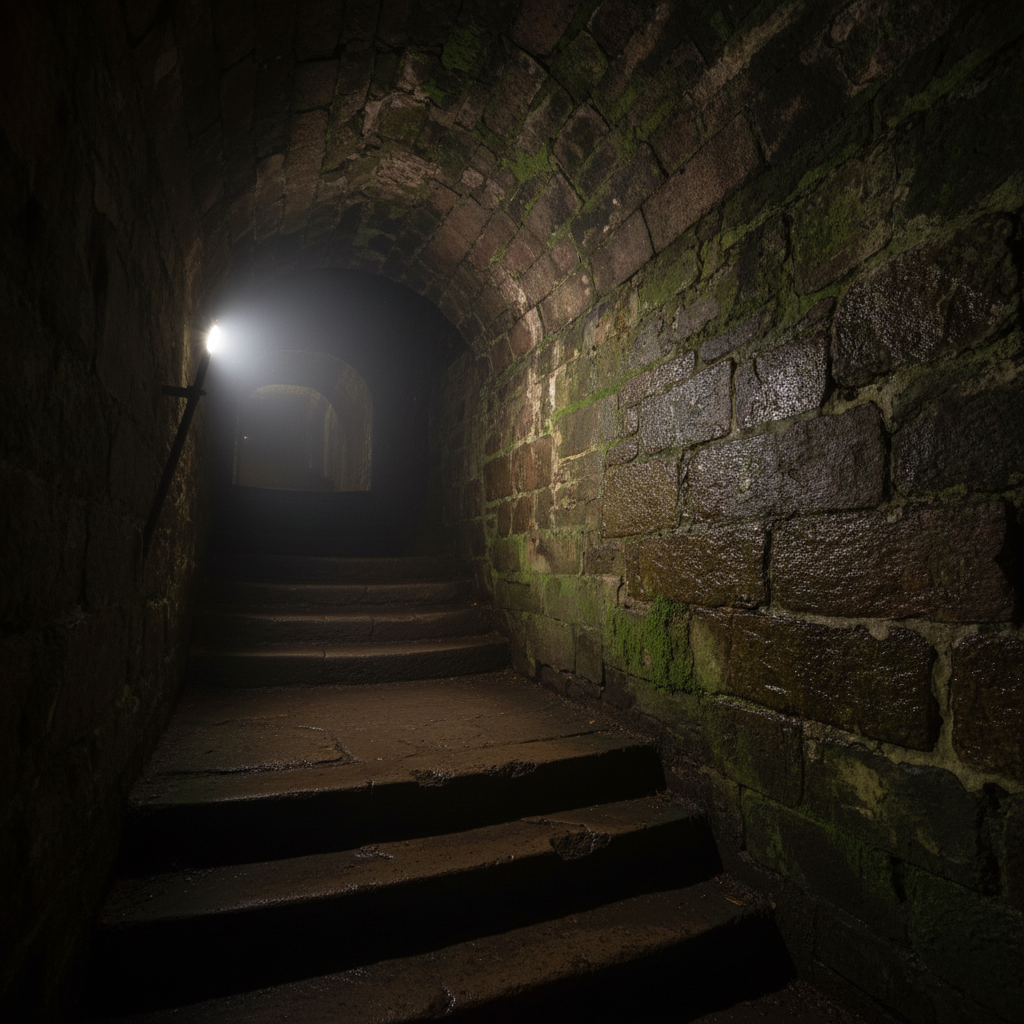
With their home burning above and danger closing in, the Campbells descend into the hidden passages beneath their estate. Shadows press close, torches cut narrow paths of light, and centuries of stone secrets swallow the sounds of the world above. As trust frays and questions multiply, the family must keep moving forward—deeper into the unknown, where survival and revelation intertwine.
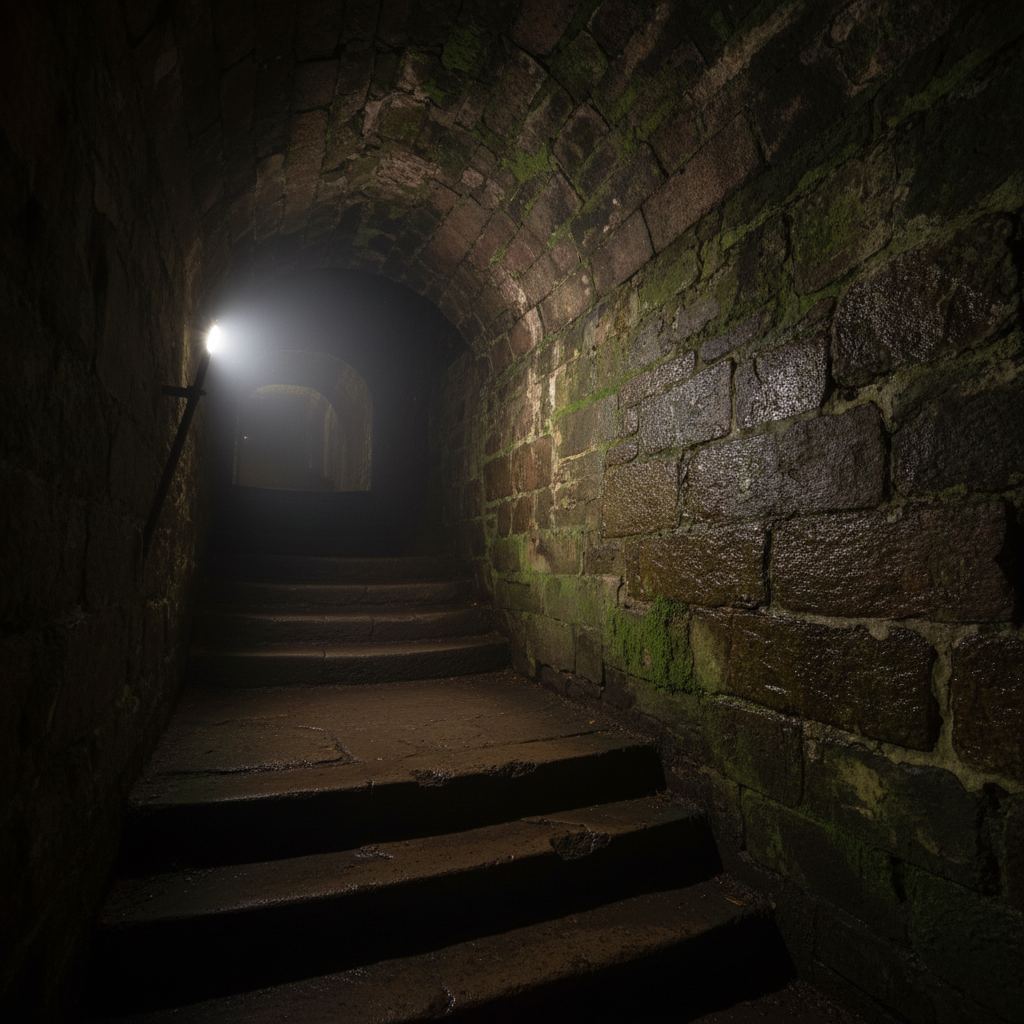
“Every step down here feels like we’re walking inside history’s lungs.” — Maeve Campbell
"Go," Nathan said, stepping back and motioning to the girls, his voice stripped of its usual café warmth and Australian lilt, replaced by something harder, urgent. The single syllable hung in the smoke-laden air like a command that couldn't be questioned. Sweat beaded on his forehead despite the cool night breeze, reflecting the fire’s glow in perfect, trembling droplets.
Isla moved first, practical as always. She shifted the wooden crate in her arms, then reached into her coat pocket with one hand, fingers closing around the slim torch she’d grabbed on instinct during their hurried flight. She clicked it on, and a narrow beam cut through the blackness, catching on the damp stone steps and the glistening moss that lined the walls.
Without a word, she stepped onto the first tread. The darkness below seemed to rise up to meet her, swallowing her lower half as she descended—person to silhouette to shadow in moments. The light from the torch bobbed with each careful step, a single thread of illumination stretching into the unknown.
She paused partway down the staircase and turned back, the torch beam catching her sisters in stark relief.
"Come on," she said—firm, steady, the same voice she used on school mornings when Rowan didn’t want to get out of bed, when Maeve got lost in daydreams and missed the bus. This time, it wasn’t a morning routine—it was survival. But the tone hadn’t changed.
Maeve followed, her silhouette briefly outlined against the growing glow of the fire before being consumed by shadow, the portfolio case clutched to her chest forming a geometric interruption to her human outline. The artist who always sought light and colour now stepped willingly into darkness, necessity overwhelming aesthetics.
Rowan hovered at the edge, her wide eyes fixed on the shadowy staircase that seemed to vanish into nothing. A digital native faced with the most analogue of solutions—no screens, no signal, just stone steps and silence. The stuffed bear tucked in her backpack suddenly felt like a flimsy shield, Mr. Whiskers’ protection good for nightmares and maths tests, not for whatever waited in the dark below.
Her mind betrayed her, dragging up ghost stories she’d half-laughed at during sleepovers and school trips—plague pits, hidden vaults, prisoners sealed behind bricks, spirits still pacing the floors beneath the Royal Mile. Now those stories didn’t feel so far-fetched. Now they had weight.
"What if they follow us?" she whispered, the words escaping before she could stop them, the question more child than teenager.
"They won’t," Nathan said firmly, though his body spoke a different truth—the slight crouch, the tension coiled in his limbs, the way his eyes kept flicking toward the garden and the distant pinpricks of headlights now moving through it. But his voice was steady, grounded in something deeper than guesswork. "Trust me."
Daniel placed a gentle hand on her shoulder blade, his calloused fingers grounding her like they had a hundred times before—when she was sick, when she was scared, when she needed to believe he’d handle whatever came next.
"Go on, Rowan. I’m right behind you."
His voice cut through the noise in her head, the panic and what-ifs, and for a moment she was just a daughter doing what her dad asked.
She nodded, throat tight, and stepped onto the first stair. Isla was only a few steps ahead, the torch in her hand casting fractured light up the stone walls—and catching Rowan’s face in fleeting silhouette before she, too, disappeared into the dark.
One by one, the girls began to descend into the darkness, their movements careful and hesitant on the ancient steps that felt almost alive beneath their feet—stone worn into subtle curves that guided their descent with the wisdom of centuries. The sound of their footfalls echoed softly in the confined space, accompanied by the quiet rustle of their bags and the occasional sharp intake of breath when a step proved less stable than expected, small sounds amplified by stone walls into a symphony of escape.
Cool, damp air enveloped them, carrying whispers of Edinburgh's history—of covenanters and royalists, of smugglers and merchants, of a city built upon layers of its own past. Each breath they took contained molecules that might once have been inhaled by figures from their school history books, a visceral connection to time that no museum could provide. The passage smelled of time itself, that particular combination of stone, earth, and moisture that signifies great age, a scent untouched by modern chemicals or artificial fresheners. Occasional droplets of water splashed onto their heads and shoulders, the city's countless underground streams finding their way through tiny fissures in the ceiling, following paths carved by centuries of persistent erosion.
Daniel waited until the last of them had disappeared into the gloom before helping Nathan push the heavy slab back into place with a grunt of exertion, muscles straining against centuries of gravity. The stone settled with a final, definitive thud, sealing them away from the world above where their home continued to burn, where strangers walked through their private spaces with calculated purpose. The sound reverberated through the narrow passage, a full stop at the end of one chapter of their lives, the period that separated before from after with startling finality.
As the opening closed, the chaos above was suddenly muffled and distant—the wail of sirens, the shouts of the raiders, and the crackling of fire all swallowed by the oppressive silence of the tunnels, creating an auditory vacuum that pressed against their eardrums with almost physical force. The transition was jarring, like stepping from one world into another, from noise to silence, from heat to cool, from open space to confinement. One moment surrounded by open air and distant stars, the next enclosed in ancient stone with nothing but darkness ahead and behind, a birth in reverse as they entered the stone womb of the city.
For a heartbeat, fear paralysed them all—primal, instinctive terror of the dark that predated civilisation and reason, that lived in the oldest parts of their brains where language held no sway. Breath became shallow, hearts accelerated, pupils dilated uselessly against nothingness, seeking light where none existed.
Nathan switched on a torch, its narrow beam cutting through the darkness like a blade, dividing the void into illuminated space and deeper shadow. The sudden light was almost painful after the near-complete blackness, causing the sisters to blink rapidly as their eyes adjusted, pupils contracting sharply against the unexpected illumination. The torch illuminated a low, arched ceiling of fitted stones placed with remarkable precision despite their age, walls slick with condensation that captured light in trembling droplets, and steps that continued downward into the earth, descending toward Edinburgh's forgotten depths.
Several more flashlights quickly illuminated their surroundings as Daniel and the younger girls activated their phones' torch functions, creating overlapping pools of light that pushed back the darkness without defeating it entirely.
The rough stone walls of the passage seemed to press in around them, centuries of history weighing down on their shoulders with almost physical pressure. Isla felt a momentary claustrophobia, the awareness of tonnes of earth and stone above them triggering a fleeting panic that she quickly suppressed, rational mind overriding instinctive fear as she had taught herself to do through years of assuming responsibility beyond her years.
Maeve's fingers traced the damp wall beside her, connecting physically with the history surrounding them, her artistic mind already translating the texture and atmosphere into future drawings—the play of light and shadow, the texture of ancient stonework, the contrast between her sisters' modern clothing and this medieval passage.
Rowan shuffled closer to her father, the childhood fear of darkness temporarily overwhelming her teenage desire for independence, her shoulder pressing against his arm in a silent request for reassurance.
Water dripped somewhere in the darkness beyond their lights, each drop marking time in their underground sanctuary with metronomic precision. The sound echoed metallically, suggesting wider spaces ahead, perhaps ancient chambers or intersecting tunnels that formed part of Edinburgh's subterranean labyrinth, a hidden city beneath the visible one where they had spent their lives in blissful ignorance of what lay beneath their feet.
Daniel straightened, his face transformed into a mask of sharp shadows by the flickering torchlight that exaggerated every line and hollow.
"You'd better explain how you knew about this," he said, his voice low and tense, barely above a whisper yet carrying clearly in the confined space.
Nathan met his gaze but didn't respond immediately, the torchlight catching in his eyes and turning them into reflective surfaces that revealed nothing of the thoughts behind them. His features, similarly transformed by the harsh lighting, revealed little of the internal conflict raging beneath his composed exterior—the struggle between immediate safety and full disclosure, between necessary action and complete honesty. The truth was too complex, too dangerous to explain in this moment of crisis—a truth that would transform him from saviour to betrayer in the eyes of the family that had welcomed him into their lives, that had shared meals and celebrations, that had treated him as more than just an employee.
"Let's keep moving," he said instead, his tone leaving no room for argument, though the evasion was obvious to all. "We're not out of this yet."
The beam of the torch swung forward, illuminating the path ahead—ancient paths descending deeper into Edinburgh's underground, leading the Campbell family away from everything they had known and toward an uncertain future. The light caught on small details—a mason's mark carved into stone centuries ago, patches of moss that grew despite the absence of sunlight, the skeletal remains of insects that had found their way into the passage only to become trapped between worlds.
Behind them, above the stone ceiling of their escape route, their home burned—erasing evidence, destroying history, and forcing them into a new chapter none of them had chosen or anticipated when they woke that morning to an ordinary day of school and café and routine.
Nathan took the lead, his torch cutting a swath through darkness that had remained undisturbed for perhaps centuries, his footsteps sure despite the unfamiliar terrain, suggesting knowledge that raised questions none of them had time to ask. Daniel brought up the rear, his presence a reassuring barrier between his daughters and the threats they had fled, his eyes constantly checking over his shoulder despite the sealed entrance, paternal vigilance undiminished by stone barriers.
Between them, the three Campbell sisters moved in silence, each processing the night's events in their own way, each carrying precious cargo—both in their arms and in their hearts—into whatever awaited them in the darkness ahead.
Isla's mind worked methodically even now, cataloguing what was lost, what remained, what would need to be rebuilt—the practical considerations of life after catastrophe already taking shape behind her carefully controlled expression. The weight of the crate in her arms became an anchor, something to focus on besides the burning home above, besides the questions that multiplied with each step deeper into the earth. Her university prospectus, her carefully maintained financial spreadsheets for the café, the acceptance letter she'd been so proud to receive—all gone now, reduced to ash, yet the essentials of who she was remained intact, carried forward in her ordered mind and protective instincts.
Maeve walked as if in a dream, her artistic sensibility both overwhelmed and stimulated by the extraordinary circumstances. The torch beams created dramatic lighting effects that another time would have had her reaching for her sketchbook—the way shadows elongated against ancient walls, how light caught in water droplets transforming them to momentary diamonds, the profile of her father's face etched in sharp relief against darkness. The portfolio case bumped against her hip with each step, containing the distilled essence of her artistic journey, preserved while canvases and supplies left behind were consumed by flame. Something about this space—its age, its secret nature, its connection to history—spoke to the part of her that had always tried to capture Edinburgh's unique character in line and colour.
Rowan's technological mind struggled to process their surroundings, this ancient infrastructure so at odds with the digital world where she felt most comfortable. No WiFi, no electricity, no signals connecting them to the wider world—just stone and darkness and the small bubble of light they carried with them. Her fingers kept fiddling with her phone, not to check messages but from nervous habit, seeking comfort in familiar technology.
Yet something about the passage—its ingenious construction, its surprising durability, its effectiveness as an escape route—appealed to the problem-solving aspect of her nature. This was technology too, she realised, just of a different era, solving human problems with the materials and knowledge available, not so different from the coding solutions she created in her room—her room that now existed only in memory.
Ahead of them, the passage seemed to stretch endlessly into darkness. Behind them lay the ruins of everything familiar. Between past and future, they moved forward step by careful step, a family bound by blood and experience, by shared loss and determination, by the legacy contained in the plants they carried and the knowledge they preserved—leaves and beans that connected them to generations past and, though they couldn't yet know it, to revelations waiting in the darkness ahead.







