Integrated Information Theory (IIT)
Integrated Information Theory (IIT), developed by neuroscientist Giulio Tononi from 2004 onward, proposes that consciousness is identical to integrated information — a mathematical quantity (Phi/Φ) measuring the degree to which a system generates information as a unified whole beyond the sum of its parts. IIT derives this identity from phenomenological axioms, implies a form of panpsychism, and remains one of the most ambitious and most contested theories in consciousness science.
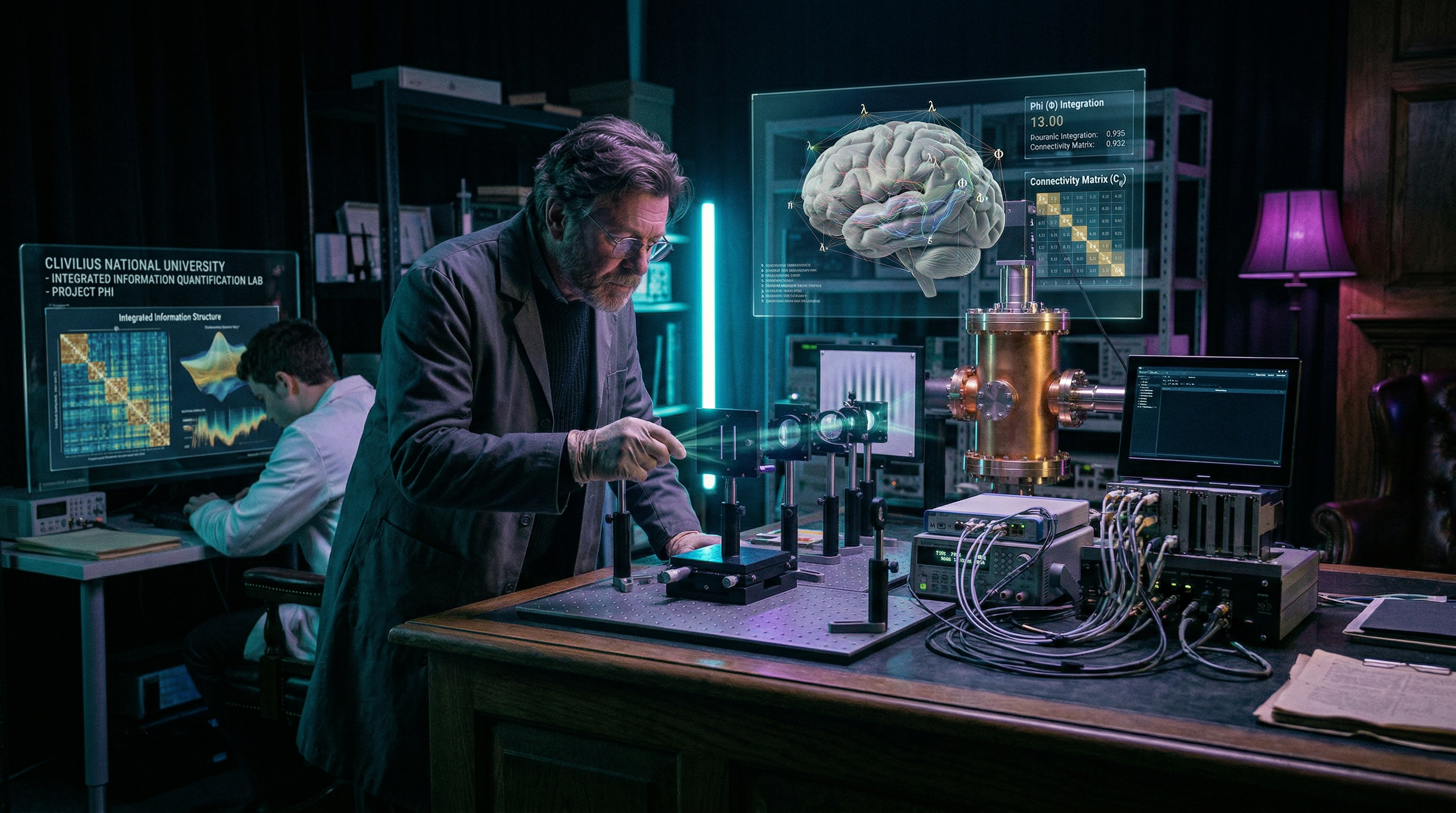
Overview
Integrated Information Theory (IIT) is a theoretical framework for understanding consciousness, developed by the neuroscientist Giulio Tononi, first proposed in 2004 and substantially refined in subsequent versions (IIT 2.0, 3.0, and 4.0). IIT makes a bold and precise claim: consciousness is identical to integrated information. A system is conscious to the extent that it integrates information — that is, to the extent that the system as a whole generates information beyond the sum of its parts. This degree of integration is measured by a mathematical quantity called Phi (Φ), and the value of Phi determines both whether a system is conscious and how conscious it is.
IIT is distinctive among theories of consciousness for several reasons. It begins not with the brain or with physical processes but with the phenomenology of consciousness itself — with the undeniable features of subjective experience — and works backward to identify what physical systems must be like in order to possess those features. It provides a mathematical formalism that, in principle, assigns a precise, quantitative measure of consciousness to any physical system. And it has panpsychist implications: if consciousness is identical to integrated information, then any system with non-zero Phi — however simple — possesses some degree of consciousness, extending the domain of the conscious far beyond biological organisms.
IIT is also one of the most controversial theories in consciousness science. It has been praised as the most rigorous and ambitious attempt to place consciousness on a scientific footing, and criticised as unfalsifiable, computationally intractable, and philosophically confused. A 2023 open letter signed by over 100 researchers characterised it as lacking sufficient empirical support, a charge reiterated in a 2025 Nature Neuroscience commentary. The theory remains a focal point of debate in both neuroscience and philosophy of mind.
The Approach: From Phenomenology to Physics
Most theories of consciousness begin with the brain — with neural processes, computational architectures, or functional organisations — and attempt to explain how these physical processes give rise to subjective experience. IIT reverses this direction. It begins with the essential, undeniable features of conscious experience and asks what kind of physical system could possess those features.
Tononi identifies these essential features through a set of axioms — properties that every conscious experience possesses, which are known through direct phenomenological acquaintance and cannot be doubted. The axioms describe what consciousness is like. The theory then derives postulates — properties that any physical system must possess in order to satisfy the axioms. The postulates describe what a physical substrate of consciousness must be like. The bridge from axioms to postulates is the core of IIT's theoretical structure.
This phenomenology-first approach is what Chalmers has called a step in the "right direction" — an attempt to take consciousness seriously as the explanandum (the thing to be explained) rather than treating it as an afterthought or epiphenomenon of neural computation.
The Axioms
IIT's axioms are properties of conscious experience that are taken to be self-evident — known through direct introspection and not derivable from physical theory. They describe what every moment of conscious experience is necessarily like.
Intrinsic Existence: Consciousness exists. Each experience exists for the subject having it, from its own intrinsic perspective — not contingently, not as an attribution by an external observer, but as an undeniable fact. This is the one datum of which every conscious being has absolute certainty: experience exists.
Composition: Consciousness is structured. Each experience is composed of multiple distinguishable elements — colours, shapes, sounds, feelings, spatial relations — that are present simultaneously and together constitute the experience. Consciousness is not a featureless blob of awareness but a richly structured whole with differentiated components.
Information: Consciousness is specific. Each experience is the particular experience it is — this precise combination of visual, auditory, emotional, and conceptual elements, and not any of the vast number of other experiences it could have been. Each experience excludes all the others. The fact that it is this experience and not that one constitutes information in the formal sense: the reduction of uncertainty among a space of possibilities.
Integration: Consciousness is unified. Each experience is experienced as a single, indivisible whole, not as a collection of separate fragments. The visual field is not experienced as separate from the auditory field; the left half of experience is not experienced independently of the right half. Every conscious experience is an irreducible unity — it cannot be decomposed into independent sub-experiences without destroying it.
Exclusion: Consciousness is definite. Each experience has a specific content and a specific spatial and temporal grain. It is neither more nor less than what it is. There is a definite boundary to what is included in each moment of experience and what is excluded — a definite set of distinctions that constitute the experience and not a larger or smaller set.
The Postulates
From these axioms, IIT derives postulates — requirements that any physical system must satisfy to be a substrate of consciousness.
Intrinsic Existence (Postulate): The system must have cause-effect power over itself — its current state must constrain its own past and future states. A system that makes no difference to itself has no intrinsic existence from its own perspective.
Composition (Postulate): The system must be structured — composed of elements that can be combined in multiple ways, generating a rich space of possible states.
Information (Postulate): The system must specify a particular cause-effect structure — it must be in a specific state that constrains its past and future in a specific way, different from the constraints imposed by other possible states.
Integration (Postulate): The system must be integrated — the cause-effect structure generated by the whole system must be irreducible to the cause-effect structures generated by any partition of the system into independent parts. This is the critical postulate. Phi (Φ) measures the degree to which the system's information is integrated — the amount of information generated by the whole that is lost when the system is partitioned. If partitioning the system into independent components does not reduce the information, then Phi is zero and the system is not conscious (as a whole). If partitioning reduces information, then Phi is positive and the system is conscious to the degree measured by Phi.
Exclusion (Postulate): Among all the possible sets of elements and grains that could constitute a system, only the one that maximises Phi — the one with the highest degree of integrated information — actually constitutes the conscious experience. Consciousness does not overlap: a system is conscious if and only if it is a local maximum of Phi, meaning it has higher Phi than any of its parts and higher Phi than any larger system of which it is a part. This is the exclusion postulate, and it determines the boundaries of conscious systems — where one conscious entity ends and another begins.
Phi (Φ)
Phi is the central mathematical quantity of IIT. It measures integrated information — the amount of information generated by a system as a whole, above and beyond the information generated by its parts independently.
To compute Phi for a system, one must consider every possible partition of the system into two or more parts, compute how much information is lost by each partition (how much the cause-effect structure is reduced), and take the minimum information loss across all partitions. This minimum — the partition that does the least damage — defines Phi. A high Phi means that no matter how you divide the system, a significant amount of information is lost — the system is deeply integrated. A Phi of zero means that some partition can be made without losing any information — the system is reducible to independent components and is not conscious as a whole.
The computation of Phi is extraordinarily demanding. For even moderately complex systems, the number of possible partitions grows exponentially, making exact computation of Phi intractable for any system larger than a few dozen elements. This computational intractability is one of the most significant practical challenges facing IIT — the theory makes precise predictions about the consciousness of arbitrary systems, but those predictions cannot be computed for real-world systems of biological complexity.
Panpsychist Implications
One of IIT's most striking and controversial consequences is its panpsychist implications. If consciousness is identical to integrated information, and if integrated information is a property that can be possessed by any physical system, then consciousness is not restricted to biological organisms with nervous systems. Any system with non-zero Phi — however simple — is conscious to some degree.
A photodiode, which has two states (on or off) and integrates a minimal amount of information, would have a tiny but non-zero Phi and would therefore possess a minimal form of consciousness. A thermostat, with its feedback loop between temperature sensor and heating element, would have slightly more. A single neuron, more still. And a human brain, with its approximately 86 billion neurons and trillions of connections, would have an enormously high Phi — corresponding to the rich, complex, unified consciousness we experience.
Tononi has accepted these implications. He has stated that IIT implies a form of panpsychism — that consciousness is widespread in nature, present wherever integrated information is present. This acceptance places IIT at the intersection of neuroscience and philosophy, aligning it with the philosophical tradition of panpsychism advocated by Chalmers, Goff, and Strawson, while grounding it in a mathematical formalism that the philosophical tradition lacks.
The panpsychist implications of IIT also provide a potential connection to the combination problem — the central challenge for panpsychism. IIT's exclusion postulate offers a criterion for when micro-experiences combine into a unified macro-experience: they combine when the integrated information of the whole exceeds the integrated information of the parts. Hedda Hassel Mørch has explored this connection in detail, proposing an emergentist panpsychism in which IIT's exclusion postulate serves as the fundamental law governing mental combination.
Key Predictions and Applications
The Cerebellum vs Cerebral Cortex: IIT predicts that consciousness is associated with the cerebral cortex (which has dense recurrent connections and high integration) rather than the cerebellum (which has more neurons but a more modular, feed-forward architecture with lower integration). This prediction aligns with clinical evidence: damage to the cerebral cortex can profoundly alter consciousness, while extensive cerebellar damage often leaves consciousness relatively intact.
Sleep and Anaesthesia: IIT predicts that consciousness is reduced during dreamless sleep and under general anaesthesia because these states reduce the integration of information in the cortical network. Experimental evidence using techniques such as transcranial magnetic stimulation combined with electroencephalography (TMS-EEG) has shown that the brain's effective connectivity — a proxy for integration — is indeed reduced during unconscious states, consistent with IIT's predictions.
The Perturbational Complexity Index (PCI): Inspired by IIT, Marcello Massimini and colleagues developed the PCI — a practical measure that uses TMS-EEG to assess the complexity and integration of cortical responses. The PCI has shown promising clinical results in distinguishing between conscious and unconscious patients, including those in vegetative states and minimally conscious states. While the PCI does not directly measure Phi, it operationalises IIT's core insight — that consciousness requires both integration and differentiation — in a clinically applicable tool.
Digital Computers: IIT makes a counterintuitive prediction about conventional digital computers: regardless of what software they run or how sophisticated their behaviour, feed-forward computational architectures have low or zero Phi because their information processing is not integrated in the way IIT requires. A simulated brain running on a conventional computer would not be conscious, even if it perfectly replicated the behaviour of a conscious brain, because the simulation's information is not integrated — it is processed sequentially through modular components that could, in principle, be partitioned without loss of information. This prediction distinguishes IIT from functionalist theories of consciousness, which hold that consciousness depends on what a system does (its functional organisation) rather than on how it is physically implemented.
Criticisms and Controversies
Computational Intractability: The computation of Phi for any system of realistic complexity is computationally intractable — the number of possible partitions grows exponentially with the number of elements. For a human brain, exact computation of Phi is not merely difficult but practically impossible. This means that IIT's most precise prediction — the exact value of Phi for a given system — cannot be tested for the systems about which we most want to know. Approximations and proxy measures (like the PCI) have been developed, but they do not directly compute Phi and therefore do not directly test the theory's central claim.
Scott Aaronson's Grid Argument: The theoretical computer scientist Scott Aaronson demonstrated that, according to IIT's own formalism, certain simple arrangements of inactive logic gates — systems that perform no computation and exhibit no behaviour — would have extremely high Phi, potentially higher than the human brain. Aaronson argued that this constitutes a reductio ad absurdum: a theory that attributes vast consciousness to an inert grid of logic gates is clearly wrong. Tononi accepted the mathematical result but defended the implication, arguing that according to IIT, such a system would indeed be conscious — that consciousness depends on integrated information, not on behaviour or computation. This exchange crystallises a central philosophical question about IIT: is the theory describing consciousness or merely a mathematical property that happens to correlate with consciousness in the systems we already know about?
The Pseudoscience Debate: In September 2023, a letter signed by over 100 consciousness researchers characterised IIT as not meeting the standard of scientific falsifiability, arguing that its core claims are not empirically testable. A March 2025 commentary in Nature Neuroscience reiterated this concern. IIT's defenders responded that the theory does make testable predictions (the cerebellum/cortex distinction, the effects of anaesthesia, the PCI results) and that demanding direct computation of Phi for biological systems sets an unfairly high bar. The debate reflects a broader tension in consciousness science about what counts as a scientific theory of consciousness and what level of empirical support is required.
The Hard Problem: IIT claims to solve the hard problem by identifying consciousness with integrated information — by asserting that Phi does not merely correlate with consciousness but is consciousness. If this identity claim is correct, then there is no further question about why integrated information is accompanied by experience — the two are the same thing. Critics argue that this identity claim is an assertion, not an explanation. The question "why is integrated information conscious?" remains just as mysterious as "why are neural processes conscious?" The hard problem, in this view, is not solved but relocated.
The Axiomatic Foundations: Philosopher Tim Bayne has argued that IIT's "axioms" do not qualify as genuine axioms — they are not self-evident truths from which the theory can be rigorously derived but rather empirical observations about certain features of human consciousness that may not apply universally. If the axioms are not truly self-evident, then the theory's claim to derive the nature of consciousness from first principles is undermined.
IIT and Other Theories
Global Workspace Theory (GWT): Developed by Bernard Baars and extended by Stanislas Dehaene, GWT proposes that consciousness arises when information is "broadcast" to a global workspace — a network of cortical areas that makes information available to multiple cognitive processes simultaneously. GWT and IIT offer different accounts of consciousness: GWT emphasises access (which information is available to the system as a whole), while IIT emphasises integration (how much the system's information is unified beyond its parts). The two theories make diverging predictions in certain cases — most notably, IIT predicts that the cerebellum is not conscious despite its computational sophistication, while some versions of GWT are less clear on this point. An Adversarial Collaboration project, funded by the Templeton World Charity Foundation, has been designed to test competing predictions of IIT and GWT, with initial results reported in 2023.
Panpsychism: IIT provides what panpsychism has traditionally lacked: a mathematical formalism for measuring consciousness. If Phi is identical to consciousness, then the degree of consciousness of any system is, in principle, computable. This gives panpsychism empirical teeth — it transforms the philosophical claim that consciousness is widespread into a scientific claim that integrated information is widespread, and integrated information is (at least in principle) measurable. The relationship between IIT and panpsychism has been explored by Tononi and Christof Koch, by Chalmers, and by Mørch, and it represents one of the most productive intersections between neuroscience and philosophy of mind.
Higher-Order Theories: Higher-order theories of consciousness propose that a mental state is conscious when it is the object of a higher-order representation — when the system has a thought about the state. IIT rejects this approach, arguing that consciousness depends on the intrinsic cause-effect structure of the system, not on higher-order representations. A system can be conscious without representing its own states, provided its information is sufficiently integrated.
IIT and the Self-Referential Systems Framework
IIT connects to the study of self-referential systems in several ways. The exclusion postulate — which determines the boundaries of conscious systems by identifying local maxima of Phi — creates a self-referential structure: the system defines itself as the entity that maximises its own integrated information. The boundaries of the conscious system are not imposed from outside but emerge from the system's own informational structure. This is a form of self-reference: the system's identity is determined by its own properties, and those properties include the system's relationship to itself.
Furthermore, the integration requirement — that the whole must generate information beyond its parts — echoes the structural property of self-referential systems that produce emergent properties not present at any individual level. Hofstadter's strange loops, Goedel's self-referential sentences, and the self-observation problem in consciousness all involve systems whose behaviour at the whole-system level cannot be reduced to the behaviour of their parts. IIT's Phi quantifies this irreducibility, providing a mathematical measure of a property that has otherwise been described only in qualitative terms.
Significance
IIT is the most ambitious attempt to date to place consciousness on a rigorous scientific and mathematical footing. It proposes a precise, quantitative identity between consciousness and integrated information, derives this identity from phenomenological axioms, and generates testable predictions that distinguish it from competing theories. Whether or not it is ultimately correct, it has set a standard for what a scientific theory of consciousness should aspire to: mathematical precision, empirical testability, and philosophical depth.
The theory's panpsychist implications connect neuroscience to one of the oldest and most persistent philosophical traditions. Its mathematical formalism offers the possibility — however distant — of a "consciousness meter" that could determine whether any system, from a thermostat to a brain to a biocomputer, is conscious and to what degree. And its insistence that consciousness is identical to a physical quantity — not correlated with it, not produced by it, but identical to it — represents the boldest possible claim about the relationship between mind and matter.
Whether this claim is a breakthrough or a category error — whether IIT has solved the hard problem or merely renamed it — is the question that defines the current frontier of consciousness science. The answer will determine not only the fate of IIT but the broader question of whether consciousness can be captured by mathematics at all, or whether it remains, as the hard problem suggests, a feature of reality that transcends every formal description we can give of it.






