Henry Woolley
Henry Woolley was born in Wootton, Oxfordshire, on 29th April 1803, the second child and eldest son of Thomas and Agnes Woolley. He emigrated with his family to Van Diemen's Land aboard the Morley in 1820 and established the Woolley family's northern branch by settling in Launceston, where he built a successful grain merchant business. He married Anne Porter in 1825, fathering eight children, three of whom died in childhood. He died in Launceston on 15th July 1880, aged seventy-seven.
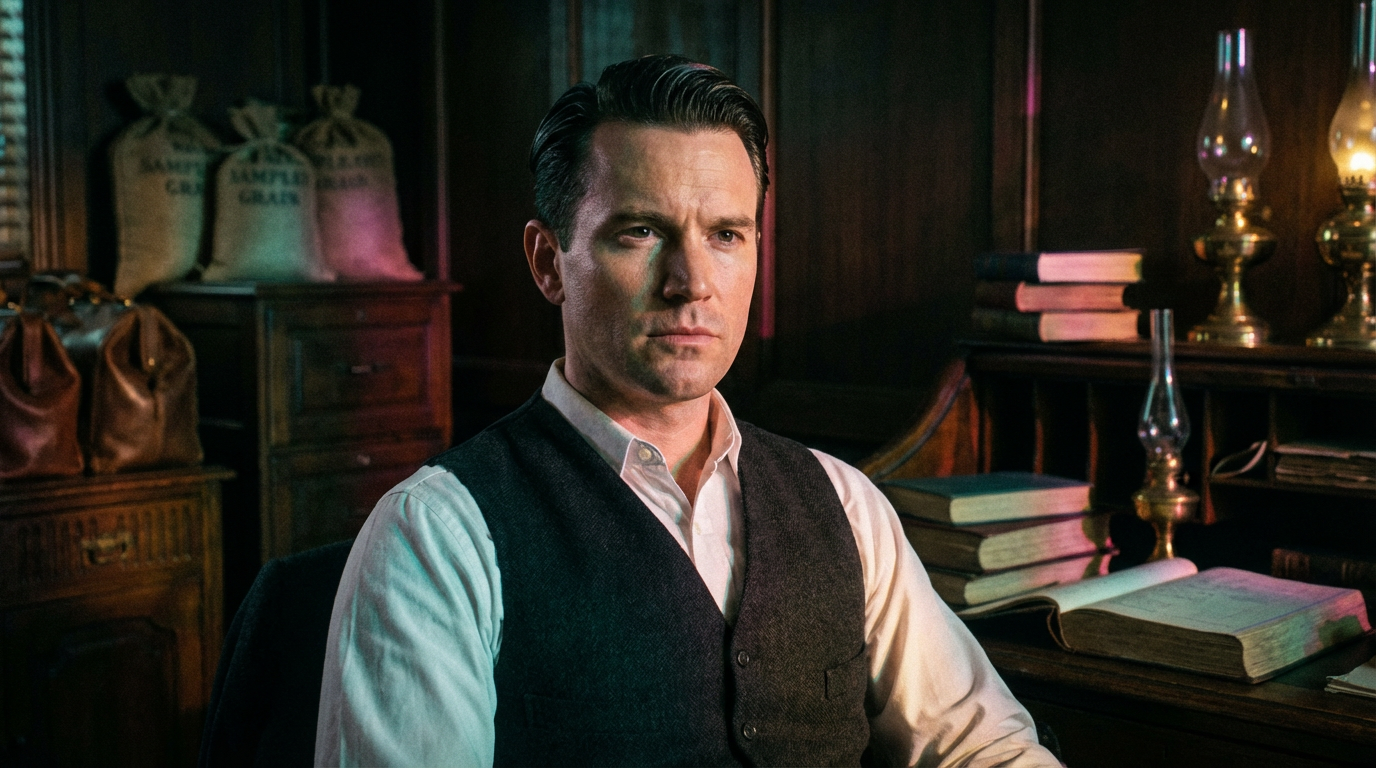
The Eldest Son's Burden (1803–1815)
Henry Woolley was born on 29th April 1803 in the cottage on Pound Lane, Wootton, Oxfordshire, arriving as the second child but first son of Thomas Woolley Sr. and his wife Agnes, née Evans. Elizabeth, two years his senior, had already established herself as their mother's deputy, leaving Henry to navigate the uncertain space between feminine domestic obligation and a masculine expectation of useful labour that he was still years from being able to fulfil. The cottage—cramped, saturated with the smell of leather from the cobbling workshop where his grandfather William Woolley still practised his increasingly unreliable trade—offered no obvious role for a boy too young to work but already too old, in his parents' estimation, to occupy time without purpose.
His earliest memories carried the twin odours that defined the household: the acrid bite of tanning solutions from his father's workshop, and the metallic tang of blood that accompanied his mother's return from difficult births. Agnes's growing midwifery reputation meant she was perpetually absent, attending women in the village and its surrounds, whilst Thomas worked the leather or—increasingly—sought agricultural day labour when the workshop's dwindling custom proved insufficient. Henry learned early to gauge the household's fortunes by sensory evidence: fresh leather meant an order had come in; blood on his mother's apron meant payment would follow. The absence of both meant lean days ahead.
The death of grandfather William Woolley in 1808, when Henry was five, brought the first serious upheaval to his young life. The inheritance proved poisonous—debts exceeded assets, and William's reputation for inconsistent work had driven away whatever customers might have provided his son with a foundation for continuing the trade. Henry watched as items were sold to cover obligations, as his father's already sombre temperament darkened into the prolonged withdrawals the family would learn to call his "dark moods." The lesson imprinted itself with the clarity that only childhood vulnerability permits: family name meant nothing without the means to support it, and inheritance could arrive as burden rather than gift.
Frederick's birth in 1805 introduced Henry's first real rival for the limited attention their father could spare. Where Henry was watchful and cautious, Frederick was naturally engaging, drawing smiles from adults with an ease that Henry could never replicate regardless of how diligently he performed his duties. This dynamic—Henry doing what was expected whilst Frederick did as he pleased—established a pattern of fraternal resentment that would persist, in varying degrees of concealment, across continents and decades.
The subsequent arrivals of Sarah in 1807, John in 1809, Thomas Jr. in 1812, George in 1814, and finally Mary in 1817 pressed Henry ever deeper into premature responsibility. At six, he was watching toddlers. At eight, he was negotiating credit at the village shop. At ten, he worked alongside his father in whatever seasonal labour the surrounding farms could offer. Each new sibling represented both another claim on the household's insufficient resources and another person whose welfare rested, however unfairly, upon his shoulders. The arrival of Thomas Jr.—another son bearing their father's name—stung with a specificity Henry could never quite articulate. He had done everything right, and yet the nominal honour went elsewhere.
Emigration and the Voyage (1819–1820)
The post-Napoleonic depression that devastated rural Oxfordshire brought the Woolley household to its crisis point. By 1818, Thomas Sr. could find work barely three days in any given week, and the family survived primarily on Agnes's midwifery income. Henry, at fifteen and approaching the age when apprenticeship should have been securing his future, instead spent his days competing with returning soldiers for farm labour that paid in spoiled vegetables or not at all. Each failed attempt at employment sharpened his determination to escape circumstances that offered nothing but their own continuation.
When the emigration advertisements appeared in the county newspaper in 1819, Henry recognised opportunity with an immediacy that surprised his parents. At sixteen, he became Agnes's chief ally in pressing the case to Thomas Sr., who regarded the prospect with the paralysed ambivalence that characterised his response to every major decision. Henry researched colonial conditions, calculated costs, and reframed the venture as strategic advancement rather than desperate flight. His organisational competence during the preparations—cataloguing possessions, negotiating sales, managing logistics—impressed the local magistrate sufficiently to produce a character reference that specifically praised "young Henry Woolley's remarkable competence." He carried this document to the southern hemisphere with the care of a man holding a key to a lock he had not yet found.
The Morley departed Deptford on 15th February 1820, and the four-month voyage positioned Henry perfectly within the shipboard community. At seventeen, he was old enough to be genuinely useful but young enough to adapt without the resistance that plagued older passengers. He established himself as a reliable intermediary between the ship's authorities and the emigrant families, translating official instructions into practical guidance, maintaining order in the chaotic spaces between decks. The storm off the Cape of Good Hope revealed in him not courage precisely, but something more durably useful: a capacity for systematic response under pressure. Whilst others prayed or panicked, Henry secured loose cargo, organised bucket chains for flooding compartments, and distributed rations to prevent hoarding. His actions drew no admiration—they were too methodical for that—but they earned the quiet respect of passengers and crew alike.
Early Colonial Establishment (1820–1825)
The family's arrival in Hobart Town on 18th June 1820 deposited seventeen-year-old Henry into a society that rewarded precisely the qualities his childhood had forced him to develop: practical reliability, strategic deference, and the ability to work within existing systems rather than challenging them. Within weeks, he had secured employment as a junior overseer with the Van Diemen's Land Company, a position that paid modestly but provided crucial education in colonial agriculture—the seasonal rhythms of the southern hemisphere, the management of convict labour gangs, and the commercial networks through which Tasmanian produce reached markets in Hobart and beyond.
His advancement came through observation and careful imitation. He studied the speech patterns, business methods, and social strategies of successful colonists, gradually suppressing his Oxfordshire accent and adopting the democratic informality of frontier society. He learned to navigate between free settlers and convict workers without fully identifying with either group, cultivating a chameleon quality that made him appear trustworthy to superiors without provoking resentment from those below. This ability to occupy intermediate positions—useful enough to retain, unambitious enough to seem unthreatening—would define his entire commercial career.
Frederick's early success in the colonial postal service, beginning around 1821 when he secured a position as a post boy at barely sixteen, triggered the first significant flare of the resentment Henry had carried since childhood. His younger brother, through natural charm rather than demonstrated competence, had obtained a role with more public visibility and clearer prospects than Henry's agricultural work. The pattern established in Wootton—Henry labouring harder for less recognition—appeared to be reproducing itself in the colonies.
Anne Porter entered Henry's life when her family arrived in Hobart from Oxfordshire. The Porters had emigrated with modest capital and established themselves within the colony's merchant community, occupying a social position that aligned precisely with Henry's ambitions. Anne, practical and perceptive, possessed the commercial instincts of her family background combined with a temperament that complemented Henry's controlled intensity. Their courtship proceeded with a directness that reflected colonial pragmatism—both understood that marriage in these circumstances was a partnership requiring compatible skills rather than merely compatible feelings.
Marriage and the Northern Venture (1825–1835)
Henry and Anne married in 1825, a union that represented his formal entry into the colony's mercantile class. At twenty-two, he had accumulated sufficient reputation and savings to be accepted by the Porter family, whilst Anne brought connections that would prove invaluable in the commercial ventures to come. The marriage was not passionless, but passion was not its organising principle. Both parties understood what they were building and approached the construction with shared seriousness.
Their decision to relocate to Launceston represented the most consequential gamble of Henry's life. The northern settlement, smaller than Hobart but expanding rapidly as agricultural development pushed into Tasmania's interior, offered opportunities for those willing to exchange established networks for less crowded ground. Henry recognised what others had not yet grasped: that Launceston's position at the head of the Tamar estuary made it the natural commercial hub for the island's northern half, and that whoever controlled the grain trade between the growing farming districts and the town's expanding population would prosper accordingly.
He secured commercial premises near Launceston's port and established Woolley Grain Merchants with a business model of elegant simplicity. He purchased grain directly from small farmers who needed immediate cash, stored it in warehouses he gradually acquired, and sold to urban consumers and export merchants at margins that reflected his control over timing and supply. His years as an agricultural overseer had given him intimate knowledge of farming conditions—he could assess a harvest's quality by smell, predict yields from weather patterns, and calculate the precise moment at which a farmer's cash shortage would make him amenable to accepting a lower price. This combination of agricultural understanding and commercial instinct made him formidable in business whilst his practised manner of pleasant reliability concealed the calculation beneath.
Anne's contribution to their success was fundamental, though largely invisible to the world beyond their household. She managed domestic economy with the precision of a ledger, maintained the social relationships that lubricated commercial dealings, and provided counsel that Henry trusted more than he ever acknowledged publicly. Their partnership operated on a division of labour so efficient that neither could have achieved their shared prosperity alone—a fact Henry understood intellectually but struggled to express in any language more personal than household accounts.
Children and the Cruelty of Colonial Life (1835–1855)
William Henry, born on 2nd March 1835, established the next generation of northern Woolleys. The boy inherited his father's methodical temperament and his mother's commercial awareness, showing early aptitude for the grain business. Henry, remembering the burdens that had been placed on him as eldest son, made a conscious effort to limit expectations whilst providing the educational opportunities his own childhood had lacked.
Elizabeth Anne arrived on 14th July 1837, bringing an unexpected lightness to a household organised around commerce. Her brightness and quick intelligence delighted both parents. Her death from scarlet fever in 1843, at the age of six, delivered a blow from which Henry never fully recovered. She had been learning to read, showing musical talent that neither parent possessed, introducing something into the household that had nothing to do with ledgers or grain prices. The wound her absence created remained open for the rest of Henry's life, though he carried it with the same composed silence he applied to every other form of suffering.
James Robert, born on 22nd September 1839, displayed an affinity for metalwork that resisted all Henry's attempts to redirect toward commerce. The boy spent hours watching blacksmiths, understanding the properties of iron with an intuitive comprehension that owed nothing to formal instruction. Anne's influence eventually secured James an apprenticeship to Launceston's master blacksmith, teaching Henry the uncomfortable lesson that children were not blank ledgers upon which parents could inscribe whatever entries they chose.
Catherine Margaret arrived on 8th March 1841 during a period of particular commercial prosperity, the grain business exceeding Henry's original projections. The little girl appeared robust initially, but whooping cough in 1846 proved fatal despite every medical resource Henry could procure. Five years old, she died struggling for breath whilst her father stood helpless beside her, his wealth purchasing nothing of value. The contrast between professional success and domestic powerlessness left a mark that shaped Henry's relationship with money for the remainder of his life—an understanding that capital could secure comfort and standing but could not protect those he loved from the arbitrary cruelties of colonial existence.
John Frederick was born on 15th November 1843, a serious child who inherited what Henry recognised, with quiet dread, as his grandfather Thomas Sr.'s tendency toward dark moods—the withdrawals, the prolonged silences, the sudden rages that arrived without warning and departed without explanation. Henry guided John toward farming rather than commerce, providing him with land where solitude was a practical advantage rather than a social liability.
Thomas Albert, born on 30th April 1845, seemed destined to fulfil every hope Henry had ever entertained. Bright, charismatic, combining his father's competence with a social ease that Henry had never possessed, Thomas Albert appeared to be the son who would exceed his origins. His death at the age of seven, crushed by falling timber in a sawmill where he had been playing where he should not have been, devastated Henry more completely than any previous loss. This was the child who might have been everything—the version of himself that circumstances and temperament had never permitted Henry to become.
Eleanor Grace arrived on 12th January 1848, when Anne was forty-four and the risks of childbearing had become severe. The baby survived, but Anne haemorrhaged dangerously and remained bedridden for months. Henry, forced to manage household and business simultaneously, developed a new and belated appreciation for the contribution his wife had been making throughout their marriage. Eleanor would eventually become one of Launceston's first female teachers, using the education her parents provided to achieve an independence that surprised and unsettled her father in equal measure.
Samuel Edward, born on 9th June 1850 when Anne was forty-six, was clearly the last child and received, perhaps as a consequence, more affection and fewer expectations than his siblings had known. He developed a restless adventurousness that would eventually take him to sea and then to New Zealand—a trajectory that Henry observed with a complicated mixture of pride and envy, recognising in his youngest son the appetite for experience that his own life of careful calculation had never permitted him to indulge.
Prosperity and Its Discontents (1850–1872)
The 1850s brought Henry his greatest commercial success. The Victorian gold rushes created enormous demand for Tasmanian grain, and Henry's established network of suppliers and storage facilities positioned him to profit handsomely. By 1855, Woolley & Sons—though only William actually worked in the business—was one of Launceston's most substantial merchant houses. The family moved to a larger property on Wellington Street, employed domestic staff, and achieved the solid middle-class respectability that Henry had pursued since boyhood.
George's arrival in Launceston in 1851, relocating from Hobart with his family, introduced a complication. Henry's younger brother quickly established himself in the northern trading networks, his commercial activities operating with a fluidity that made Henry uncomfortable. Henry had built his position through methodical, scrupulously legitimate effort; George's more flexible approach to the boundaries of commerce felt like a threat to the reputation Henry had spent decades constructing. The brothers maintained cordial relations—they were, after all, Woolleys—but the cordiality rested on a mutual wariness that neither acknowledged openly.
The deaths of his parents—Thomas Sr. on 22nd May 1853, Agnes on 9th August 1855—affected Henry differently. His father's passing closed a relationship that had been defined more by duty and distance than warmth, the old silences finally becoming permanent. Agnes's death cut deeper. She had been the parent who provided ballast, whose competence and determination had kept the family functional through poverty and emigration. Without her, the Woolley clan's cohesion depended increasingly on Elizabeth's correspondence and force of will—assets Henry appreciated from a distance without ever quite acknowledging their value.
The relationship with Frederick continued to grate. Frederick's position as Hobart's postmaster represented the kind of public standing that commercial success, however substantial, could never quite match. Henry's grain warehouses generated more wealth than Frederick would see in a lifetime of government service, yet it was Frederick whom people remembered, Frederick whose name appeared in civic records, Frederick who had earned a place in the colony's institutional architecture. The resentment was not constant—Henry was too disciplined for that—but it surfaced at family gatherings, in the careful way he steered conversations toward business matters where his superiority was unambiguous.
Anne's declining health from the late 1860s transformed their marriage's dynamics in ways neither had anticipated. The practical partnership that had sustained them through decades of commercial striving evolved, under the pressure of her illness, into something more tender. Henry nursed her through cancer's slow devastation with an attentiveness that surprised their children, who had grown up observing efficient cooperation rather than visible affection. Her death on 23rd September 1872 left him genuinely bereft, forcing the discovery—too late, as these discoveries always come—that what had begun as strategic alliance had become actual love.
The Narrowing Years (1870–1880)
Henry's final decade saw the generation that had crossed the ocean aboard the Morley thin steadily around him. Frederick died on 5th January 1870, at sixty-four, his connection to the Jeffries disappearance still casting its faint shadow over the family's reputation. At Frederick's funeral, Henry delivered an unexpected eulogy—acknowledging his brother's decades of public service with a generosity that caught the mourners off guard, as though proximity to death had dissolved resentments that a lifetime of living had been unable to shift.
John's death in 1864 from injuries sustained in a farming accident had already removed the brother whose quiet struggles Henry had observed without fully understanding. Mary's death on 4th May 1875 grieved him in the particular way that the loss of the weakest sibling grieves the strongest—not because they had been close, but because her suffering represented everything he had spent his life trying to prevent in his own family, and her failure confirmed that effort alone was no guarantee against life's capacity for destruction. Elizabeth's death on 19th December 1876 removed the last figure whose authority within the clan rivalled his own—the sister who had held the Woolleys together through correspondence and intervention whilst Henry built his northern empire. With her gone, the responsibility for the family's coherence passed to a generation that had never known the Pound Lane cottage or the Morley's between-decks.
Henry withdrew gradually from active business after Anne's death, ceding commercial operations to William whilst maintaining a ceremonial presence at board meetings and harvest assessments. His life contracted into routines—morning walks through Launceston's streets, afternoon reading in his study, evening solitude that the servants learned not to disturb. The Mechanics' Institute that he funded with significant donations represented his most deliberate attempt at legacy beyond commerce—education that he himself had been denied, made available to future generations who might use it to build lives that extended beyond the calculation of profit margins. The inscription on the foundation stone—"Knowledge Is Power"—suggested an understanding arrived at too late for personal application.
His letters from this period, preserved by Eleanor, reveal a man attempting retrospective comprehension of a life lived primarily through action rather than reflection. He wrote about Frederick with less resentment and more regret than he had ever expressed whilst his brother was alive. He discussed the three dead children with a raw grief that decades of suppression had failed to diminish. He wondered, in the careful handwriting of a man whose education had been practical rather than literary, whether different choices might have produced different outcomes—whether the commercial success he had pursued with such single-minded determination had been worth the emotional costs it had imposed upon his family and himself.
Death and Burial
Henry Woolley died at half past three in the morning on 15th July 1880, his son William and daughter Eleanor at his bedside. His last words—"I kept them safe"—carried an ambiguity that seemed appropriate for a man who had spent seventy-seven years building success upon foundations of discipline, suppressed feeling, and the particular determination of someone who had understood from childhood that nobody else was going to do it for him. Whether "them" referred to his children, his business, or his remaining secrets, he did not clarify and no one present thought to ask.
The funeral on 18th July drew Launceston's commercial and civic establishment. The eulogy praised his business acumen, his devotion to family, his charitable contributions. Nobody mentioned the three children whose graves he had visited every Sunday for decades, the brother whose success he had envied for half a century, or the wife he had discovered he loved only when it was too late to tell her. The omissions would have suited Henry perfectly. He had always preferred that the world see the ledger's summary rather than the workings behind it.
He was buried at Launceston General Cemetery, the headstone reading simply: "Henry Woolley, Merchant, 1803–1880." The reduction of a complex life to occupation and dates was, in its way, exactly the epitaph he would have composed himself.







