4109.227 · August 15, 1789 AD
Henry David Lawson
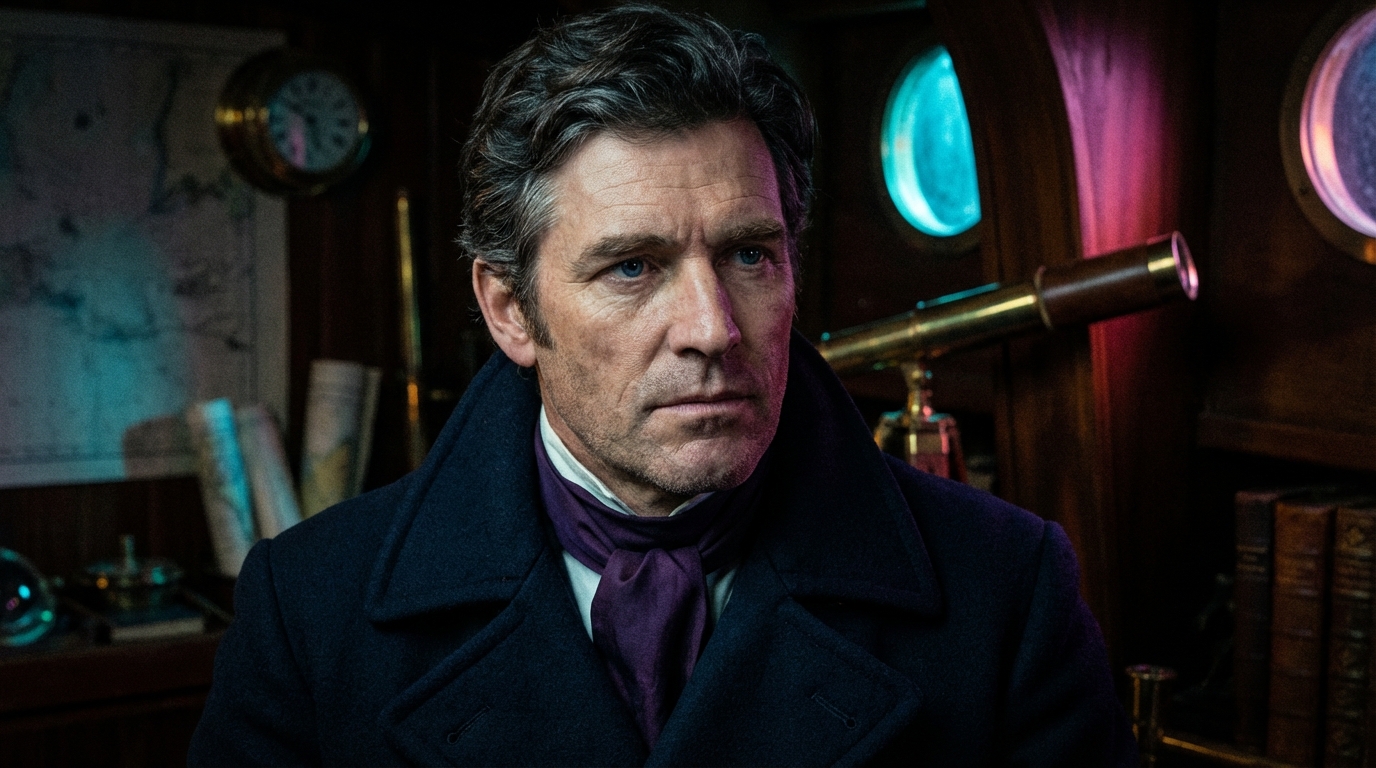
Henry David Lawson (1789–1855) was a gifted British navigator, cartographer, and maritime scholar whose precise celestial calculations and steadfast character made him one of the most respected sailing masters of the early 19th century. Born in Greenwich to a family rooted in scientific inquiry, Lawson’s life was defined by exploration, intellectual rigour, and a quiet moral integrity. His service aboard the merchant vessel Persephone, particularly during its clandestine 1818 voyage, remains a testament to his navigational brilliance and scholarly dedication.
Early Life and Family Background
Henry David Lawson was born on 15 August 1789 at 10 Maze Hill, Greenwich, London, a district intrinsically linked to maritime science due to its proximity to the Royal Naval College and Greenwich Observatory. He was baptised on 22 August 1789 at St Alfege's Church, a longstanding centre of local civic and religious life.
He was the third of five children born to Thomas Augustus Lawson (b. 12 February 1754, Hastings, East Sussex – d. 2 October 1816, Greenwich) and Emily Beatrice Lawson (née Hartley) (b. 4 May 1761, Winchester, Hampshire – d. 14 March 1834, Deptford, Kent). Thomas Lawson was a skilled civil cartographer, trained under Francis Rooke, and intermittently employed by the Hydrographic Office of the Admiralty. Known for his elegant copperplate drafts and cautious temperament, he worked on coastal surveys of the Channel Islands and contributed to revisions of naval maps during the Napoleonic Wars.
Emily Beatrice Hartley, daughter of a dissenting schoolmaster, was educated in part at home and in part under the guidance of her elder brother, Rev. Josiah Hartley, a mathematician-clergyman with an interest in celestial mechanics. Despite the era's gendered restrictions, Emily quietly collaborated with her husband on trigonometric projections and was respected in niche circles for her handwritten manuscripts analysing lunar parallax correction. Their marriage, solemnised on 3 September 1779 at St Swithun-upon-Kingsgate, Winchester, was characterised by an enduring intellectual partnership.
Henry's siblings, all born in Greenwich, were:
- Charlotte Eliza Lawson (b. 26 June 1781 – d. 17 November 1846, Chislehurst): The eldest, known for her gift in languages. She served as governess to several diplomatic families and later published translations of maritime Dutch logs.
- Frederick Hartley Lawson (b. 3 January 1784 – d. 28 September 1805, lost at sea off Almería, Spain): Apprenticed in the Navy as a midshipman, Frederick perished aboard HMS Halberd during a skirmish with privateers. His death had a lasting emotional impact on Henry, shaping his sense of duty and caution.
- Agnes Marianne Lawson (b. 7 May 1793 – d. 12 December 1861, Canterbury): A skilled botanical illustrator, Agnes exhibited briefly at the Society of Female Artists and remained unmarried, living later with Charlotte.
- Edwin Thomas Lawson (b. 19 February 1796 – d. 9 March 1853, Bath): Trained as a surveyor, Edwin worked for the Ordnance Survey, producing topographic drafts of the South Downs and contributing to early experiments in triangulation.
The Lawson family home on Maze Hill was a modest three-storey brick dwelling within walking distance of the Thames embankment. Though plain in outward appearance, the house was dense with objects of scientific purpose: oak cabinets filled with rolled vellum charts, an orrery operated by a weighted crank, and a mercury barometer mounted above the staircase. Henry grew up amidst nightly discussions of celestial observations and ink-stained hands drafting tide tables. From a young age, he demonstrated a tactile curiosity for instruments—by the age of nine, he could calculate lunar distance with a borrowed Hadley's quadrant and had annotated his mother's almanac with his own observational notes.
Education and Intellectual Formation
Henry's formal education was preceded by rigorous domestic instruction under his parents' close supervision. Mornings began with Latin exercises from Erasmi Colloquia, followed by practical mathematics from Bonnycastle's Algebra and Robertson's Navigation. His mother took particular responsibility for his education in trigonometry and geometry, whilst his father introduced him to draftsmanship, ink mapping, and the rudiments of surveying instruments.
In 1799, aged ten, Henry enrolled at the Royal Greenwich School, a grammar institution noted for serving the sons of naval families and civil servants. He boarded during term time, studying under Mr. Nathaniel Cribb, a former master's assistant from HMS Vanguard. Henry excelled in arithmetic, astronomy, geography, and classical studies, receiving multiple commendations. In 1803, he was awarded the St. Dunstan's Medal for Applied Mathematics.
Due to his father's occasional commissions with the Admiralty, young Henry was introduced to several figures within the Royal Naval College, Greenwich. Most notably, he came under the private mentorship of Dr. Silas Peregrine Wren, a reclusive astronomer and former assistant to Nevil Maskelyne. Dr. Wren, impressed by Henry's annotations in a borrowed volume of The Nautical Almanac, tutored him in advanced celestial navigation, lunar distance refinement techniques, and precession and nutation impact on long-range voyages.
By the age of sixteen, Henry had assisted his father in revising coastal sketches of the Orkney archipelago, and his observations on tidal irregularities in the Thames Estuary were informally circulated in correspondence among Admiralty drafters. In 1806, he was granted provisional access to the Royal Observatory's east library wing—according to visitor logs, the youngest civilian granted access to that section at the time.
Henry's learning style was marked by a quiet methodicalness and a fondness for marginalia. He often linked mathematical ideas to natural philosophy, influenced by his mother's spiritual rationalism. A note in his 1807 logbook reads: "If the stars are fixed, yet we must move beneath them—not merely in body, but in rightness of intention."
Maritime Career
Henry's formal maritime career commenced in May 1807, shortly after his eighteenth birthday. Through the intervention of his mentor Dr. Wren and his father's Admiralty connections, Henry secured a position as assistant navigator aboard HMS Cerberus, a sixth-rate post ship under Captain Julian Thorne Alvey. The Cerberus was assigned to patrol and survey missions across the Caribbean Sea, focusing on the Leeward Islands where disputes over colonial shipping lanes and privateering activities were intensifying.
Onboard, Henry was initially treated with suspicion by senior crew, referred to as "the Professor"—a moniker that shifted from mockery to respect after several incidents demonstrated his practical utility. In September 1807, when an error in the ship's eastward drift near Dominica risked grounding her on submerged volcanic outcrops, Henry quietly recalculated the position using lunar distance and sidereal time, convincing Captain Alvey to alter course just in time. First Lieutenant Silas Gorran formally noted that Henry "exhibited a rare and disciplined proficiency in the arts of navigation."
Between 1808 and 1814, Lawson served aboard a succession of vessels:
- HMS Lively (1808–1810): Escort missions along the West African coast, where he observed magnetic anomalies that would later form the basis of a paper on compass deviation in equatorial zones.
- The Petrel (1811): Anti-smuggling operations in the Bristol Channel, where he used soundings and echo estimates to navigate back to safe anchorage without visual reference during hazardous fog.
- HMS Orontes (1812–1814): Under Captain Edwin Malvern, contributing to the redrafting of the Bay of Biscay hydrographic profile.
His reputation spread not only for navigational talent but for a temperament described as "steel-spined but even-voiced"—capable of issuing calm directives during tempestuous conditions whilst taking time to teach younger crewmen meridian altitude readings. His close friend Midshipman Elias Moorcroft later described him as "neither boastful nor meek, but grave with kindness, as if every star he read reminded him of human error."
Marriage and Family
In 1812, whilst ashore in Portsmouth for a charting commission, Henry met Anne Elizabeth Fairchild (b. 22 March 1791, Portsmouth – d. 17 September 1863, Greenwich), the spirited daughter of Professor Horace Fairchild, a lecturer in astronomy at King's College, London. Anne was known for her observational journals on lunar movement, and the two quickly discovered a shared fascination with the cosmos.
They married on 14 February 1812 at St Thomas's Church, Portsmouth, settling initially in Deptford. Their marriage was one of intellectual companionship as much as domestic union. Anne contributed frequently to her husband's journals, particularly on optical corrections for northern latitudes. Henry's letters to Anne during his time at sea—preserved in part in the Lawson-Fairchild Private Archive—offer a vivid window into maritime life, navigation theories, and the emotional strain of long absence.
The couple had two children:
- Thomas Edward Lawson (b. 8 June 1813, Deptford – d. 3 November 1891, Greenwich): Naval architect and draughtsman at Deptford Dockyard. Through his grandson James Henry Lawson, Thomas's line would eventually cross to Clivilius and establish the Lawson family's presence in Duncarron and later Chewbathia.
- Lydia Anne Lawson (b. 12 December 1816, Greenwich – d. 28 May 1899, Canterbury): Amateur botanist who remained unmarried, living later with her aunt Charlotte and then Agnes.
Sailing Master of the Persephone
In January 1815, Henry was formally offered the position of sailing master aboard the Persephone, a heavily-rigged merchant vessel launched in 1803 from Woolwich Dockyard. Designed with reinforced oak beams and a shallow keel ideal for manoeuvrability in shallow or hostile waters, the Persephone had gained a quiet reputation for discretion and reliability on sensitive charters.
The ship's master, Captain Rupert James Blackwell (b. 17 March 1770, Lancaster – d. 3 August 1830, Lisbon), was a former naval officer turned private merchant captain—disciplined, precise, and known for his unwillingness to suffer fools. Blackwell selected Lawson upon the recommendation of Captain Edwin Malvern and after personally reviewing Lawson's annotated star logs from the Orontes.
As sailing master, Lawson was responsible for all aspects of navigation and nautical charting: course plotting using celestial and terrestrial markers, maintenance and calibration of instruments, production of original charts for uncharted routes, and instruction of junior mates. His methods were known for precision and near-ritualistic discipline. He rose before dawn for pre-sunrise readings, logged multiple cross-checks of position per day, and updated his star charts fortnightly. His cabin became known among the crew as "the chartroom of thought," its shelves lined with Epitome of Practical Navigation, Newton's Principia, Anne's handwritten lunar almanacs, and his mother's trigonometric notebooks.
Between 1815 and 1818, Lawson directed the Persephone through numerous challenging voyages, including a winter crossing of the Bay of Biscay during a magnetic anomaly, a survey mission along the Berber coast involving clandestine anchorage, and a near shipwreck off the Azores avoided by his recalculated barometric corrections. His observations during these years were published anonymously in The Hydrographer's Companion.
The 1818 Voyage
In early February 1818, the Persephone was chartered for a private voyage from Hobart Town, Van Diemen's Land, to London. The commission came with explicit instructions for discretion to preserve the privacy of the passenger: William Thomas Jeffries Sr., a wealthy landowner and formerly transported convict who was consolidating his influence through land acquisition and mercantile ventures centred around Jeffries Manor near New Norfolk.
Lawson plotted the course across a late southern summer, navigating seasonal swells and equatorial shifts. The voyage encountered severe weather, most notably on 12 March 1818, when a storm south of Tasmania nearly drove the vessel onto submerged rocks. Lawson's careful star plotting and emergency triangulation helped avert disaster—a feat Captain Blackwell later described as "navigation of rare nerve and brilliance, concealed within a whisper."
On 15 May 1818, a small group of crewmen led by Quartermaster Elias Trenwick attempted a mutiny, their demands centring on the voyage's secrecy and superstitions about Jeffries' presence. Lawson's response was understated but effective—he redirected focus by ordering emergency stowage drills and issuing revised night navigation rotations, dispersing dissenters before the mutiny gained momentum. He later recorded: "Men need movement when they cannot have certainty. Give them a task, and they will trade mutiny for rhythm."
The Persephone docked in London on 5 June 1818. Jeffries disembarked quietly, and within weeks had met and swiftly courted Miss Madelyn Bally. By late 1818, the Persephone was again at sea, carrying William and Madelyn Jeffries back to Tasmania where their son William Jr. would be born the following year.
Later Years and Legacy
After concluding his service aboard the Persephone in 1824, Lawson retired from active seafaring and returned permanently to Greenwich. He took up a senior position at the Royal Maritime Instructional College, teaching advanced celestial navigation, map calibration, and the philosophy of maritime mathematics.
He published several influential treatises during this period:
- The Southern Arc: Notes on the Celestial Equator and Maritime Latitude (1826)
- Lines of Quiet: Reflections on Star Paths and Memory (1831)
- On the Moral Cartography of Voyaging (1839), combining navigational science with ethical reflections
Lawson remained a private man, preferring scholarly gatherings at the Greenwich Observatory Club over public speaking. He declined multiple offers to join the Royal Society, citing "a preference for silence over ceremony."
Henry David Lawson passed away peacefully on 4 April 1855, aged 65, at his home on Crooms Hill. His final days were spent in correspondence with former pupils and working on an unfinished manuscript tentatively titled Of Bearings and Becoming—a philosophical treatise on the relationship between navigation and moral agency. He was buried at St Alfege's Church, near the river he had known since boyhood. His gravestone bears a simple inscription chosen by his daughter Lydia: "He read the stars and held true."
Though not a household name in maritime history, Lawson's technical work remains embedded in navigation practices. His refinements to star-sighting correction techniques were adopted by Admiralty charting departments, and his annotated star logs from the Persephone voyage are still referenced in academic naval archives. His insistence on blending empirical calculation with moral self-reflection marked a philosophical departure in an era more concerned with imperial efficiency than ethical voyaging.
In the words of his former student Captain Elias Moorcroft: "Lawson taught us that knowing the stars was not enough; one had to earn the right to follow them."
His legacy extends beyond charts and journals. Through his son Thomas Edward, Henry's descendants would cross into Clivilius in 1878, eventually establishing the Lawson family line that produced the renowned Chewbathian Hunter Charity Fiona Lawson—a warrior who, like her distant ancestor, reads signs others cannot see and holds true in darkness.







