4338.209 · July 28, 2018 AD
Henri Still Wants Breakfast
As the weight of Duke’s death settles over the camp, Beatrix searches for something tangible—clean clothes, a tin of dog food, a thread of normality—to hold herself together. But grief, tension, and Paul’s unwelcome remarks push her to the edge. With a white bedsheet in hand and no clear plan, Beatrix chooses the only direction that makes sense: away.
"Everyone wants you to carry the grief properly—folded, quiet, respectable. But sometimes it just drags behind you in the dirt, and that’s the best you can do."
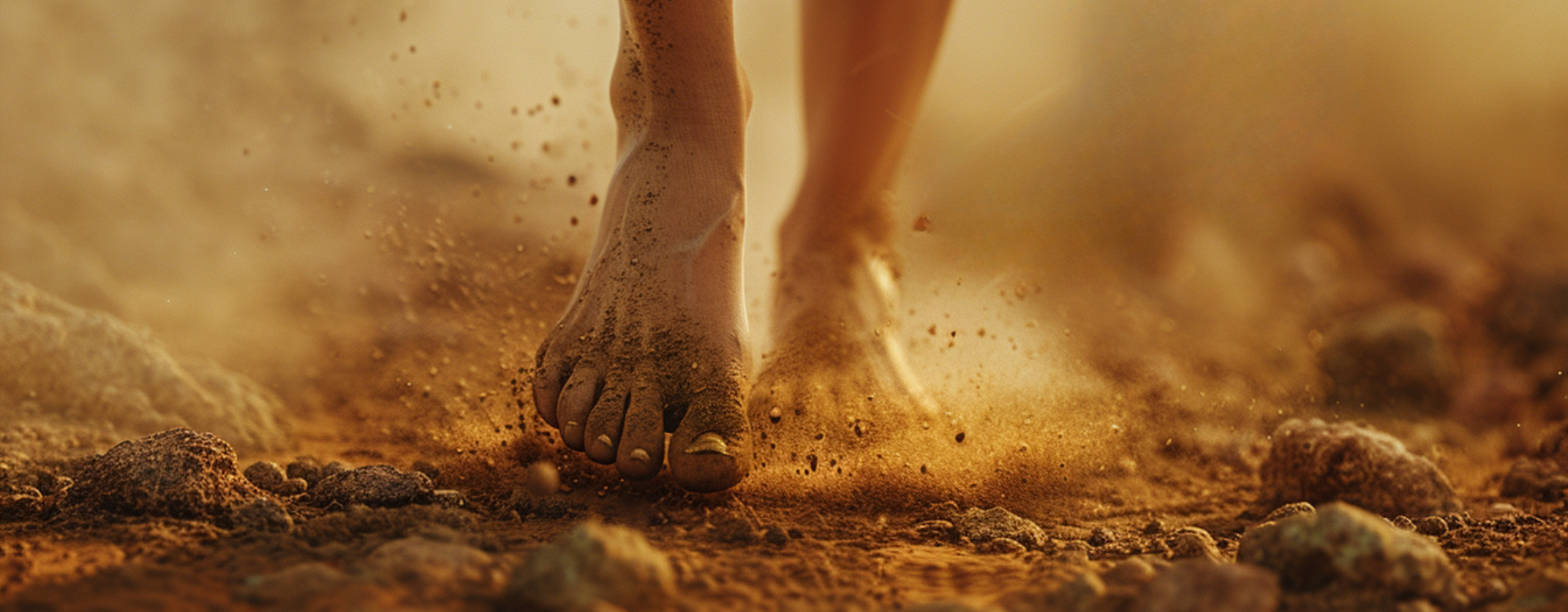
"Which tent?" I mumbled, my voice little more than a ghost of itself, worn thin from grief and coated in dust. My feet dragged through the grit, each step a reluctant negotiation with gravity. The air was warm, dry, thick with silence.
He can’t really be gone, can he?
The thought looped like a scratch on vinyl—quiet but insistent, a steady thrum behind my eyes. Duke’s absence wasn’t loud. It was worse. It was a stillness that settled over everything, casting long shadows even in the relentless sun.
"Beatrix!"
Paul’s voice cleaved through the haze in my mind, harsh and startling. I blinked as he came into view, jogging towards me with the sort of energy I couldn’t begin to summon. His face was drawn tight, his expression somewhere between concern and that awful tension that creeps in when control begins to slip.
"What do you want?" I snapped, the words spitting out before I could reshape them into something less brittle. Too blunt, too raw. But once they were loose, I didn’t reach for an apology. We were well past pleasantries.
Still, even in my irritation, I recognised the overlap. Whatever had brought him running, it likely aligned with my own desperate quest for purpose.
"I've sent Karen to the lagoon to fetch Chris and Kain. Hopefully, Joel found his way there, too. You’ve still not seen him?" His words spilled out in a rush, as though each one were trying to catch up to the moment.
"No," I replied, flat and final. No flourish. No hope.
Paul’s face tightened. His brow furrowed, folding in a way that made him look older than he had an hour ago. Worry had a way of ageing us all.
"Which tent is Jamie’s?" I asked, cutting across his mounting concern. I didn’t have room for more uncertainty just now. Jamie needed clean clothes. That, at least, was something I could do. Something practical. Tangible. Grief didn’t like clean lines, but logistics—those I could handle.
"He needs clean clothes."
"Follow me," Paul said with a weary sigh, his hand lifting in the direction of a tent on the far left. His movements carried a quiet resignation, the sort that came from too many problems stacking atop one another without pause.
I fell into step behind him, not out of enthusiasm, but necessity.
A small sigh escaped me—half exhaustion, half protest—as the dust swirled around our ankles.
"You could have just pointed the tent out to me," I muttered, mostly to myself. A small rebellion against the assumption that I needed company to manage this one small task. But still, I didn’t turn around. Didn’t walk off alone.
Because even in all this mess, even buried under the ache and the dust and the echo of Duke’s final stillness, a part of me—however grudging—was glad not to be walking entirely alone.
Paul held back the front flap of the tent, and I stepped inside with the kind of hesitancy that came less from fear and more from simple overload. My eyes adjusted quickly to the dimmer light within, and I blinked at what unfolded in front of me.
"Impressive," I whispered, the word escaping before I’d even fully taken stock.
It was impressive—absurdly so. The central space was wide and clean, with enough room to stretch out without bumping into a bedframe or a boot or someone else's elbow. Off to each side were canvas doorways leading into smaller rooms. There was structure here. Order. Something that felt almost… domestic.
"It looked big on the outside, but the inside is even—"
"They’re ten-man tents," Paul interjected, tone clipped, a little too proud. "Almost military-grade quality."
His words yanked me back from my brief architectural appreciation. I scoffed, quietly.
Military-grade, right. What next, a coffee station and hot water? Still, I couldn’t help wondering—where the hell did Luke get these from? These weren’t the sort of thing you picked up in an outdoor outlet on the edge of Hobart. Someone, somewhere, had planned for something far more organised than the chaos we’d walked into.
My musings were cut short by a noise—a loud grunt, unmistakably canine and deeply disgruntled. I turned, startled, and spotted him.
Henri.
He was curled into himself on the floor near the back, his sausagey frame slumped like a half-deflated cushion. His face lifted slowly, eyes meeting mine with a look so soulfully pitiful it almost knocked the breath out of me.
"He looks so sad," Paul murmured, crouching beside him with a tenderness I hadn’t expected. His fingers reached out tentatively, careful not to startle.
"He's hungry," I corrected without missing a beat, watching as Henri gave a theatrical sigh, followed by a look of pure manipulative charm. Despite everything, a wry smile tugged at the corner of my mouth. "Don't mistake that resting bitch face for sadness. I've seen that gluttonous look in his eyes many times."
Henri yapped at that—quick, affirming—and his foxy tail began to swish rhythmically through the air, a metronome of food-related optimism.
I felt a flicker then, a strange warmth threading its way through the grief. Something like normality, or maybe just familiarity wearing its thinnest disguise. Henri hadn’t changed. Henri still wanted breakfast.
And somehow, that mattered.
"Come on, Henri," Paul said, his voice gentler than I’d heard it all morning. There was a faint warmth behind it—an unexpected softness reserved for small dogs and the rare moments when grief made space for kindness. He rose and moved towards the cluster of bags lining the right wing of the tent, his steps oddly purposeful in a scene otherwise frayed at the edges.
"I'll feed him," I said quickly, the words jumping out before I’d fully caught up with them.
Maybe it was selfish. Maybe I needed something to care for that wouldn’t die on me. But seeing Henri, now one half of what had once been an inseparable pair, made something tug deep in my chest. A thread wound tight around a place I’d tried to keep guarded.
As I turned from Paul, I brushed at the tear that had slipped down my cheek without permission. I caught it just before it hit the ground—small victories.
Henri didn’t need coaxing. Whether he recognised the shift in tone or just heard the rustle of food approaching, he trotted dutifully beside me, his paws making soft pad-pad sounds against the woven floor. There was a slight wobble in his gait, more pronounced than usual. Grief weighed differently on them, but it did weigh.
"Here, catch," Paul called out.
I looked up just in time to see a tin arcing towards me. I caught it one-handed, with a competence that surprised us both. My fingers automatically traced the label—some generic pet food brand that had probably never seen a cow in its life. But right now, Henri didn’t care about branding. He just wanted comfort in gravy form.
Henri gave a piercing yap, the sound splitting the quiet like a firecracker. Impatience, plain and simple. If he could talk, he’d have said, "I’m bereaved, not starved. Hurry up."
I allowed myself the smallest of smiles. A real one this time, though it barely crept past the corners of my mouth.
With a flick of my thumb, I pulled the ring tab. The tin hissed open with a sound so domestic it felt absurd in the middle of all this grief and wilderness. The scent hit me a moment later—surprisingly rich, dark and meaty, like something that should’ve come with mashed potatoes and a fork.
"That almost smells good," Paul said, a glimmer of amusement threading through his words. His chuckle rolled gently through the tent, not out of place, but carefully placed—like setting a fragile vase somewhere it won’t fall.
As I scooped the food into Henri’s bowl, he danced in tight little circles, his tail wagging like he’d never lost a thing in the world. Eager, hopeful, present.
"And people say that I’m the odd one," I replied, raising an eyebrow in Henri’s direction. He was already locked onto the bowl, eyes wide, tongue testing the air like a gourmand anticipating a Michelin-starred plate.
Henri snorted—whether in agreement or complete disregard, I wasn’t sure—and then buried his snout into the food like it was the only thing anchoring him to the earth.
Maybe it was. Maybe it was the only thing anchoring me, too.
"Hey, Beatrix!" Paul’s voice echoed from the tent’s left wing, cutting across the soft sounds of Henri’s enthusiastic munching and pulling me out of the brief sanctuary we’d found together.
"Enjoy, little fella," I murmured, scratching behind his ear, feeling the warmth of him beneath my fingers. His fur was soft and slightly coarse, a familiar texture that clung to the edges of normality. I lingered just a second too long before pushing to my feet, the absence of that small contact more noticeable than I’d expected.
Paul’s tone carried an edge this time—less casual, more clipped. Urgency with a dash of authority. Whatever he’d found, he wasn’t playing.
Still holding the empty tin—no bin in sight, of course, because Clivilius didn’t exactly pride itself on waste management—I weaved my way through the cavernous interior towards the left wing. The light shifted subtly here, filtered through layers of canvas, giving the space a dim, almost conspiratorial hush.
"What am I looking at?" I asked, stepping up beside him. He was crouched low, one finger extended towards the floor like a lecturer mid-thesis.
He didn’t respond immediately, just pointed, his focus riveted to several small, dark droplets that had disrupted the otherwise tidy canvas beneath us.
"Does this look like blood to you?" he asked finally, his voice now loaded with a tension that had me leaning in before I’d even processed what I was doing.
I squatted beside him, peering closer. The droplets were irregular, not quite splattered, more like they'd fallen—not flung. Too few to tell a story on their own, but enough to raise questions. Always questions.
"I guess it could be," I murmured, unsure, unwilling to leap to conclusions but unwilling to ignore the unease either. My voice lacked conviction, and I hated that. I hated the ambiguity.
Paul's eyes lifted, meeting mine. There was frustration in them. Expectation. Maybe even a touch of something else—fear trying not to look like fear.
"I would have thought you'd be able to give a more certain answer given how much blood you’ve seen recently."
The remark stung. Not because he was wrong, but because it hit too close. My jaw tightened, and I felt the familiar flicker of defensiveness spark in my chest. It would’ve been easy to snap back, to throw the tin at his feet and tell him to do his own bloody analysis.
Instead, I rolled my eyes, long and slow, and turned away.
If sarcasm were lethal, Paul might've just dropped dead.
Pushing Paul's remark to the back of my mind—though it clung there like a burr—I moved towards the pile of bags and battered suitcases clustered in one corner of the tent. The fabric rustled beneath my hands as I rummaged, searching for something, anything, that might offer Jamie even the smallest comfort. Clean clothes felt like a fragile balm, but it was something I could do.
Each zip and buckle, each familiar texture beneath my fingertips, gave me a reason not to dwell on the bloodstains or the look in Paul’s eyes. Or the fact that Duke’s body still waited, shrouded in silence by the riverbank.
"I'm sorry, Beatrix, I didn't mean it like that," Paul said.
His voice broke through the taut quiet like a twig snapping underfoot. I didn’t turn. I didn’t want him to see the way my jaw clenched at the sound of my name in his mouth.
"It's fine," I snapped—harder than I’d intended, but the words came fast and unbidden, like a reflex against everything. The dull ache behind my eyes had bloomed into a full-blown throb now, pulsing in time with the rise and fall of my temper. The tension in my skull made it feel as if my thoughts were being forcibly squeezed out, one pressure wave at a time.
Paul, to his credit, didn’t push. His voice softened instead, edged with something uncomfortably earnest. "I think Joel's in real trouble," he said, glancing back down at the stains on the floor and the tangled sheets. "We're just not equipped to survive out here."
I paused in my rifling, fingers frozen in the middle of a shirt collar. For a moment, I considered telling him we hadn’t been equipped for any of this. Not the portal, not Clivilius, not shadow panthers or portal pirates or watching our friends die.
Instead, I said, "There's a bunch of camping gear and related shit piled in Luke’s lounge room."
A hint of irritation slipped into my tone. That gear should’ve been top priority. Why hadn’t it been the first thing they’d sourced?
"Really?" Paul’s voice lifted with cautious interest.
"It's where that kayak came from," I reminded him, casting a quick glance over my shoulder. "I think some of it may have got a bit damaged during the shadow panther attack last night, but I can bring you everything that’s there anyway."
"That’d be great," he said. Relief softened the hard lines around his mouth. It made him look less like a man managing a crisis and more like someone momentarily allowed to hope. "We’ll sort that out once we've decided what to do about Joel."
"And Duke," I said quietly, but the words landed like iron dropped into water.
He flinched—just slightly—and nodded, his expression folding into something gentler, sadder. "It’s really sad that we can’t give Duke a proper burial."
That sentence—casual, well-meaning, oblivious—struck a match somewhere inside me.
My hand clenched around a bundle of shirts, the fabric wrinkling tightly beneath my grip. I stared at it a moment too long, my thoughts twisting into knots.
Pausing in the archway, I turned back, just enough to let my voice reach him without having to look him in the eye.
"Jamie won’t let you cremate him."
Flat. Final. No room for argument.
Then I stepped out, not waiting for his response.
The air outside hit me like a gulp of water after a long drought—cooler, cleaner, unsullied by the stifling tension inside that tent. I walked quickly, not because I was in a rush, but because I needed to move—needed to break away from the grief that was beginning to wrap itself around us like ivy. If I didn’t, I was going to choke on it.
Head down, thoughts spiralling in a thousand directions, I almost didn’t see her until she was right on top of me.
Glenda.
She surged towards me with a velocity that belonged to triage wards and battlefield tents, not the dusty quiet of this morning. The collision was narrowly avoided—my startled gasp caught somewhere between a curse and a breath—and she halted just short of slamming into me.
Her presence hit like weather: sudden, charged, and unmistakably full of purpose.
"Please take this with you and give it to Jamie. He can wrap Duke in it until we can organise more suitable arrangements," she said, thrusting a neatly folded sheet into my hands.
Her voice was brisk, clipped by urgency but underpinned with compassion—a rare thing in a place where most people were too numb to feel, let alone care.
I nodded silently and accepted the offering. The fabric was smooth, too smooth. Cold against my skin. It didn’t look like much—a simple, clean white bedsheet—but it might as well have been woven from stone. The weight of it dragged at my arms like it knew what was coming.
It was meant to protect, to contain, to honour. But I knew it was really for concealment. A shroud. A placeholder for the funeral we wouldn’t be allowed to have.
"Charity is right, Beatrix," Paul’s voice came from behind me, following me like a second shadow. He’d stepped out of the tent, his tone riding the fine line between rationale and control.
I didn’t even turn.
"You take charge of it then," I huffed, the words escaping clipped and brittle. I didn’t bother to modulate my tone anymore. I was too tired, too raw. My skull throbbed with a dull, incessant beat that matched the drum of my heart. Or my temper. It was hard to tell which.
Without waiting for a reply, I pivoted on my heel and walked away.
The sheet was still clutched tightly in my hands, its white edge trailing ever so slightly in the dirt. I didn’t stop to fix it. Let the dust cling. Let it bear witness.
Each step away from them was a protest—against the burden, against the expectation, against the relentless press of grief and decision-making and everyone looking to me for clarity I didn’t possess.
I didn’t know where I was going. I just knew I had to keep moving.
Because if I stood still for too long, I might just come apart.







